

Translations, from Portuguese, are automatic. If you notice any errors in the text, help us identify them, clicking here.
Subscribe to our Newsletters and receive our articles directly in your email.
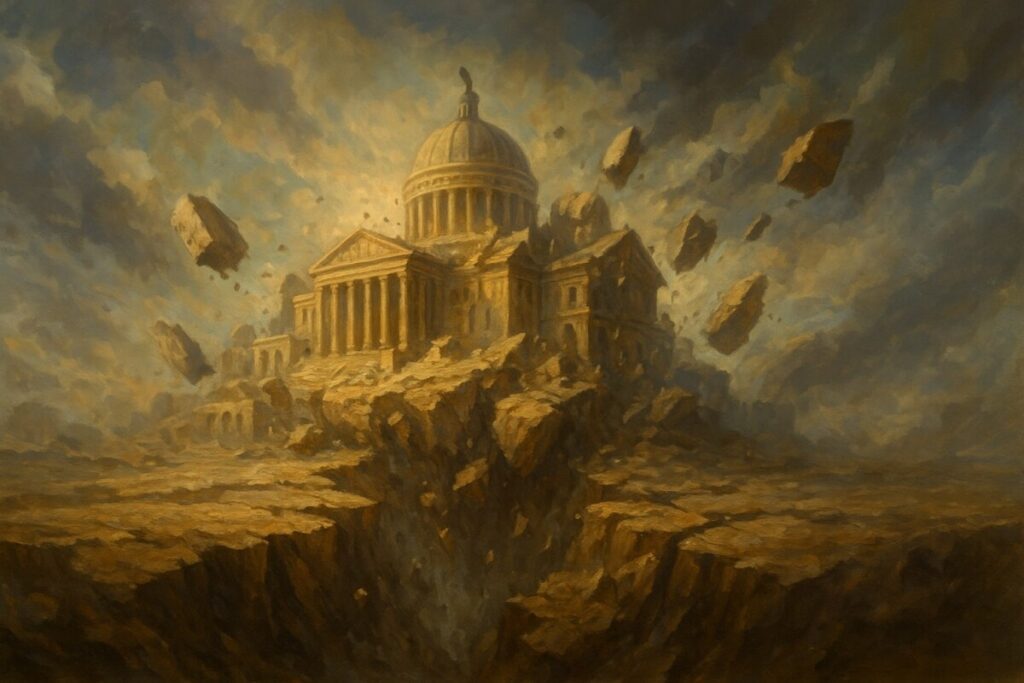
Thesis: Images of a materialized spiritual plane—walled colonies, a geographical threshold, armed spirits, an economy of "bonus-hours," soup kitchens, small houses, and hospitals—are myths incompatible with the central principles of Spiritist Doctrine. Kardec submitted such ideas to analysis—he never consolidated them.
1. Spiritual Colonies and "Our Home"“
Common assertion: the afterlife is structured in cities and colonies, with walls, ministries, and permanent residences (as in Our home).
Refutation: Spiritual identity is moral, not architectural. Form and environment are fluidic creations, shaped by thought and evocation. Lucid spirits describe the spiritual environment as states of consciousness, not as built cities. Conclusion: Myth of walled colonies—debunked.
2. The threshold as a geographical location of suffering
Common assertion: the "threshold" is an intermediate region, a dense and purgatorial zone.
Refutation: suffering stems from a guilty conscience and mental fixation on error. Spirits remain bound to the places of their crimes until they are morally renewed, not by territorial imprisonment, but by mental affinity. "Umbral" is a metaphor for the state of post-death disturbance, not a physical space. Conclusion: myth of the geographical Umbral — debunked.
3. Spiritual battles and energetic defenses
Common claim: Spirits protect themselves from attacks with electric darts, force fields, or walls.
Refutation: Lower spirits cannot tolerate the presence of higher ones. Interpersonal interaction is moral, not warlike. The mere radiance of good dissolves any attempt at hostility. Conclusion: myth of spiritual weapons — debunked.
4. Spiritual economy and "bonus-hours"“
Common saying: good deeds generate quantifiable spiritual credits.
Refutation: merit is not quantifiable. Good is spontaneous, free, and selfless. Replacing morality with accounting corrupts the principle of freedom of conscience. Conclusion: myth of the "bonus-hour" — debunked.
5. Spirits feeding on subtle substances
Common claim: Spirits "drink soup" or "drink juice" in spiritual realms.
Refutation: spiritual "hunger" is a moral desire, not an organic need. Spirits attached to matter project food illusions until they are freed. Conclusion: the soup myth — debunked.
6. Need for physical shelter
Common belief: Spirits reside in houses, with furniture, beds, and utensils.
Refutation: There is no cold, heat, or physical fatigue. The idea of a physical dwelling expresses only a mental analogy. Spirits live in communities of affinity, without material dependence. Conclusion: myth of the little house — debunked.
7. Body shape and spiritual identity
Common belief: Spirits retain fixed features and bodies.
Refutation: Form is a product of thought; it only persists when evoked or desired. Spiritual recognition occurs through essence, not appearance. Conclusion: Myth of fixed form—debunked.
8. Spiritual Hospitals
Common claim: There are hospitals and infirmaries in the spiritual realm, where "sick" Spirits receive medical treatment.
Refutation: Spiritual pain is moral, not organic. There are no bodies to medicate, nor tissues to regenerate. The so-called "treatment" is moral assistance and enlightenment, conducted through the influence of good Spirits and the education of the will. The descriptions of rooms, beds, and instruments are symbolic translations of the fluidic and pedagogical action on Spirits still bound to the impressions of matter. Conclusion: Myth of spiritual hospitals — debunked.
Overall conclusion
The Spiritist Doctrine, based on Kardecism, is dematerializing. The spiritual world does not replicate the physical world: it is a field of consciousness, morality, and vibratory affinity. Kardec never consolidated the idea of colonies, astral planes, hospitals, or spiritual economies—because, under comparative and rational analysis, such conceptions do not hold up. To insist on them is to abandon observation and return to materialism in the form of religious fantasy.
Reading Recommendations (Books)
- Free PDFs by Kardec – https://bit.ly/3sXXBxk
- Autonomy – The Untold History of Spiritism: https://amzn.to/3PIvbyy
- Allan Kardec's Legacy: https://amzn.to/3RIn2gv
- Final point – the reunion with spiritualism with Allan Kardec: https://amzn.to/48PLaE7
- Neither Heaven nor Hell – The Laws of the Soul According to Spiritism: https://amzn.to/3F2voYO
- Genesis – Miracles and Predictions According to Spiritism (unadulterated): Free PDF or https://amzn.to/3RM91hF
- Heaven and Hell: Or divine justice according to Spiritism (unadulterated): Free PDF or https://amzn.to/3ZGrcal
- Spiritist Revolution. Allan Kardec's forgotten theory: https://amzn.to/3t7HIUH
- Mesmer. The denied science of animal magnetism: https://amzn.to/3PYc1X2
- The Book of Mediums: https://amzn.to/3PDNTHK
- The Spirits' Book: https://amzn.to/3QkcFx9
- Spiritist Magazine – complete collection: https://amzn.to/48Uxh7s
- Practical Instructions on Spiritist Manifestations: https://amzn.to/3QiR8Gc
- Spiritism in its Simplest Expression: https://amzn.to/3M6fXT5

 Português do Brasil
  English
  Français
  Español