

Translations, from Portuguese, are automatic. If you notice any errors in the text, help us identify them, clicking here.
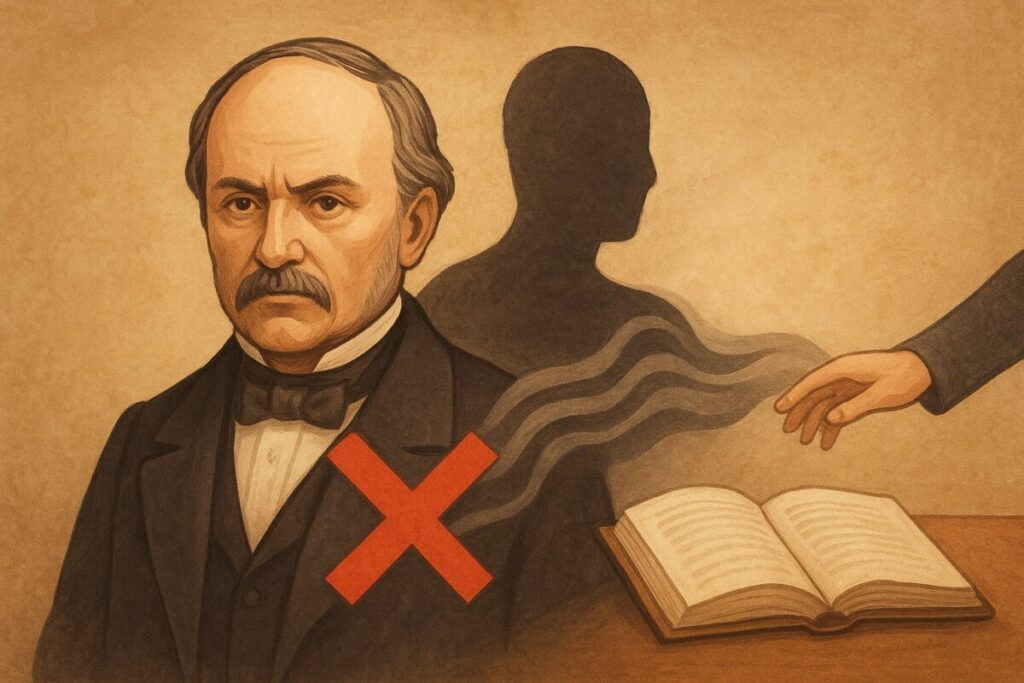
After Allan Kardec's death, the Spiritist movement underwent a decisive methodological shift. The critical examination of communications, controlled evocation, and systematic comparison—foundations established in the Codification—were gradually replaced by an attitude of unrestricted acceptance of mediumistic messages. This process paved the way for conceptions alien to the Doctrine to gain traction, transforming Spiritist science into something closer to a dogmatic religion.
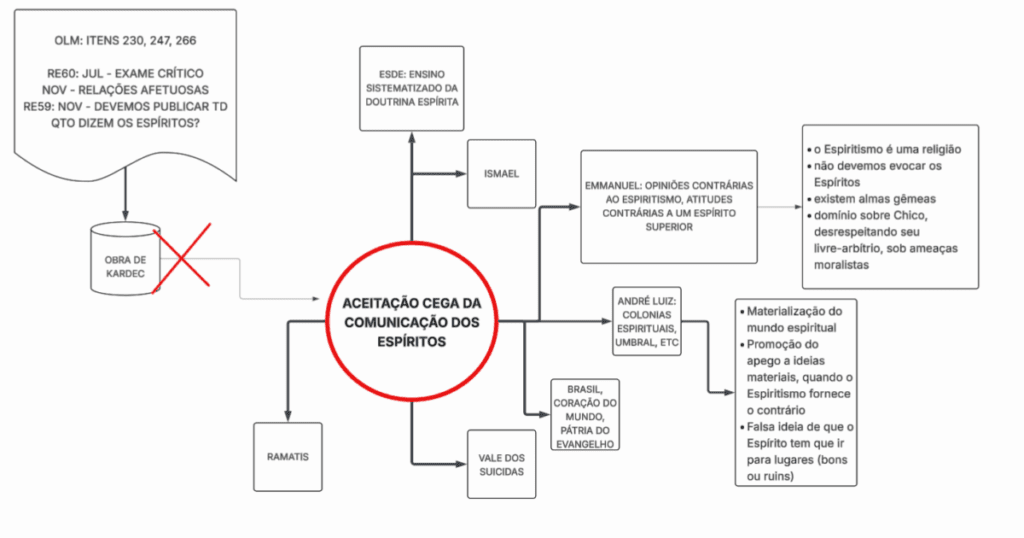
The path of this transformation, its causes and consequences, can be seen in the following diagram.
1. The Starting Point: Kardec and the Spiritist Methodology
It is essential to understand that Kardec did not create Spiritism, but organized its manifestations into a coherent doctrinal body through scientific method. This method was based on:
- Direct evocation of Spirits, to test the consistency of the information (cf. The Mediums' Book, items 230, 247, 266).
- Critical comparison of messages received in different places and by different mediums (Spiritist Magazine, articles on examination and control).
- Submission of all teaching to the sieve of reason (The Gospel According to Spiritism, introduction, item VI).
- Distinction between the opinion of Spirits and the principles of the Doctrine (RE, November/1859: “Should we publish everything that the Spirits say?”).
What Kardec left was a method, not a dogmaSpiritism, being a fact of nature, only becomes legitimate when subjected to rational and scientific criteria. Abandoning this guideline paved the way for the indiscriminate acceptance of mediumistic communications.
2. The Break: From Control to Cult
The diagram marks this break with the symbol of X on Kardec's work. Instead of following the method of critical examination, a significant part of the Spiritist movement began to:
- Accept communications without comparison or control.
- Taking as “superior revelation” messages that, according to Kardec, would only be private opinions of Spirits.
- Relativize or disregard the evocation, transforming it into something “forbidden” or “dangerous”, in direct opposition to Kardecian practice.
This rupture opened the way for a dangerous phenomenon: the blind acceptance of communication from Spirits, which became the new axis of the movement.
3. The Consequences of Blind Acceptance
The diagram highlights several developments of this uncritical stance:
3.1 Emmanuel
Presented as Chico Xavier's guide, Emmanuel introduced notions that directly confront the Spiritist Doctrine:
- Declaration that the Spiritism would be a religion (Kardec defined it as a science of observation and philosophy of moral consequences).
- Prohibition of evocation, in direct contradiction with The Mediums' Book.
- Idea of soulmates, rejected by Kardec.
- Dominion over Chico, imposing moral conditions and threats, which violate freedom of conscience.
3.2 André Luiz
The series of books psychographed by Chico Xavier, attributed to André Luiz, created representations such as:
- Spiritual colonies (Our Home).
- threshold as an intermediate region.
These concepts materialize the spiritual world, encouraging attachment to spatial and institutional constructions, when Kardec made it clear that Spiritism points to the progressive dematerialization of spiritual existence.
3.3 Ramatis
It introduces communications filled with esoteric theories, mysticism, and catastrophic predictions, inconsistent with Kardec's method. Its acceptance stems from the same logic: any communicating Spirit would be a source of truth.
3.4 Valley of the Suicides
Works such as Memoirs of a Suicide reinforce the notion of “fixed places” in the afterlife, of a punitive or reformatory nature, in contradiction with the idea that the spiritual state is an intimate reflection of consciousness, not of metaphysical geographies.
3.5 Brazil, Heart of the World, Homeland of the Gospel
Work attributed to Humberto de Campos (inspired by Emmanuel), which presents Brazil as a spiritually predestined nation. This conception reinforces a mystical nationalism, strange to the universality of Spiritism.
4. The Role of ESDE
O Systematic Study of the Spiritist Doctrine (ESDE), although structured with good pedagogical intentions, reflects the consolidation of this rupture. By adopting as a basis not only Kardec, but also post-Kardec mediumistic works (Emmanuel, André Luiz, etc.), the ESDE institutionalizes the departure from critical criteria and installs the uncritical eclecticism.
Result: the new generations of Spiritists began to consider as “Spiritist doctrine” that which is merely the opinion of Spirits, reproducing the blind acceptance.
5. Doctrinal Problems Arising
The diagram lists the concrete effects of this deviation:
- Materialization of the spiritual world: conception of colonies, cities, hospitals, prisons — reflection of human projections.
- Promoting attachment to material ideas, when Spiritism has as its mission precisely free from materiality.
- False idea of the geographic destinations of the Spirit (good or bad places), replacing the understanding that “heaven” or “hell” are states of the soul.
6. The Replacement of Criticism by Dogma
The diagram ultimately shows how the Spiritist movement went:
- Of critical examination (Kardec, 1857–1869),
- For the blind acceptance (post-Kardec, especially in Brazil).
This process transformed Spiritist science into institutionalized religion, with dogmas, moralism and submission to “spiritual guides” not tested by the original method.
7. Conclusion: Restoration of the Spiritist Methodology
The central message of the diagram is clear:
- As long as Kardec's work remains excluded as a criterion, Spiritism will live under the dominion of blind acceptance.
- The return to the Kardecian method of rational examination, critical evocation and universality of the teachings of the Spirits is the only way to preserve Spiritism as a science of observation.
The diagram, therefore, is not just a historical critique, but a call for methodological restoration: Without criticism, Spiritism dissolves into mysticism; with criticism, it maintains its scientific and philosophical identity.
Reading Recommendations (Books)
Discover the books we recommend as essential for your understanding of true Spiritism: https://www.geolegadodeallankardec.com.br/livros-recomendados/
Conheça as obras altamente indicadas para sua instrução. Clique aqui

 Português do Brasil
  English
  Français
  Español