

Translations, from Portuguese, are automatic. If you notice any errors in the text, help us identify them, clicking here.
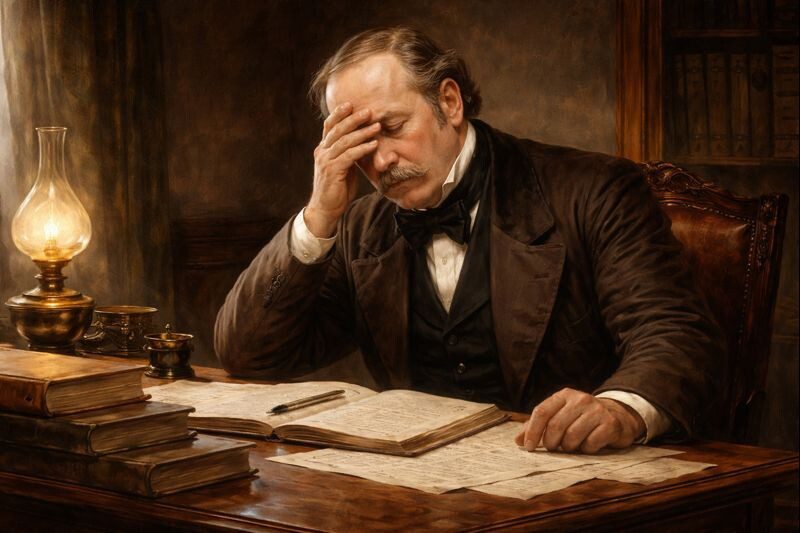
It's tiring. Because everywhere, Countless people speak of "spiritism" without first bothering to learn about it, showing more willingness to offer opinions than to study. But that's not the worst part, since "the force of circumstances" has created this state of almost complete ignorance. No: the worst part is that, when confronted... through Spiritism, They feel personally attacked, thwarted in their souls, and instead of seeking understanding, they choose to distance themselves and continue in error. Kardec also suffered from this, but today, technology puts us in contact much faster and easier with the gigantic mass of people who opine without method or basis, confusing conviction with knowledge.
This is my first action related to Spiritism in about a month. As I said, it's tiring. But what's tiring isn't Spiritism itself, but rather the incessant attacks from people who don't know how to separate criticism of opinions from personal criticism, and while we criticize erroneous opinions—as Kardec did—we are personally attacked without ceasing. Roustainguism, especially entrenched in the FEB (Brazilian Spiritist Federation) since 1890, achieved its goal and replaced Spiritist science with a belief system formed merely by opinions, lacking the necessary method exhaustively demonstrated by Kardec in [his work]. ALL his works.
Not long ago, at the end of 2025, we published an article Regarding an evocation we made of the Spirit of Kardec. We sought to demonstrate the possibility, without any intention of making this an authoritative article., ...receiving a general instruction, just as Kardec himself often did. We knew that criticism would come, and we were even prepared to accept criticism willingly, as it was important for our own study. However, one of the most negatively relevant criticisms came precisely from Rodrigo Xavier, a social media influencer who presents himself as knowledgeable about Spiritism and acts as a disseminator on social media, but whose criticism, as we will see, deviates from the methodological foundations established by Kardec, as we will demonstrate.
Rodrigo Xavier's review
Surprisingly (or not), his criticism was entirely based on Aksakof, and not on Kardec. Worse still: he relied on a limited reading of what Aksakof proposes, treating indications as if they were absolute requirements.
According to him, the text would not have exceeded in any way the common intellectual repertoire of a modern spiritualist: divisions within the movement, "return to Kardec," regeneration, Jesus—known, repeated themes, and therefore explainable as simple "latent memory." Since there would be no objective novelty, no unknown revelation, nor any element that the medium "could not know," the verdict would already be ready: animism, that is, the somnambulistic consciousness of the medium disguised as a message.
And it didn't stop there. For Rodrigo, any proof of identity would also be lacking. The tone — he says — would be emotional, slightly mystical, with expressions like "God the Father Almighty" and "blessings," which, in his view, would clash with the "historical Kardec," rational and professorial. The language, in turn, would simply be modern Portuguese, and in this he sees yet another indication of personification: the medium's unconscious fabricating a "character" based on what he imagines Kardec to be, instead of a real Spirit showing independence through 19th-century French or unmistakable stylistic traits.
Finally, Rodrigo resorts to what he calls a "mirror": the communication would have confirmed the group, validated its efforts, and criticized opponents—exactly what, according to him, a circle would want to hear when invoking the Codifier. For Aksakof and Hartmann, he insists, mediums in trance would be highly suggestible and would tend to reflect the thoughts and expectations of those present; therefore, messages that agree too much with the group would be suspicious. His conclusion is predictable: animism or personism; no unknown facts, no intellectual superiority, no external sign of identity. And, as a "scientific requirement," he even suggests asking questions in French, without coordinating with the medium, as if language—and not method—were the definitive boundary between illusion and reality.
A rebuttal to Rodrigo's criticism.
The refutation is simple: Rodrigo takes auxiliary criteria as if they were absolute laws, and in that he already starts wrong. Kardec teaches the opposite. The Spirit does not "speak" a human language; it communicates thought, and to transform thought into words it needs, through mediumship, the medium's vocabulary. Xenoglossia can occur, yes, but it is accidental, rare, and depends on specific conditions; for extensive and usual communications, Spirits prefer the language familiar to the medium, as it presents fewer material obstacles. Therefore, demanding 19th-century French as a necessary condition is not 'science': it is only an apparent rigor, which confuses rare indications with necessary conditions. It is, moreover, a criterion that, if taken to its ultimate consequences, would invalidate a huge mass of perfectly understandable and useful communications—including those recorded in the evocations of the Spiritist Review, with Spirits who, in life, spoke different languages, without this preventing the exchange.
Similarly, Rodrigo makes "proof of identity" the central point, when Kardec is explicit: the identity of ancient figures is often impossible to demonstrate materially and, at most, is morally assessed by the quality of the language. Furthermore, in philosophical and moral communications, identity is a secondary issue. If the content is worthy, coherent, and in accordance with the character attributed to the name, there is moral probability; but even when this certainty does not exist, the communication is not invalidated for that reason. The burden of proof for those accusing animism is not to point out the absence of evidentiary spectacle; it is to demonstrate doctrinal incongruity, fundamental error, serious contradiction—not merely to say "there was no unknown fact" and call that a scientific conclusion.
Regarding the "mirror," Rodrigo misses the mark altogether: the communication doesn't refer to our group as a closed club, but to the collective of Spirits and incarnate beings dedicated to disseminating the truth, and this was explicitly stated. Furthermore, the content doesn't fuel the thesis of vanity or self-confirmation: infallibility isn't asserted, exclusive authority isn't established, and doctrinal innovation isn't introduced; on the contrary, limits, trials, and difficulties are acknowledged. Mirroring, when a serious hypothesis, appears as a systematic confirmation of personal interests and human aggrandizement—not here. The result: Rodrigo's criticism reveals more haste than method, and more ignorance of Spiritist science than scientific zeal.
It's tiring.
As I said, it's tiring and even discouraging. Like Rodrigo Xavier, many others, claiming to be authentic Spiritists, approach Spiritism in a misguided way, basing themselves on belief systems stemming from opinions—of incarnate or disincarnate beings—and not on Spiritist science. Many well-known or rising figures also behave this way: opinions are repeated as if they were principles, and the debate shifts from method to adherence.
Among these, I cite public and verifiable examples: Luís Fernando Amaral, who argues in videos that Brazil is governed by the "angel" Ismael; Nibi Pensa, who defends the idea that divine justice operates according to a logic of debit and credit, contradicting the Kardecian principle and the very moral teachings of Christ; Maira Rocha, whose psychographies are frequently questioned regarding their content and purpose; Haroldo Dutra Dias, who endorses the same construction of the "angel" Ismael and the interpretation of "Nosso Lar" as an assured destiny. These are concrete points, and it is on them that criticism should focus: not on people, but on statements.
We wish that, before going to the microphone, there would be greater dedication to the study of Spiritist science, so well-founded and serious. Instead, there has been a preference for replacing the Spiritism of 1857 with a systematic belief, assembled without method, without control, and without due criteria, supported by communications taken as incontestable, as if they were immune to the possibility of mystification.
It's really exhausting... But we can't let ourselves get discouraged. I'm starting 2026 with this first outpouring of emotion, to try and resume the activities that are my responsibility, of my own free will.
Reading Recommendations (Books)
Discover the books we recommend as essential for your understanding of true Spiritism: https://www.geolegadodeallankardec.com.br/livros-recomendados/
Conheça as obras altamente indicadas para sua instrução. Clique aqui

 Português do Brasil
  English
  Français
  Español