

Translations, from Portuguese, are automatic. If you notice any errors in the text, help us identify them, clicking here.
From the very beginnings of the Spiritist movement, certain terminological errors have created distortions that still hinder a precise understanding of the Doctrine. Words borrowed from other fields—laden with established meanings, disputed by divergent currents, or marked by traditions foreign to Spiritism—have been incorporated into Spiritist discourse with particular meanings, different from the predominant meanings in common usage. This practice, although often well-intentioned, has produced profound ambiguities, bringing Spiritism closer either to religious structures it does not possess or to political currents that have never been part of its doctrinal body. The result has been fertile ground for confusion, misappropriation, and interpretations that deviate from the clear, simple, and rational method established by Kardec.
1. The genesis of the terminological problem
From early on, part of the Spiritist movement insisted on classifying Spiritism as a "religion," even if only "in a philosophical sense." However, the choice of term contradicted the very doctrinal structure: in common usage, religion implies worship, ritual, spiritual authority, dogma, and institutional hierarchy—elements foreign to the Spiritist science organized by Allan Kardec. The result of this insistence was the consolidation of a permanent misunderstanding. A single word, taken from another semantic field, brought Spiritism closer to structures alien to its rational method, creating an ambiguity that has persisted.
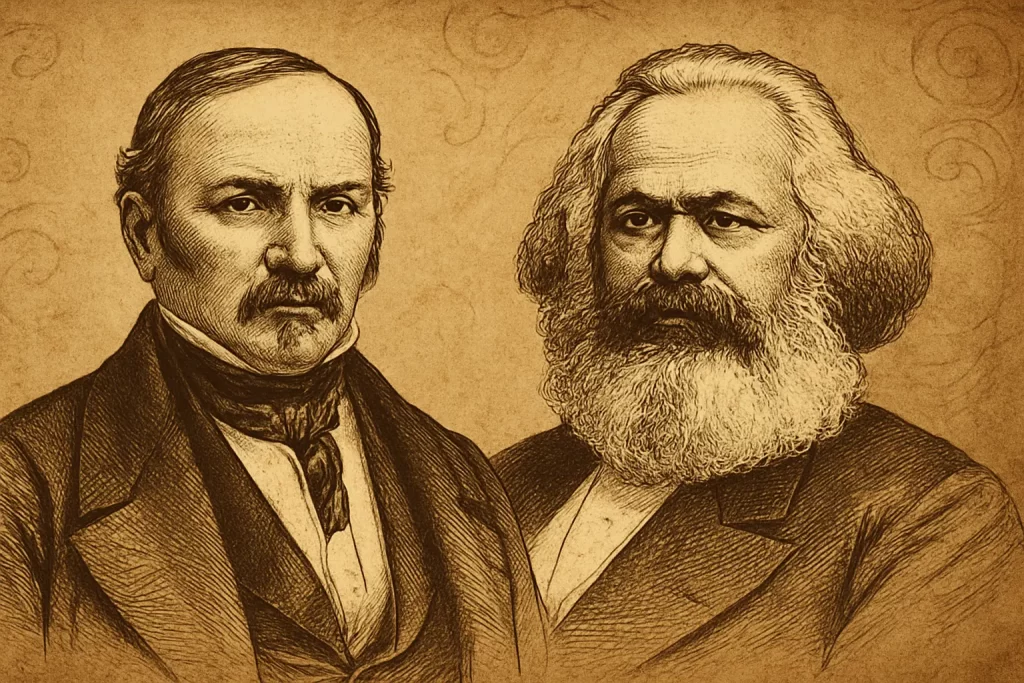
The same process is repeated in the use of the term "socialism" by Léon Denis and, later, by Herculano Pires. Denis uses the word to express an ideal of fraternity, moral cooperation, and solidarity among men—a spiritualist, ethical use, based on the perfectibility of the individual. However, the intellectual landscape of the 19th century was already marked by multiple socialist currents coexisting and competing with each other. Among them, one stood out with increasing force: scientific, materialist socialism, constructed by Marx and Engels from the 1840s onwards, possessing a robust theoretical body, its own vocabulary, and concrete influence on the European workers' movement.
The term "socialism," therefore, was already deeply saturated with divergent, if not openly antagonistic, meanings. It lacked semantic neutrality. There was not one "socialism," but "socialisms," of which only a portion shared an affinity with spiritualist values. Thus, when Denis and Herculano chose to preserve the word by attempting to differentiate it from Marxist materialism, they ended up facing an unavoidable obstacle: the term did not belong to them. It carried with it the force of dominant usage, and this force prevailed over the author's particular intention.
3. Capturing terms by their predominant meaning
The phenomenon is identical to what occurred with the expression "religion in a philosophical sense." Words laden with broad and consolidated uses do not submit to artificial redefinition. Upon entering Spiritist discourse, these words immediately trigger the connotations predominant in the social imaginary. Thus, Denis's "socialism"—moral, spiritual, humanitarian—is easily taken for Marxist "socialism"—materialistic, collectivist, partisan, centered on class struggle. The same applies to "religion": the attempt to limit the term to a philosophical sense does not prevent its traditional meanings from being evoked.
This semantic capture produces concrete doctrinal effects:
- Denis and Herculano came to be used as legitimizers of modern political currents.
- Moral criticism of inequality is often confused with adherence to ideological programs.
- Spiritism is being dragged into political disputes that don't concern it.
- Materialistic currents find a loophole to infiltrate Spiritist discourse.
The confusion does not stem from the doctrinal content, but from a poorly calibrated terminological choice for the semantic environment in which it circulates.
4. The rational self-sufficiency of Spiritism
The Spiritism organized by Kardec does not need these external categories. It is a clear, simple, logical doctrine, founded on the observation of facts and the rational analysis of phenomena. Its vision of life rests on moral laws and the spiritual evolution of the individual—not on theological structures, nor on political projects.
And it is precisely this rational structure, when preserved in its original form, that naturally leads to social transformation. It is not a matter of state intervention, collectivist planning, or reform programs imposed from the outside in. The social change derived from Spiritism occurs through the progressive modification of consciousness: moral enlightenment, responsibility, free adherence to good, perception of the spiritual consequences of actions. It is an autonomous, spontaneous, and non-coercive change. This point is... fundamental, Because Spiritism clearly contradicts and refutes materialistic and coercive doctrines of social change, demonstrating them to be merely artificial and unsustainable, such as scientific socialism, communism, and Marxism (using this term only for clarity).
When the doctrine is kept intact—faithful to the Kardecian methodology—the moral transformation of the individual inevitably radiates to social structures. There is no need to clothe Spiritism in terms from other fields, nor to artificially link it to political currents. When this occurs, the effect is the opposite: the nature of the Doctrine is distorted, loses clarity, and opens space for improper interpretations.
5. The inevitable consequence of terminological ambiguity
To graft loaded terms like "religion" or "socialism" onto Spiritism is always counterproductive. Each word carries with it a universe of meanings that obscures, confuses, and gives rise to erroneous interpretations. Dominant semantics dominate thought. The doctrine, then, ends up embroiled in disputes that do not belong to its field of action.
Restoring conceptual precision means recovering the language proper to Spiritism—that constructed by Kardec, rigorous, rational, devoid of ambiguities. It means preventing external concepts from distorting its structure. It means preserving the conditions for its social action to occur in the only way compatible with its nature: through freedom of conscience, through understanding spiritual laws, through inner maturity, without impositions, without ideological alignments, and without terminological borrowings that divert the focus of the Doctrine.
Reading Recommendations (Books)
Discover the books we recommend as essential for your understanding of true Spiritism: https://www.geolegadodeallankardec.com.br/livros-recomendados/
Conheça as obras altamente indicadas para sua instrução. Clique aqui

 Português do Brasil
  English
  Français
  Español