

Translations, from Portuguese, are automatic. If you notice any errors in the text, help us identify them, clicking here.
Kardec and the racial paradigm of the 19th century: between scientific hegemony and structural counterpoint.
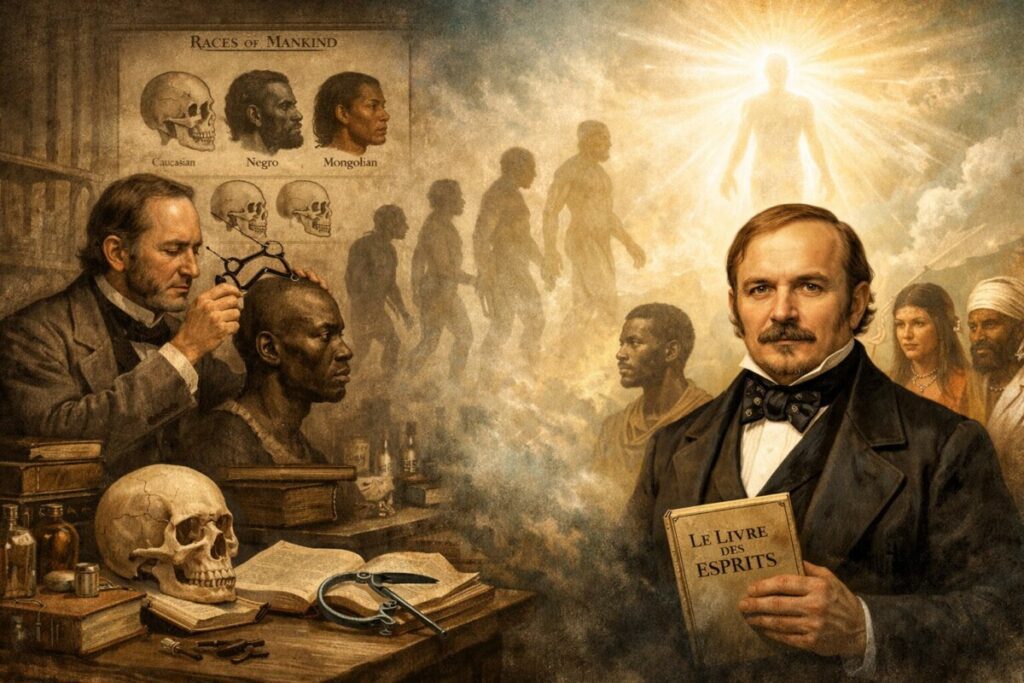
In the mid-19th century, European and North American scientific thought operated under a widely disseminated paradigm: the idea that humanity was divided into hierarchical “races,” with natural and permanent differences in intellectual capacity. This model was not marginal—it was hegemonic. It manifested itself in currents such as polygenism, craniometry, and racialist theories that sought to justify, with a scientific veneer, social structures such as slavery and colonialism.
Authors such as Samuel George Morton used cranial measurements to support intellectual differences between human groups, while Arthur de Gobineau explicitly defended the inequality of "human races." Today it is recognized that these approaches lacked methodological rigor and were heavily contaminated by ideological assumptions. At the time, however, they were widely accepted as legitimate science.
It is within this context that the work of Allan Kardec is situated.
The presence of the paradigm of the time in Kardec
Kardec is not isolated from his intellectual environment. In The Spirits' Book and the Spiritist Review, he employs categories typical of the 19th century, such as the idea of "more or less advanced peoples." In certain passages, he uses examples—such as that of the "Hottentot"—to illustrate differences in average intellectual development among populations.
There are also passages in which he states that certain groups, in that historical context, did not produce figures equivalent to Pierre-Simon Laplace. Taken in isolation, these statements can be interpreted as agreement with the notion of inferiority.
This interpretation, however, ignores the structural level of Kardecian thought.
The breaking point: the explanatory structure
The dominant scientific thinking operated with the following causal chain:
— body → determines intelligence → establishes racial hierarchy
Kardec breaks with this model by proposing:
— Spirit → uses the body → intellectual capacity is universal
In this system, intelligence is not a product of physical organization, but an attribute of the Spirit. Since all Spirits possess the same origin and potential, there is no logical basis for maintaining an innate intellectual inferiority based on physical characteristics.
This reversal directly strikes at the core of 19th-century scientific racialism.
Observed inequality versus essential inferiority
Kardec acknowledges observable differences between peoples, but does not interpret them as natural and permanent inequalities. He attributes them to contingent factors:
— historical conditions
— access to education
social development
— evolutionary stage of the Spirit
The error of the hegemonic paradigm was to convert empirical differences into essential inferiority. Kardec avoids this leap: he maintains inequality on the level of phenomena, not of nature.
Internal tension: old language, new structure.
However, there is a real tension in his work. Kardec still uses a hierarchical language ("advanced" and "backward") typical of the cultural evolutionism of his time. In some passages, his formulations may suggest stricter limits than his own system would allow.
This tension arises from the coexistence of two levels:
— a vocabulary inherited from the 19th century
— an explanatory structure that breaks with this vocabulary
Reading individual sentences in isolation leads to misinterpretations. Analyzing the whole reveals the system's internal coherence.
Kardec's counterpoint in the scientific context
By shifting the source of intelligence from the body to the Spirit, Kardec:
— invalidates the biological determinism of intellectual capacity
— rejects innate racial inferiority
— establishes the essential equality between all human beings
— interprets differences as temporary, not permanent.
This movement was not common in the scientific community of the time, which was largely aligned with biological materialism and racial hierarchies.
Conclusion
The 19th century was marked by attempts to naturalize human inequalities under the guise of science. Kardec is not entirely outside this context, but neither does he submit to it.
He incorporates some of the language and descriptions of his time, but constructs an explanatory model that contradicts the foundation of those same ideas. By separating intelligence from physical structure and linking it to the Spirit, he eliminates the logical basis for innate racial inferiority.
A rigorous interpretation requires recognizing this duality: the presence of 19th-century contextual elements combined with a significant structural rupture.
Bibliographic references
KARDEC, Allan. The Book of Spirits. 1857.
KARDEC, Allan. Spiritist Review. 1858–1869.
KARDEC, Allan. The Genesis. 1868.
MORTON, Samuel George. American Crania. Philadelphia: J. Dobson, 1839.
GOBINEAU, Arthur de. Essai sur l'inégalité des races humaines. Paris: Firmin Didot, 1853–1855.
GOULD, Stephen Jay. The Mismeasure of Man. New York: WW Norton & Company, 1981.
STOCKING JR., George W. Race, Culture, and Evolution: Essays in the History of Anthropology. Chicago: University of Chicago Press, 1982.
FREDRICKSON, George M. Racism: A Short History. Princeton: Princeton University Press, 2002.
Reading Recommendations (Books)
Discover the books we recommend as essential for your understanding of true Spiritism: https://www.geolegadodeallankardec.com.br/livros-recomendados/
Conheça as obras altamente indicadas para sua instrução. Clique aqui

 Português do Brasil
  English
  Français
  Español