

Translations, from Portuguese, are automatic. If you notice any errors in the text, help us identify them, clicking here.
How can one defend charity, free will, and individual moral reform while advocating class struggle, violent revolution, and the dictatorship of the proletariat?
Introduction: An Unsustainable Paradox
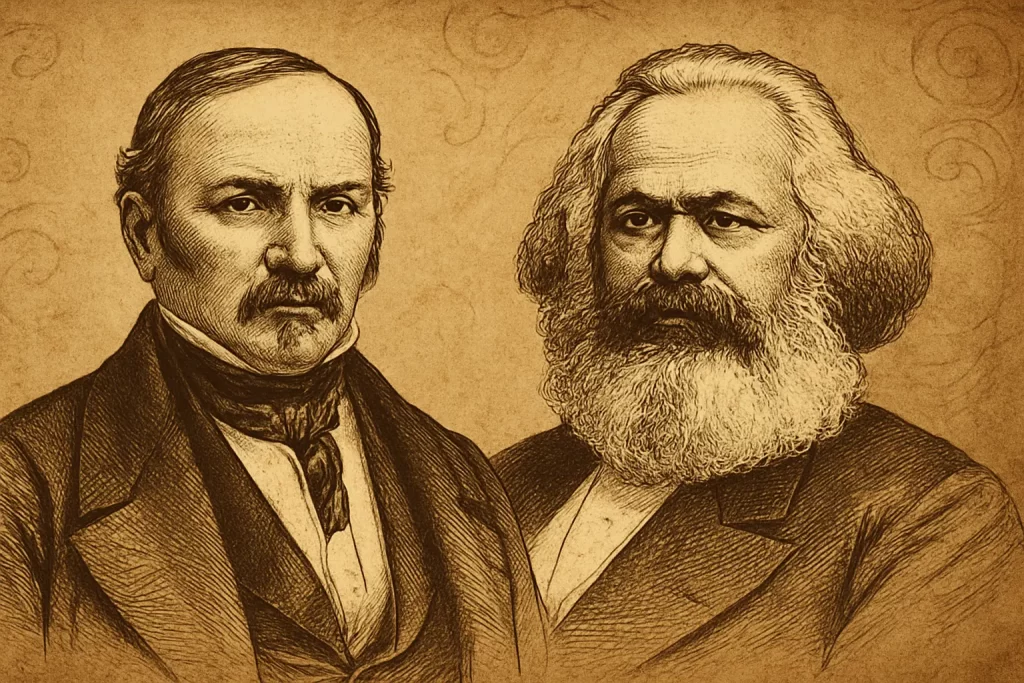
Lately, a curious and, from a doctrinal point of view, profoundly contradictory phenomenon has been observed: people who declare themselves adherents of Spiritism while simultaneously defending and propagating the tenets of Marxism, communism, and other currents of social reform based on class struggle and violent revolution.
This article does not intend to discuss personal political preferences. Its sole purpose is to demonstrate, in light of the fundamental works of Allan Kardec, that such positions are... doctrinally incompatible. This is not a question of "left" or "right," but of an ontological, ethical, and methodological antinomy, where defending one system is, by definition, denying the other.
As we have summarized: Marxism seeks to impose a social reform based on materialism and utilitarian good through force and violence. Spiritism, on the contrary, is based on free will, inner reform, and charity as a transformative force. One thing cancels out the other.
The Ontology of Conflict — Matter vs. Spirit
The entire theoretical edifice of Marxism rests upon... dialectical materialism. For Karl Marx and Friedrich Engels, as expressed in Communist Manifesto, Ideas, morals, religion, and human consciousness itself are a superstructure — a reflection of the material relations of production and the interests of the ruling class.
At the Manifest, They are categorical:
“Your own ideas are products of bourgeois relations of production and property, just as your right is merely the will of your class elevated to law.” (p. 46)
For historical materialism, man's consciousness is determined by his material social existence. Man is, in his essence, an economic and class-based being. There is no immortal soul, no pre-existent Spirit; there is only matter in motion and consciousness as its reflection.
The Spiritist Doctrine, in turn, was born as the the declared antithesis of materialism. Allan Kardec is emphatic in stating, in the Introduction of The Book of Spirits, ...that one of the missions of Spiritism is precisely to combat materialism:
“By destroying materialism, which is one of the scourges of society, he makes men understand where their true interests lie.” (The Spirits' Book, Chapter VIII, item 799)
For Spiritism, man is, above all, a incarnate spirit — an immaterial, intelligent being that pre-exists the body and survives it. The answer to the question “What is the soul?” is straightforward: “An incarnate Spirit” (The Spirits' Book, q. 134). Consciousness, morality, and thought are not mere reflections of matter; they are attributes of the soul, which is the cause, not the effect.
Therefore, the first major contradiction of the "communist spiritualist" is ontological: How can one construct a worldview upon the negation of that which is the central pillar of one's own belief? Marxist materialism denies the autonomous existence of the Spirit; Spiritism exists to prove it. One negates the other.
The Engine of History – Class Struggle vs. Individual Moral Reform
For the Communist Manifesto, The engine of history is... class struggle. The work opens with the famous statement:
“"The history of all hitherto existing society is the history of class struggles." (p. 29)
Modern society is irremediably divided between "bourgeoisie and proletariat," and social progress only occurs through conflict, exploitation, and ultimately, revolution. The emancipation of the working class "must be the work of the working class itself" (Manifest, p. 20; 1888 preface, p. 14), in a collective, antagonistic, and inevitable movement. The solidarity that Marxism preaches is the class solidarity, which is defined in opposition to another class.
According to Spiritist Doctrine, the true driving force behind social transformation is... moral reform of the individual. In his Spiritual Journey in 1862, Kardec analyzes the utopian socialist systems of his time (such as that of Robert Owen) and points out the reason for their failure:
“What they lacked was not numerous arms, but solid hearts. […] Their mistake was wanting to build a building starting from the roof, before laying solid foundations.” (Spiritist Journey, pp. 37-38)
And what is the solid foundation for Kardec? The inner transformation of the human being. It is no use modifying institutions if man remains selfish, proud, and avaricious. As he himself states in the same discourse:
“"Without charity, there is no stable human institution. And there can be no charity or fraternity, in the true sense of the term, without belief." (Spiritist Journey, p. 38)
Spiritism proposes a reverse revolution: first, man transforms himself through charity, self-knowledge, and his own effort; then, this multitude of transformed men creates a new society through natural irradiation. For Kardec, conflict is a vestige of selfishness and barbarism, never a virtuous or desirable means of progress.
The Transformation Method — Violence and Coercion vs. Free Will
This is perhaps the most glaring and obvious incompatibility between the two doctrines.
O Communist Manifesto It leaves no room for doubt about the means to achieve a communist society. In the final chapter, the authors state bluntly:
“"Communists disdain to conceal their views and aims. They openly declare that their ends can be achieved only through..." violent overthrow of all social order up to this point. "Can the ruling classes tremble before a communist revolution?" (pp. 64-65)
The language is belligerent. There is talk of "forced annihilation of a mass of productive forces," of "industrial war of extermination," and the proposed method itself is the violent conquest of political power. The capitalist is not "converted" by reason or charity; he is... expropriated, Their property is confiscated, and their class is destroyed as such.
Spiritism, in total and absolute opposition, is based on the inalienable principle of Free Will. In The Book of Spirits, The question is straightforward:
“843. Does man have free will over his actions? – Since he has the freedom to think, he also has the freedom to act. Without free will, man would be a machine.” (The Spirits' Book, q. 843)
The core of spiritual evolution is... free and conscious choice. No one can be forced to be good, and forced goodness has no merit whatsoever. Charity, to be true, must spring from the heart, not be imposed by decrees or cannons. The selfish person cannot be "dispossessed" of their selfishness; they must, through their own effort and understanding, come to the conclusion that selfishness is harmful to themselves and others.
The duration of the suffering of the guilty Spirit is subject to its self-improvement
In Heaven and hell, Kardec is even clearer in explaining that the duration of the suffering of the guilty Spirit is subordinate to its self-improvement:
“8) The duration of punishment is subject to the improvement of the guilty spirit. No sentence for a fixed period is pronounced against it. What God requires to put an end to suffering is repentance, expiation, and reparation – in short: a serious, effective improvement, as well as a sincere return to good.” (Heaven and Hell, Chapter VIII, item 8)
Reform, therefore, is an act of individual will, not an external imposition. Spiritism respects each person's timing, each person's choice, each person's path. Violent revolution, which does not respect anyone's freedom, is the complete antithesis of this principle.
The hypocrisy here is evident: How can a Spiritist, based on charity and respect for the free will of others, defend a system that advocates the extermination of a social class ("class enemy") and the dictatorship of the proletariat as necessary steps towards a greater good? This is the complete antithesis of "Do unto others as you would have them do unto you.".
The Evidence of Wealth and Poverty – Instruments of Evolution, Not Structures to Be Abolished by Force
Here we arrive at a crucial point, often ignored by those who try to reconcile Spiritism with materialistic ideologies.
In Spiritism, wealth and poverty are not merely "unjust social structures" to be abolished by force. They are, above all, evidences – experiences necessary for the learning and evolution of the Spirit. In The Book of Spirits, The issue is clear:
“814. Why has God granted riches and power to some, and misery to others? – To test them in different ways. Besides, as you know, these trials were chosen by the Spirits themselves, who, however, frequently succumb to them.”
“815. Which of the two trials is more terrible for man, that of misfortune or that of wealth? — Both are equally terrible. Misery provokes complaints against Providence, wealth incites all excesses.” (The Spirits' Book, questions 814-815)
Wealth, therefore, is not an "evil in itself" that needs to be eradicated by revolution. It is a dangerous test, Poverty, on the other hand, is a test of resignation, which can lead the spirit to rebellion against God or to humility and patience. It can also be used effectively as an instrument of charity and helping others.
The existence of this evidence is not a historical accident or a "social injustice" to be corrected by violence. It is a characteristic of our planet, which is at a specific stage of its evolution – that of atonements and trials. Kardec explains that the Earth will one day transform itself, ceasing to be a world of trials and becoming a world of regeneration. In this new phase, the material conditions will be different, and the Spirits who incarnate here will no longer need to go through the trials of wealth and poverty.
The transformation will not happen by force.
But this transformation will not happen by force. It will not be a violent revolution that will produce it. On the contrary, the transformation will be... natural consequence of the moral evolution of the Spirits who inhabit the Earth. In Kardec's own words:
“Good will reign on Earth when, among the Spirits who come to inhabit it, the good predominate, because then they will cause love and justice to reign there, the source of good and happiness. It is through moral progress and by practicing God's laws that man will attract good Spirits to Earth and drive away the evil ones.” (The Spirits' Book, question 1019)
In other words: first, man becomes good through his own effort, understanding, and will; then, naturally, his institutions become good. Violence, coercion, and the imposition of a model by force are methods that belong to the old world, the world of selfishness and barbarism – precisely the world we want to overcome.
A “communist spiritualist” who advocates the forced expropriation of the rich is, in practice, denying the very reason for wealth's existence as a test. In other words, he is saying: “Wealth is not a test for the Spirit; it is merely theft to be repaired by violence.” And, in doing so, he is proposing a method that transforms no one – it only frightens and subjugates – and which is therefore useless for the true spiritual progress of humanity.
The Spiritist Critique of Social Reform Systems
It is important to note that Allan Kardec was not naive. He was familiar with the social reform systems of his time (utopian socialism, Fourierism, Owenism) and analyzed them critically. In his Spiritual Journey in 1862, He makes a surprisingly sharp analysis, which could very well be directed at Marxism:
“Some well-intentioned men, moved by the suffering of a portion of their fellow men, supposed they would find the remedy for evil in certain doctrines of social reform. […] The authors, founders, or promoters of all these systems, without exception, aimed only at organizing material life in a way that benefits everyone. The purpose is undoubtedly laudable. It remains to be seen whether, in this edifice, the foundation that alone could consolidate it is not lacking.” (Spiritist Journey, p. 36)
And what is the missing foundation? Kardec answers:
“Community is the most complete self-denial of the personality. It requires the most absolute devotion, for each person must pay with their own person. Now, the motive for self-denial and devotion is Charity, that is, love for one's neighbor. However, it must be recognized that the basis of charity is belief; that the lack of belief leads to materialism, and materialism to selfishness.” (Spiritist Journey, p. 37)
Kardec's critique is accurate: systems of social reform that ignore the spiritual dimension of man are doomed to failure because they attempt to build fraternity upon selfishness, solidarity upon disbelief. Marxism, by denying God, the soul, and the afterlife, removes precisely the foundation that could sustain selflessness and disinterested devotion.
Furthermore, by attempting to impose by force what should spring from the heart, such systems not only fail to transform man, but harden him even further, just as happens with the Spirit that rebels against God in the face of trials. Violent revolution produces embittered revolutionaries, not good men.
Conclusion: The inconsistency is doctrinal, not political.
Defending communism and Spiritism simultaneously is not a matter of "political openness" or "pluralism of ideas." It is a fundamental logical and doctrinal contradiction, comparable to defending atheism and the priesthood at the same time.
Anyone who calls themselves a Spiritist and proclaims themselves a Marxist or Communist needs, at the very least, to explain how they reconcile these two ideologies.
| Spiritist Doctrine | Marxism-Communism |
|---|---|
| He believes in immortality and the pre-existence of the soul. | He states that consciousness is a reflection of matter. |
| The driving force of history is individual moral reform. | The driving force of history is class struggle. |
| The method is charity, example, and persuasion. | The method is violent revolution and dictatorship. |
| Progress depends on the free will of each individual. | Progress demands the imposition of a new order. |
| Wealth and poverty are evidences for the Spirit | Wealth is, by definition, the result of exploitation. |
| Social transformation is a consequence of moral evolution. | Social transformation is the cause of human evolution. |
| The end of inequality will come naturally with moral progress. | The end of inequality must be imposed by force. |
This is not about defending capitalism or any other system. It is about recognizing that Spiritism proposes its own original and unique path: transformation through education, rational faith, example, and charity. Embracing Marxist logic is, fundamentally, demonstrating a profound... disbelief in the reforming power of Spiritism.
In practice, this means that charity, love for one's neighbor, and free will are insufficient to change the world, and that violence is necessary to fix society. It is to assert that the example of Jesus – who preached forgiveness, mercy, and transformation through love – is powerless in the face of the force of weapons and barricades.
A true Spiritist understands that the trials of wealth and poverty are necessary for the learning of the Spirits who incarnate on Earth. He knows that he cannot, by force, abolish these trials without harming the free will and evolution of his brothers and sisters. What he can – and should – do is, through his own example of detachment and charity, help those around him to understand the true meaning of happiness and good.
And when a sufficient number of Spirits have understood this, naturally the Earth will be transformed, and the conditions of trial will give way to conditions of regeneration. But this transformation will be the result of a long process of... voluntary awareness, not through violent imposition.
This, ladies and gentlemen, is the opposite of everything Allan Kardec taught us.
The true Spiritist does not expect the State to force him to be good. He strives, day after day, for his own inner reform, certain that it is through example, word, and charity that the human heart is transformed – and that it is by transforming heart by heart that the world will be transformed. As Kardec said in his... Spiritual Journey:
“Be good to your brothers, be good to the whole world, be good to your enemies! […] Perform these miracles and God will bless you.” (Spiritist Journey, p. 43)
In this vision, there is no room for class hatred, violent revolution, or the dictatorship of the proletariat. There is only the silent, continuous, and transformative work of consciousness which, freed from selfishness, builds, stone by stone, the kingdom of good on Earth. Let each choose their own path. But let them not call Spiritism that which is its most absolute negation.
Allan Kardec (Paris, 1865)
“Spiritism did not create social renewal, for the maturity of humanity makes this renewal a necessity. Because of its moralizing power, its progressive tendencies, the elevation of its purposes, and the generality of the issues it embraces, Spiritism is, more than all other doctrines, able to support the regenerative movement. That is why it is contemporary. It arose at a time when it could be useful, for the time has also come for it.” (The Genesis, chapter XVIII, item 23)
Reading Recommendations (Books)
Discover the books we recommend as essential for your understanding of true Spiritism: https://www.geolegadodeallankardec.com.br/livros-recomendados/
Conheça as obras altamente indicadas para sua instrução. Clique aqui

 Português do Brasil
  English
  Français
  Español
I believe it is much more difficult to defend Spiritism from the right. I suggest a careful reading of Leon Denis. After all, the movements based on this author advocate for changes in the exploitation of human beings by the owners of the means of production—people who routinely use all forms of violence to guarantee their selfishness. They desire that the work sold be worth enough to provide food, shelter, clothing, access to water, education, leisure, and culture. This does not diminish Jesus's statement, "I was hungry, and you gave me food." Making exploitation beautiful and making the fair distribution of wealth ugly does not make selfishness and pride any more beautiful. Ultimately, the Spiritist doctrine preaches the moral improvement of humanity, and in a moralized humanity, this conflict does not exist. If we do not distort Spiritism by having the decency and respect not to associate this noble doctrine with one side, which would end up polarizing it, as we have seen in various movements, that is already an immense act of charity.
It is you, my friend, who is associating Spiritism with a system, not us. Spiritism is not associated with any system, neither right nor left.