

Translations, from Portuguese, are automatic. If you notice any errors in the text, help us identify them, clicking here.
Subscribe to our Newsletters and receive our articles directly in your email.
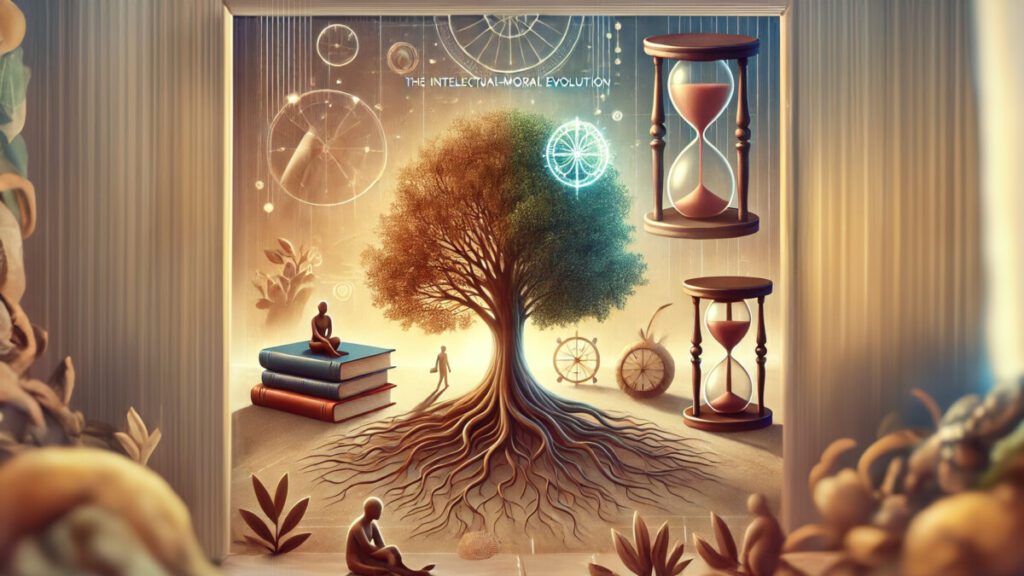
DE explains the evolution of humankind in the world. Many philosophers and current science advocate that humankind was born selfish, that selfishness is in nature. This, then, reverses the truth. The simple and ignorant act according to instinct, and instinct is harmonious. But do they do both good and evil?
The Article The Evolution of Moral Intellect is Continuation of the article Evil in Civilizations
In reality, in the evolution of humanity, the first phase is of the simple, who act naturally through harmony, acting by instinct. But the simple and ignorant age. Later, with the arrival of the exiles, they will spread the false mentality, which reverses the true idea taught by Jesus' precursors.
In their first human lives, the spirit simple and ignorant does neither good nor evil, acts according to instinct, which leads him to harmony. As the spirit gains awareness of its individuality over hundreds of incarnations, it begins to act according to its faculties: feeling, reason and willFrom there, he makes his choices between good and evil, therefore the cause of his actions, and his responsibility, stems from the mindset he adopts. The true idea lies in understanding the law of love, which is divine and natural.
All spirits at the beginning of their evolution deal with personal interests, as they act in the world and need to take care of their survival. Balance lies in cooperation and the collective good. Becoming habits, they are the virtues.
The understanding of evil and the choice of good
Through trial and error, the spirit is initiated into the knowledge of good and evil.
When the spirit at the beginning of evolution eventually acts according to the interests of its personality, it commits a fault. Every fault is associated with moral suffering, as the divine law is in everyone's conscience, indicating that the act is contrary to good. A fault occurs when the individual knows it is wrong, their conscience tells them it is wrong. But if the individual does not know it is wrong, they will not experience moral suffering.
Moral suffering is associated with how much an individual knows. If one knows a lot, there is much more moral suffering than if one knows little. Moral suffering doesn't occur with every mistake, because the individual already knows they will make a mistake the next time, so their suffering becomes constant. The selfish suffer constantly. They constantly know they are doing wrong; they can only change their habits, which is perhaps more difficult than overcoming the mistake. Through the exercise of reason and the effort of will, the spirit decides to act differently and remains on the path of good. In moral autonomy, understanding error allows one to choose the truth.
Teaching what is good and what is evil is the premise for the individual to act by free choice; otherwise, he or she will simply be obeying. Those who obey are not choosing!
The imperfections and the moral suffering
Moral suffering is inherent in imperfections, and the spirit, yearning for happiness, rethinks and chooses good.
When an individual insists on acting out of self-interest, seeking immediate sensations, the lack becomes a habit, creating a condition of attachment. In this deviation, the individual uses reason and will to possess possessions and abuse the simple things.
When attachment is stronger than the effort to return to goodness, it becomes an acquired habit, selfishness. Moral suffering
associated with the lack, according to natural law, due to bad habit, it remains constant and will last until the imperfection is overcome.
It is the person who blames himself, it is not God punishing.
When the spirit at the beginning of evolution eventually acts according to the interests of its personality, it commits a fault. Every fault is associated with moral suffering, as the divine law is in everyone's conscience, indicating that the act is contrary to good. A fault occurs when the individual knows it is wrong, their conscience tells them it is wrong. But if the individual does not know it is wrong, they will not experience moral suffering.
Moral suffering is associated with how much the individual knows.
If one knows a lot, there is much more moral suffering than if one knows little. Moral suffering doesn't occur with every mistake, because the individual already knows they will make a mistake the next time, so their suffering becomes constant. The selfish suffer constantly. They constantly know they're doing wrong; they can only do so by changing the habit, which is perhaps more difficult than overcoming the mistake.
the false idea
The selfish person, when his conscience weighs on him, must overcome his imperfections. But when attachment dominates, he creates false ideas to quench the light of his conscience. This happens because those who act out of selfishness suffers morally, feels guilty, knows he's wrong, and his goal is to overcome it. But when the horizon of recovery recedes, the spirit feels defeated and the goal difficult. To endure the pain and low self-esteem, he justifies himself by pride. Inverting the truth, he tells himself: I am superior, I deserve privileges; others are inferior, they must serve me. Thus arises the false idea. The more the proud believe in this lie and imposes it on the simple, but by violence will defend your false rights.
The false idea in the spiritual world
Deluded by the false idea he has adopted to govern his actions, the proud man blindfolds himself, and when he reaches spirituality, he does not see the happiness of good. So he wanders and suffers, inertia of the soul.
No matter how active it is in the corporeal world, spiritually, the imperfect spirit (selfish and proud) becomes inactive, disconnecting itself from its fellow beings and superiors who are on the path of good, as it acts in its own interests, and not for everyone else.
To alleviate unbearable moral suffering, the spirit creates antipathy towards fellow beings and superiors who are on the path of good, fights against and distorts the truth or divine law, creating or defending false ideas to circumvent their reason and conscience.
This article was prepared based on a lecture given by Paulo Henrique de Figueiredo. Click here to meet her.
Reading Recommendations (Books)
- Free PDFs by Kardec – https://bit.ly/3sXXBxk
- Autonomy – The Untold History of Spiritism: https://amzn.to/3PIvbyy
- Allan Kardec's Legacy: https://amzn.to/3RIn2gv
- Final point – the reunion with spiritualism with Allan Kardec: https://amzn.to/48PLaE7
- Neither Heaven nor Hell – The Laws of the Soul According to Spiritism: https://amzn.to/3F2voYO
- Genesis – Miracles and Predictions According to Spiritism (unadulterated): Free PDF or https://amzn.to/3RM91hF
- Heaven and Hell: Or divine justice according to Spiritism (unadulterated): Free PDF or https://amzn.to/3ZGrcal
- Spiritist Revolution. Allan Kardec's forgotten theory: https://amzn.to/3t7HIUH
- Mesmer. The denied science of animal magnetism: https://amzn.to/3PYc1X2
- The Book of Mediums: https://amzn.to/3PDNTHK
- The Spirits' Book: https://amzn.to/3QkcFx9
- Spiritist Magazine – complete collection: https://amzn.to/48Uxh7s
- Practical Instructions on Spiritist Manifestations: https://amzn.to/3QiR8Gc
- Spiritism in its Simplest Expression: https://amzn.to/3M6fXT5

 Português do Brasil
  English
  Français
  Español