

Translations, from Portuguese, are automatic. If you notice any errors in the text, help us identify them, clicking here.
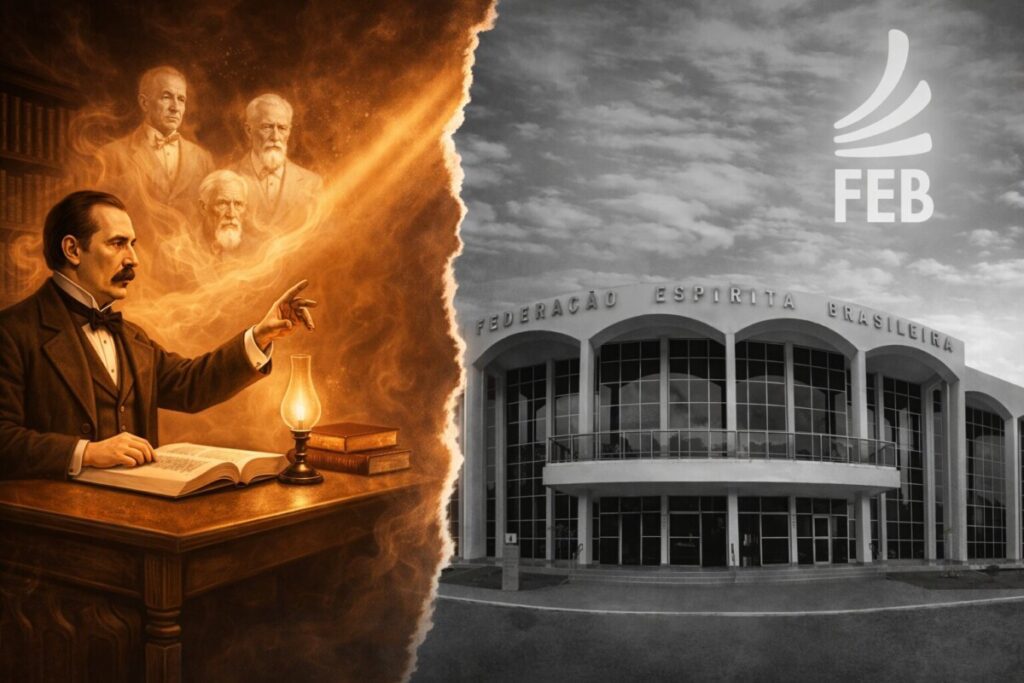
Anyone who opens the frontispiece of one of the fundamental works of Spiritism reads the following title: “"The Book of Mediums or Guide for Mediums and Evocators"”. Note that the word "Evocators" is not there by chance; it defines the very nature of the mediumistic exchange established by Allan Kardec. However, when we analyze modern teaching manuals, such as the booklet... Study and Practice of Mediumship From FEB's perspective, we perceive a drastic paradigm shift that deserves careful analysis.
1. Initiative: Human Activity vs. Group Passivity
The most glaring divergence occurs in the initiative of spiritual communication. In The Mediums' Book, Kardec is categorical: “"When one wishes to communicate with a specific Spirit, it is necessary to evoke it."”. He teaches that evocation is an act of will that serves as protection. “We call upon it through our desire, and thus we oppose a kind of barrier to intruders.”.
In contrast, the FEB textbook guides the student in the opposite direction: “"Direct evocations of spirits should be avoided, opting instead for their spontaneous manifestation."”. While Kardec saw evocation as a way to attract sympathetic Spirits and ward off "intruders," the FEB (Brazilian Spiritist Federation) transfers all responsibility for selection to the Beyond, stating that... “"It is up to the spiritual direction to select the disembodied spirits who should manifest themselves at the meeting."”.
2. The Role of the Group: Scientific Research or Spiritual Infirmary?
Kardec conceived of the mediumistic meeting as a laboratory for psychological observation and moral teaching, where the identity of the Spirit was fundamental. He emphasizes that “"Spiritist instruction includes not only the moral teachings given by the Spirits, but also the study of facts."”.
In the FEB (Brazilian Expeditionary Force) manual, the focus falls almost exclusively on “"Assisting Spirits in need of help"”, transforming the mediumistic meeting into a kind of emergency room. The term "evocator" is replaced by “"enlightening"” or “"dialoguer"”, changing the role from someone seeking instruction to someone who only seeks to provide assistance.
3. Spiritual “Filtering” and the Technology of the Beyond
The FEB (Brazilian Spiritist Federation) booklet introduces concepts of spiritual organization that are not found in Kardec's work, such as the use of... “"Magnetic barriers and protective equipment"” to control who communicates. According to FEB, spiritual guides use devices such as the “"psychoscope"” to listen to the souls of the incarnate and ensure order.
Kardec, on the other hand, based the security of the meeting on moral authority and on... “"homogeneity of feelings"”. For the Encoder, the filtering was done by “"law of affinity"” and by “"control of reason and the most rigorous logic"” exercised by men, and not by an invisible administrative technological apparatus.
4. Risks of Omitting the "Summoner's Guide"“
By omitting or discouraging the use of spirits in spiritual healing, the Spiritist movement risks falling into what Kardec called... “"ignorance of the most elementary principles of Spiritism"”. The Encoder warned that “"The primary cause of doubt concerning the existence of spirits is ignorance of their true nature."”. If the group remains passive, merely waiting for what the "Beyond" sends, it misses the opportunity to conduct comparative studies and verify the identity of the Spirits, as taught in chapter XXIV of The Mediums' Book.
Conclusion: Returning to Kardec
While the charity of helping suffering Spirits is noble, it should not replace the science of observation that underpinned the Doctrine. To claim that evocation is dangerous or unnecessary directly contradicts the work of Allan Kardec, who saw in it the means of transforming Spiritism into a... “"observational science and a philosophical doctrine"”.
According to fundamental works, the true safety of the medium does not come from passivity, but from... “"serious, persevering and in-depth study"”. As the Coder himself would say: “"Spiritism addresses reason."”.
Reading Recommendations (Books)
Discover the books we recommend as essential for your understanding of true Spiritism: https://www.geolegadodeallankardec.com.br/livros-recomendados/
Conheça as obras altamente indicadas para sua instrução. Clique aqui

 Português do Brasil
  English
  Français
  Español
Moses forbade interaction with the dead due to the frivolous practices of people at that time. Kardec edited Heaven and Hell based on evocations. The Book of Mediums, chapter XXV, is entirely about the seriousness of evocations. Official Spiritism advises against evoking spirits… Papal infallibility fell into disuse due to the human nature of the Supreme Pontiff, just as the infallibility of secular official Spiritism will be derogated by the proper use of mediumship. I don't remember, but certainly evocations continued even with Moses' prohibition. In the same way that official Spiritism recommends against evocation, instead of guiding and clarifying – which is its duty – evocations will continue, because speaking with the dead is a human condition granted by God. Guidance from spirits is different from "guidance from Spiritists." It's like prohibiting the use of money due to misuse… Both will continue to exist according to the moral stature of the medium.
Friend, just one correction: it's not "Official Spiritism" that advises against evocations. That's done by the FEB (Brazilian Spiritist Federation). "Official Spiritism" is found in Kardec's 23 works. 😉