The Evolution of Moral Intellect

DE explains the evolution of humankind in the world. Many philosophers and current science advocate that humankind was born selfish, that selfishness is in nature. This, then, reverses the truth. The simple and ignorant act according to instinct, and instinct is harmonious. But do they do both good and evil?

The Article The Evolution of Moral Intellect is Continuation of the article Evil in Civilizations

In reality, in the evolution of humanity, the first phase is of the simple, who act naturally through harmony, acting by instinct. But the simple and ignorant age. Later, with the arrival of the exiles, they will spread the false mentality, which reverses the true idea taught by Jesus' precursors.

The understanding of evil and the choice of good

Through trial and error, the spirit is initiated into the knowledge of good and evil.
When the spirit at the beginning of evolution eventually acts according to the interests of its personality, it commits a fault. Every fault is associated with moral suffering, as the divine law is in everyone's conscience, indicating that the act is contrary to good. A fault occurs when the individual knows it is wrong, their conscience tells them it is wrong. But if the individual does not know it is wrong, they will not experience moral suffering.

Moral suffering is associated with how much an individual knows. If one knows a lot, there is much more moral suffering than if one knows little. Moral suffering doesn't occur with every mistake, because the individual already knows they will make a mistake the next time, so their suffering becomes constant. The selfish suffer constantly. They constantly know they are doing wrong; they can only change their habits, which is perhaps more difficult than overcoming the mistake. Through the exercise of reason and the effort of will, the spirit decides to act differently and remains on the path of good. In moral autonomy, understanding error allows one to choose the truth.

The imperfections and the moral suffering

Moral suffering is inherent in imperfections, and the spirit, yearning for happiness, rethinks and chooses good.
When an individual insists on acting out of self-interest, seeking immediate sensations, the lack becomes a habit, creating a condition of attachment. In this deviation, the individual uses reason and will to possess possessions and abuse the simple things.
When attachment is stronger than the effort to return to goodness, it becomes an acquired habit, selfishness. Moral suffering
associated with the lack, according to natural law, due to bad habit, it remains constant and will last until the imperfection is overcome.

When the spirit at the beginning of evolution eventually acts according to the interests of its personality, it commits a fault. Every fault is associated with moral suffering, as the divine law is in everyone's conscience, indicating that the act is contrary to good. A fault occurs when the individual knows it is wrong, their conscience tells them it is wrong. But if the individual does not know it is wrong, they will not experience moral suffering.

If one knows a lot, there is much more moral suffering than if one knows little. Moral suffering doesn't occur with every mistake, because the individual already knows they will make a mistake the next time, so their suffering becomes constant. The selfish suffer constantly. They constantly know they're doing wrong; they can only do so by changing the habit, which is perhaps more difficult than overcoming the mistake.

the false idea

The selfish person, when his conscience weighs on him, must overcome his imperfections. But when attachment dominates, he creates false ideas to quench the light of his conscience. This happens because those who act out of selfishness suffers morally, feels guilty, knows he's wrong, and his goal is to overcome it. But when the horizon of recovery recedes, the spirit feels defeated and the goal difficult. To endure the pain and low self-esteem, he justifies himself by pride. Inverting the truth, he tells himself: I am superior, I deserve privileges; others are inferior, they must serve me. Thus arises the false idea. The more the proud believe in this lie and imposes it on the simple, but by violence will defend your false rights.

The false idea in the spiritual world

Deluded by the false idea he has adopted to govern his actions, the proud man blindfolds himself, and when he reaches spirituality, he does not see the happiness of good. So he wanders and suffers, inertia of the soul.
No matter how active it is in the corporeal world, spiritually, the imperfect spirit (selfish and proud) becomes inactive, disconnecting itself from its fellow beings and superiors who are on the path of good, as it acts in its own interests, and not for everyone else.
To alleviate unbearable moral suffering, the spirit creates antipathy towards fellow beings and superiors who are on the path of good, fights against and distorts the truth or divine law, creating or defending false ideas to circumvent their reason and conscience.

This article was prepared based on a lecture given by Paulo Henrique de Figueiredo. Click here to meet her.


Evil in Civilizations

The Evil of Civilizations is a continuation of the article The Double Concept of Good and Evil

Evil in civilizations begins with the belief in false ideas, in those who act motivated by selfishness and pride, prioritizing their own interests. When many individuals adopt this mentality, it transforms into a collective malaise. The mistaken view of this false idea permeates social relations. This problem is exacerbated when leaders, religions, philosophies, and sciences propagate this false mentality, influencing and shaping the entire culture.

The first is summed up in these words of Christ: 'Do unto others as you would have them do unto you.' In short, it applies without exception to all social relations. We must agree that if all members of a society acted in accordance with this principle, there would be fewer disappointments in life. As soon as two people are together, they thereby contract reciprocal duties; if they wish to live in peace, they will be obliged to make mutual concessions. These duties increase with the number of individuals; agglomerations form a collective whole that also has its respective obligations. You therefore have, in addition to the relations between individual and individual, those between city and city, between country and country. These relations can have two motives that negate each other: selfishness and charity, since there is also national selfishness.

Allan Kardec, Spiritist Journey, 1862

There is selfishness in science, in religion. Everywhere there is the false idea.

With selfishness, self-interest prevails; each person lives for themselves, seeing others as merely an antagonist, a rival who can compete with us, whom we can exploit, or who can exploit us; someone who will do everything possible to get there before us: victory goes to the smartest, and society—sad to say—often consecrates this victory, which divides it into two main classes: the exploiters and the exploited. This results in a perpetual antagonism that makes life a torment, a veritable hell.
Replace selfishness with charity, and everything will change; no one will seek to harm their neighbor; hatred and jealousy will die out for lack of fuel, and men will live in peace, helping one another instead of tearing each other apart. If charity replaces selfishness, all social institutions will be founded on the principle of solidarity [cooperation] and reciprocity [mutual support]; the strong will protect the weak, instead of exploiting them.

Idem

If the individual considers the other weak, he will exploit him.

If the individual considers the other strong, he becomes an adversary to be fought. The change lies in what the individual chooses to do.

This article was prepared based on a lecture given by Paulo Henrique de Figueiredo. Click here to meet her.



The Double Concept of Good and Evil

This article The Double Concept of Good and Evil is a continuation of the article The Truth that Sets You Free

Pixabay GoldenVionist

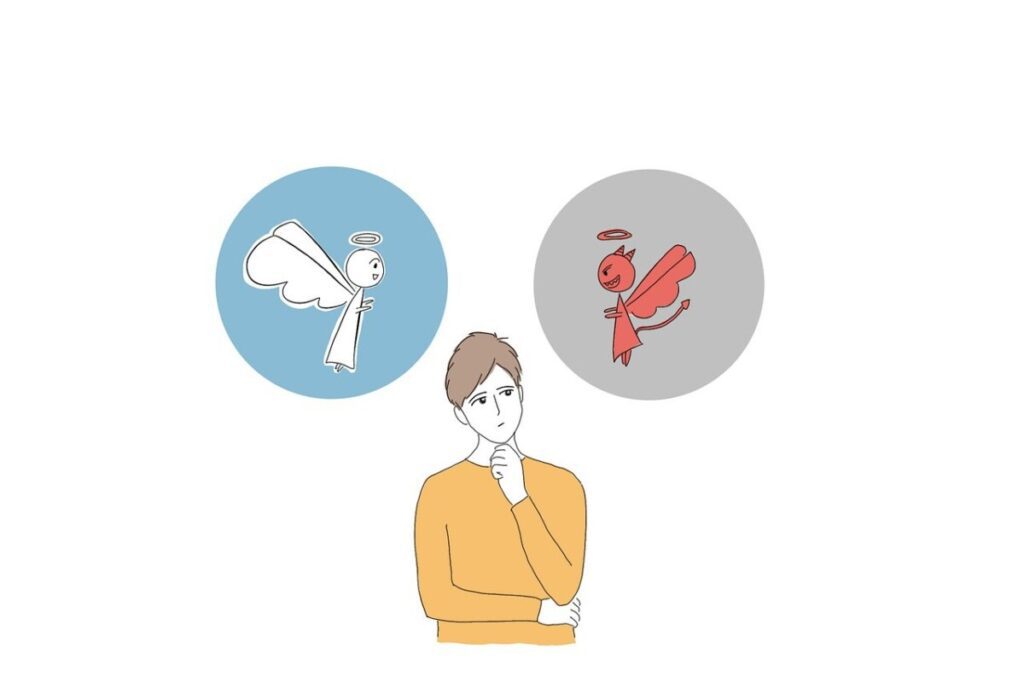
The double concept of good and evil is a false idea: doing what is right is considered acting in good, while making mistakes is seen as acting in evil. Consequently, each failure committed by the person accompanies self-condemnation, as if committing an evil act. In reality, it is natural to make mistakes when carrying out any activity that we have not yet mastered in our lives; This is not evil, but simply a mistake.

Thus, through this false mentality, the person believes that it is better to avoid mistakes. But how can you avoid mistakes? “Do as I say” is what religious leaders and academics alike say, demanding blind obedience. In the gym, you often hear, “Do as I say.” “You are incapable, I know what is best!” “Learn from me and repeat my words!” (HETERONOMY). However, memorizing and imposing does not lead to learning, as each individual has their own way of learning and understanding; some faster, others less; skills differ from individual to individual; Who said there was only one right way?

True progress lies in everyone understanding the reasons why things don't work. It is impossible to achieve something without trying. Unfortunately, we condition ourselves to fear error as a sin, which paralyzes people, preventing them from trying and, consequently, from evolving. This notion is absurd; It's a false idea!

Allan Kardec established that Spiritism is a Philosophical Science, a classification from the 19th century. At that time, science was divided between Natural Sciences and Philosophical Sciences, the latter included the spiritualists. At that time, all these philosophical ideas were being discussed. Surprisingly, when revisiting the academic texts of that century, we discovered scientific spiritualism, which, together with Spiritism, has the potential to build a new world.

At the book “Heaven and Hell”, Spiritism explains that the double concept of good and evil are not personified in God and the Devil, nor are they limited to the exclusive division between the saved and the damned. This false dichotomy diverts humanity from the correct path.

There is no battle between good and evil; any statement to the contrary is misleading, as Evil is an illusion that dissipates when understood (AUTONOMY). Understanding is the tool of Good.

All creation exists in function of divine law, God's ministers organize the worlds, life and humanities according to the path of good. But the human spirit needs act in good by understanding the truth, in a free and disinterested way, that is, You need to overcome the false idea through your effort, conquering faith supported by reason: rational faith!

Pixabay by Congerdesign – O Bem

This article was prepared based on a lecture given by Paulo Henrique de Figueiredo. Click here to meet her.

Continue on Evil in Civilizations


The Truth that Sets You Free

Continuation of the article The Dominion by Lies and Violence

Jesus came to bring us the truth that sets us free! He mentioned the devil in the Bible, but did he believe in the literal existence of the devil? The word “Devil” is written in the Bible, but its meaning goes beyond the literal.

Pixabay – Golden Violinist – birds

It really all comes down to interpretation. God and Devil are representations of Good and Evil, respectively. However, viewing the Devil as purely malevolent is a misconception. The Devil is not an entity; it resides in those who embrace this false idea. Mal has no form, is not a real entity. No one is inherently evil. Is there anyone truly evil in this world? No, because evil is a false conception that supports a habit. When someone changes their mindset, they stop acting in evil ways, but overcoming the habit is a long process. However, you never overcome if your mentality doesn't change.

What will really transform the world is genuine education – not that which merely perpetuates false ideas, that decorates teachings, but rather that which is understood, which liberates. The weapons of good are understanding and explanation. How can I make you understand that the future of the world lies in cooperation? Simply explaining and cooperating endlessly, without worrying about the results.

We are introducing a new habit into the world. By overcoming the false idea of evil, we will see global renewal, offering new opportunities for everyone. There is no Spirit that will not, sooner or later, choose the path of good. However, the good is not imposed; everyone must achieve it with their own effort.

True understanding will free us from this false dichotomy between good and evil, leading us to a life of cooperation and harmony. The following passage from Jesus is revealing:

42 Jesus said to them, “If God were your father, you would love me. I came from God and I go [to God]. For I did not come on my own, but He sent me. “


Bible – Volume I: New Testament – The four gospels – Gospel of John (pp. 470-471). Company of Letters. Kindle Edition. Trans. Frederico Lourenço

Jesus said he was sent by God and not by his own means. He came to teach the Law of God.

43 Why do you not understand my speech? Why you can't hear my word.

Idem

Science advances mainly through a paradigm shift, that is, a change in ideas.Paradigm comes from the Greek “paradigm”, which means “example” or “model”. Initially, it was applied in grammar (to define its use in a given context) and rhetoric (to refer to a parable or to a fable). From the 1960s onwards, it began to be used to define a model or a standard in any discipline scientific or epistemological context. source: Click here. We have to understand what the new idea looks like. So, after it makes sense, we test it and when we verify its coherence, we adopt it. The key is to share the new idea.
But that doesn't mean everyone will become superior, that's not the world's idea. Children do not need to study at school just to get the best grades, generating competition between them. Each person must seek to learn more than they knew before, as we are all spirits at different stages of evolution. There are very intelligent spirits in our world because they have spent more time experiencing the world. However, the intelligent are not superior to the simple, because in other existences they were simple like them. They came to our world because they felt more prepared there. Intelligent spirits are not malevolent or demonic; however, they must cultivate simplicity to serve and contribute, not to be served. This is the great motto of the world.

To move toward happiness in this world, we need to help remove the blinders from the eyes of those who are blinded by false ideas. However, they will not easily accept acting for everyone. Thus, some leave for another world, where they can progress, help many others to progress technologically more quickly and have a new opportunity to rethink their choices. It is not a punishment or punishment to be sent to another world; it is simply a consequence of a choice that did not allow them to evolve. If they reconsider their attitudes in the other world, renewed, they can return here.

This has occurred in our world; the simple ones were on Earth when the exiles arrived. They were given a second chance by coming here, but now they must contribute in useful ways to the advancement of this world. Unfortunately, many have fallen into the false idea that they must be served, thus creating all the mistaken ideas that permeate the world. But whenever we try to explain the truth, because it is a false idea, they resist.

This is the last opportunity both to change your mindset and to fully participate in this world. Those who refuse to cooperate will not understand the truth through force, memorizing orders, or blind obedience. Only through personal effort can someone understand.

44 You are [children] of your father the devil; and you want to put your father's wishes into practice. He is homicidal from the beginning and was not and is not in the truth, because there is no truth in him. When he utters the lie, he utters it from his own; for he is a liar and is the father [of lies]. 45 Me because I tell the truth you don't believe me. 46 Who among you condemns me regarding error? If I speak the truth, why don't you believe me? 47 Whoever belongs to God listens to the words of God. This is why you do not listen to me: because you are not from God.”

Idem

This part of John's Gospel is pointing out that the “devil” is in the false idea of superiority and purity. When we consider ourselves pure and superior, we tend to judge and condemn others who we consider simple and inferior. However, the act of judging is, in itself, a false idea: when we point out the error in another person, we are actually making a mistake, as we are judging the person instead of their specific behavior. This is equivalent to considering the person as “evil” and condemning them unjustly. Nobody has the right to act like that. Not even benevolent spirits condemn others in this way.

Evil reveals itself in the distortion of divine law, when we seek to satisfy our personal interests at the expense of the submission of the simplest, sacrificing their tranquility and happiness. However, we must reject the notion of superiority due to our knowledge.

In this context, our responsibility becomes even more crucial! Those who possess knowledge have a duty not only to help those less knowledgeable, but also to serve.

We must dedicate our efforts to disseminating knowledge and ensuring that many understand it. The future of the world lies in cooperation, not competition. Any new value must be shared globally so that everyone can benefit.

48 The Jews answered and said to him: “Do we not say well that you are a Samaritan and have a demon?”. 49 Jesus answered them: “I do not have a demon, but I honor my Father and you dishonor me. 50 I I do not seek my glory. There is one who seek and judge. 51 Amen, amen, I say to you: if anyone observes my word, he will not see death until eternity.”

ibid.

In this part, it is expressed: “You are contaminated by evil! And there’s a devil!” If someone already thinks the other is a devil, there seems to be no solution. Those who are selfish and arrogant label others as inferior, always seeing the evil in others. Religious fanatics see those who are different as inferior. Materialists judge those who think differently as inferior. The crux of the problem is when an individual believes they are superior and is stubborn about not changing their mind, even when faced with the truth. The truth confronts you, questioning your lofty self-image.

Now, if someone considers themselves superior, they will only recognize their error when they reach that conclusion on their own. Often, this person, deep down, does not really believe in their superiority, which is why they feel the need to affirm it so vehemently.

The only factor that makes us equal is our individuality. We are unique Spirits, each with different experiences to develop and understand. However, having more knowledge does not make us superior to others. What truly defines the evolution of a Spirit is not its intelligence or experience, but its ability to understand the law of God. The goal of the Spirit is to give the best of itself.

This article was prepared based on a lecture given by Paulo Henrique de Figueiredo. Click here to meet her.

Continue on The Double Concept of Good and Evil