Closing of an Era: Reflections on the Death of Divaldo Franco

The death of medium Divaldo Franco marks the symbolic end of an era in the Brazilian Spiritist movement—an era in which renowned mediums were elevated to the status of Spiritist leaders. But it must be stated clearly: this role was never theirs.

Divaldo Franco, as an incarnate spirit, certainly did good. On many occasions, he positioned himself correctly regarding the Spiritist Doctrine. However, his work—like that of any medium—needs to be analyzed in the light of reason and compared with the principles established by Allan Kardec. Unfortunately, several of his works deviate from these foundations, often adopting ideas linked to Roustainguism and to the karma, concepts that do not belong to the doctrinal structure of Spiritism.

It is important to emphasize: one does not “return” to the spiritual worldWe never leave it. We are incarnate spirits, and the material world is merely a transitory expression of spiritual reality. This point, so often simplified or distorted, needs to be rediscovered in its depths.

No More Idolatry

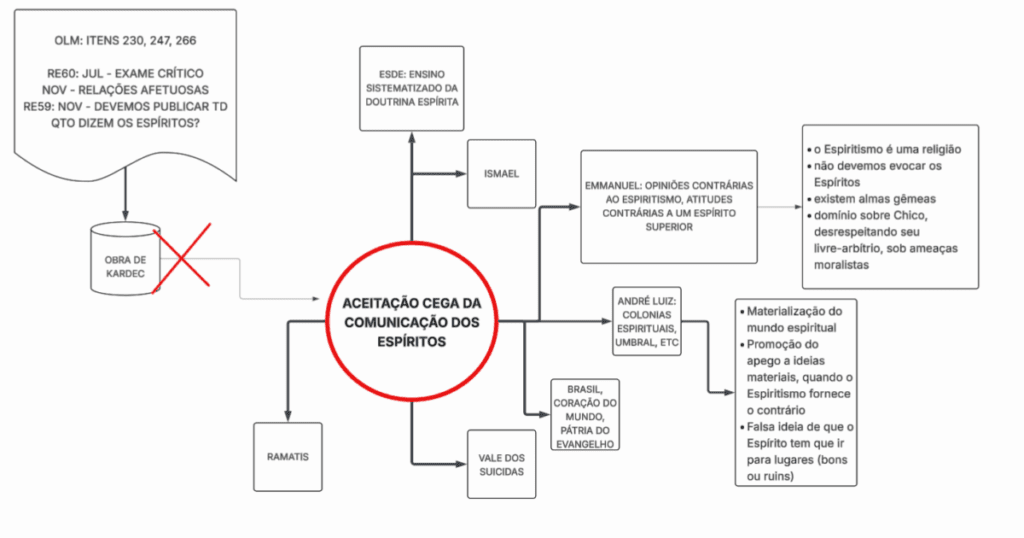
The Spiritist movement urgently needs to abandon its idolatry of mediums. Famous names are accepted uncritically, and their psychographies are published by the hundreds, without any rigorous doctrinal examination. Spiritism, being a science, demands... constant critical examination — and this examination cannot be waived on account of the fame or supposed moral elevation of the person who writes or transmits a message.

Let's be blunt: many of the communications attributed to higher spirits by Divaldo and other mediums don't stand up to rational analysis. Some are well-intentioned but reproduce earthly ideas. Others are hoaxes. The difference between them can only be discerned through serious study, reasoning, and the practice of conscious and judicious evocation—exactly as Kardec taught.

Alert: The Scramble for Vacant Space

With Divaldo's departure, the symbolic space it occupied will be vacant —and this is where we need to pay extra attention. Some mediums, already well-known for their supposed "letters from beyond," filled with emotional clichés and doctrinally poor, will certainly try to occupy this position.

Discernment is required. These letters, which comfort without enlightening, move without instructing, and repeat clichés and banal ideas, are the opposite of Allan Kardec's proposal. They represent a sentimentalized, moralistic Spiritism disconnected from serious investigation. We cannot allow Spiritism to continue to be shaped by this type of superficial mediumship.

It's Time to Reclaim True Spiritism

The Spiritist Doctrine does not need leaders. It needs Spiritists committed to the method of rational investigation of spiritual phenomena, with the active evocation of Spirits and with the meticulous examination of messages. Kardec showed us this unequivocally.

For those who wish to better understand this model of collaborative organization, we recommend two fundamental texts from Spiritist Magazine, both by Allan Kardec:

  • December 1861Organization of Spiritism
  • December 1868Transitory Constitution of Spiritism

True Spiritism is practiced online, by everyone, methodically, critically, and with reason. The time has come to leave myths and idols behind and return to the path laid out by Kardec—without detours, without sycophants, without "letters from beyond" recycled into books that merely repeat what the world already knows.


The FEB and its continuous attempt to manipulate the Spiritist Movement

The Brazilian Spiritist Federation, a Roustainguist organization practically since its inception, has always deliberately manipulated the Spiritist Movement, distancing it from the true Spiritism codified by Allan Kardec. I've already discussed this institutional deviation in a previous article.

We know well (and if you didn't know, now you do) that the FEB was taken over by followers of the dogmatic Jean-Baptiste Roustaing starting in 1895, when Bezerra de Menezes—also a supporter of Roustaingist theses—assumed its presidency. From this doctrinal appropriation emerged one of the greatest aberrations ever seen in the Brazilian Spiritist Movement: the book Brazil, Heart of the World, Homeland of the Gospel. This is a work clearly inspired by a mystifying Spirit — probably Ishmael — which served as the basis for the formulation of the “Golden Pact” and, later, for the creation of the ESDE (Systematized Study of the Spiritist Doctrine), a program that is completely permeated by the distortions of Roustainguism.

In the ESDE handouts, more specifically in chapter 4, we find a quote from this work (psychographed by Chico Xavier, under supposed spiritual authorship of Humberto de Campos), which I transcribe below with the appropriate emphasis:

[…] This is how Allan Kardec, on October 3, 1804, saw the light of the Earth's atmosphere, in the city of Lyon. According to the work plans of the invisible world, the great missionary, in his marvelous effort of synthesis, would count on the cooperation of a host of assistants in his work, designated specifically to assist him, in the individualities of John Baptist Roustaing (Jean-Baptiste Roustaing), who would organize the work of faith; Léon Denis, who would carry out the philosophical unfolding; Gabriel Delanne, who would present the scientific path; and Camille Flammarion, who would open the curtain of the worlds, drawing the wonders of the celestial landscapes, thus cooperating in the Kardecian codification in the Old World and expanding it with the necessary complements.

This statement, in particular, is factually false. Roustaing was not only not Kardec's assistant, but he also placed himself in clear opposition to genuine Spiritism, especially due to his rejection of the scientific methodology that underpinned Kardec's work—a point that represented the true Achilles' heel of his mystical and doctrinally fragile writings.

Recently, when trying to show this distortion to a friend, I realized that volume I of the ESDE had been “revised,” and the above quote had been modified: Roustaing’s name was simply removed from the excerpt, as if it had never been there.

An attempt shameless to erase its Roustainguist roots without, however, publicly acknowledging the doctrinal deviation or giving any sign of returning to the right path. This is the FEB: always operating behind the scenes, trying to control the Spiritist Movement and maintain its influence, just as the Catholic Church did with Christianity over the centuries.

Make no mistake: the FEB remains a Roustainguist. It continues to reject the evocation and rational examination of spirit communications—practices essential to Kardecian methodology. It continues to attempt to control mediumship according to its own dogmas, limiting it to the molds of its centers (Roustainguists, although they call themselves "Spiritist"). And it remains silent when it should stand up in defense of the true Spiritist Doctrine.

The FEB, my dears, can only be considered legitimate when, publicly and unequivocally, assume your deviation and recognize the historical error committed. Not before. Never before.


Dialogues from Beyond the Grave – Evocation – Marcos, the Repentant Spirit

At the previous meeting, the group had some questions about healing. It was decided that we would ask the good spirits to help us with our doubts. A spirit came spontaneously to answer these questions. At the end, we asked him what he needed. He told us he needed prayers because he had made many mistakes and regretted them after his last incarnation. We prayed to him, and he said goodbye.

In this meeting, after preparing some questions, we decided to call on you to better understand your situation. 

Here is the communication. 

Evocation. 

1. We want to welcome you to our group, dear brother, with all affection. We want to talk to you, to learn, to educate ourselves, and, if possible, to help you with something you need and for you to help us with something we need. Our intention is very legitimate, and we will not judge you. We are here to talk as friends, as brothers.

A: I appreciate your prayers for me. They were very helpful.

2. Friend, could you tell us what was your motivation for communicating with us last time?

A: Just the need for prayer. People forget about me.

Note: This isn't the first time we've seen a Spirit lament this. Indeed, no one wants to be forgotten, but the Spiritist Movement, absent from the studies of Spiritist science, no longer practices evocations due to various false ideas. It stops helping and learning, and such is the dominance of untruths that some go so far as to not praying for the Spirit, believing that this would be a hindrance. In this sense, large channels, so-called Spiritists, but also ignorant of Spiritism, collaborate in the dissemination of these false ideas.

3. What happened to make them forget about you?

A: It's been a long time since I passed away. Those I loved are no longer physical bodies. And I couldn't find them anywhere. Today, through your prayers, I can visualize those who were with me in my physical life. This is comforting.

4. So you mean to say that until they went to their spiritual homeland you had no contact with them?

A: No. I tried. But they wouldn't listen to me.

5. And when you saw them, what was it like, did they come, did they contact you, or did you contact them? What was it like?

A: They. They arrived. My wife, my mother, my father. My father Alberto, my mother Eliza, my wife Helena.

6. And your name?

A: Marcos.

7. Marcos. You said last time that you regretted the things you had done. We don't quite understand what happened, so if you feel free, can you tell us what happened? It would be interesting because we could understand you better and we could learn more.

A: There was a lot of fighting. Money. Greed. I robbed many people. I put my family in a bad situation. They suffered because of me. I left them to fend for themselves because of money.

8. And you were before all of them? Did you pass away before all of them?

A. Yes. It was an accident. I have trouble remembering.

9. It's okay, brother. If you feel like talking, Marcos, you can. We're not forcing you, it's okay. When did you enter? When did you realize you had died, that you had passed away? And how did you feel?

A: Alone. I had the darkness.

Note: Here we notice how necessary it is to ask objective questions, one at a time. This isn't the first time we've noticed the Spirit focusing only on the last question.

10. So the environment you were in, you couldn't decipher, everything was dark.

A: No. It is. It was dark. I couldn't see, I couldn't see anyone.

Note: this fact, which we were unable to delve into further at the time, reminded us of the article “The Spirit of a Damned Man” in the Spiritist Magazine of February 1860.

11. And how did you manage to get out of that darkness? What was that process like? That it was an achievement, right? That you achieved it, Marcos? If you'll allow me to call you that, right? Allow M. and I to call you that.

A: Yes. Yes, it was.

Note: The interlocutor asked several questions. The Spirit focused on a simple answer.

12. How did you manage to free yourself from this? What was it like?

A. I saw first. I didn't see, I heard some voices. I heard my wife's crying, my father's lamentations, but my mother's love... My mother began to appear to me. And it was then that I began to understand what had happened.

13. Marcos, did you hear your mother praying for you?

A: Yes. She called my name and she prayed.

14. Just as you listened to our prayers, did you listen to your mother's prayers or was it different?

A: It was different. She had and still has a love that I don't know how to understand.. It's grand. She made me see a little of the light from where she is. It moved me. So I listened.

Note: This probably has a lot to do with spiritual magnetism. Your mother's spirit has a deeper connection with him, which should make it easier for him to register her. This is how those who have a greater connection with certain individuals will have a greater capacity, even in the physical world, to assist them with prayers and dialogue in overcoming difficulties, returning to goodness, etc.

15. From these prayers of your mother?

A: Yes.

16. During your mother's prayers, you began to feel more comfortable. And then you were able to better see your companions around you? How was it? Could you explain this part better, Marcos? How did you overcome all of this?

A: Yes. I don't know if I've gotten over it. I still feel guilty.

17. Yes, but you've already taken a big step, haven't you?

A. Yes. I still feel a lot of guilt, but with that love, she opened a path for me, and the darkness started to leave, it started to go away. She showed me where I was and what I had to do.

18. Can you be a little more specific about what you said, what I "had to do"? How did she instruct you, what were her instructions?

A: Ask God for opportunities to grow. Ask God to show me how to reach Him. I saw other spirits approaching me, calming me, and telling me how to become a better person. I am seeking forgiveness from those I have harmed. I'm trying to forgive myself for the mistakes I've made. Every day some spirit approaches me and encourages me, shows me what forgiveness is like. He takes me to different places, where I can see and feel what love is and what forgiveness is..

Note: This is not the only Spirit who speaks to us about the idea that in the Spiritual world they learn by example, and not by readings. They are led to follow other cases, to assist and be useful. This is the reality of the Spiritist world.

19. This has helped you, these “visions,” and these “hearings,” have helped you understand better.

A: Yes, yes. But I'm not ready yet. I still need more faith, maybe.

20. The conversation you, Marcos, had with us last time and this one you had now is the first time you have been able to talk in a meeting like ours, a mediumistic meeting?

A: Yes, yes.

21. In this disincarnation of yours?

A: Yes. I didn't know what that was like.

22. Who brought him to us?

A: The spirit that accompanies me. I think… I think he is always here with you.

23. Yes. Who? And now he's here with us too?

A. He knows everyone.

24. How many are there, Marcos?

A: The one that accompanies me. There are 3 more... 4. But there are others too. The 4 that have the most light are.

25. I wanted to understand, my brother Marcos, in what environment you were while you were unable to see the light, do you remember?

A: It's space! Big, but it's dark.

26. Were you unable to see any region, any house, any place?

A: No. No. Just dark, just darkness.

27. Brother! Marcos! In the name of our Lord Jesus Christ, I would like to thank you for the message, and may the good spirits always guide you. May you always feel welcomed here in this space of ours, and may you be able to forgive yourself, because the most important thing is to forgive yourself for the things you've done. Oh, I would like to know if you have anything else to say to us for our instruction, for our better understanding of the doctrine, or so that we can help you better or even more.

A: I just want to say thank you for your prayers and for the opportunity to be here, for your hospitality, for not judging me for what I did. And they say that you are gathered here and that more messages will come soon—messages, I think. Instructions. But they pray for you too and are with you. I need to go.

NOTE: The group is in a development phase, and returning to this practice is a novelty for mediums from the Spiritist Movement, which does not engage in dialogue with spirits. This causes them certain difficulties, which will be overcome with time and practice. For this reason, inaccuracies are normal, but since the dialogue contains nothing that merits special attention beyond the analysis we have already conducted, we present it with the aim of encouraging others to resume these dialogues.

Our group meets online, via video, each from their own homes.


Friar Gilson needs to study the Bible better

Below, I leave an excellent comment, posted on the Espiritismo de Verdade channel on YouTube, by my friend Antonio AG:

“"Friar Gilson needs to study the Bible better, which he claims to know so well, because when Jesus was accused by the priests (coincidence?) of having his miracles performed by the devil, He responded with a masterful syllogism!"

He taught that a kingdom divided against itself cannot stand, that if Satan casts out Satan, the kingdom will be divided against itself and will destroy itself.

The formula that Jesus gave for recognizing Good and Evil is to analyze the fruits of the tree: a good tree cannot bear bad fruit, and vice versa, nor can brackish water flow from a good spring.

It is necessary to see what fruits Spiritism produces. What do good Spirits teach and practice? Are their fruits good or bad? So as not to judge according to appearance, but rather with righteous judgment, as He advised us to do with all things.

Do you want to learn about true Spiritism? Click here.

The friar needs to study the Bible independently, not through the blurred lens of Catholicism, but to ascertain what it truly teaches and what it does NOT teach!

On the other hand, when the friar claims that the Bible does not teach the concept of past lives (which allows for return through reincarnation), observe what Jesus teaches in the episode of the man born blind:

When they asked Him who had sinned so that the man was BORN BLIND—his parents or the blind man himself—He answered that neither the blind man nor his parents had sinned so that he was born that way, but that the blindness from birth would be an instrument for the manifestation of God's glory in the person of the blind man!

The starting point of the blind man's life was being BORN blind, and the verb "to sin" is in the past tense, preceding the blind man's birth! Need I draw you a picture?

And note that Jesus, because of the great responsibility of his mission, never missed an opportunity to correct erroneous and dangerous beliefs.

In the episode with the Sadducees, who believed in nothing beyond this material life, the Master warned them that they were greatly mistaken because they did not know the Scriptures or the power of God. This is the problem of many Christians and their priests: not knowing the Scriptures.

It is necessary to dare and know how to question one's own beliefs, Friar Gilson. Leave the comfort zone of denominational Catholicism and immerse yourself in the pure Gospel!

"If Spiritism were that deceptive and evil doctrine that the friar claims, Jesus would certainly have condemned the Jewish belief in reincarnation at that time!"”


Brother Gilson, why do you contradict Jesus?

Recently, Friar Gilson declared that if someone finds healing through Spiritism, it is because "the devil can also heal." This statement is not new. It echoes the same accusation the Pharisees made against Jesus, saying that He cast out demons by the power of Beelzebub.

Jesus, however, rejected this absurd logic with an irrefutable argument:

“Every kingdom divided against itself will be destroyed, and every city or house divided against itself will not stand. And if Satan casts out Satan, he is divided against himself. How then will his kingdom stand?” (Matthew 12:25-26)

Furthermore, He taught that A bad tree cannot bear good fruit.:

“By their fruits you will know them. Do people pick grapes from thornbushes, or figs from thistles? Likewise, every good tree bears good fruit, but a bad tree bears bad fruit. A good tree cannot bear bad fruit, nor can a bad tree bear good fruit.” (Matthew 7:16-18)

If there is healing in Spiritism, if there is comfort, if there is spiritual enlightenment, how can Frei Gilson claim that it comes from evil? Would Jesus himself have been wrong to say that a bad tree cannot produce good fruit?

The frivolousness of the attacks on Spiritism

Attacks on Spiritism follow a pattern: they are based on the most false ideas, the grossest distortions, and the repetition of unfounded accusations. Without understanding the Spiritist Doctrine, its critics condemn it. without study, without analysis, and often without any intellectual honesty..

The accusation that "the devil heals" is a classic example of a fallacy constructed to confuse people. If the devil had the power to heal, he wouldn't be an enemy of humanity, but a benefactor! Would Frei Gilson be willing to defend the idea that evil is dedicated to alleviating suffering? This logic, besides contradicting Catholic theology itself, is an outrage to common sense.

Accusing Spiritism of operating through the devil is a serious mistake. Spiritism is not based on occult rituals, magical practices, or the worship of entities. On the contrary, It is a doctrine that preaches reasoned faith, selfless charity, and the pursuit of truth above human conventions..

The commitment to Truth

Jesus clearly stated that he came. to bear witness to the truth (John 18:37) and that only the truth sets you free (John 8:32). But when Frei Gilson attributes something that produces good to the devil, he not only ignores the teachings of Jesus but also becomes a witness to the lie.

By spreading this falsehood about Spiritism, Who is Frei Gilson really with? If he is not telling the truth, he is not with Jesus. If he is spreading the same accusation as the Pharisees, wouldn't he be repeating their mistake?

Let each one reflect: Who benefits from distorting the teachings of Jesus to lead people away from the truth?


Friar Gilson's ...

It is regrettable that, almost 160 years after Allan Kardec organized the principles of Spiritism with method and rigor, we still have to deny absurdities that could be avoided with a simple reading of What is Spiritism.

Frei Gilson, like so many other critics who speak without knowledge, insists on distorting the Spiritist Doctrine, mixing it with practices of divination, magic, and esotericism. His approach is not based on study, but on the repetition of old misconceptions that have long since been clarified. The effect of such irresponsible statements is always the same: to misinform and fuel prejudice against knowledge he has not even bothered to understand.

@espiritismodeverdade

Friar Gilson's Frivolous Opinion on Spiritism It is regrettable that, almost 160 years after Allan Kardec organized the principles of Spiritism with method and rigor, we still have to deny absurdities that could be avoided with a simple reading of What is Spiritism? Friar Gilson, like many other unprepared critics, offers opinions on the Spiritist Doctrine without demonstrating the slightest understanding of its foundations. His statements confuse Spiritism with divination, magic, and esoteric practices that have nothing to do with Kardec's proposals. This type of irresponsible statement only perpetuates ignorance and misinforms those seeking to understand the Spiritist Doctrine. Spiritism: Science, Philosophy, and Moral Consequences Contrary to what misinformation preaches, Spiritism is not a set of rituals, does not involve mystical practices, and has no connection with divination. Kardec defines it clearly in What is Spiritism: "Spiritism is at the same time a science of observation and a philosophical doctrine." In other words, it is based on the rational analysis of spiritual phenomena and the search for understanding the nature of spirits and their relationship with the material world. Why doesn't Spiritism involve divination? Divination is based on the idea of predicting the future, usually through oracles or omens. However, Spiritism teaches that the future is not absolutely fixed, as free will is a fundamental principle of spiritual life. In The Spirits' Book, Kardec questions the spirits about this issue and receives the following answer in question 868: "If man knew the future, he would neglect the present and would not act with the same freedom." This demonstrates that any attempt to predict the future with absolute certainty goes against Spiritist principles. And what about magic? Magic, as popularly understood, involves the manipulation of occult forces and rituals to gain advantages. Spiritism opposes any superstitious practice. Kardec warns, in The Mediums' Book, that many deceptive Spirits exploit human credulity, encouraging deceptive practices. In Genesis, chapter II, Kardec reinforces: "Spiritism does not perform miracles or prodigies; it does not derogate the laws of Nature." Therefore, there is no room for mysticism or supernatural manipulation in the Spiritist Doctrine. Ignorance or bad faith? The question that arises is: are those who propagate such falsehoods truly unaware of Spiritism or are they deliberately distorting its teachings? The answer may vary, but the effect is the same: the perpetuation of lies that distance people from true knowledge. Spiritism has always been open to rational debate, unlike many dogmatic beliefs that condemn without study. Friar Gilson could at least have the intellectual humility to read What is Spiritism before passing judgment. But, like so many others, he prefers to offer opinions without proper knowledge. Do you want to know true Spiritism? In addition to the works of Allan Kardec, a fundamental read to understand how Spiritism deviated from its original principles in Brazil is *Autonomia – A História Jamais Contada do Espiritismo*, by Paulo Henrique de Figueiredo. This book clarifies how religious and ideological interests distorted the Spiritist Doctrine over time, distancing it from its original proposal of freedom of thought and scientific method. Let us be responsible when speaking about what we do not know. And, for those who wish to understand true Spiritism, the path lies in Kardec's works and serious studies, not in frivolous discourse. #hespiritism #spiritual doctrine #allankardec #freigilson #hespiritismoftruth

♬ original sound – True Spiritism

Spiritism: Science, Philosophy and Moral Consequences

Contrary to what its detractors preach, Spiritism is not based on rituals or mysticism. It relies on the rational investigation of spiritual phenomena and the search for understanding the nature of spirits and their relationship with the material world.

Kardec clearly defines this proposal in What is Spiritism (which you can download for free, clicking here):

“Spiritism is at the same time a science of observation and a philosophical doctrine.”

In other words, far from any superstitious practice, he proposes a serious study of spiritual reality, guided by logical reasoning and the experimental method.

Why doesn't Spiritism get involved with divination?

Divination is based on the belief that the future can be absolutely predicted. However, Spiritism teaches that the future depends on individual choices and circumstances that unfold over time.

Kardec addresses this issue in The Book of Spirits, question 868:

“If man knew the future, he would neglect the present and would not act with the same freedom.”

Therefore, Spiritism does not make deterministic predictions, as this would contradict the principle of free will and the very logic of spiritual evolution.

What about magic?

Magic, in the popular imagination, involves the manipulation of occult forces to obtain advantage. Spiritism opposes any such practice, as everything in it must be analyzed through the lens of reason and morality.

Kardec warns, in The Mediums' Book, about the existence of deceiving spirits who exploit human credulity. And in The Genesis, chapter II, he reinforces:

“Spiritism does not perform miracles or prodigies; it does not derogate the laws of Nature.”

In other words, it does not rely on rituals or magic formulas, but on the rational understanding of spiritual phenomena.

Ignorance or bad faith?

Those who insist on spreading misinformation about Spiritism do so either out of ignorance or deliberately. In both cases, the result is the same: perpetuation of prejudice and distancing from the truth.

Spiritism has always been open to rational debate, unlike dogmatic doctrines that condemn what they do not understand. Friar Gilson could at least have the intellectual honesty to read What is Spiritism before expressing his opinions. But, like so many others, he prefers to criticize without knowing.

The real reason for the attack on Spiritism

Frei Gilson's repeated statements about Spiritism, repeating the most absurd—and frivolous—ignorance, make clear the true motive behind these attacks. The Catholic Church, sustained by dogma and the subjugation of its faithful, has for centuries viewed with fear any idea capable of liberating consciences.

In the past, he burned at the stake those who dared to say they heard spirits, as this undermined the priestly monopoly on communication with the divine. Later, he persecuted heliocentrism and nearly condemned Galileo to the stake for stating the obvious. Later, he rejected fossil evidence, as evolution contradicted his dogmatic narrative. Now, his fight is against Spiritism, as it offers a rational Christianity, free from arbitrary impositions and based on freedom of conscience.

History repeats itself. And those who refuse to learn from it continue to spread the same old fallacies.

Do you want to know true Spiritism?

In addition to the works of Allan Kardec, an essential reading to understand how Spiritism was diverted from its original principles in Brazil is Autonomy – The Untold Story of Spiritism, by Paulo Henrique de Figueiredo. This work reveals how religious and ideological interests have distorted the Spiritist Doctrine over time, distancing it from its proposal for freedom of thought and rational inquiry.

Talking without knowledge is easy. But for those who truly wish to understand Spiritism, the path lies through serious study, not empty talk.


Spiritism Statistics – 6 to 7 million in 1868

In 1869, Kardec estimated that there were 6 to 7 million Spiritists, according to statistics he compiled. He compiled them based on data from subscribers to his magazines and his correspondence. This is how he explains the Spiritist Magazine of January 1869. He did not provide an approximate measurement because:

An exact enumeration of Spiritists would be impossible, as we have already said, for a very simple reason: Spiritism is neither an association nor a congregation; its adherents are not registered in any official registry. It is well known that one cannot assess the number by the number and importance of the societies, attended only by a tiny minority. Spiritism is an opinion that does not require any profession of faith and can extend to all or part of the principles of the Doctrine. It is enough to sympathize with the idea to be a Spiritist. Now, since this quality is not conferred by any material act, and implies only moral obligations, there is no fixed basis for determining the number of followers with precision. It can only be estimated approximately, based on relationships and the greater or lesser ease with which the idea spreads. This number increases daily, at a considerable rate; this is a positive fact, recognized by even its adversaries; opposition diminishes, clear proof that the idea finds more sympathy.

Spiritist Magazine of January 1869

In the same article, Kardec highlights;

Meanwhile, it can be said, without exaggeration, that, in short, the number of adherents has increased a hundredfold in ten years, despite the maneuvers employed to stifle the idea and contrary to the predictions of all those who boasted of having buried it. This is a fait accompli, of which the antagonists must be made aware.

Idem

Kardec addresses two categories of people in relation to Spiritism: those who consciously accept it after studying it and those who, although they do not yet identify as Spiritists, have intuitions and beliefs aligned with the doctrine. He emphasizes that Spiritist ideas arise naturally in many individuals, even without prior contact with Spiritism, which proves that these ideas are part of nature and tend to spread. Opposition to Spiritism, in many cases, is due to misperceptions based on distorted criticism. Once these people learn about the true doctrine, they will tend to accept it, becoming Spiritists in the future. Despite these considerations, Kardec did not include them in the study.

He also explains that, while it is impossible to obtain exact numerical statistics on the number of Spiritists, it is possible to analyze their distribution based on professions, social status, nationalities, and religious beliefs. Considering the variation in the number of people in each profession, it is possible to identify in which categories Spiritism has the most followers. In some cases, the proportion was calculated as percentages with good precision, although without mathematical rigor, while in other categories, the classification was based on the relative number of followers. These conclusions were obtained from over ten thousand observations.

generic statistics
world and people

Let's look at the (relative) numbers presented in the January 1869 edition:

Of the 11 items, we want to highlight this one, which deals with religious ideas. Here, Kardec makes clear the distance between Spiritism and religion. Once again, Spiritism was never a religion; Spiritism is a philosophical science. As a science, it investigates everything rationally; it can remain a religion and study Spiritism. Those with free thought and reasoned faith do not cling to dogma.

We were impressed that doctors and engineers topped this list. Kardec states in the article that for every hundred Spiritist doctors, at least eighty are homeopaths. This is because the principle of homeopathy brings them closer to spiritualism, and it is rare to find materialists among them, unlike allopaths. Homeopaths understand Spiritism better, identifying the properties of the perispirit as the basis of their system. Spiritists, in turn, recognize the rationality of homeopathy and defend it against unfair criticism, maintaining a balanced stance toward allopathy.

Since Magnetism and Spiritism are complementary sciences that explain each other, neither can fully evolve without the support of the other, functioning in an integrated manner, much like Physics and Chemistry or Anatomy and Physiology. Many magnetists intuitively recognize this connection and use their knowledge of magnetism as a way to approach Spiritism.

It's more difficult to understand the position occupied by certain industrial professions in this classification. One wonders, for example, why tailors rank first, while booksellers and printers, much more intellectual professions, are near the bottom. This is a fact that has been established for a long time, and we still haven't grasped the cause.

idem

There are a number of consequences of these results that Kardec found. Among them, we highlight:

That there are spiritists at all levels of the social scale. Furthermore, the vast majority of Spiritists are found among enlightened people, not among the ignorant. And nowhere did it first develop in the lower classes.

The curious thing is that after Kardec published his statistics on Spiritism, he presents, in the February 1869 edition, the assessment of these same statistics made by the newspaper Solidarity of January 15, 1869. In the article he refutes the numbers presented by Kardec, saying that Kardec made a big mistake because he did not count the followers from Asia.

We will highlight only a few excerpts, and leave the complete reading of this article to the reader. To read the article Click here

"We regret that we cannot reproduce, due to lack of space, the very wise reflections that Mr. Allan Kardec adds to these statistics. We will limit ourselves to noting with him that there are Spiritists at all levels of the social ladder; that the vast majority of Spiritists are found among enlightened people and not among the ignorant; that Spiritism has spread everywhere, from top to bottom on the social ladder; that affliction and unhappiness are the greatest recruiters of Spiritism, as a result of the consolations and hopes it gives to those who mourn and lament; that Spiritism finds easier access among nonbelievers in religious matters than among people with a fixed faith; finally, that, after fanatics, those most resistant to Spiritist ideas are those whose thoughts are entirely focused on possessions and material pleasures, regardless of their condition."

idem

“It is very wrong to Spiritist Magazine when she estimates the number of Spiritists for the entire world at only six or seven million. She obviously forgets to count Asia.

"If the term 'spiritists' refers to people who believe in life beyond the grave and in the relationships between the living and the souls of the dead, they must be counted in the hundreds of millions. Belief in spirits exists among all followers of Buddhism, and it can be said that it constitutes the foundation of all the religions of the Far East. It is widespread, especially in China. The three ancient sects that have long divided the populations of the Middle Kingdom believe in manes, in spirits, and profess their worship. ─ It can even be said that this is a common ground for them. The worshippers of So and of Fo there they meet the followers of philosopher Confucius.

“The priests of the sect of Lao-Tseu, and particularly the Tao-Tse, or doctors of Reason, owe a large part of their influence over the populations to spiritualist practices. These religious people interrogate the Spirits and obtain written answers that are no more or less valuable than those of our mediums. These are advice and warnings considered to be given to the living by the Spirit of a dead person. There are revelations of secrets known only to the one questioning, sometimes predictions that come true or not, but which are of a nature to shock the attendants and greatly stimulate their desires, so that they take charge. to carry out, themselves, the oracle.

“This correspondence is obtained by processes that do not differ much from the processes of our spiritists, but which, however, must be further perfected, if we consider the long experience of the operators who traditionally practice them.


Spontaneous Communication — The Renewal Movement

Concerned about the world's difficulties, the medium, Mrs. C., accustomed to this type of natural dialogue with Spirits, submitted a request for discussion on the matter, the answer to which is presented below.

In the spiritual world, there is a movement of renewal that will soon return to the realm of the incarnate; those who desire a new era where charity will prevail. The time for societal reforms will not be long in coming.

Destruction will bring renewal. Do not fear the difficult times, have faith, for we, who are the light of God, are constantly vigilant. We are inspiring the multitudes of incarnate beings who aim for the goals to which this new period will have its growth and its apogee.

The small, the underprivileged, the stateless will have their place in the world. The despots, the selfish and the proud, will also find their exile.

Prayers will sustain suffering humanity. Proactive attitudes will have their place and, above all, will overcome the vices of those who have not yet understood the grandeur of love for their neighbor.

The harvest of these efforts will transform the Earth and its people. Nature will take care of cleansing the places where respect and benevolence have not yet arrived. Remember that physical life is only a passage. Good Spirits will find their refuge, and the wicked will have their expiations.

Abstain from the revolt and hatred that corrodes your spirits and robs you of hope and faith.

Those who do not submit to the Creator's laws will be punished, as were all those who came before them. It is so, and always will be.

Raise your thoughts to God and seek in Him solace for your despair, which is normal, since you do not understand the grandeur of His work. The consciousness of Kardec's time regarding equality, liberty, and fraternity will resurface, even if suffering afflicts your physical bodies. Spiritism remains the path to achieving your goal.

Raise this banner: "Outside of charity there is no salvation." Instruct your neighbors, without fearing obstacles, persevere, pray, seek your own improvement, and encourage your peers to follow the same path.

We are with you in this fight. We are the light of God.

Friendly Spirit


Notes:

The communication itself is quite touching, direct, and helps to renew faith in the truth, already demonstrated by Spiritism, that the world is not ungoverned and that, despite the ill will of human beings, forgetful or careless about the essence of their being, Creation continues to develop, continues to march on, counting on those of good will like little ants carrying their grains, so that the mountain that will never crumble may be built.

It remains to add that the phrase “a Destruction will bring renewal.”"It refers to the destruction of the material, cyclical world, which serves the development of the spiritual element.".


Communications from Beyond the Grave — Allan Kardec

The medium Mr. D., seeking help from good Spirits, submitted the following appeal to the Spirit of Allan Kardec:

evocation(To Master Allan Kardec) I ask for your guidance, Master, for our mediumistic group.

Response (emphasis added): For all meetings, we advise you to prepare in advance, having the topic and questions ready for your studies. To the mediums, the pursuit of improving their faculties. Do you want to be good mediums? Then study, the regular practice of mediumship, and the uninterrupted pursuit of moral improvement is the right path. You don't need to practice excessively, without proper rest and without caution, so as not to attract charlatans.. But even a quarter of an hour of dedication, for example. Sincerity of intention will also help you. Ask yourselves why you are gathered here, consult your conscience, for Frivolous arguments attract only the frivolous and the mocking.. Faith is the instrument of reason, not just emotion. You will make it unshakable through study and meditation. Mediums, strive to be good mediums; collaborators who do not yet have their mediumistic faculty well developed, strive to have a good heart and faith. Q., I tell you that you are an inspired medium and a conscious psychophonist, without knowing it. Z., an inspired and intuitive medium. All mediums, strive to be good mediums..

Comments:

The communication was obtained by the medium D., a psychographer, in an environment separate from our group's meeting. Before asking this question, he concentrated on prayers and first sought the opinion of the Spirit of Saint Augustine, president of another mediumistic group with which he interacts.

Like all communications obtained within and outside our group, we subject it to the most rigorous critical examination, within our capabilities. We do this through a virtual document, shared among all of us, where we make observations and raise questions that, as needed, may be addressed in a new evocation (to the same Spirit, or to another that we deem appropriate to try to call upon), as you can see in an excerpt from another communication., to be discussed shortly:

Regarding the communication in response to the evocation of the Spirit of Allan Kardec, we had nothing to criticize. It seemed eloquent, direct, simple, and alerting, without circumlocutions or subterfuges—all characteristics of Allan Kardec, who communicated to make himself understood by all. Whether he himself communicated or whether the communication came through another Spirit, inspired by him, does not really matter, since the message arrived and fulfilled its purpose.

Yes, friends, even the spirit of Allan Kardec can be evoked and communicate, but the question will always be the intent and seriousness of the one who calls. As we know, calling out of curiosity or frivolity will end up arousing the interest of frivolous or impostor spirits, mystifiers.

We chose this brief message to open our article section entitled “Communications from Beyond the Grave,” where we will seek to follow in the footsteps of Allan Kardec, both in the analysis and presentation of communications, whether spontaneous or not., obtained in our environment or in other groups. We wish to be yet another example, another small light, still somewhat pale, shining in this dark night into which the Spiritist Movement has plunged, from which we hope that everyone may soon awaken—and this "soon" depends only on the will of each one. Gather together, friends. Study, persevere. Immerse yourselves in Kardec's pages so that you may emerge aware of the needs of this science, inspired by him to take your own steps. Into the night you will advance and, gathered together, you will do your part in illuminating this path. Private meetings, thus held, will always be of better quality than those held in heterogeneous environments and, above all, without study.

Ask yourselves why you are gathered here, consult your conscience, for frivolous reasons attract only the frivolous and the mocking.."”


Obstacles of Mediums

Mediumship is a faculty that allows interaction between the material world and the spiritual world. Allan Kardec, throughout his studies, observed that mediumship expresses itself in diverse ways and with distinct effects, which leads us to understand that there is no single way to establish communication with spirits. As he himself states, “mediumship is a multifaceted faculty”, which implies the variety of manifestations and experiences that it can generate.

Collaboration by Ceres Marcon

"Mediumship is a multifaceted faculty; it presents an infinity of nuances in its means and effects. Whoever is able to receive or transmit communications from Spirits is, for this very reason, a medium, regardless of the means employed or the degree of development of the faculty—from simple occult influence to the production of the most unusual phenomena."

Allan Kardec, Spiritist Review, February 1859

Among the countless mediumistic manifestations, one of the best known and most used is psychographyIn this type of mediumship, the medium acts as a channel for written communication with the spiritual plane, being one of the most common forms of manifestation in the field of Spiritism. When we address psychography, we can observe that mediums can be classified according to their degree of control over the process, and these classifications directly influence the obstacles they face throughout the development of this faculty.

There are three main types of psychographic mediums:

  • Intuitive mediums: These are those who receive inspiration from spirits but write consciously, with some control over what is being said. The communication is more indirect, with the medium receiving intuitions or guidance, but still maintaining control over the writing.
  • Mechanical mediums: These mediums become automatic channels for spirit communication. During the process of psychography, they have no conscious control over what is being written, which characterizes a more spontaneous and intense manifestation.
  • Semi-mechanical mediums: They represent a middle ground between the previous types. Although there is some influence of the spirit on the writing, the medium still maintains some degree of control and awareness over the process.

However, as Kardec warns us, even though it is a natural faculty, mediumship is not without its difficulties. He tells us:

"Although the faculty is not an exclusive privilege, it certainly encounters opponents, at least in the sense that it is understood. It is also true that it does not fail to present obstacles to those who possess it; it can be altered and even lost, and it can often be a source of serious disappointment."

Allan Kardec, Spiritist Review, February 1859

These words from Kardec remind us that mediumship, despite its accessibility to many people, is not simple. It can encounter resistance, both internal and external, and the medium may face obstacles of various kinds—from difficulty maintaining control over communications to the risk of being influenced by deceptive or malicious entities.

In his analysis, Kardec alerts us to the complexity of the causes of mediumship and how it can often manifest in individuals whose moral characteristics are not necessarily exemplary. He states:

"The gift of mediumship depends on causes still imperfectly understood, in which physical factors appear to play a large role. At first glance, it would seem that such a precious gift should only be shared by select souls. However, experience proves otherwise, for we find powerful mediumship in people whose morals leave much to be desired, while others, esteemed in every respect, lack it."

Allan Kardec, Spiritist Review, February 1859

From the above excerpt, we can see that, contrary to what one might assume, this mediumistic faculty is not an exclusive privilege of people of great moral virtue. Mediumship does not depend solely on the individual's purity or moral character, but involves a combination of factors, including physical and spiritual aspects that are not yet fully understood. This complexity can even result in powerful manifestations in individuals whose moral conditions are not ideal, while others, who could be considered more balanced, lack it.

Furthermore, Kardec also warns us:

“(…) the good quality of the medium is not only in the ease of communication, but solely in his ability to receive only good ones. Now, it is in this that his moral conditions are omnipotent; and it is also in this that he encounters the greatest obstacles.” 

Allan Kardec, Spiritist Review, February 1859

This statement is crucial to understanding that, for a medium, the quality of spiritual communications is related to the quantity or ease with which they receive messages, as well as their ability to discern and filter spiritual influences. The medium must be prepared to reject the influences of imperfect spirits and accept only messages from elevated and trustworthy spirits.

However, Kardec emphasizes that the medium's moral condition is of paramount importance. The medium's morality not only influences the type of communication they are able to receive, but also acts as a true "filter" to prevent them from being deceived or influenced by inferior or deceptive spirits. Therefore, the greatest obstacles for the medium are not only technical or physical difficulties, but also moral issues, which require constant vigilance and improvement.

In this sense, mediums must be in a constant process of self-knowledge and inner transformation. Mediumship is, by its very nature, an opportunity for growth, but it also demands great responsibility. The medium cannot be a mere passive channel, but must constantly seek moral elevation, ethics, and spirituality, so that their mediumistic faculties will be well-directed and bring benefits to themselves and others.

Therefore, the moral obstacles mediums face are often linked to a tendency to be carried away by ego, vanity, or the anxiety of "showing" their abilities. Humility, discipline, and detachment are essential qualities to ensure that the medium does not stray from the path of goodness and truth, thus minimizing the risk of disappointment or harmful communications.