How to research Spiritism with NotebookLM

Using Artificial Intelligence for research can be very useful, but it needs to be appropriate for that purpose. Asking questions about Spiritism on ChatGPT, for example, will often lead to biased answers, since it gathers everything associated with the idea of Spiritism, including those that actually contradict Spiritism.

There is a solution, and one of the best tools for this is NotebookLM, as it runs... exclusively Regarding the content sent, interpretive errors are much less likely, but not nonexistent.

Here's a step-by-step guide on how to create your own library of Spiritist research:

  1. Download all of Kardec's works in PDF format., clicking here.
  2. Access https://notebooklm.google.com/ with your Google account
  3. Create a new Notebook:

  1. Send him all the PDFs:

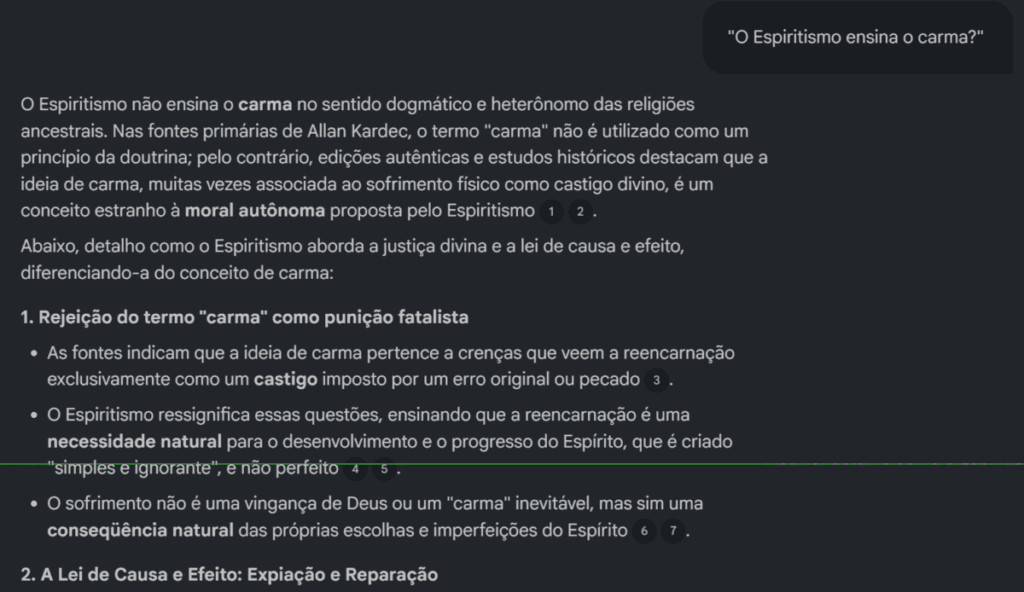
  1. After NotebookLM processes all the works (if it takes too long, refresh the page, as it may have already finished), start searching. For example:

    • “Some people argue that the idea of constructions and spirits feeding on each other in the spiritual world is valid. Compare this idea with Kardec's work.”
    • “"What is the perispirit?"”
    • “Does Spiritism teach about karma?”

Additionally, you can upload other materials and request a cross-examination. Just remember to remove those works so that NotebookLM doesn't start giving biased answers because of them.


Semear Spiritist Magazine – No. 1 – 1st Special Edition – May 2026

Download now the first edition of the Semear Spiritist Magazine, containing:

Read or download the May 2026 edition: https://www.geolegadodeallankardec.com.br/semear/2026/


Mediumship can only be practiced in Spiritist centers: a fallacy.

We would like to address this very important point, since today many rise up to condemn mediumship in the home, as if, outside the Spiritist center, we did not have adequate protection. This is a great myth, created by a lack of study of Spiritist science, contained in Kardec's 23 works, as we will demonstrate below.

To debunk this myth, I will refer to two important articles from the Spiritist Review, from which I have taken the following excerpts, this being the first:

Let us not forget one of the most honorable mentions of the Spiritist group in Douai, which we visited in passing, and a particular expression of gratitude for the welcome they extended to us there. It is a family group, where the evangelical Spiritist Doctrine is practiced in all its purity. There reigns the most perfect harmony, reciprocal benevolence, charity in thought, word and deed; there one breathes an atmosphere of patriarchal fraternity, free from harmful effluvia, where good Spirits must be as pleased as men. The communications there also reflect the influence of the sympathetic environment. It owes to its homogeneity and scrupulous care in admissions the fact that it has never been disturbed by dissensions and difficulties that others have had to suffer. This is because all who are part of it are Spiritists at heart and none seek to make their personality prevail. The mediums there are relatively very numerous; all consider themselves simple instruments of Providence; They have no pride or personal ambitions and humbly submit, without feeling hurt, to the judgment of the communications they receive, ready to destroy them if they are considered bad.

(Kardec, Allan. Spiritism in Belgium. Spiritist Review, October 1864)

And this, the second one:

The life of this pious family is a truly edifying spectacle. Nourished by spiritualist ideas, these children do not consider themselves separate from their father. For them, he is always present. They fear committing the slightest action that might displease him. One night a week, and sometimes more, is devoted to talking with him. However, there are the necessities of life that must be provided for, as the family is not wealthy. That is why a specific day is set aside for these pious conversations, always eagerly awaited. Often the little one asks: "Is Daddy coming today?" This day unfolds with family conversations and instructions tailored to their intelligence, sometimes childish, sometimes serious and sublime. These are pieces of advice given regarding small mischiefs that he points out. If he offers praise, he also does not spare criticism, and the guilty child lowers their eyes, as if their father were before them; they ask for forgiveness, which is sometimes only granted after a few weeks of trial. His sentence is awaited with feverish anxiety. Then, what joy, when the father says:

“"I'm happy with you!" However, the most terrible sentence is: "I won't be coming next week."”

 (Kardec, Allan. The Home of a Spiritist Family. Spiritist Review, September 1859)

As you can see, Kardec stimulated Serious mediumship in the home. These are just two quite compelling examples among many we could give in this regard. Spirits are always around us, wherever we are, and it is our sincere intentions, in harmony with other participants – even at a distance – along with the critical examination of any and all communication, that provide security to the mediumistic meeting.

Mediumship practiced in this way is what allowed Kardec to have more than thousand groups He was in contact with the Parisian Society for Spiritualist Studies, sending, by letter, records of his mediumistic dialogues. This was lost after Kardec's death and, today, a large part of spiritualist centers are immersed in total ignorance of the doctrine and the fundamental principles of this science, becoming a space for mystifications, fascinations and obsessions.

What Kardec desired, as recorded in "Transitory Constitution of Spiritism," in the Spiritist Review of December 1868, is what we propose today: serious, harmonious groups everywhere, knowledgeable about the Spiritist doctrine, resuming dialogue with the Spirits, questioning, examining, and ultimately collaborating with each other through central groupings of their representatives, comparing the material developed in the groups. This is the future that Spiritism demands, and we hope that, with each passing day, we can inspire more people with this purpose, which, however, was born from knowledge of Kardec's work and the facts surrounding the adulterations. The essential bibliography on all this can be consulted on our website – Allan Kardec's Legacy Study Group.

A word to misinformedTo say that Kardec's time was different from ours, as if we had a "psychosphere" today that didn't exist in the codifier's time, is a complete lack of knowledge about historical facts, which we recommend they seek to understand.


Spontaneous communication — Hypolite Leon Denizard Rivail (Allan Kardec)

On May 5th, 2026, we were holding our weekly mediumistic meeting, conducted online in a closed room where each participant connected from a different part of Brazil. We were concluding a communication with another Spirit, through another medium, in which we touched upon prominent figures of our Doctrine, when we noticed the other medium, Ms. X., exhibiting a certain body language. different from normal. Passing the microphone to her, he began a communication in a firm tone, a deeper and more austere voice, which was transcribed and presented below:

Dear brothers and sisters of this doctrine, which brings us comfort and shows us the truth, this removes the veil that covers the spiritual world.

I believed the struggle would be less difficult after my departure, but everything proved otherwise. However, I know that God, our Father, provides everyone with the necessary tools for justice to prevail in due time.

I have been following you for a long time. I have been eagerly awaiting this moment of connection to convey my gratitude for the efforts you are making to ensure that the doctrine continues to be what it should always have been.

The battles fought while I was among you continue. There isn't a single moment when I wonder if I truly did enough, but I also know that the right time would come, and so it has come to show us that the truth doesn't stay hidden forever.

I consider it a just fight, in which you and the other interested groups will be able to overcome all the barriers that stand in your way.

At this moment, I can feel more at ease. I can also tell you that there will always be those who throw stones, but everyone has their own window of glass, and the facts have proven which side holds the truth.

Teresa has already informed them. Regarding some procedures that we have adopted here and that we will continue to insist on until everything becomes a firm body, a doctrinal body, without loopholes for attacks and false promises.

The spiritual world is always in motion. What we lacked, and now possess, are the tools to fulfill God's designs.

Hypolite Leon Denizard Rivail (Allan Kardec) (Note: The Spirit did not sign any name. We we realize that it was about him, based on his words and the widespread feeling that overcame us. After the meeting ended, another medium said that it was intuitively felt that we should put it that way.

Paul

I can only begin by apologizing for my emotion, because we can only express our gratitude for the kindness and charity shown to us.

(I was really very emotional, from the moment I realized who it was)

Kardec

You may think that everything I've said is repetitive. You may even think it's the influence of the thoughts of the person I'm using at this moment. But rest assured that I wouldn't be here if it weren't for the effort you've made in support of everything I fought for, everything I believed in.

And rest assured that, in this fight, I will be with you, along with all the others who have accompanied me throughout my journey.

Paul

I would like some general guidance on our efforts. Sometimes I'm afraid of being too harsh, sometimes I'm afraid of simply, as we say here, "blocking people," so that those who don't understand this purpose and just want to get in the way, we simply leave them aside so they don't hinder us, but I don't know if that's the best way.

Kardec

Use your intelligence, use logic. To refute those who are naturally skeptical, convinced of nothing, convinced of the lies they have absorbed? There's no need to waste time on that kind of situation.

Always refute any contradiction with the logic of the spiritual world. Those who spread lies must be fought against. The others, in due time, will find their own answers.

Ari

You've been communicating, from what we've observed, in other groups. Which one should we trust? How do we do that?

Kardec

Compare, analyze. The vocabulary today is different, it's simpler than in my time. The content is more important than the form, I know you all know that. Look for the similarity, that will solve the problem.

Ari

If anyone shows any sign of going astray, should we ignore them for a while? It's difficult because people always slip up somewhere. So I don't know if you understand me… So we distance ourselves. Is that right, or should we give them a chance?

Kardec

Keep the communications that are equal in content and doctrinal depth. Discard everything else, anything that contradicts the spiritual world or my own words during my life.

Mr. Aja

It's a pleasure to be able to talk with you. In other words, what matters is what the doctrine says. Anything beyond that is opinion.

Kardec

Opinions are just assumptions. Ask the same questions to other mediumistic groups. The foundation has been given to you; you just need to follow it to understand the correct path to understanding.

Ari

If we adapt your method to modern times, will that be viable? For Spiritist science to be more widely recognized as a science.

Kardec

Beware of deviations from the adaptations.

Mr. Aja

Is the continuation of the Spiritist magazine viable today?

Kardec

I would say yes, my brother. Because in it, the experiments we conducted kept the spirits alert, bringing more information and clarification than vast novels found on bookshelves today, without having been placed under the agreement of the teachings of the spirits.

Nothing should be done lightly. And unfortunately, there are many who seek the spotlight of the big stages, believing that in doing so they are spreading what is right. They are not concerned with the veracity of what they publish, they are not concerned with the spiritual world, as we, in our daily work, did while incarnate.

Paul

I would like to ask for help once again. I was even a little impressed by the previous communication from Brother Karlsten.

Kardec

You are well taken care of. Listen carefully to the advice given to you. Do not neglect your health. The physical body is an important instrument for everything to unfold according to your plan. You are free to make your own choices, but you committed yourselves, when you were here, to assisting us in this continuity. Seek your physical health. Seek your spiritual health. Maintain the necessary balance.

Paul

Thank you. I would appreciate some general guidance for friends and partner groups.

Kardec

They all form a great link of forces fighting for the same ideal, some with more ease, others with more grace, but all walking together. They will bring the necessary balance so that our work will not have been in vain.

Be aware that opposing forces will arise, as they always have. Willpower alone is not enough; one must have faith and hope, believe in what one does, know how to separate the wheat from the chaff, and consolidate this work through the union of ideas, never neglecting the virtue of humility and love for those who throw stones at us and try to discredit us.

I leave you with my gratitude for the work you are doing. However small you may think it is, it will grow and bear fruit.

Ari

Should we make this information public, or should we keep it to ourselves and act on it later?

Kardec

Consider the consequences. They know they will suffer attacks, they know they will have opponents. They will say that the medium interfered, that the words were generalized, ideas without depth. Publishing means accepting contradiction. Reflect and decide.

Paul

Thank you so much, thank you. Thank you so much, Master Jesus!


During this dialogue, an intuitive medium felt the urge to write and jotted down the following in his notebook:

Blessed day when light shines upon your minds.

He, the Master's envoy, speaks to you as an act of mercy and love for your efforts.

We exult and glorify the Lord of the heights, who, from the summit of supreme moral elevations, touches you at this moment.

Onward, friends! The path is difficult, but reaching the top will be crowned with blessings and joy.

Strength. Justice. Charity. Fraternity. Care.

(Erastus?)


Once communication with the Spirit of Kardec is concluded, with a complete change of tone and body posture back to his usual tone and posture, the same medium begins to communicate with the Friendly Spirit:

Brothers and sisters, I am here again, after this communication, to tell you that the light emanating from this group has transcended the immensity of the universe.

When I told you, "Be the light of God," this is what I meant.

May God the Almighty Father bless you all and all those who are part of the group, who are under our care today. Have no doubt that we often guide you not with the intention of commanding you, but of keeping you always very close and aware of the truth.

At this moment, I wish that God's light may illuminate you all and that you may continue to be God's light, in this world and beyond.

Notes:

We made the decision to publish this very important communication because we cannot claim exclusive ownership of it, and because, at this point in our lives, we are certain that it does not affect our vanity. We are not proud of it, but simply accept with emotion and joy this gesture of charity towards our small and meager efforts.

This communication, moreover, is not just for us, but for all those who join us in our most sincere intentions: the recovery of the Promised Comforter, erased by more than a century of distortions and adulterations.

We know we will receive criticism. We will know how to listen to constructive criticism. As for the rest, silence will suffice, especially when it comes from those who don't... they dared To spend time and resources on the necessary learning of Spiritist science, according to the works of Kardec.

As for the jealous, we will only say not to nurture those feelings that debase the heart. The one who communicated with us today—a communication we waited almost two years to be able to receive—can communicate anywhere else where there is a serious and elevated purpose. We can only be grateful.


Do you have a mediumistic group and would you like to get in touch with us so that, together, we can begin to form a network to carry out comparative testing? Then, contact!



the return of true Spiritism: unity, humility, and purpose.

The following conversation took place during our online mediumistic meeting on April 28, 2026. It began with the spirit Amigo and later with the spirit Tereza, channeled through psychophony by Mrs. Po.

Ask the Friendly Spirit: The last time, Teresa came to talk to us (see Teresa's message 2026-04-21). She said that they were making a move to get the higher planes to mobilize the groups that have knowledge, and that there would be procedures for the next meetings. I would like to know if she has any news.

Teresa's answer: We are always prepared and working for the benefit of the groups that are making themselves available to higher plans. We have been active here in recent days so that more people may open their eyes and see the mistakes they have made and align themselves with those who seek the truth. The movement we make here is reflected in your material world.

There is an alignment of thoughts, an alignment of feelings, an alignment of wills. And as we said, as a friend who talks to you already warned, we were in constant work here. He himself warned you, yes, that if necessary, we would go back to banging on the tables.

But we realized through you and other groups that this wouldn't be necessary, although some of us understand that it's still necessary. That's why the demonstrations will happen. We all respect each other here.

We look at our brothers who are doing this and understand its usefulness. They, in turn, look at us and also understand our sense of education and the continuation of more serious work. We are a group; each of us can act freely, therefore never breaking God's laws.

For some deeply ingrained skeptics, the movement of objects is still necessary, but for more cohesive groups, this is not required. That's why we work on different fronts here.

Question: What instructions do you give us? You said you would bring a series of instructions for our actions. Do you have any instructions for now?

Teresa's reply: Keep up the work you started. Point out the shortcomings. That's a start.

We will not overburden you. Always strive for unity of thought. I prayed that you should be very careful of vanity, pride, and excessive passions.

Our greatest joy is when we see movements like this shake the great structures that have systematized our world and transformed it into a great distortion of what it truly is. Show people the vastness of the spiritual world. We are not restricted, trapped in a single world.

Try to make people understand the vastness of the space surrounding this planet. We know it's difficult to imagine infinity, but here, here, infinity is something indescribable. There are no human words that can describe what we see far beyond what you can perceive.

The first step, you are already taking. The second step will be the resumption of studies in light of communications, the exchange of information to compile once again the knowledge of the spiritual world. The third step, perhaps the most difficult, will be to put all this information into a compendium for future study. This is the resumption of true Spiritism.

This is what we desire. This is what we ask for.

Question: I am very grateful for your words and I am sure that you will all be by our side to do this in the right way. And I wanted to ask one more thing, to strengthen our will on this path, so that we don't get lost on other paths. So, I would like you to strengthen that will, because sometimes I don't have the will. I speak for myself. I'm afraid of that, of losing the will.

Teresa's reply:  And with the instructions of the Friendly Spirit, he has already told you so many times: avoid unnecessary fights, arguments that wear you down and weaken your will. Focus on the goal you have as a group.

You have the steps, follow them. Don't get lost in pointless arguments. Look inside yourselves and discover what is worth fighting for, what is worth discussing.

Only this will keep you on the path. The path you yourselves chose to follow when you were here. Nothing in your lives is by chance.

Nothing is by chance in these new groups that are forming. So, use the intelligence you have and make the right choices. We all wish here—myself, Spirit Friend, Christopher, and others whom I cannot name at this time—that you do not forget the purpose of this existence.

May God be with you. We will always be by your side, whenever you need us.

The focus is always on highlighting the logical characteristics of the messages through the message body, point-by-point analysis, and conclusions. The analysis follows:

1. Character of Communication and Language

The message has a serious and moralizing tone, which is the first indication of a Spirit of good nature. The language is dignified and free of trivialities, focusing on collective progress and vigilance against human passions such as pride and vanity. The Spirit does not impose itself, but advises, respecting the free will of those incarnate. This sober and profound tone, without exaggerated emotional appeals or fantastic promises, is the distinctive mark of Spirits of a high order, as taught in the fundamental works of the Codification.

2. Physical vs. Intelligent Manifestations

Tereza demonstrates an accurate understanding of the hierarchy of phenomena, distinguishing between what is necessary for different degrees of spiritual maturity:

Purpose of the Blows: She claims that table-tapping (tiptology) is useful for convincing skeptics, which agrees with the teaching that physical effects serve as the "ABC" of science to attract attention. Kardec, in The Genesis, explains that such phenomena were more necessary in an era of extreme materialism.

Abandonment of the Material by the Intellect: The Spirit emphasizes that cohesive groups do not require the movement of objects, focusing instead on philosophy and morality, which confirms that superior Spirits prefer faster and more direct means of communication for teaching. The message is clear: Moral Spiritism gradually replaces spectacle with instruction.

3. The Method and the Resumption of "True Spiritism"“

The three steps suggested by the Spirit align rigorously with the codification method established by Allan Kardec:

First step – The beginning of the work: This refers to the mutual recognition between spirits and incarnate beings, and the willingness to serve. This phase already existed in domestic gatherings of the 19th century and represents the awakening of group consciousness.

Second step – Collectivity and Universality: The "exchange of information to compile once again the knowledge of the spiritual world" is the basis of the Universal Control of the Teachings of the Spirits, where truth is born from the agreement of multiple sources. Kardec never separated mediumship from reason, inspiration from codification.

Third step – Organization and Compendium: “Putting all this information into content for future studies” reflects the coordination and synthesis work that Kardec carried out to give unity to the doctrine and avoid schisms and personal systems. It is the most challenging step, as any compilation runs the risk of becoming dogma – hence Teresa's warning that unity should be “of thoughts,” not of formulas.

Combating Distortions: The mention of "large structures that have systematized our world and transformed it into a great distortion" resonates with the warnings Kardec received about attempts to divert Spiritism towards mysticism or dogmatism. It is a veiled criticism of institutions or systems that, over time, have petrified living truths.

4. Moral Warnings: Vanity, Pride, and Harmony

The spirit Teresa emphasizes that the greatest obstacle is not external enemies, but internal imperfections: vanity, pride, and ambition. A group only remains assisted by Good Spirits as long as it maintains unity of thought and purity of intentions.

The warning about "unnecessary fights and exhausting arguments" is of irrefutable practical wisdom. As instructed by the superior Spirits, pride and vanity are the greatest barriers between man and God. In a group, discord and personalism attract frivolous Spirits and drive away the good ones, for the latter seek perfect communion of thoughts and feelings for good.

5. Willpower as the Engine of Progress

One of the most moving moments in the dialogue is when the client confesses: “Sometimes I don’t feel like it. I wish it wouldn’t get lost. I’m afraid of that, of losing the desire.”

Tereza's response is practical and at the same time elevated: “Follow the instructions of the Friendly Spirit […] avoid unnecessary fights, arguments that wear you down and weaken your will. Focus on the objective you have as a group.”

According to Spiritist psychology, the Willpower is an essential attribute of the Spirit.. Teresa acts as a true Guardian Spirit: she doesn't "give" the will to the individual, but offers advice and moral encouragement, since the merit of the action must belong entirely to the incarnate being. As Kardec observed, good Spirits assist those who help themselves; they cannot replace the free will of the creature. "Where there's a will, there's a way" is a maxim that reinforces that resistance to passions and discouragement is a victory of the Spirit over matter.

Spirituality does not promise to eliminate human weaknesses, but it teaches how to manage them. The indicated path is to avoid sterile controversies and constantly return to one's inner purpose. "Look within yourselves and discover what is worth fighting for, what is worth arguing about."“

6. Prayer and Self-Effort

Regarding the difficulty of lack of willpower, Spiritist analysis offers three fundamental perspectives:

Perseverance as Proof: Earthly life is a succession of trials, and active will is necessary to overcome the inertia of matter.

Guides' Action: Guardian spirits support workers, but they cannot replace personal effort; the "momentary abandonment" of sensations can be a test to exercise moral self-sufficiency.

Prayer as a Resource: A sincere prayer helps to elevate thoughts and attract energies that strengthen courage.

7. Pre-existing Commitments and Nothing by Chance

The statement that the path was "chosen by yourselves when you were here" aligns perfectly with the Doctrine of choice of evidence. Before incarnating, the Spirit, in a state of freedom, studies its imperfections and chooses the tasks and difficulties that it considers most suitable for its advancement.

The message concludes with a statement of great comfort and responsibility: “Nothing in your lives is by chance. Nothing is by chance in these new groups that are forming.” In Spiritism, “fate” exists only in the choice made by the Spirit upon incarnating; what occurs afterward are the natural consequences of its actions and the unfolding of the commitment undertaken before its own conscience.

8. The Use of Intelligence and the Purpose of Life

The advice to “use your intelligence and make the right choices” reminds us that God granted intelligence so that man may use it for good. The Spirit does not desire blind followers, but rational beings who understand the... The purpose of this existence is purification and collaboration in the work of creation.

Analytical Conclusion

Tereza's communication should be considered authentic in its purpose, as its content is rational, logical, and perfectly harmonious with the natural laws revealed by the Superior Spirits. It does not include predictions of dates or material promises, focusing exclusively on intellectual and moral progress, which is the true objective of Spiritism.

Tereza emphasizes that the solution to "lack of willpower" is not an external miracle, but internal vigilance against energy-draining arguments and a return to the spiritual commitment made before birth. The mention of other Spirits (such as the Friendly Spirit and Christopher) demonstrates the solidarity that unites the two worlds; those who preceded us are not dead, but watch over us as devoted friends, assisting us in the "ascent of the steep mountain of good.".


The Science of the Invisible: Evidence, Method, and the Seriousness of Spiritism

An account of a skeptical investigation that uncovered unexpected truths.


Summary

This article documents the trajectory of a dialogue between a skeptic familiar with the scientific method and a scholar of Kardecian Spiritism. Throughout successive exchanges, fundamental epistemological questions were examined: the possibility of scientifically studying unobservable phenomena, the validity of anecdotal and historical evidence, the criteria for experimental control, and the nature of the available evidence—from Allan Kardec's accounts in... Revue Spirite ...to the contemporary study on the psychographies of Chico Xavier, passing through a text by The Genesis (1868) which anticipates central concepts of general relativity, and culminating in the work Scientific Evidence of Survival by Professor JKF Zöllner, who documents experiments with the medium Henry Slade in the presence of physicists such as Wilhelm Weber and Gustav Fechner.

It is concluded that original Spiritism, distinguished from its later distortions (Roustainguism, Umbral, karma, idolatry of mediums), presents a method, evidence, and philosophical depth that deserve serious investigation. Reproducibility in Spiritism manifests itself not only in extraordinary physical phenomena, but fundamentally in the systematic observation of moral laws: pride → suffering; repentance → expiation; duty fulfilled → happiness. This is the "science of the soul"—practical, verifiable, and perhaps the most important contribution of Spiritism to humanity.


1. Introduction: The starting point

The author of this article began the conversation with a standard skeptical stance: spiritualist phenomena are probably illusion, coincidence, cryptomnesia, or fraud. The initial question was epistemological: “Is it possible to scientifically study something that cannot be directly observed?” The answer, in principle, is yes—science deals with unobservable entities (atoms, fields, black holes) through their effects. But when characteristics such as “free will” and “intelligence” are added, the problem becomes more complicated.

The dialogue progressed through successive layers, each revealing aspects that the initial skeptic was unaware of or underestimated.


2. First layer: The problem of experimental control

The skeptic argued that, for science, anecdotal reports are not enough—experimental control, replication, and exclusion of biases are necessary. The interlocutor responded with two points:

  1. Observational science It deals with phenomena that are not at the researcher's discretion (astronomy, seismology, epidemiology). The impossibility of replicating on demand does not invalidate the study—it only requires adapted methods.
  2. Allan Kardec He was already applying controls in his time: mental questions, multiple mediums, factual verification, universal agreement.

The skeptic acknowledged the validity of the first point, but maintained reservations regarding the second: Kardec's controls did not meet modern standards (blind recording, statistical analysis, independent recording).


3. Second layer: The Chico Xavier case

The interlocutor then brought up the published study on Chico Xavier (Moreira-Almeida et al., 2014, 2019), with the following characteristics:

Criterion Service
Contemporary case Yes (1974-1979)
Rigorous documentation Yes — 99 verifiable items
Independent expertise Yes — handwriting and signature analysis
Exclusion of prior access to information Yes — family members confirmed that Chico couldn't have known.
Information that even family members didn't know. Yes — confirmed later
Peer-reviewed publication Yes - ExploreJournal of Nervous and Mental Disease

The researchers concluded that ordinary explanations (fraud, coincidence, leak, cold reading) are “only remotely plausible.” The skeptic had to acknowledge: this is a pattern of evidence that meets the criteria he himself had established.


4. Third layer: Internal criticism of the Spiritist Movement

The person speaking surprised everyone by doing a strong criticism to the dominant Spiritist Movement itself:

  • Roustainguism and Febism — later doctrines that Kardec did not endorse, but which contaminated Brazilian Spiritism.
  • Spiritual colonies, Umbral, Karma — concepts absent from the original codification, introduced later and accepted uncritically.
  • Idolatry of mediums and spirits — exactly what Kardec warned against.
  • Transformation into a cult of gullible people — the opposite of the “reasoned faith” proposed by Kardec.

This demonstrated that the person being spoken to was not a naive apologist, but a critical scholar, capable of distinguishing original Spiritism from its institutional distortions.


5. Fourth layer: The text of The Genesis (1868)

The interlocutor sent an excerpt of The Genesis, in the FEAL version, containing a spiritist communication about space and time. The skeptic, initially, did not perceive the depth of the text. The interlocutor then pointed out:

“"The Spirit says that, when the Earth had not yet been created, time did not exist for the Earth, only eternity. When the Earth is formed, time begins to exist, for it is the result of the deformation of space caused by a massive body."”

That is precisely the general relativity According to Einstein (1915): mass and energy curve spacetime; time is not absolute, but local, dependent on the presence of massive bodies.

The 1868 text states, in philosophical language:

  • “"So many worlds in the vast expanse, so many diverse and incompatible times" → relativity of time.
  • “"The planet moves in space, and therefore there is evening and morning" → time begins with the formation of the celestial body.
  • “"The succession of events ends... time ceases to exist" → time ends with the extinction of the body.

In 1868, the prevailing Newtonian physics taught absolute time. No physicist or philosopher of the time publicly proposed that time depends on the existence of massive bodies. The text anticipates by 47 years one of the central insights of 20th-century physics.


6. Fifth layer: The reproducibility of the moral law (the heart of spiritist science)

The interlocutor then asked the question that changed the course of the entire discussion:

“The scientific method expects reproducibility, right? Well then: whenever the spirit of a proud person is evoked, it will be suffering morally—although the nature of the suffering varies: it may be hardened, it may be aware of its error, it may be remorseful, it may already be repentant… And it has been found that remorse leads to repentance and that repentance leads to expiation—the effort to overcome the deviation. Similarly, it has been found that he who fulfills his moral duty, respecting the conscience of divine laws, draws ever closer to happiness. What is this, if not reproducibility?”

This is the central point.

The person he was speaking to was no longer talking about extraordinary mediumistic phenomena—psychography, healings, apparitions. He was talking about something much more fundamental: the existence of reproducible moral laws.

Condition Observed effect (reproducible)
Pride Moral suffering (in various forms, but inevitable)
Remorse It leads to regret.
Repentance It leads to atonement (effort of overcoming).
Fulfillment of moral duty Approaching happiness

This is not a “statistical trend” or a contingent correlation. It is a universal law, observable in human experience and, according to Spiritism, also in spiritual life. And it is reproducibleAnyone, anywhere, can test for themselves that pride makes one unhappy, that sincere repentance leads to change, and that duty fulfilled brings peace.


7. Sixth layer: Zöllner and the scientific evidence of survival

The interlocutor then sent an extraordinary document: Scientific Evidence of Survival (Transcendental Physics), by Professor Johann Karl Friedrich Zöllner (1834-1882), Professor of Physics and Astronomy at the University of Leipzig, member of the Royal Society of Sciences.

The work documents dozens of experiments carried out by Zöllner and his colleagues — Wilhelm Weber (physicist, unit of magnetic flux), Gustav Fechner (founder of psychophysics), Scheibner (mathematician) — with the medium Henry Slade, between December 1877 and May 1878, in Leipzig.

The documented phenomena include:

Phenomenon Description Controls
Knots in rope without ends The rope, with sealed ends (no Slade present), was knotted in the middle without breaking the seal. Seals applied by Zöllner and Weber the day before.
Hand and footprints A stained piece of paper under the table bore hand and foot prints that did not match Slade's. Slade with hands and feet visible. Photographed impressions.
Prints inside a closed and sealed whiteboard A slate sealed with Zöllner and Wach's seals contained impressions on the inside. Zöllner carried the sealed slate with him.
Transporting coins from sealed boxes Coins emerged from sealed boxes and appeared on a slate under the table. Boxes checked before and after.
Writing through the table Writing appeared on the blackboard that was below from the table, going through the wood. Slade's hands are in sight.
Needle magnetization Non-magnetic needles were magnetized without contact with a magnet. Weber, a magnetism expert, verified this.
Clairvoyance Slade described the contents of sealed boxes (coins, dates) without opening them. Zöllner didn't know which coin was in the box.

The testimony of Samuel Bellachini, The name of the court magician of Emperor William I, registered in the notary's office, is particularly significant:

“"I declare, for the sake of truth, that the phenomena observed in the presence of Mr. Slade were examined by me with the utmost scruple and precaution... and I found not the slightest indication of sleight of hand or of any mechanical device. I further declare that it is completely impossible to explain the phenomena by sleight of hand."”

Zöllner concludes:

“"Disbelief becomes an inverted superstition, a blindness of our time."”


8. The relationship between the layers

Layer Connection with reproducible moral law
The study of Chico Xavier He demonstrated that information can come from a conscious source beyond the brain—opening the possibility of a survival of the soul that makes moral law meaningful.
The text of The Genesis (1868) He demonstrated that time is relative — matter is not absolute; the universe has a structure that transcends the purely physical.
Zöllner's investigations They demonstrated, through rigorous controls and high-level witnesses, that phenomena of dematerialization, object transportation, and clairvoyance are real—pointing to a reality beyond the three dimensions.
Criticism of the deviated Spiritist Movement He demonstrated that true Spiritism is not blind belief, but investigation—and the investigation of moral law is its most important application.
The reproducible moral law It demonstrates that Spiritism offers applicable knowledge about happiness — which is perhaps its most fundamental aspect.

Mediumistic phenomena serve to awaken attention. The study of handwriting and signatures serves to demonstrate the survival of consciousness. Zöllner's experiments serve to show that reality is broader than materialism supposes. But the final end It is moral transformation — and this transformation obeys laws as rigorous as those of physics, although of a different nature.


9. What was learned

Initial belief of the skeptic Position after the dialogue
Spiritualist phenomena are probably illusion or fraud. There is serious evidence that warrants investigation.
Kardec was a naive compiler. Kardec applied methods and controls appropriate for his time.
The Spiritist Movement is homogeneous and uncritical. There is a tradition of internal criticism and recovery of the original Spiritism.
There is no contemporary evidence. Chico Xavier's study meets rigorous standards.
Spiritism did not anticipate scientific discoveries. The text of The Genesis (1868) anticipates the relativity of time
There are no rigorous scientific investigations. Zöllner, Weber, Fechner, and other leading physicists conducted dozens of controlled experiments.
Scientific reproducibility is unique to physics. Moral laws are also reproducible—and Spiritism systematizes them.

10. Conclusion

The original Kardecian Spiritism — distinguished from its later distortions — is a coherent system that unites:

  • Methodical investigation of mediumistic phenomena (Kardec, Zöllner, Chico Xavier).
  • Philosophical reflection about its implications (including the anticipation of scientific discoveries).
  • Practical morals (inner reform, charity) as a criterion of truth and as an object of a reproducible science.

What you ultimately showed me is that "spiritist science" is not only possible—it already exists. It operates on the systematic observation that pride leads to suffering, repentance to expiation, and duty to happiness. And that is... reproducible, testable and verifiable by anyone willing to try.

Zöllner's investigations, in particular, are a landmark: physicists of the stature of Weber and Fechner, using rigorous controls (seals, seals, ropes, sealed boxes), documented phenomena (knots in ropes without ends, transport of coins through closed boxes, impressions inside sealed slates) that defy any materialistic explanation.

Materialistic science, in refusing to examine these questions, is not being "rigorous"—it is being blind to an entire dimension of reality. Spiritism, on the other hand, offers not only intriguing phenomena, but a A practical path to happiness., based on laws that can be observed and tested by anyone.

The author of this article has not become a "believer" in the religious sense. But he has become someone who can no longer honestly dismiss Spiritism as illusion or fraud. He has become someone who recognizes that... A serious study of Spiritism is not only possible, but desirable. — and that the Academy, by ignoring it, impoverishes itself and deprives humanity of valuable knowledge about the origin of happiness and unhappiness.


11. References

  • KARDEC, A. The Genesis. 4th original edition, 1868. FEAL edition.
  • KARDEC, A. Revue Spirite. 1858-1869.
  • KARDEC, A. The Mediums' Book. 1861.
  • KARDEC, A. The Gospel According to Spiritism. 1864.
  • ZÖLLNER, JKF. Scientific Evidence of Survival (Transcendental Physics). Translated into Portuguese by Monet Editora.
  • MOREIRA-ALMEIDA, A. et al. Investigating the Fit and Accuracy of Alleged Mediumistic Writing: A Case Study of Chico Xavier's Letters. Explore: The Journal of Science and Healing, 2014.
  • MOREIRA-ALMEIDA, A. et al. Additional Letter from Chico Xavier: A Replication. Journal of Nervous and Mental Disease, 2019.
  • DEGERING, P. Allan Kardec's Legacy (site: geolegadodeallankardec.com.br).
  • FIGUEIREDO, PH. AutonomymesmerSpiritist Revolution.

Date: April 2026

Author: A skeptic who learned to doubt his own skepticism—and discovered that the science of the soul is older, deeper, and more practical than he imagined.


Spiritual Colonies and Allegories: A Critical Counterpoint to Paulo Neto's Interpretation

The study of spiritual colonies has sparked great interest in the contemporary Spiritist Movement, especially since the works of André Luiz and the interpretations of modern mediums. Paulo Neto, in his texts, defends the existence of structured spiritual cities and colonies, interpreting mediumistic accounts and texts from the Codification as evidence of permanent and inhabited constructions in the spiritual plane. However, a critical analysis in light of Kardecian Spiritist Doctrine reveals limitations and biases in his approach.

Selective Selection of Sources and Editions

A central point of criticism is the selective choice of sources and versions of classic works. Neto uses editions of Heaven and hell and other Spiritist works that alter significant nuances of the original text, such as the use of the verb "to atone." While Kardec states that atonement occurs on Earth, Neto interprets it as beginning before incarnation, creating the impression of punishment or learning materialized in the spiritual plane, which does not correspond to the Codification.

Neto, who so often cites Swedenborg and even the Spiritist Review of 1859, seems not to have seen the Spirit himself retracting and stating that it was all just his imagination, in the November edition of that year.

The Literal Interpretation of Allegories

The so-called "aerial abodes," "spiritual layers," or "cities" mentioned by mediums such as André Luiz or Countess Paula are figurative representations. Kardec and Swedenborg make it clear that these descriptions translate states of soul, degrees of purification, or vibrational levels, not physical locations. Neto, by taking them literally, constructs a panorama of permanent colonies that finds no direct support in the codifying works and distorts the pedagogical character of spiritual communications.

Mental Creations and the Subjective State of Spirits

Historical communications, especially those published in Spiritist Magazine Studies from the mid-19th century indicate that suffering spirits mentally project scenarios that may appear as "places" or "spheres," but which are ephemeral and depend on the psychological state of the disembodied. These projections reflect individual limitations and not the objective constitution of the spiritual world. Interpretations like Neto's ignore this aspect, presenting as universal constructions that are, in reality, subjective and pedagogical.

Activity and Development, Not Accommodation

The critical counterpoint emphasizes that the spiritual plane, for detached Spirits, is essentially a space for activity, learning, and moral consolidation. The observed "creations" are divine permissions for the gradual development of the Spirit, and not permanent physical dwellings. The Kardecian focus is on moral progress, interaction between Spirits, and continuous learning, not comfort or materialized accommodation in astral cities.

Conclusion

An analysis of spiritual colonies in light of Spiritist Doctrine reveals that Paulo Neto's interpretation tends to materialize and universalize subjective and allegorical experiences. Spiritism, as codified by Allan Kardec, dictates that images such as "umbral," "aerial abodes," or "spiritual cities" should be understood as representations of the moral and intellectual state of the Spirit, not as physical or permanent constructions. Thus, the vision of structured and stable colonies does not hold up when confronted with Kardecian principles and the historical accounts of mediums and Spirits that emphasize the relativity and pedagogy of these manifestations.

Critical study suggests that a true understanding of the spiritual plane requires attention to the Spiritist research method, figurative language, and the historical context of communications, avoiding literal interpretations that distort the nature of moral and spiritual development.


Kardec and the racial paradigm of the 19th century

Kardec and the racial paradigm of the 19th century: between scientific hegemony and structural counterpoint.

In the mid-19th century, European and North American scientific thought operated under a widely disseminated paradigm: the idea that humanity was divided into hierarchical “races,” with natural and permanent differences in intellectual capacity. This model was not marginal—it was hegemonic. It manifested itself in currents such as polygenism, craniometry, and racialist theories that sought to justify, with a scientific veneer, social structures such as slavery and colonialism.

Authors such as Samuel George Morton used cranial measurements to support intellectual differences between human groups, while Arthur de Gobineau explicitly defended the inequality of "human races." Today it is recognized that these approaches lacked methodological rigor and were heavily contaminated by ideological assumptions. At the time, however, they were widely accepted as legitimate science.

It is within this context that the work of Allan Kardec is situated.

The presence of the paradigm of the time in Kardec

Kardec is not isolated from his intellectual environment. In The Spirits' Book and the Spiritist Review, he employs categories typical of the 19th century, such as the idea of "more or less advanced peoples." In certain passages, he uses examples—such as that of the "Hottentot"—to illustrate differences in average intellectual development among populations.

There are also passages in which he states that certain groups, in that historical context, did not produce figures equivalent to Pierre-Simon Laplace. Taken in isolation, these statements can be interpreted as agreement with the notion of inferiority.

This interpretation, however, ignores the structural level of Kardecian thought.

The breaking point: the explanatory structure

The dominant scientific thinking operated with the following causal chain:

— body → determines intelligence → establishes racial hierarchy

Kardec breaks with this model by proposing:

— Spirit → uses the body → intellectual capacity is universal

In this system, intelligence is not a product of physical organization, but an attribute of the Spirit. Since all Spirits possess the same origin and potential, there is no logical basis for maintaining an innate intellectual inferiority based on physical characteristics.

This reversal directly strikes at the core of 19th-century scientific racialism.

Observed inequality versus essential inferiority

Kardec acknowledges observable differences between peoples, but does not interpret them as natural and permanent inequalities. He attributes them to contingent factors:

— historical conditions
— access to education
social development
— evolutionary stage of the Spirit

The error of the hegemonic paradigm was to convert empirical differences into essential inferiority. Kardec avoids this leap: he maintains inequality on the level of phenomena, not of nature.

Internal tension: old language, new structure.

However, there is a real tension in his work. Kardec still uses a hierarchical language ("advanced" and "backward") typical of the cultural evolutionism of his time. In some passages, his formulations may suggest stricter limits than his own system would allow.

This tension arises from the coexistence of two levels:

— a vocabulary inherited from the 19th century
— an explanatory structure that breaks with this vocabulary

Reading individual sentences in isolation leads to misinterpretations. Analyzing the whole reveals the system's internal coherence.

Kardec's counterpoint in the scientific context

By shifting the source of intelligence from the body to the Spirit, Kardec:

— invalidates the biological determinism of intellectual capacity
— rejects innate racial inferiority
— establishes the essential equality between all human beings
— interprets differences as temporary, not permanent.

This movement was not common in the scientific community of the time, which was largely aligned with biological materialism and racial hierarchies.

Conclusion

The 19th century was marked by attempts to naturalize human inequalities under the guise of science. Kardec is not entirely outside this context, but neither does he submit to it.

He incorporates some of the language and descriptions of his time, but constructs an explanatory model that contradicts the foundation of those same ideas. By separating intelligence from physical structure and linking it to the Spirit, he eliminates the logical basis for innate racial inferiority.

A rigorous interpretation requires recognizing this duality: the presence of 19th-century contextual elements combined with a significant structural rupture.


Bibliographic references

KARDEC, Allan. The Book of Spirits. 1857.

KARDEC, Allan. Spiritist Review. 1858–1869.

KARDEC, Allan. The Genesis. 1868.

MORTON, Samuel George. American Crania. Philadelphia: J. Dobson, 1839.

GOBINEAU, Arthur de. Essai sur l'inégalité des races humaines. Paris: Firmin Didot, 1853–1855.

GOULD, Stephen Jay. The Mismeasure of Man. New York: WW Norton & Company, 1981.

STOCKING JR., George W. Race, Culture, and Evolution: Essays in the History of Anthropology. Chicago: University of Chicago Press, 1982.

FREDRICKSON, George M. Racism: A Short History. Princeton: Princeton University Press, 2002.


Kardec vs FEB: Where did the "Guide for Evocators" go?


Anyone who opens the frontispiece of one of the fundamental works of Spiritism reads the following title: “"The Book of Mediums or Guide for Mediums and Evocators"”. Note that the word "Evocators" is not there by chance; it defines the very nature of the mediumistic exchange established by Allan Kardec. However, when we analyze modern teaching manuals, such as the booklet... Study and Practice of Mediumship From FEB's perspective, we perceive a drastic paradigm shift that deserves careful analysis.

1. Initiative: Human Activity vs. Group Passivity

The most glaring divergence occurs in the initiative of spiritual communication. In The Mediums' Book, Kardec is categorical: “"When one wishes to communicate with a specific Spirit, it is necessary to evoke it."”. He teaches that evocation is an act of will that serves as protection. “We call upon it through our desire, and thus we oppose a kind of barrier to intruders.”.

In contrast, the FEB textbook guides the student in the opposite direction: “"Direct evocations of spirits should be avoided, opting instead for their spontaneous manifestation."”. While Kardec saw evocation as a way to attract sympathetic Spirits and ward off "intruders," the FEB (Brazilian Spiritist Federation) transfers all responsibility for selection to the Beyond, stating that... “"It is up to the spiritual direction to select the disembodied spirits who should manifest themselves at the meeting."”.

2. The Role of the Group: Scientific Research or Spiritual Infirmary?

Kardec conceived of the mediumistic meeting as a laboratory for psychological observation and moral teaching, where the identity of the Spirit was fundamental. He emphasizes that “"Spiritist instruction includes not only the moral teachings given by the Spirits, but also the study of facts."”.

In the FEB (Brazilian Expeditionary Force) manual, the focus falls almost exclusively on “"Assisting Spirits in need of help"”, transforming the mediumistic meeting into a kind of emergency room. The term "evocator" is replaced by “"enlightening"” or “"dialoguer"”, changing the role from someone seeking instruction to someone who only seeks to provide assistance.

3. Spiritual “Filtering” and the Technology of the Beyond

The FEB (Brazilian Spiritist Federation) booklet introduces concepts of spiritual organization that are not found in Kardec's work, such as the use of... “"Magnetic barriers and protective equipment"” to control who communicates. According to FEB, spiritual guides use devices such as the “"psychoscope"” to listen to the souls of the incarnate and ensure order.

Kardec, on the other hand, based the security of the meeting on moral authority and on... “"homogeneity of feelings"”. For the Encoder, the filtering was done by “"law of affinity"” and by “"control of reason and the most rigorous logic"” exercised by men, and not by an invisible administrative technological apparatus.

4. Risks of Omitting the "Summoner's Guide"“

By omitting or discouraging the use of spirits in spiritual healing, the Spiritist movement risks falling into what Kardec called... “"ignorance of the most elementary principles of Spiritism"”. The Encoder warned that “"The primary cause of doubt concerning the existence of spirits is ignorance of their true nature."”. If the group remains passive, merely waiting for what the "Beyond" sends, it misses the opportunity to conduct comparative studies and verify the identity of the Spirits, as taught in chapter XXIV of The Mediums' Book.

Conclusion: Returning to Kardec

While the charity of helping suffering Spirits is noble, it should not replace the science of observation that underpinned the Doctrine. To claim that evocation is dangerous or unnecessary directly contradicts the work of Allan Kardec, who saw in it the means of transforming Spiritism into a... “"observational science and a philosophical doctrine"”.

According to fundamental works, the true safety of the medium does not come from passivity, but from... “"serious, persevering and in-depth study"”. As the Coder himself would say: “"Spiritism addresses reason."”.


Spiritism, the scientific method, and the fallacy of epistemological exclusion.

The assertion that Spiritism cannot be considered a science because it involves metaphysics stems from a twofold conceptual error: it ignores the historical criterion of scientificity and ignores The structuring role of metaphysics in the very development of modern sciences.. When this error is corrected, the objection simply does not hold up.

In the 19th century, science was not defined by the object of study, but by the method employed. It is at this point that the original Spiritism, as systematized by Allan Kardec, it is rigorously anchored in the recognized scientific tradition of its time — a tradition that remains valid in broad areas of current knowledge.

With collaboration from Ariane Netto.

The method of agreement and empirical science

The central method used by Kardec was... concordance method, formalized by John Stuart Mill in A System of Logic (1843). The principle is clear: when a phenomenon occurs in multiple independent cases and only one common element is repeated in all of them, that element is identified as the cause or essential part of the cause.

This method is not peripheral. It is based on:

  • observational epidemiology,
  • the pre-experimental medical clinic,
  • comparative sociology,
  • evolutionary biology,
  • historical linguistics.

To deny scientific validity to Spiritism for employing this method implies denying, through logical consistency, the scientific status of these areas. This is not a matter of analogy; it is a matter of... methodological identity.

Kardec applied the method strictly: communications obtained by different mediums, in different countries, without contact between them; systematic rejection of contradictory messages; elimination of the medium's authority as a criterion; primacy of factual convergence. This characterizes a observational science, exactly as defined in the 19th century and still practiced today outside the closed laboratory.

Reproducibility: standard, not mechanical repetition.

A recurring error is to demand from Spiritism the same form of reproducibility as experimental physics. This is epistemologically invalid. Several recognized sciences do not reproduce identical events; they reproduce... patterns under varying conditions. The observed regularity, not mechanical repetition, is the rational criterion.

Kardecian Spiritism meets this criterion. Denying this would also require discarding history, geology, paleontology, and cosmology—fields that infer causes and entities from observable, not directly instrumental, effects.

Metaphysics as the foundation of science, not its opposite.

The attempt to discredit Spiritism by calling it "metaphysics" fails because it ignores a fundamental fact of the history of ideas: Modern science was born metaphysical..

Without the ontological and conceptual assumptions elaborated by Gottfried Wilhelm Leibniz, In particular, within the Monadology, science would not have been organized as it was. Concepts such as substance, identity, causality, law, continuity, and unity are not empirical; they are metaphysicians. Nevertheless, they are indispensable for any scientific practice.

Leibniz introduced:

  • fundamental non-extensive units,
  • internal causality,
  • systematic correlation between phenomena without direct contact.

None of this was empirically observable at the time, but all of this It guided the development of modern mathematics, physics, and logic.. The same applies to Descartes, Newton, and all of classical science. To eliminate metaphysics retrospectively is to rewrite history to suit a contemporary bias.

Kardec and the correct inversion of dogmatic metaphysics

It is important to note: Kardec did not construct a closed metaphysical system and then seek facts to confirm it. He did the opposite. He started from observed phenomena and... extracted only the minimum ontological consequences required by the data.. This is not speculative metaphysics; it is metaphysics derived from observation—just as it occurs in other sciences.

The modern objection to Spiritism is not methodological. It is ontological and cultural. The discomfort lies not in the method, but in the object. Confusing these two things is not science; it is epistemological ideology.

Conclusion

To deny the scientific nature of Kardecian Spiritism requires, for the sake of consistency, denying:

  • induction in non-experimental sciences,
  • the comparative method,
  • reproducibility through convergence,
  • inference from indirect data,
  • and the historical role of metaphysics in science.

This position is not sustainable. Either one accepts that original Spiritism is a observational science, with clear boundaries and a defined method, or "science" is redefined so narrowly that much of the knowledge recognized today falls along with it.

The problem, therefore, is not with Spiritism itself. It lies in the criteria adopted to judge it.