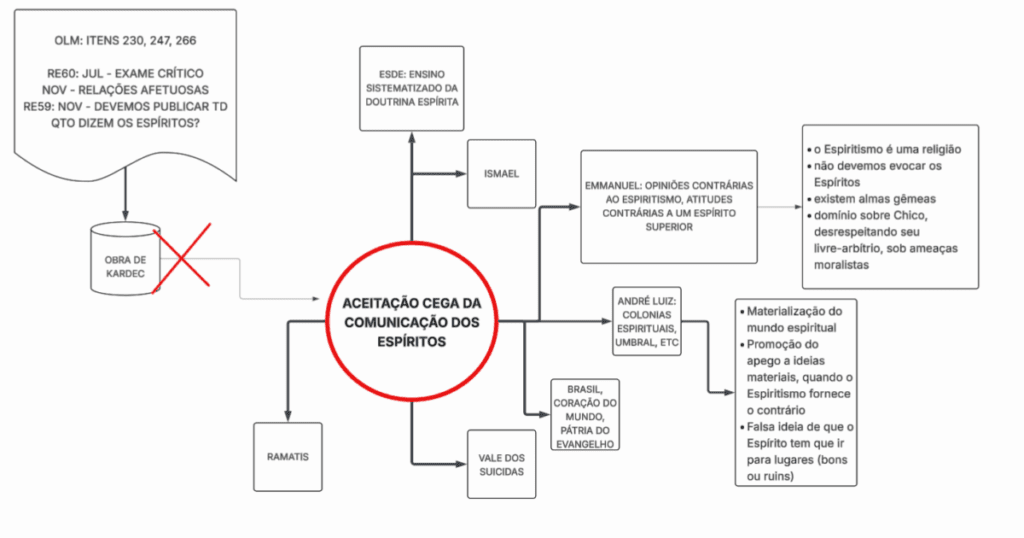
The real problem of the Spiritist Movement

Let us return to the Spiritist Movement in Kardec's time, according to the "Statistics of Spiritism" published in the Spiritist Review of 1869:

: Roman Catholics, freethinkers, not bound by dogma, 50%; ─ Greek Catholics, 15%; ─ Jews, 10%; ─ liberal Protestants, 10%; ─ Catholics linked to dogmas, 10%; ─ Orthodox Protestants, 3%; ─ Muslims, 2%.

From the beginning, the Spiritist Movement has been heterogeneous in terms of the religious origins of its participants. This has never been a problem. No one needs to renounce their religious identity to study a science. The real problem lies in the loss of unity of knowledge within that science.

With Kardec, Spiritism possessed a clear definition, well-defined principles, and a vigorous defense of its method of observation, comparison, and control of intelligent manifestations. After his death, the science was distorted, the method abandoned, and the principles betrayed. In Brazil, in particular, the name Spiritism was hijacked to designate a syncretic religion, marked by mysticism, fatalism, and mediumistic idolatry—whose “Vatican” goes by the name of the [Non-]Spiritist Brazilian Federation.

We need to stop shifting blame. The problem with the Spiritist Movement is not, in essence, Catholicism or Protestantism. The central deviation is Roustainguist. Religious dogmatism, yes, contaminated the Movement, but only because it found fertile ground within it: Spiritists who, lacking intellectual autonomy, rigorous study, and critical thinking, allowed themselves to be led by human authorities and abandoned the scientific model proposed by Kardec.

In the past, this might have been excusable, since the Spiritist Review was only translated into Portuguese in the 1960s. There also wasn't the same ease of access to knowledge as there is today. Today—and for some time now—this is no longer tenable. There is no plausible excuse other than a pure lack of willingness to study the Doctrine as it truly is, instead wasting time on systematizing ideas gleaned from NOVELS (sic!).

This is the real problem. It's not about external factors, but about the doctrinal cowardice of those who call themselves Spiritists and don't dare to study, evoke, analyze, and confront errors—as Kardec did, with courage and method—as many others also did, whether they were freethinkers, Catholics, Protestants, Jews, Muslims, etc.


The missing key to science understanding life and death

Science has made enormous progress in describing the mechanisms that keep an organism alive and those that collapse when it dies. We understand precisely how cells function, how DNA coordinates tissue formation, how proteins regulate biochemical processes, and how death leads to the degradation of these structures. But an essential question remains that still eludes purely material models:

Why does matter organize itself?

Not only as she organizes herself, but why Does it assume a functional, integrated, cohesive, and directed configuration? Physics and chemistry describe the interactions between molecules, but they do not satisfactorily explain the presence of an ordering principle that maintains this organization throughout life. Nor do they explain why this organization ceases in such a coordinated manner with death.

This is the missing key: the intelligent and organizing principle that acts on matter. And it is precisely here that Spiritism, founded by Allan Kardec, offers a decisive contribution to scientific thought.

According to Spiritism, the living organism is structured by a triad: the body, the perispirit, and the spirit. The perispirit is a semi-material covering that serves as a bridge between the spirit (intelligent principle) and the body (material structure). It is the perispirit that shapes the physical body from conception and sustains it throughout life, maintaining functional cohesion and organic identity.

With death, the spirit detaches from the body, ceasing this coordinating action. Matter then collapses not due to a random "failure," but because it lacks the element that gave it unity. Chemical reactions that were previously regulated by an intelligent principle now follow only the natural laws of degradation.

This view is not arbitrary metaphysics. Kardec proposed Spiritism as a science of observation, based on facts, experimentation, and reasoning. The hypothesis of the perispirit as a biological organizing model does not exclude the discoveries of biology; it integrates them into a broader and more coherent approach.

To deny this possibility is not to be scientific, but ideological. The true scientific spirit is not afraid to broaden its horizons when the facts of reality demand it. And the facts, both physiological and psychic, point to something that goes beyond matter: an intelligence that acts upon it.

Therefore, we say firmly:

Spiritism offers the missing key to complete the understanding of life and death. It does not oppose true science; on the contrary, it invites it to evolve beyond materialistic reductionism.

The body dies. But consciousness, and the principle that sustained the organization of that body, remain alive. This is the key. This is the spiritual science inaugurated by Allan Kardec. And this is the legacy that we must study, disseminate, and honor with seriousness, depth, and reason.


Brazil and the Illusion of the Homeland of the Gospel: The Roustainguist Chimera in the Spiritist Movement

Introduction: The frustrated promise of a spiritual mission

Brazil, with its unparalleled natural wealth and geostrategic position, has been repeatedly touted as a country of the future. However, this "future" never seems to arrive. Amid this constant expectation, a peculiar narrative emerged within the Brazilian Spiritist movement: the idea that Brazil would be the "Homeland of the Gospel." This thesis, never foreseen by Allan Kardec or the Spirits of the Codification, gained traction after the publication of the book "Brazil, Heart of the World, Homeland of the Gospel," attributed to the spirit Humberto de Campos and psychographed by Chico Xavier.
Far from representing an authentic mission or a divine promise, this idea has become an emotional and ideological crutch, used by institutions like the FEB to perpetuate their influence and keep the people in a paralyzing illusion.

The Doctrinal Deviation: When the FEB Became a Roustainguist Trench

Founded in 1884, the Brazilian Spiritist Federation underwent a decisive shift in 1895 with the ascension of Bezerra de Menezes to its presidency. A follower of Jean-Baptiste Roustaing's ideas, Bezerra promoted the integration of Roustaingist theories into the FEB's institutional practice. Roustaing advocated a mystical Spiritism, strongly influenced by dogmatic interpretations and ideas such as the fluidic body of Jesus and the infallibility of certain mediums.
These positions directly contradicted Kardec's proposal, which always advocated universal control of spiritual teachings, a plurality of sources, and reason as the criterion of analysis. The progressive replacement of rational, experimental, and philosophical Spiritism with a sentimentalist and dogmatic version created a profound split in the movement.

The mystification of the book “Brazil, Heart of the World, Homeland of the Gospel”

Published in 1938, this book became a cornerstone of the FEB's institutional mythology. The work presents a highly symbolic narrative, replete with supernatural elements and unverifiable assertions, positioning Brazil as a direct instrument of divine providence.
The most controversial passage of the work claims that Kardec relied on Roustaing's collaboration as one of the pillars of the Codification. This claim is not only false but also offensive to Kardec's memory and method. Roustaing positioned himself in opposition to Kardec, rejecting the criterion of rational examination and replacing it with a dogmatic and personalistic belief.
The recent silent removal of Roustaing's name from ESDE handouts, without any retraction or public statement, highlights the FEB's modus operandi: erasing traces of its doctrinal orientation without ever admitting its error.

The consequences of this illusion for the Brazilian people

By promoting the idea that Brazil has a pre-assured divine mission, a culture of spiritual passivity is created. The Brazilian people, already weakened by a history of inequality, corruption, and impunity, find in this narrative a justification for inaction: after all, if Providence chose Brazil, everything will work out in the end.
The lack of real moral education, as proposed in The Spirits' Book (questions 614 to 625), coupled with the absence of critical thinking and civic engagement, allows fascinated mediums and dogmatic institutions to manipulate millions. Instead of promoting the emancipation of conscience, as is the true objective of Spiritism, these practices keep individuals spiritually infantilized.

The true role of Brazil in light of Kardec's Spiritism

Kardec never singled out nations as having exclusive missions. In Genesis, chapter XVIII, item 27, he states that "great progressive movements generally operate simultaneously in various parts of the globe." The mission, therefore, is always moral, individual, and collective, never nationalistic or predestined.
The true redemption of Brazil will not come by spiritual decree, but by the work of good men, as described in The Gospel According to Spiritism, chapter XX, item 5: “The true 'workers of the Lord' are all those who place themselves at the service of good with dedication and selflessness.”
Therefore, Spiritism can indeed play a fundamental role in the moral reconstruction of Brazil, but only if it is Kardec's Spiritism — not the dogmatic, nor the manipulative.

Conclusion: Brazil can still redeem itself — but with Kardec, not with illusions

If there is a mission reserved for Brazil, it is conditional: it depends on the awakening of moral conscience, inner reform, overcoming personalism, and a return to the solid foundations of the Codification. None of this will happen with the perpetuation of myths, mystifications, or apocryphal books disguised as doctrine that, unfortunately, have long been unfairly labeled "Spiritist."
Spiritism in Brazil is at a turning point. It is up to serious Spiritists committed to the truth to distinguish between the Doctrine of the Spirits and the institutional system compromised by the past. Only then can Brazil begin to fulfill, with dignity and reason, its true role in the spiritual future of humanity.

By Marcus Vinicius


Specific Language of Spiritist Science

Did you know that most of those who call themselves Spiritists… don't know anything about Spiritism? Nor do they use the specific language of Spiritist science to explain its phenomena and concepts.

Being a spiritualist is not a matter of emotional adherence, nor of consuming supposedly “spiritualist” novels.
Being a Spiritist means seriously studying Spiritist Science, understanding its foundations and putting its principles into practice — as Allan Kardec taught.

Spiritism is a doctrine of study, reason, and observation. Replacing this science with fiction is a great harm to Spiritism. As it is a Philosophical Science it must be studied with specific scientific terms.

In Kardec's time, the Philosophical Sciences were part of the teaching.

When Allan Kardec launched his First Edition of the Spiritist Magazine in 1858, he immediately defined it in his introduction to justify its title Journal of Psychological Studies. Spiritist Science is, according to its time presented in the table above: Moral Science

As a science, its language is specific to the elements of this science so that everyone can understand each other. Terms are extremely important for the adequate communication of spiritual ideas. We see, today, a mixture of the totally materialistic science of our time in which the study of metaphysical hypotheses, for example, is ignored. Furthermore, words from one field are mixed with the other. Because of this, there is a confusion of materialist concepts mixed with the study of spiritual matters, which are also studied metaphysically.

We will give some examples of the mistaken use of materialistic terms that go unnoticed:

  1. USE PSYCHOPHONY – DO NOT USE EMBEDDING: We see many speakers or even descriptions of manifestations in so-called Spiritist texts that use the term "incorporation." Spirit is not matter that occupies a physical place. Spirit does not incorporate any body, nor does your own spirit incorporate you. The Spirit speaks through the medium through a phenomenon called PSYCHOPHONY. The medium's spirit is WITH them and does not incorporate their physical body. This point is very important to avoid creating the false idea that the medium is possessed by another spirit, or that the spirit communally takes over the medium's body, or even that the medium's spirit goes to other places while the medium is in psychophony. This does not exist in Spiritist Science!
  2. THE ACTION OF THE SPIRIT IS SOLELY AND ONLY THROUGH ITS THOUGHT: The spirit does not have a material body. According to studies of Spiritist Science, God created two general elements: SPIRIT and MATTER. Spirit has no analogue in our material world. The perispirit is matter. The material of which the perispirit is made is unknown to us, but even without knowing its characteristics, it is matter. The perispirit is not part of the spirit, just as the perispirit is not spirit. The spirit acts through and solely through thought. How exactly this happens is still unknown to us, but there are several theories in books that explain this mechanism (read Genesis, chap. XIV – The Fluids.)
  3. USE EMANATION OR PROPAGATION – DO NOT USE ENERGY: The term energy is defined in Physics as the capacity of a body, substance, or physical system to perform work. Figuratively (non-scientific) speaking, energy is vigor or moral power; philosophically speaking, according to Aristotle, it is the action of a physical or metaphysical motor (metaphysics is not considered science today) that allows the actualization of a potentiality. Note, all definitions take into account something physical acting on something physical. One of the principles of Spiritist Science is that we are an incarnate soul. If we are a soul, we do not have a body, so it cannot be energy (something physical) leaving the spirit or soul (non-physical) and arriving at a body (physical). The more appropriate term would be an emanation or even propagation.
  4. USE SPIRITDO NOT USE MIND: The mind is used in other areas of current materialist science. Some confuse the mind with the brain; the brain is an organ of the body, the brain is matter. Since Materialist Science does not admit the spirit as a hypothesis, it attributes the thinking process to the brain, but that is not what the spirits explained. According to Spiritist Science, through its observation, it is the spirit that controls the body, not the brain. The brain sends the commands. The brain is born, lives, and dies, and the spirit remains and carries with it the knowledge acquired through various incarnations. It is the spirit, not the mind, that possesses and carries knowledge. It is the spirit that thinks. You who understand the Spiritist doctrine know this and always use Spirit instead of Mind, don't you?
  5. USE “AS IF IT WERE A VIBRATION” DO NOT USE “VIBRATION” IN ITS FORM WHEN TALKING ABOUT SPIRITUAL PHENOMENA: There are hypotheses about the mechanism itself (see item 2) and only hypotheses. Using the term vibration may lead one to believe that the spiritual phenomenon is a wave as studied in Wave Physics, where it presents different types of waves and different vibrations, etc.
  6. USE PERISPIRIT – DO NOT USE GHOST: Those who study Spiritist Science know that there are apparitional phenomena that evoke these figures that impress our imagination. But they are nothing more than spirits and their phenomena, often to play with or frighten the incarnate. There's no such thing as a Spiritist being afraid of spirits!
  7. WE ARE ALWAYS IN THE SPIRITUAL WORLD: According to Spiritist Science, when we are incarnated, we live in a dual world: the world of matter and the world of spirit. When we die, we disincarnate, that is, we leave matter, but we CONTINUE IN THE SPIRITUAL WORLD. Do not use the terms “he died and went to the spiritual homeland” (He was already in the spirit world); “now he will meet his loved ones who have already died” (his loved ones are never far away. Remember that Spirits do not stay in any one place? (see item 1); “he left us”, etc.
  8. USE CAUSE AND EFFECT – DO NOT USE THE LAW OF CAUSE AND EFFECT: Causality is generally considered a fundamental principle, rather than a specific law, in philosophical and scientific contexts. It describes the cause-and-effect relationship between events, where one event (the cause) is understood as the reason behind the occurrence of another event (the effect). Causality is a fundamental principle that helps understand the nature of the relationship between cause and effect, and is used in a variety of fields, from physics and natural sciences to philosophy and law. Although causality is often referred to as the "law of cause and effect," it is not a scientific law in the sense of a quantitative, experimentally verifiable relationship, like the laws of physics. It is more of a concept or principle that describes the nature of the relationship between cause and effect. Causality is important for understanding the world around us, as it allows us to identify the causes of phenomena and predict their effects. It is fundamental to science, technology, and everyday life, as it helps us understand and interact with the world more efficiently. An example: Imagine a hunt, an animal is shot and dies. The effect is death. The cause was the shotgun blast. It wasn't a law. In Spiritist Science, Kardec used many of these principles to explain the intelligent effects of intelligent spirit manifestations. There, he explains that for every intelligent effect, there is an intelligent cause. There are countless accounts of this in his works.
  9. USE TRIALS AND EXPIATIONS – DO NOT USE KARMA: Karma and Spiritism are like oil and water: they do not mix. Be careful with people who preach the doctrine of karma within the spiritist environment, as the understanding of Spiritist Doctrine goes in the opposite direction.(click on the link to read the full explanation).
  10. USE PARKED SPIRIT – DO NOT USE RETROGRADATION: Many people mix other reincarnationist doctrines with spiritual science. According to Spiritual Science, we spirits, when we are immersed in imperfections, such as pride and selfishness, remain stuck in a loop and do not evolve. But this doesn't mean we're going back and reincarnating as animals. It just means we're stuck in the evolutionary process! A human spirit never loses the knowledge it previously had, so it will never reincarnate as an animal because of its imperfections. It simply won't progress until it repents and sincerely returns to goodness.
  11. THOSE WHO WILL REGENERATE WILL BE THE SPIRITS OF PLANET EARTH – PLANET EARTH WILL NOT REGENERATE: The planet will not change, and therefore spirits will have to evolve. There is no deadline, year, century, or anything like that. It's the other way around! The spirits on the planet will evolve. It will simply be when the majority of incarnate spirits are more evolved, no longer needing trials and atonements to evolve. One day, Planet Earth will become extinct, as any other planet will. This is the order of the material universe as we know it.
  12. USE PURE SPIRIT – DO NOT USE PERFECT SPIRIT: The ideal of perfection is God, so a spirit will never be perfect. A spirit will reach perfection relative to its evolutionary level. A pure spirit no longer needs to reincarnate to evolve because it is no longer influenced by matter. Even though they are pure, they will evolve (Law of Progress).
  13. PASS IS NOT ENERGY TRANSFER: see item 3

If you remember any incorrect expression, just leave a comment.


Why Education Urgently Needs a Spiritist Vision: What Spiritist Science Reveals About Children

Modern education has become, in many respects, a mechanical process: the main objective seems to be to prepare children for a competitive world, teaching content, technical skills, and social rules. However, this approach ignores an essential dimension of the human being—one that transcends biology, environment, and the present.

The Spiritist Doctrine, the fruit of the methodical work of Spiritist Science, reveals a transformative truth: a child is not born blank. She is not simply a product of her environment, nor a blank slate ready to be filled with instructions. Each child is an immortal Spirit, with a past, with achievements, with moral challenges and natural aptitudes that she already carries with her even before opening her eyes to the earthly world.


🕊 The Child as a Reincarnated Spirit: A New Educational Perspective

While materialistic pedagogy focuses only on hereditary and social factors, Spiritism demonstrates that there are deep spiritual roots behind each child's tendencies.

Why can a child, even when raised in a loving environment, exhibit selfishness, vanity, jealousy, and pride?
Why is it that another person, even under adverse conditions, demonstrates patience, generosity, and empathy?

The answer lies not only in DNA or environment: it lies in the past experiences of the Spirit. It reincarnates to advance, to correct its imperfections, to develop virtues. And childhood, as Spiritist Doctrine teaches, is a phase of plasticity, in which old tendencies are dampened and the Spirit is more receptive to moral guidance.


🌱 The Role of the Educator: Much More Than Instruction

When education is limited to providing information, content, and techniques, it creates automatons prepared for the market, but not for spiritual life.

The true role of the educator, in the light of Spiritism, is to assist the Spirit on its journey. This means:
✅ Help the child recognize their negative tendencies and work to transform them;
✅ To value and channel for good the aptitudes and skills she already possesses from past lives;
✅ To offer not only intellectual instruction, but also moral formation, which remains with the Spirit beyond this existence.

As Allan Kardec observes (The Gospel According to SpiritismMoral education is the key to the progress of humanity. It is not enough to change laws or social structures; it is necessary to transform individuals, one by one, starting from an early age.


💡 Without spirituality, education becomes impoverished.

The absence of this spiritual perspective in education generates several consequences:
🔹 Children treated as learning machines, and not as evolving Spirits;
🔹 Lack of understanding about the emotional and moral challenges that arise in childhood;
🔹 An excessive focus on academic performance, neglecting the cultivation of virtues such as patience, empathy, responsibility, and solidarity.

The Spiritist perspective is not merely a "religious addition"—it is a profound revolution in the way we understand human beings and, therefore, in the way we educate.


🌟 Educating for Eternity: An Urgent Mission

By adopting an education inspired by Spiritist principles, we are not talking about catechism or religious indoctrination. We are talking about:
✨ To see the human being in their entirety — body, mind, and spirit;
✨ Understanding that a child's greatest asset is not their grades, but their moral achievements;
✨ To help each little being grow as a free, conscious, responsible Spirit, capable of loving and working for the common good.

True education prepares you not just for a profession, but for life. for this life and for all the lives to come.


Fall into Sin: The Greatest Lie Ever Told to Humanity

The idea of the "fall into sin," coupled with the dogma of eternal hell, constitutes one of the greatest mental constructs of control, fear, and alienation ever imposed on humanity. From the perspective of true Spiritism—which is based exclusively on the works of Allan Kardec, structured as a science of observation of spiritual facts—this conception is unmasked in its philosophical, moral, and logical foundations.


  1. The Dogma of the Fall: A Guilt-Based Origin Myth

The myth of the "fall"—present in various religious traditions—is based on the idea that the Spirit was created perfect but fell through disobedience. This implies that human pain, suffering, and imperfections are divine punishments, consequences of original sin.

Kardec categorically rejects this idea. In The Spirits' Book, especially in questions 115 to 121, he demonstrates that spirits are created simple and ignorant, and that evolution is the result of a progressive, natural, and rational process, not punishment. There is no "fall": there is education and ascension. Initial ignorance is not a fault; it is a starting point.


  1. Hell: a moralistic construction based on fear

The dogma of eternal hell is even more cruel. It not only limits freedom of thought but also crystallizes error and eternalizes suffering, denying divine justice and mercy.

Kardec combats this notion in Heaven and Hell, demonstrating that there is no eternal punishment. Divine justice is proportional, educational, and regenerative. The Spirit suffers, yes, but it suffers because of its own moral inferiority, which persists as long as it remains. Suffering is temporary, didactic, never eternally punitive.


  1. The false spiritualization of punishment: karma, law of return, action and reaction

In true Spiritism, there is no place for ideas such as "karma," "law of action and reaction," or "law of return," because such concepts imply an automatic, almost mechanical justice that depersonalizes the Spirit and transforms spiritual life into a mechanism of punishments and compensations.

Kardec proposes another logic: moral freedom and progress through conscious effort. The consequences of actions are not externally imposed punishments, but natural results that offer the Spirit the opportunity to understand, grow, and overcome its limitations. This is a moral pedagogy, not a cosmic accounting.


  1. The perverse effect of these dogmas: reinforcing deviation and preventing evolution

When someone is taught to believe they are born guilty, stained by original sin, or will suffer eternally for their failures, they internalize fear and, often, hopelessness. Instead of encouraging transformation, such ideas solidify error. They come to believe they are inherently bad, unworthy, and lost—and thus justify their own deviations or become complacent.

Spiritism proposes the opposite: the Spirit is perfectible. It is free to choose, learn, make mistakes, correct, love, and evolve. There is no eternal guilt, but continuous responsibility. There is no hell, but inner states of suffering or peace, as the conscience becomes enlightened.


  1. Conclusion: Spiritism liberates, it does not condemn

The greatest liberation that true Spiritism offers humanity is this: the destruction of the shackles of guilt and fear, replaced by the light of reason and confidence in progress. We have not fallen from paradise: we are ascending, step by step, from ignorance to wisdom, from imperfection to virtue.

We are not condemned for existing: we were created to evolve. This is Kardec's great legacy.


No one becomes a Spiritist by mere adherence (nor by reading novels)

Did you know that most of those who call themselves Spiritists… don't know about Spiritism?

Being a spiritualist is not a matter of emotional adherence, nor of consuming supposedly “spiritualist” novels.
Being a Spiritist means seriously studying the Spiritist science, understanding its foundations and putting its principles into practice — as Allan Kardec taught.

Unfortunately, even famous speakers repeat nonsense that is not in the works of Codification.
See a list of false ideas commonly spread, but totally incompatible with true Spiritism:

You cannot practice mediumship outside the center (yes, you can).

You cannot evoke Spirits (you must evoke, as Kardec taught).

Accept communications without reviewing them (never do this!).

Our Home and threshold exist (they don't exist; they are literary creations).

A pass is a transfer of energy (it isn't; there is no such thing as "fluidic energy" as commonly understood).

All sufferings are expiations caused by guilt (they are not; there are tests, missions and current causes).

The FEB defines Spiritism (it does not define; it often moves away from it).

Physically disabled people were born that way because of… in their previous life (this is false and dangerous).

The perispirit stores damage to be repaired in future lives (false; the perispirit does not store physical "damage").

Recommending novels to newcomers to learn about Spiritism (this should not be done; novels generate false ideas).

And so it goes…

Spiritism is a doctrine of study, reason and observation.
Exchanging this science for fiction is a huge harm done to Spiritism.

If you want to know true Spiritism, without distortions:

Visit the website of the Study Group The Legacy of Allan Kardec

Start studying now based on the original works, without distortions.


Closing of an Era: Reflections on the Death of Divaldo Franco

The death of medium Divaldo Franco marks the symbolic end of an era in the Brazilian Spiritist movement—an era in which renowned mediums were elevated to the status of Spiritist leaders. But it must be stated clearly: this role was never theirs.

Divaldo Franco, as an incarnate spirit, certainly did good. On many occasions, he positioned himself correctly regarding the Spiritist Doctrine. However, his work—like that of any medium—needs to be analyzed in the light of reason and compared with the principles established by Allan Kardec. Unfortunately, several of his works deviate from these foundations, often adopting ideas linked to Roustainguism and to the karma, concepts that do not belong to the doctrinal structure of Spiritism.

It is important to emphasize: one does not “return” to the spiritual worldWe never leave it. We are incarnate spirits, and the material world is merely a transitory expression of spiritual reality. This point, so often simplified or distorted, needs to be rediscovered in its depths.

No More Idolatry

The Spiritist movement urgently needs to abandon its idolatry of mediums. Famous names are accepted uncritically, and their psychographies are published by the hundreds, without any rigorous doctrinal examination. Spiritism, being a science, demands... constant critical examination — and this examination cannot be waived on account of the fame or supposed moral elevation of the person who writes or transmits a message.

Let's be blunt: many of the communications attributed to higher spirits by Divaldo and other mediums don't stand up to rational analysis. Some are well-intentioned but reproduce earthly ideas. Others are hoaxes. The difference between them can only be discerned through serious study, reasoning, and the practice of conscious and judicious evocation—exactly as Kardec taught.

Alert: The Scramble for Vacant Space

With Divaldo's departure, the symbolic space it occupied will be vacant —and this is where we need to pay extra attention. Some mediums, already well-known for their supposed "letters from beyond," filled with emotional clichés and doctrinally poor, will certainly try to occupy this position.

Discernment is required. These letters, which comfort without enlightening, move without instructing, and repeat clichés and banal ideas, are the opposite of Allan Kardec's proposal. They represent a sentimentalized, moralistic Spiritism disconnected from serious investigation. We cannot allow Spiritism to continue to be shaped by this type of superficial mediumship.

It's Time to Reclaim True Spiritism

The Spiritist Doctrine does not need leaders. It needs Spiritists committed to the method of rational investigation of spiritual phenomena, with the active evocation of Spirits and with the meticulous examination of messages. Kardec showed us this unequivocally.

For those who wish to better understand this model of collaborative organization, we recommend two fundamental texts from Spiritist Magazine, both by Allan Kardec:

  • December 1861Organization of Spiritism
  • December 1868Transitory Constitution of Spiritism

True Spiritism is practiced online, by everyone, methodically, critically, and with reason. The time has come to leave myths and idols behind and return to the path laid out by Kardec—without detours, without sycophants, without "letters from beyond" recycled into books that merely repeat what the world already knows.


The FEB and its continuous attempt to manipulate the Spiritist Movement

The Brazilian Spiritist Federation, a Roustainguist organization practically since its inception, has always deliberately manipulated the Spiritist Movement, distancing it from the true Spiritism codified by Allan Kardec. I've already discussed this institutional deviation in a previous article.

We know well (and if you didn't know, now you do) that the FEB was taken over by followers of the dogmatic Jean-Baptiste Roustaing starting in 1895, when Bezerra de Menezes—also a supporter of Roustaingist theses—assumed its presidency. From this doctrinal appropriation emerged one of the greatest aberrations ever seen in the Brazilian Spiritist Movement: the book Brazil, Heart of the World, Homeland of the Gospel. This is a work clearly inspired by a mystifying Spirit — probably Ishmael — which served as the basis for the formulation of the “Golden Pact” and, later, for the creation of the ESDE (Systematized Study of the Spiritist Doctrine), a program that is completely permeated by the distortions of Roustainguism.

In the ESDE handouts, more specifically in chapter 4, we find a quote from this work (psychographed by Chico Xavier, under supposed spiritual authorship of Humberto de Campos), which I transcribe below with the appropriate emphasis:

[…] This is how Allan Kardec, on October 3, 1804, saw the light of the Earth's atmosphere, in the city of Lyon. According to the work plans of the invisible world, the great missionary, in his marvelous effort of synthesis, would count on the cooperation of a host of assistants in his work, designated specifically to assist him, in the individualities of John Baptist Roustaing (Jean-Baptiste Roustaing), who would organize the work of faith; Léon Denis, who would carry out the philosophical unfolding; Gabriel Delanne, who would present the scientific path; and Camille Flammarion, who would open the curtain of the worlds, drawing the wonders of the celestial landscapes, thus cooperating in the Kardecian codification in the Old World and expanding it with the necessary complements.

This statement, in particular, is factually false. Roustaing was not only not Kardec's assistant, but he also placed himself in clear opposition to genuine Spiritism, especially due to his rejection of the scientific methodology that underpinned Kardec's work—a point that represented the true Achilles' heel of his mystical and doctrinally fragile writings.

Recently, when trying to show this distortion to a friend, I realized that volume I of the ESDE had been “revised,” and the above quote had been modified: Roustaing’s name was simply removed from the excerpt, as if it had never been there.

An attempt shameless to erase its Roustainguist roots without, however, publicly acknowledging the doctrinal deviation or giving any sign of returning to the right path. This is the FEB: always operating behind the scenes, trying to control the Spiritist Movement and maintain its influence, just as the Catholic Church did with Christianity over the centuries.

Make no mistake: the FEB remains a Roustainguist. It continues to reject the evocation and rational examination of spirit communications—practices essential to Kardecian methodology. It continues to attempt to control mediumship according to its own dogmas, limiting it to the molds of its centers (Roustainguists, although they call themselves "Spiritist"). And it remains silent when it should stand up in defense of the true Spiritist Doctrine.

The FEB, my dears, can only be considered legitimate when, publicly and unequivocally, assume your deviation and recognize the historical error committed. Not before. Never before.


Dialogues from Beyond the Grave – Evocation – Marcos, the Repentant Spirit

At the previous meeting, the group had some questions about healing. It was decided that we would ask the good spirits to help us with our doubts. A spirit came spontaneously to answer these questions. At the end, we asked him what he needed. He told us he needed prayers because he had made many mistakes and regretted them after his last incarnation. We prayed to him, and he said goodbye.

In this meeting, after preparing some questions, we decided to call on you to better understand your situation. 

Here is the communication. 

Evocation. 

1. We want to welcome you to our group, dear brother, with all affection. We want to talk to you, to learn, to educate ourselves, and, if possible, to help you with something you need and for you to help us with something we need. Our intention is very legitimate, and we will not judge you. We are here to talk as friends, as brothers.

A: I appreciate your prayers for me. They were very helpful.

2. Friend, could you tell us what was your motivation for communicating with us last time?

A: Just the need for prayer. People forget about me.

Note: This isn't the first time we've seen a Spirit lament this. Indeed, no one wants to be forgotten, but the Spiritist Movement, absent from the studies of Spiritist science, no longer practices evocations due to various false ideas. It stops helping and learning, and such is the dominance of untruths that some go so far as to not praying for the Spirit, believing that this would be a hindrance. In this sense, large channels, so-called Spiritists, but also ignorant of Spiritism, collaborate in the dissemination of these false ideas.

3. What happened to make them forget about you?

A: It's been a long time since I passed away. Those I loved are no longer physical bodies. And I couldn't find them anywhere. Today, through your prayers, I can visualize those who were with me in my physical life. This is comforting.

4. So you mean to say that until they went to their spiritual homeland you had no contact with them?

A: No. I tried. But they wouldn't listen to me.

5. And when you saw them, what was it like, did they come, did they contact you, or did you contact them? What was it like?

A: They. They arrived. My wife, my mother, my father. My father Alberto, my mother Eliza, my wife Helena.

6. And your name?

A: Marcos.

7. Marcos. You said last time that you regretted the things you had done. We don't quite understand what happened, so if you feel free, can you tell us what happened? It would be interesting because we could understand you better and we could learn more.

A: There was a lot of fighting. Money. Greed. I robbed many people. I put my family in a bad situation. They suffered because of me. I left them to fend for themselves because of money.

8. And you were before all of them? Did you pass away before all of them?

A. Yes. It was an accident. I have trouble remembering.

9. It's okay, brother. If you feel like talking, Marcos, you can. We're not forcing you, it's okay. When did you enter? When did you realize you had died, that you had passed away? And how did you feel?

A: Alone. I had the darkness.

Note: Here we notice how necessary it is to ask objective questions, one at a time. This isn't the first time we've noticed the Spirit focusing only on the last question.

10. So the environment you were in, you couldn't decipher, everything was dark.

A: No. It is. It was dark. I couldn't see, I couldn't see anyone.

Note: this fact, which we were unable to delve into further at the time, reminded us of the article “The Spirit of a Damned Man” in the Spiritist Magazine of February 1860.

11. And how did you manage to get out of that darkness? What was that process like? That it was an achievement, right? That you achieved it, Marcos? If you'll allow me to call you that, right? Allow M. and I to call you that.

A: Yes. Yes, it was.

Note: The interlocutor asked several questions. The Spirit focused on a simple answer.

12. How did you manage to free yourself from this? What was it like?

A. I saw first. I didn't see, I heard some voices. I heard my wife's crying, my father's lamentations, but my mother's love... My mother began to appear to me. And it was then that I began to understand what had happened.

13. Marcos, did you hear your mother praying for you?

A: Yes. She called my name and she prayed.

14. Just as you listened to our prayers, did you listen to your mother's prayers or was it different?

A: It was different. She had and still has a love that I don't know how to understand.. It's grand. She made me see a little of the light from where she is. It moved me. So I listened.

Note: This probably has a lot to do with spiritual magnetism. Your mother's spirit has a deeper connection with him, which should make it easier for him to register her. This is how those who have a greater connection with certain individuals will have a greater capacity, even in the physical world, to assist them with prayers and dialogue in overcoming difficulties, returning to goodness, etc.

15. From these prayers of your mother?

A: Yes.

16. During your mother's prayers, you began to feel more comfortable. And then you were able to better see your companions around you? How was it? Could you explain this part better, Marcos? How did you overcome all of this?

A: Yes. I don't know if I've gotten over it. I still feel guilty.

17. Yes, but you've already taken a big step, haven't you?

A. Yes. I still feel a lot of guilt, but with that love, she opened a path for me, and the darkness started to leave, it started to go away. She showed me where I was and what I had to do.

18. Can you be a little more specific about what you said, what I "had to do"? How did she instruct you, what were her instructions?

A: Ask God for opportunities to grow. Ask God to show me how to reach Him. I saw other spirits approaching me, calming me, and telling me how to become a better person. I am seeking forgiveness from those I have harmed. I'm trying to forgive myself for the mistakes I've made. Every day some spirit approaches me and encourages me, shows me what forgiveness is like. He takes me to different places, where I can see and feel what love is and what forgiveness is..

Note: This is not the only Spirit who speaks to us about the idea that in the Spiritual world they learn by example, and not by readings. They are led to follow other cases, to assist and be useful. This is the reality of the Spiritist world.

19. This has helped you, these “visions,” and these “hearings,” have helped you understand better.

A: Yes, yes. But I'm not ready yet. I still need more faith, maybe.

20. The conversation you, Marcos, had with us last time and this one you had now is the first time you have been able to talk in a meeting like ours, a mediumistic meeting?

A: Yes, yes.

21. In this disincarnation of yours?

A: Yes. I didn't know what that was like.

22. Who brought him to us?

A: The spirit that accompanies me. I think… I think he is always here with you.

23. Yes. Who? And now he's here with us too?

A. He knows everyone.

24. How many are there, Marcos?

A: The one that accompanies me. There are 3 more... 4. But there are others too. The 4 that have the most light are.

25. I wanted to understand, my brother Marcos, in what environment you were while you were unable to see the light, do you remember?

A: It's space! Big, but it's dark.

26. Were you unable to see any region, any house, any place?

A: No. No. Just dark, just darkness.

27. Brother! Marcos! In the name of our Lord Jesus Christ, I would like to thank you for the message, and may the good spirits always guide you. May you always feel welcomed here in this space of ours, and may you be able to forgive yourself, because the most important thing is to forgive yourself for the things you've done. Oh, I would like to know if you have anything else to say to us for our instruction, for our better understanding of the doctrine, or so that we can help you better or even more.

A: I just want to say thank you for your prayers and for the opportunity to be here, for your hospitality, for not judging me for what I did. And they say that you are gathered here and that more messages will come soon—messages, I think. Instructions. But they pray for you too and are with you. I need to go.

NOTE: The group is in a development phase, and returning to this practice is a novelty for mediums from the Spiritist Movement, which does not engage in dialogue with spirits. This causes them certain difficulties, which will be overcome with time and practice. For this reason, inaccuracies are normal, but since the dialogue contains nothing that merits special attention beyond the analysis we have already conducted, we present it with the aim of encouraging others to resume these dialogues.

Our group meets online, via video, each from their own homes.