Manifesto for the Rescue of Spiritist Science: The Awakening of Truth
True Spiritists, the time has come to awaken.
It is time for us to unite and walk upon the ruins of an old world. It is time to tread upon the rubble of obsolete ideas, concepts that imprison, and distortions that mask the truth. Progress calls to us, and to reach it, we must leave behind everything that has prevented us from seeing the light of reason.
For decades, the so-called "House of Ishmael" has infiltrated Brazil, adorning itself with the trappings of the Spiritist movement to, in reality, destroy the true understanding of Spiritism in Brazil and throughout the world. Enough of false ideas. Enough of blind faith, idolatry, and perverse distortions. The time is over for us to witness all this with hypocritical "compassion," in the name of a false charity that cannot stand up to the truth. We will no longer tolerate the ideas of Ishmael, echoes of Roustainguism, annihilating the essence of Spiritism.
Stand up! Form groups! Unite!
We need harmony and unity, but make no mistake: we are not seeking forced “unification” based on the lies propagated by the FEB (Brazilian Expeditionary Force) since 1895. What we need is... collaboration.
The way back is clear: resume the rigorous study of Allan Kardec's works. Kardec's legacy is our only secure foundation. When you have mastered the science of Spiritism and feel the time is right, resume your mediumistic practice—but do it as it should be done: with rigor, seriousness, and above all, with... critical and comparative examination of all communications, without exception.
The“false angel Ishmael”"It only managed to dominate because we remained silent. Shamefully, many of us abandoned Spiritist science and renounced the monumental work recorded in Kardec's 23 books. We preached that Spiritism was not a doctrine of blind faith, but we blindly accepted everything that was published in the last century, from the Sayão group to Ismael's narratives.".
This era of silence is over. The story will no longer remain hidden. The world needs to understand why Chico Xavier himself eventually distanced himself from the FEB (Brazilian Spiritist Federation). The time when Herculano Pires' warnings were confined to inaccessible books and magazines is over.
The truth about the House of Ishmael will be revealed: a mystifying, fascinated, and observant spirit who found free rein in 1895 to dominate the Brazilian Spiritist Federation. From within, they implanted a dogmatic, dark, and archaic vision, transforming Spiritism into a disgrace to itself. They toppled the central pillar of the doctrine—reasoned faith—to impose obedience. Today, the FEB claims that critical examination is unnecessary because the messages already come "filtered" by chosen spirits.
Even more serious is Ishmael's legacy and RoustaingThe aberrant idea that reincarnation is a punishment and that only those who have erred are reincarnated. This imprisoning lie transforms life, which should be a blessed school of learning, into a sentence of punishment. To sustain this system and blind the faithful, they created the "Star Mediums"—untouchable oracles that serve as shields to prevent any questioning.
Spiritism has never been a religion.
What they created in Brazil was a disguised Rustangist religion, a movement so fanatical that it is capable of silencing and excluding anyone who dares to present Kardec's works to prove the errors of the FEB (Brazilian Spiritist Federation) positions and their careless novels.
But we warn you: this dominion is numbered. Truth is the only force capable of destroying, slowly and gradually, the Ismaili and Febian contamination. Until nothing remains but memory or an isolated and irrelevant religion.
Let us reclaim Spiritism from the ruins.
Click the link in our bio, visit our website, and join our study group: Allan Kardec's Legacy.
The truth will set you free.
Kardec's communication in another group
In May 2026, we received a very interesting mediumistic communication from N…, from Pernambuco, attributed to the Spirit of Allan Kardec, which occurred spontaneously in one of our partner groups:
Dear friends and brothers, the one who communicates with you has already been through and experienced all these labors firsthand. Continue steadfast and strong with the work. This work is a force united in minds that cannot stop; many attempts have already been made. If there is doubt in the message, use the universal criterion of the spirits: submit yourselves to asking, be persistent, and do not accept that the message comes from a single source, for, if so, my brother, it is nothing more than a simple opinion. I have already said and I say again: you are being advised. Our brothers in the spirit world have also committed themselves to assisting you. Your head and unwavering faith have kept strong the doctrine that is not ours, it is from the spirits; we are only the maintainers. Hippolyte?
Having found nothing to discredit in her, we have only reinforced what the Spirits themselves say: that their efforts do not cease, that the time for resumption has arrived, and that the Spirit of Allan Kardec assists us all on this journey.
Spontaneous Communications on the Resumption of Spiritism
In the mediumistic meeting of May 19, 2026, we questioned the mystifications that occurred in our group when we attempted to evoke the spirit of André Luiz, as well as another time when we attempted to evoke the spirit of Chico Xavier. We wanted to understand the reason for these mystifications, honestly seeking the help of superior spirits capable of enlightening us, and we ended up receiving two very instructive communications through different mediums. As you will see, we concluded that the purpose is much deeper and that, in one way or another, such evocations would not be of great benefit to us. Deep down, we wanted to prove to ourselves that it would be possible to perform such evocations, as if that would give us more certainty, but we ended up being blessed, from the very beginning. communication with Kardec, with serious and profound communications, which bring us much more certainty of the purpose that unites us, as well as the assistance of Spirits who, seeing our honest effort, have the charity to help us, as children that we still are on this journey.
Neophilis
It's great to be with you again, my brothers. I haven't communicated here before because it wasn't the right time, but I observe the work of this group. You are well assisted by excellent brothers. This will help in your work. Have courage and strength. Remain firm in your purpose. May we always have the good will to be an instrument of good spirits. And you already have that good will. That's beyond doubt.
It is necessary to be on guard against the mystifications that seek or are attempting to hinder, delay, and somehow cause this work to regress. But, with the help of those who are here, with reasoning, logic, and common sense, this will not happen. frequently. The good brother said: it is evident that tests will happen. Do not be saddened by this. The work is serious. The work will help in this recovery. We must never waver. Never stray from the proposal. Courage! Always remember that good spirits assist those who truly want to work and do what is right, without personal interests, without personal gain.
Your love for this project is evident from here. You are not alone, you have never been alone! You are not alone, just as the codifier was not. The spirits of all who love this work, who advise and guide you, are always by your side. There is no doubt that the time has come when the truth will return to its rightful place. There is no more room for lies; there is no more room for deviations. Nothing This will halt the great march that is the march of Spiritism, the march of the third revelation. The works are readily available; let us meditate on this with love and respect, within our capabilities. Others will come to help you in this beautiful endeavor. That is all I have to say.
Ari
Brother, those are beautiful words, I was moved. Could you please tell me your name?
My name is Neophilis
Note: This is not a well-known name. We believe this was intentional.
Ari
Neophilis, it's a pleasure to have you here with me. I was very touched by your words. Thank you so much. I am not worthy of all the beautiful words you brought to us.
Neophilis
I brought only the message from the brothers. I was graced with these words. We are here, do not be afraid. We hold your hand. Preserve confidence, faith, and respect. The Spiritist codification is a treasure for this world, a treasure without equal. How healthy it would be for imperfect spirits to meditate sincerely on what is written in its lines… To observe with love and practice the law of justice and charity… They would not lag so far behind, they would not cry so much, they would not groan so much after their entry into the spirit world. If they observed the codification, they would suffer less; if they loved, if they followed Christ, they would suffer less. To love is to study; to love the Creator, to follow Christ, is to study. Charity, for outside of charity there is no salvation. I leave you, but I repeat: you are not abandoned, not at all. You are supported by many who love you and who will help you carry the burdens that you often consider heavy. They are heavy, because of your physical body, in your view, but remember: the Spirit is free. You are spiritualists: maintain faith in everything that has been passed down to you, always with reason and common sense. This is the message I leave with you.
May God be with you.
ObservationHow much emotion these words stirred in us! The observations of this Spirit regarding the knowledge of Spiritism are more than justified; if it had not been hindered by so many distortions, it would have spared so many tears. The words "to love is to study; to love the Creator, to follow Christ, is to study" reflect the purpose of Spiritism, for, as a scientific doctrine, it provides practical understanding and fulfillment of the words of Jesus, taken by Spiritism as the greatest example of morality, but not the only one, and not as a religious leader. Finally, the words "you are Spiritists: maintain confidence in everything that has been passed on to you, always with reasoning and common sense" reflect the position of one who recognizes themselves as a Spiritist: confidence in good Spirits, attracted by the serious purpose of good, but without ever failing to examine all communications, without exception.
A friendly Spirit of codification
Dear brothers and sisters, to you who are gathered here, in this new form of communication, I have come to offer you my comfort and my assistance in this work to which you are dedicated. I am just one more here, among so many who surround us, and it is through them that I bring you a vision that goes a little beyond the one you possess.
I can say that, soon, at least two more groups will join you. Each of them will bring messages similar to those you have already received from Master Kardec, and this will show all those who still doubt that he has always been present, waiting for the moment to return and guide everyone once again, showing the path that Spiritism should follow. (Note that there is no exclusivity regarding our group. It will guide everyone, not just us.) He himself will tell you, at the right time, how you should proceed. Consider this not a privilege, but an opportunity to resume the paths he opened and which will continue to widen from then on. The struggle is not only yours; it is ours.
Search in Kardec's foundations, and there you will find the principle of all truth, which even the blind will be able to see. Beware of personal agendas and vanities. Beware of those who minimize the problems created in this last century surrounding true spirituality.
There will always be detractors, those who, with the pose and air of professors, insinuate themselves as great sages, possessing a false sense of certainty in their words. A useless verbiage in the face of truth, which cannot be erased by false arguments. They place themselves on pedestals, in grand pulpits, as if they could be, or become, better than those who listen to them.
Those who called themselves prophets of Spiritism spread, those who, with money, bought silence, contaminated the Gospel, contaminated the works, without considering the harm and consequences of what they did. Driven by vanity, by greed, driven by pride, throwing mud on our teachings. Our compassion for these souls is infinite. We see their repentance. However, those who are still in the material world will take with them, when they arrive here, much more than repentance. To them also, our compassion.
But folded arms don't build a building. We are all here offering the foundations., But the foundation must be solid, the ground must be favorable, or our efforts and yours will fail.. Build, then, this new house and, through it, show everyone the importance of learning and communication. Without this, we will not achieve our purpose.. (Our highlights.)
Do not ask for my name at this time. I will communicate with you again at an opportune moment. Keep hope alive, and you will soon see many of the lies being spread crumble, because the building has no foundation and no ground.
Trust, persevere.
“"The True Face of Spiritism": an expectation proportionate to the accusation.
Project preparation “"The True Face of Spiritism"”, The announcement by the Dom Bosco Center naturally raises expectations. And this expectation is directly proportional to the seriousness of the announced proposal.
If someone sets out to reveal the "true face" of an entire doctrine, especially a doctrine built upon extensive written work, comparative methods, and systematic investigation, then an equally extensive, rigorous, and intellectually honest effort is expected.
In the case of Spiritism, this means a serious analysis of the 23 works by Allan Kardec that comprise the fundamental body of Spiritist science. Not isolated fragments, phrases taken out of context, criticisms directed at the modern "Spiritist movement" as if this automatically invalidated the doctrine organized by Kardec. The target of the criticism, if the book's title intends to be intellectually consistent, needs to be the original doctrinal structure.
Therefore, we eagerly await the publication of the work.
We expect to find in it nothing less than a broad, rational, and documented demonstration that, throughout these works, Spiritism teaches something objectively evil. Something contrary to good, to morality, to human elevation.
A clear demonstration is expected that Spiritism:
Encourage selfishness;
Discourage genuine charity;
promote cruelty;
encourage material attachment;
foster pride;
Destroy moral responsibility;
Legitimize hatred;
Encourage exploration of others;
lead people into moral vice;
despise human brotherhood.
Because that is precisely the level of proof required when accusing a moral doctrine of possessing a dark or perverse "true face," as the Dom Bosco Center insists on maintaining.
The accusations are simple. The difficulty has always been to substantiate with documentation that a doctrine whose moral foundation continually insists on charity, responsibility, and moral improvement is, in essence, something contrary to good.
There is yet another distinction that is frequently ignored: it is one thing to criticize practices, exaggerations, mysticism, personalism, or distortions present in sectors of the modern Spiritist movement. It is quite another to demonstrate that the Kardecian codification, in its original structure, possesses a negative moral essence.
Confusing these two things is a basic logical error. It would be equivalent to judging a scientific theory solely by the deviations of some of its adherents, without examining its foundations.
Furthermore, any intellectually serious critique of Spiritism would need to confront an unavoidable historical point: Allan Kardec did not present Spiritism as a personal creation or individual revelation. Kardec himself repeatedly insisted that Spiritism was a set of observed facts, methodically organized through the universal comparison of teachings attributed to spirits. Whether one agrees with this premise or not, honest criticism must first correctly understand what it intends to refute; otherwise, the debate ceases to be analysis and becomes mere caricature.
Therefore, the expectation surrounding “"The True Face of Spiritism"” It is legitimate. Such a strong title demands proportionally solid content. If the book truly addresses, in a comprehensive, documented, and contextualized manner, the 23 fundamental works of Spiritist science, then it will have produced something relevant for the debate of ideas. But if it resorts only to excerpts, simplifications, emotional associations, peripheral episodes, confusion between doctrine and movement, or rhetorical attacks without a global examination of Kardec's work, then it will end up like all the others: falling into ridicule. We await further developments.
Spiritism and Marxism: Fundamental Incompatibility and the Contradiction of the "Communist Spiritist"“
How can one defend charity, free will, and individual moral reform while advocating class struggle, violent revolution, and the dictatorship of the proletariat?
Introduction: An Unsustainable Paradox
Lately, a curious and, from a doctrinal point of view, profoundly contradictory phenomenon has been observed: people who declare themselves adherents of Spiritism while simultaneously defending and propagating the tenets of Marxism, communism, and other currents of social reform based on class struggle and violent revolution.
This article does not intend to discuss personal political preferences. Its sole purpose is to demonstrate, in light of the fundamental works of Allan Kardec, that such positions are... doctrinally incompatible. This is not a question of "left" or "right," but of an ontological, ethical, and methodological antinomy, where defending one system is, by definition, denying the other.
As we have summarized: Marxism seeks to impose a social reform based on materialism and utilitarian good through force and violence. Spiritism, on the contrary, is based on free will, inner reform, and charity as a transformative force. One thing cancels out the other.
The Ontology of Conflict — Matter vs. Spirit
The entire theoretical edifice of Marxism rests upon... dialectical materialism. For Karl Marx and Friedrich Engels, as expressed in Communist Manifesto, Ideas, morals, religion, and human consciousness itself are a superstructure — a reflection of the material relations of production and the interests of the ruling class.
At the Manifest, They are categorical:
“Your own ideas are products of bourgeois relations of production and property, just as your right is merely the will of your class elevated to law.” (p. 46)
For historical materialism, man's consciousness is determined by his material social existence. Man is, in his essence, an economic and class-based being. There is no immortal soul, no pre-existent Spirit; there is only matter in motion and consciousness as its reflection.
The Spiritist Doctrine, in turn, was born as the the declared antithesis of materialism. Allan Kardec is emphatic in stating, in the Introduction of The Book of Spirits, ...that one of the missions of Spiritism is precisely to combat materialism:
“By destroying materialism, which is one of the scourges of society, he makes men understand where their true interests lie.” (The Spirits' Book, Chapter VIII, item 799)
For Spiritism, man is, above all, a incarnate spirit — an immaterial, intelligent being that pre-exists the body and survives it. The answer to the question “What is the soul?” is straightforward: “An incarnate Spirit” (The Spirits' Book, q. 134). Consciousness, morality, and thought are not mere reflections of matter; they are attributes of the soul, which is the cause, not the effect.
Therefore, the first major contradiction of the "communist spiritualist" is ontological: How can one construct a worldview upon the negation of that which is the central pillar of one's own belief? Marxist materialism denies the autonomous existence of the Spirit; Spiritism exists to prove it. One negates the other.
The Engine of History – Class Struggle vs. Individual Moral Reform
For the Communist Manifesto, The engine of history is... class struggle. The work opens with the famous statement:
“"The history of all hitherto existing society is the history of class struggles." (p. 29)
Modern society is irremediably divided between "bourgeoisie and proletariat," and social progress only occurs through conflict, exploitation, and ultimately, revolution. The emancipation of the working class "must be the work of the working class itself" (Manifest, p. 20; 1888 preface, p. 14), in a collective, antagonistic, and inevitable movement. The solidarity that Marxism preaches is the class solidarity, which is defined in opposition to another class.
According to Spiritist Doctrine, the true driving force behind social transformation is... moral reform of the individual. In his Spiritual Journey in 1862, Kardec analyzes the utopian socialist systems of his time (such as that of Robert Owen) and points out the reason for their failure:
“What they lacked was not numerous arms, but solid hearts. […] Their mistake was wanting to build a building starting from the roof, before laying solid foundations.” (Spiritist Journey, pp. 37-38)
And what is the solid foundation for Kardec? The inner transformation of the human being. It is no use modifying institutions if man remains selfish, proud, and avaricious. As he himself states in the same discourse:
“"Without charity, there is no stable human institution. And there can be no charity or fraternity, in the true sense of the term, without belief." (Spiritist Journey, p. 38)
Spiritism proposes a reverse revolution: first, man transforms himself through charity, self-knowledge, and his own effort; then, this multitude of transformed men creates a new society through natural irradiation. For Kardec, conflict is a vestige of selfishness and barbarism, never a virtuous or desirable means of progress.
The Transformation Method — Violence and Coercion vs. Free Will
This is perhaps the most glaring and obvious incompatibility between the two doctrines.
O Communist Manifesto It leaves no room for doubt about the means to achieve a communist society. In the final chapter, the authors state bluntly:
“"Communists disdain to conceal their views and aims. They openly declare that their ends can be achieved only through..." violent overthrow of all social order up to this point. "Can the ruling classes tremble before a communist revolution?" (pp. 64-65)
The language is belligerent. There is talk of "forced annihilation of a mass of productive forces," of "industrial war of extermination," and the proposed method itself is the violent conquest of political power. The capitalist is not "converted" by reason or charity; he is... expropriated, Their property is confiscated, and their class is destroyed as such.
Spiritism, in total and absolute opposition, is based on the inalienable principle of Free Will. In The Book of Spirits, The question is straightforward:
“843. Does man have free will over his actions? – Since he has the freedom to think, he also has the freedom to act. Without free will, man would be a machine.” (The Spirits' Book, q. 843)
The core of spiritual evolution is... free and conscious choice. No one can be forced to be good, and forced goodness has no merit whatsoever. Charity, to be true, must spring from the heart, not be imposed by decrees or cannons. The selfish person cannot be "dispossessed" of their selfishness; they must, through their own effort and understanding, come to the conclusion that selfishness is harmful to themselves and others.
The duration of the suffering of the guilty Spirit is subject to its self-improvement
In Heaven and hell, Kardec is even clearer in explaining that the duration of the suffering of the guilty Spirit is subordinate to its self-improvement:
“8) The duration of punishment is subject to the improvement of the guilty spirit. No sentence for a fixed period is pronounced against it. What God requires to put an end to suffering is repentance, expiation, and reparation – in short: a serious, effective improvement, as well as a sincere return to good.” (Heaven and Hell, Chapter VIII, item 8)
Reform, therefore, is an act of individual will, not an external imposition. Spiritism respects each person's timing, each person's choice, each person's path. Violent revolution, which does not respect anyone's freedom, is the complete antithesis of this principle.
The hypocrisy here is evident: How can a Spiritist, based on charity and respect for the free will of others, defend a system that advocates the extermination of a social class ("class enemy") and the dictatorship of the proletariat as necessary steps towards a greater good? This is the complete antithesis of "Do unto others as you would have them do unto you.".
The Evidence of Wealth and Poverty – Instruments of Evolution, Not Structures to Be Abolished by Force
Here we arrive at a crucial point, often ignored by those who try to reconcile Spiritism with materialistic ideologies.
In Spiritism, wealth and poverty are not merely "unjust social structures" to be abolished by force. They are, above all, evidences – experiences necessary for the learning and evolution of the Spirit. In The Book of Spirits, The issue is clear:
“814. Why has God granted riches and power to some, and misery to others? – To test them in different ways. Besides, as you know, these trials were chosen by the Spirits themselves, who, however, frequently succumb to them.”
“815. Which of the two trials is more terrible for man, that of misfortune or that of wealth? — Both are equally terrible. Misery provokes complaints against Providence, wealth incites all excesses.” (The Spirits' Book, questions 814-815)
Wealth, therefore, is not an "evil in itself" that needs to be eradicated by revolution. It is a dangerous test, Poverty, on the other hand, is a test of resignation, which can lead the spirit to rebellion against God or to humility and patience. It can also be used effectively as an instrument of charity and helping others.
The existence of this evidence is not a historical accident or a "social injustice" to be corrected by violence. It is a characteristic of our planet, which is at a specific stage of its evolution – that of atonements and trials. Kardec explains that the Earth will one day transform itself, ceasing to be a world of trials and becoming a world of regeneration. In this new phase, the material conditions will be different, and the Spirits who incarnate here will no longer need to go through the trials of wealth and poverty.
The transformation will not happen by force.
But this transformation will not happen by force. It will not be a violent revolution that will produce it. On the contrary, the transformation will be... natural consequence of the moral evolution of the Spirits who inhabit the Earth. In Kardec's own words:
“Good will reign on Earth when, among the Spirits who come to inhabit it, the good predominate, because then they will cause love and justice to reign there, the source of good and happiness. It is through moral progress and by practicing God's laws that man will attract good Spirits to Earth and drive away the evil ones.” (The Spirits' Book, question 1019)
In other words: first, man becomes good through his own effort, understanding, and will; then, naturally, his institutions become good. Violence, coercion, and the imposition of a model by force are methods that belong to the old world, the world of selfishness and barbarism – precisely the world we want to overcome.
A “communist spiritualist” who advocates the forced expropriation of the rich is, in practice, denying the very reason for wealth's existence as a test. In other words, he is saying: “Wealth is not a test for the Spirit; it is merely theft to be repaired by violence.” And, in doing so, he is proposing a method that transforms no one – it only frightens and subjugates – and which is therefore useless for the true spiritual progress of humanity.
The Spiritist Critique of Social Reform Systems
It is important to note that Allan Kardec was not naive. He was familiar with the social reform systems of his time (utopian socialism, Fourierism, Owenism) and analyzed them critically. In his Spiritual Journey in 1862, He makes a surprisingly sharp analysis, which could very well be directed at Marxism:
“Some well-intentioned men, moved by the suffering of a portion of their fellow men, supposed they would find the remedy for evil in certain doctrines of social reform. […] The authors, founders, or promoters of all these systems, without exception, aimed only at organizing material life in a way that benefits everyone. The purpose is undoubtedly laudable. It remains to be seen whether, in this edifice, the foundation that alone could consolidate it is not lacking.” (Spiritist Journey, p. 36)
And what is the missing foundation? Kardec answers:
“Community is the most complete self-denial of the personality. It requires the most absolute devotion, for each person must pay with their own person. Now, the motive for self-denial and devotion is Charity, that is, love for one's neighbor. However, it must be recognized that the basis of charity is belief; that the lack of belief leads to materialism, and materialism to selfishness.” (Spiritist Journey, p. 37)
Kardec's critique is accurate: systems of social reform that ignore the spiritual dimension of man are doomed to failure because they attempt to build fraternity upon selfishness, solidarity upon disbelief. Marxism, by denying God, the soul, and the afterlife, removes precisely the foundation that could sustain selflessness and disinterested devotion.
Furthermore, by attempting to impose by force what should spring from the heart, such systems not only fail to transform man, but harden him even further, just as happens with the Spirit that rebels against God in the face of trials. Violent revolution produces embittered revolutionaries, not good men.
Conclusion: The inconsistency is doctrinal, not political.
Defending communism and Spiritism simultaneously is not a matter of "political openness" or "pluralism of ideas." It is a fundamental logical and doctrinal contradiction, comparable to defending atheism and the priesthood at the same time.
Anyone who calls themselves a Spiritist and proclaims themselves a Marxist or Communist needs, at the very least, to explain how they reconcile these two ideologies.
Spiritist Doctrine
Marxism-Communism
He believes in immortality and the pre-existence of the soul.
He states that consciousness is a reflection of matter.
The driving force of history is individual moral reform.
The driving force of history is class struggle.
The method is charity, example, and persuasion.
The method is violent revolution and dictatorship.
Progress depends on the free will of each individual.
Progress demands the imposition of a new order.
Wealth and poverty are evidences for the Spirit
Wealth is, by definition, the result of exploitation.
Social transformation is a consequence of moral evolution.
Social transformation is the cause of human evolution.
The end of inequality will come naturally with moral progress.
The end of inequality must be imposed by force.
This is not about defending capitalism or any other system. It is about recognizing that Spiritism proposes its own original and unique path: transformation through education, rational faith, example, and charity. Embracing Marxist logic is, fundamentally, demonstrating a profound... disbelief in the reforming power of Spiritism.
In practice, this means that charity, love for one's neighbor, and free will are insufficient to change the world, and that violence is necessary to fix society. It is to assert that the example of Jesus – who preached forgiveness, mercy, and transformation through love – is powerless in the face of the force of weapons and barricades.
A true Spiritist understands that the trials of wealth and poverty are necessary for the learning of the Spirits who incarnate on Earth. He knows that he cannot, by force, abolish these trials without harming the free will and evolution of his brothers and sisters. What he can – and should – do is, through his own example of detachment and charity, help those around him to understand the true meaning of happiness and good.
And when a sufficient number of Spirits have understood this, naturally the Earth will be transformed, and the conditions of trial will give way to conditions of regeneration. But this transformation will be the result of a long process of... voluntary awareness, not through violent imposition.
This, ladies and gentlemen, is the opposite of everything Allan Kardec taught us.
The true Spiritist does not expect the State to force him to be good. He strives, day after day, for his own inner reform, certain that it is through example, word, and charity that the human heart is transformed – and that it is by transforming heart by heart that the world will be transformed. As Kardec said in his... Spiritual Journey:
“Be good to your brothers, be good to the whole world, be good to your enemies! […] Perform these miracles and God will bless you.” (Spiritist Journey, p. 43)
In this vision, there is no room for class hatred, violent revolution, or the dictatorship of the proletariat. There is only the silent, continuous, and transformative work of consciousness which, freed from selfishness, builds, stone by stone, the kingdom of good on Earth. Let each choose their own path. But let them not call Spiritism that which is its most absolute negation.
Allan Kardec (Paris, 1865)
“Spiritism did not create social renewal, for the maturity of humanity makes this renewal a necessity. Because of its moralizing power, its progressive tendencies, the elevation of its purposes, and the generality of the issues it embraces, Spiritism is, more than all other doctrines, able to support the regenerative movement. That is why it is contemporary. It arose at a time when it could be useful, for the time has also come for it.” (The Genesis, chapter XVIII, item 23)
Your story can illuminate lives: Participate in the Semear Spiritist Magazine.
Have you ever had an experience that defies common explanation? A premonition that came true, a vision, an apparition, an act of profound selflessness, or even a manifestation that you believed to be of spiritual origin? Know that your experience can be of immense value for the study and understanding of Spiritist Doctrine.
Inspired by Allan Kardec's methodology, which valued observation and the collection of facts to build knowledge, the Spiritist Magazine Semear We've created a special space for you. We've established a direct and secure channel for submitting personal accounts, which will be analyzed and may be used in our studies.
What types of reports can we send?
The invitation is broad and encompasses various phenomena that spark human curiosity. If your story fits into any of the topics below, don't hesitate to share it:
Material or Intelligent Manifestations: Moving objects, sounds without apparent cause, intelligent communication through tables, psychophony or psychography.
Intuition and Premonition: Second-hand facts, predictions, premonitions.
Hidden Power: Reports about the power attributed to certain people, whether it be healing, influence, or another type, with or without foundation.
Visions and Apparitions: Encounters with loved ones who have already passed away, sightings of spiritual figures.
Phenomena of Dying: Particular psychological experiences that occur at the time of the death of someone close (sensations, striking coincidences).
Moral and Psychological Challenges: Problems you are facing that you would like to see analyzed from a spiritual perspective, in search of understanding and a solution.
Examples of Virtue: Notable acts of devotion and selflessness, the dissemination of which may serve as a useful and inspiring example for the community.
Suggestions for Works: Suggestions for old or modern books, national or foreign, that contain relevant facts or opinions about the manifestation of Spirits and their relations with humans.
Why share your story?
The submission page reinforces a fundamental point: Your identity will be protected. The guarantee is clear: “"Don't worry, we won't tell anyone!"”. The focus is on the phenomenon, the lesson, or the message, never on personal exposure.
By submitting your story, you contribute to:
The construction of collective knowledge: Just as Kardec analyzed hundreds of cases to codify the Doctrine, his accounts help to identify universal patterns and laws.
The comfort and faith of others: Your experience may be the missing key for someone facing difficult grief or a spiritual crisis.
Strengthening serious Spiritist research: We continue with the method of observing and interpreting the facts, without sensationalism, but with the seriousness that the subject demands.
How do I submit my report?
The process is simple, secure, and available on the website. Geo Legacy of Allan Kardec. Simply access the link below, fill out the form with your account (remember to focus on a clear and objective description of the facts) and submit it.
Don't put it off. Your story, kept silent for so long, could be the light that illuminates the understanding of many. Be an active contributor to the Semear Spiritist Magazine. Send your story today and be part of this current of study and evolution!
Analysis of the communication attributed to Allan Kardec
The announcement of the call “Kardec's Communication”This generated debate within the Spiritist movement. Among the questions raised, one stood out: did the text show signs of mystification because it contained words of encouragement to the group and expressions considered harsh against the dissemination of doctrinal errors?
The issue requires careful analysis. And, at this point, it is worth recalling an essential principle established by Allan Kardec: spiritual communications should not be evaluated by the emotional impression they cause, but by the coherence of their ideas, the logic of their principles, and their consonance with the Spiritist method.
Interestingly, many of the elements present in the communication move precisely in the direction of the methodological criteria advocated by the Codifier himself.
The method above the signature
Perhaps the most important aspect of communication is not the signature attributed to the spirit, but the methodological content of the message.
Instead of encouraging blind acceptance or submission to spiritual authority, the text insists on comparing messages, rational examination, and the need to confront ideas with other groups and serious studies. This closely resembles the method used by Kardec in the process of developing the Spiritist Doctrine.
Kardec constantly repeated that No communication should be accepted simply because it bears a respectable name.. True control would lie in the relative universality of teachings, in logic, and in the rational agreement between different observations.
This detail is crucial because mystification processes are usually based on opposing mechanisms:
intellectual isolation;
indisputable authority;
rejection of the right to reply;
encouragement of personalism.
The communication analyzed follows a different direction. It emphasizes prudence, humility, comparison, and continuous study.
“"Always refute it whenever the logic of the spiritual world is contradicted."”
One of the passages that generated the most discussion was the following phrase attributed to the spirit of Kardec:
“"Always refute any contradiction with the logic of the spiritual world. Those who spread lies must be fought against."”
At first glance, the language may seem harsh. However, when analyzed in light of the codification works, a significant part of the idea finds a direct correspondence with recommendations made by superior Spirits.
Kardec always maintained that reason should function as the supreme criterion in the analysis of spirit communications. No message should escape logical examination and common sense.
Similarly, several instructions present in The Mediums' Book They warn about pseudo-wise Spirits, absurd systems, and mystifications sustained by venerable names. There are even explicit recommendations to unmask doctrinal errors and prevent falsehoods from becoming entrenched under a respectable appearance.
In this sense, refuting anything that contradicts Spiritist logic would not only be legitimate, but also compatible with the duty of doctrinal preservation.
The true meaning of "fight"“
The main issue lies in the meaning of the word "combatados" (fought).
Later, in a new mediumistic meeting, we questioned the one who calls himself the Friendly Spirit, who clarified this point to the group. According to the explanation given, those words were used within the possible limitations of mediumistic transmission and perhaps required greater expressive capacity from both the group and the medium to find more precise terms.
This detail has doctrinal relevance.
Kardec himself explained that the language of the Spirits inevitably depends on the mediumistic instrument used. Spiritual thought cannot always be perfectly translated into human language. The medium's cultural, intellectual, and vocabulary limitations can influence the outward form of the message.
Thus, the "fight" mentioned should not be understood as hostility against people, but as a rational confrontation with ideas considered false or incompatible with Spiritist logic.
Kardec himself publicly combated systems that he considered contrary to the rational observation of spiritualist phenomena. He also responded to criticisms, accusations, and interpretations that he considered erroneous. However, he did so in the argumentative field, without advocating personal persecution or moral animosity.
Spiritist doctrine frequently speaks of combating materialism, pride, charlatanism, and error. However, this confrontation should occur through enlightenment, logic, and persuasion—not intolerance or verbal violence.
There is a difference between doctrinal firmness and personal aggression.
Moral depth and simplicity of language
Another interesting aspect of the communication is the simplicity of the language used.
The text suggests that what is essential lies less in verbal sophistication and more in the moral and rational content transmitted. This also finds correspondence in Kardec's observations on the nature of spiritual communications.
The Codifier explained that the language of the Spirits is, in essence, the language of thought. The material form of the words depends on the medium's capabilities and the intellectual circumstances of the environment. Therefore, the elevation of a communication should not be measured solely by its literary style, but primarily by the depth of the ideas presented.
Similarly, Kardec warned that venerable names can be misused by deceptive Spirits. The examination should always focus on the content of the message, and not on the signature that accompanies it.
The continuation of the Spiritist Review
The communication also mentions the importance of the continuity of doctrinal studies and publications, drawing closer to the historical role played by... Spiritist Magazine.
During Kardec's lifetime, the Review functioned as a true experimental laboratory for the Spiritist Doctrine. It was a space for observation, comparison, and gradual maturation of ideas before any definitive consolidation.
This contrasts with a certain modern tendency to replace serious research with emotional discourse, oversimplifications, or productions lacking any methodological rigor.
The communication analyzed demonstrates a similar concern by insisting on the need for intellectual vigilance and continuous study.
The issue of "praise"“
Another point questioned by some readers was the presence of words of recognition towards the group, but here there is an important distinction: Kardec never stated that superior Spirits were incapable of demonstrating benevolence, gratitude, or encouragement. What he condemned was systematic flattery aimed at personal vanity.
In the analyzed communication, the spirit expresses gratitude for the efforts made and encourages the continuation of the work. However, it does not present the group as infallible, chosen, or superior to others. On the contrary, it insists on humility, balance, prudence, and the need to accept opposing views.
This detail completely changes the interpretation of the message.
Mystifications typically seek to exalt the ego of the participants, stimulate a feeling of exclusive mission, or create psychological dependence around a particular spiritual authority. The text in question does not follow this pattern.
The true criterion against mystification.
Ultimately, the analysis of any spirit communication cannot depend solely on personal sympathy or automatic rejection.
Kardec himself proposed much more rigorous criteria:
logical coherence;
agreement with already established principles;
absence of pride and self-centeredness;
moral elevation;
submission to rational examination;
relative universality of teachings.
From this perspective, the most relevant aspect of "Kardec's Communication" is not the spiritual signature attributed to the text, but the fact that the message insists precisely on the mechanisms that Kardec considered indispensable for avoiding error: comparison, study, prudence, humility, and rational defense of the truth.
How to research Spiritism with NotebookLM
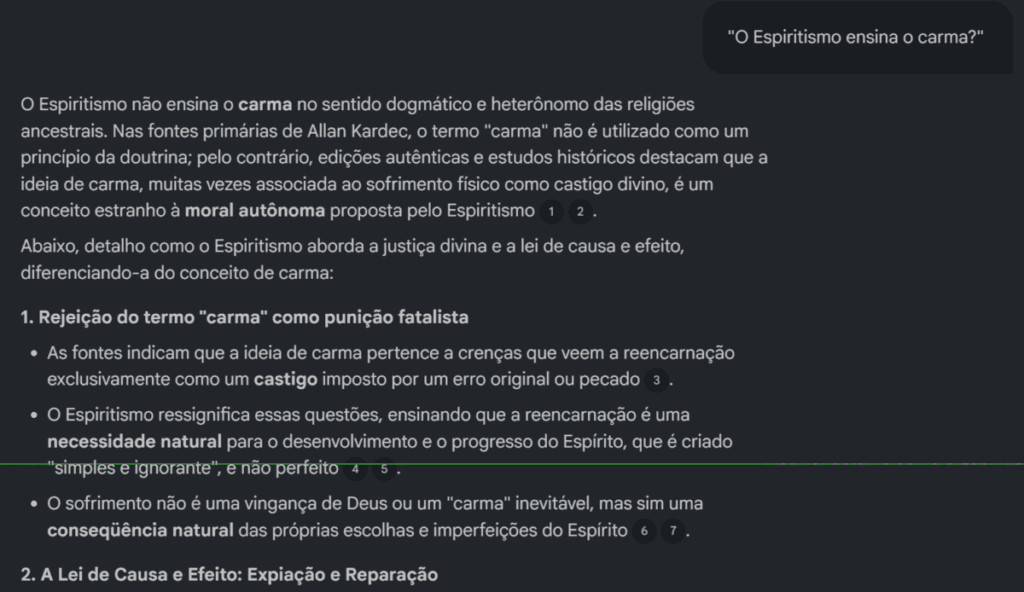
Using Artificial Intelligence for research can be very useful, but it needs to be appropriate for that purpose. Asking questions about Spiritism on ChatGPT, for example, will often lead to biased answers, since it gathers everything associated with the idea of Spiritism, including those that actually contradict Spiritism.
There is a solution, and one of the best tools for this is NotebookLM, as it runs... exclusively Regarding the content sent, interpretive errors are much less likely, but not nonexistent.
Here's a step-by-step guide on how to create your own library of Spiritist research:
Download all of Kardec's works in PDF format., clicking here.
After NotebookLM processes all the works (if it takes too long, refresh the page, as it may have already finished), start searching. For example:
“Some people argue that the idea of constructions and spirits feeding on each other in the spiritual world is valid. Compare this idea with Kardec's work.”
“"What is the perispirit?"”
“Does Spiritism teach about karma?”
Additionally, you can upload other materials and request a cross-examination. Just remember to remove those works so that NotebookLM doesn't start giving biased answers because of them.
Semear Spiritist Magazine – No. 1 – 1st Special Edition – May 2026
Download now the first edition of the Semear Spiritist Magazine, containing:
Mediumship can only be practiced in Spiritist centers: a fallacy.
We would like to address this very important point, since today many rise up to condemn mediumship in the home, as if, outside the Spiritist center, we did not have adequate protection. This is a great myth, created by a lack of study of Spiritist science, contained in Kardec's 23 works, as we will demonstrate below.
To debunk this myth, I will refer to two important articles from the Spiritist Review, from which I have taken the following excerpts, this being the first:
Let us not forget one of the most honorable mentions of the Spiritist group in Douai, which we visited in passing, and a particular expression of gratitude for the welcome they extended to us there. It is a family group, where the evangelical Spiritist Doctrine is practiced in all its purity. There reigns the most perfect harmony, reciprocal benevolence, charity in thought, word and deed; there one breathes an atmosphere of patriarchal fraternity, free from harmful effluvia, where good Spirits must be as pleased as men. The communications there also reflect the influence of the sympathetic environment. It owes to its homogeneity and scrupulous care in admissions the fact that it has never been disturbed by dissensions and difficulties that others have had to suffer. This is because all who are part of it are Spiritists at heart and none seek to make their personality prevail. The mediums there are relatively very numerous; all consider themselves simple instruments of Providence; They have no pride or personal ambitions and humbly submit, without feeling hurt, to the judgment of the communications they receive, ready to destroy them if they are considered bad.
(Kardec, Allan. Spiritism in Belgium. Spiritist Review, October 1864)
And this, the second one:
The life of this pious family is a truly edifying spectacle. Nourished by spiritualist ideas, these children do not consider themselves separate from their father. For them, he is always present. They fear committing the slightest action that might displease him. One night a week, and sometimes more, is devoted to talking with him. However, there are the necessities of life that must be provided for, as the family is not wealthy. That is why a specific day is set aside for these pious conversations, always eagerly awaited. Often the little one asks: "Is Daddy coming today?" This day unfolds with family conversations and instructions tailored to their intelligence, sometimes childish, sometimes serious and sublime. These are pieces of advice given regarding small mischiefs that he points out. If he offers praise, he also does not spare criticism, and the guilty child lowers their eyes, as if their father were before them; they ask for forgiveness, which is sometimes only granted after a few weeks of trial. His sentence is awaited with feverish anxiety. Then, what joy, when the father says:
“"I'm happy with you!" However, the most terrible sentence is: "I won't be coming next week."”
(Kardec, Allan. The Home of a Spiritist Family. Spiritist Review, September 1859)
As you can see, Kardec stimulated Serious mediumship in the home. These are just two quite compelling examples among many we could give in this regard. Spirits are always around us, wherever we are, and it is our sincere intentions, in harmony with other participants – even at a distance – along with the critical examination of any and all communication, that provide security to the mediumistic meeting.
Mediumship practiced in this way is what allowed Kardec to have more than thousand groups He was in contact with the Parisian Society for Spiritualist Studies, sending, by letter, records of his mediumistic dialogues. This was lost after Kardec's death and, today, a large part of spiritualist centers are immersed in total ignorance of the doctrine and the fundamental principles of this science, becoming a space for mystifications, fascinations and obsessions.
What Kardec desired, as recorded in "Transitory Constitution of Spiritism," in the Spiritist Review of December 1868, is what we propose today: serious, harmonious groups everywhere, knowledgeable about the Spiritist doctrine, resuming dialogue with the Spirits, questioning, examining, and ultimately collaborating with each other through central groupings of their representatives, comparing the material developed in the groups. This is the future that Spiritism demands, and we hope that, with each passing day, we can inspire more people with this purpose, which, however, was born from knowledge of Kardec's work and the facts surrounding the adulterations. The essential bibliography on all this can be consulted on our website – Allan Kardec's Legacy Study Group.
A word to misinformedTo say that Kardec's time was different from ours, as if we had a "psychosphere" today that didn't exist in the codifier's time, is a complete lack of knowledge about historical facts, which we recommend they seek to understand.