The Methodological Crisis of Post-Kardec Spiritism: A Critical Study Based on the Blind Acceptance of Spirit Communication

After Allan Kardec's death, the Spiritist movement underwent a decisive methodological shift. The critical examination of communications, controlled evocation, and systematic comparison—foundations established in the Codification—were gradually replaced by an attitude of unrestricted acceptance of mediumistic messages. This process paved the way for conceptions alien to the Doctrine to gain traction, transforming Spiritist science into something closer to a dogmatic religion.

The path of this transformation, its causes and consequences, can be seen in the following diagram.
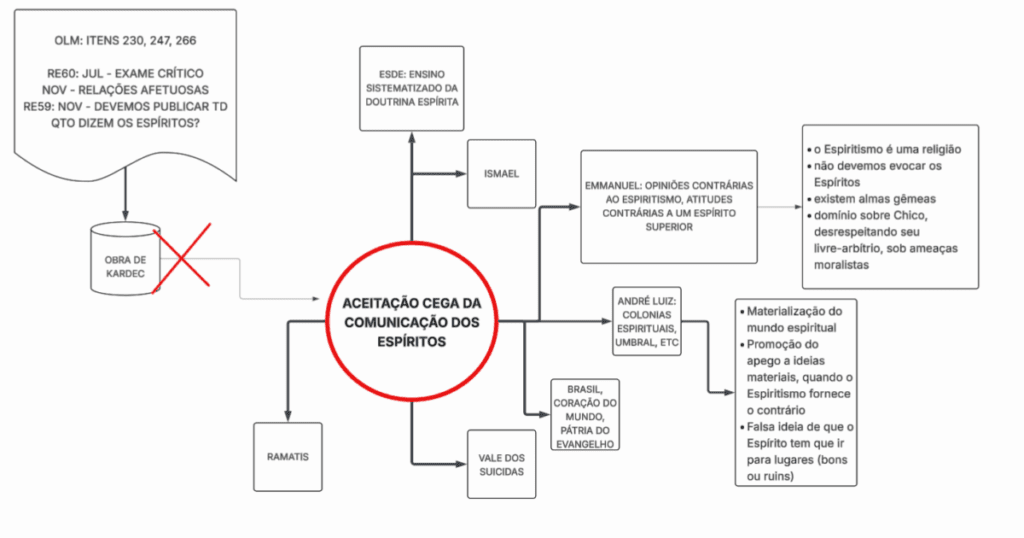
The Methodological Crisis of Post-Kardec Spiritism: A Critical Study Based on the Blind Acceptance of Spirit Communication

1. The Starting Point: Kardec and the Spiritist Methodology

It is essential to understand that Kardec did not create Spiritism, but organized its manifestations into a coherent doctrinal body through scientific method. This method was based on:

  • Direct evocation of Spirits, to test the consistency of the information (cf. The Mediums' Book, items 230, 247, 266).
  • Critical comparison of messages received in different places and by different mediums (Spiritist Magazine, articles on examination and control).
  • Submission of all teaching to the sieve of reason (The Gospel According to Spiritism, introduction, item VI).
  • Distinction between the opinion of Spirits and the principles of the Doctrine (RE, November/1859: “Should we publish everything that the Spirits say?”).

What Kardec left was a method, not a dogmaSpiritism, being a fact of nature, only becomes legitimate when subjected to rational and scientific criteria. Abandoning this guideline paved the way for the indiscriminate acceptance of mediumistic communications.


2. The Break: From Control to Cult

The diagram marks this break with the symbol of X on Kardec's work. Instead of following the method of critical examination, a significant part of the Spiritist movement began to:

  • Accept communications without comparison or control.
  • Taking as “superior revelation” messages that, according to Kardec, would only be private opinions of Spirits.
  • Relativize or disregard the evocation, transforming it into something “forbidden” or “dangerous”, in direct opposition to Kardecian practice.

This rupture opened the way for a dangerous phenomenon: the blind acceptance of communication from Spirits, which became the new axis of the movement.


3. The Consequences of Blind Acceptance

The diagram highlights several developments of this uncritical stance:

3.1 Emmanuel

Presented as Chico Xavier's guide, Emmanuel introduced notions that directly confront the Spiritist Doctrine:

  • Declaration that the Spiritism would be a religion (Kardec defined it as a science of observation and philosophy of moral consequences).
  • Prohibition of evocation, in direct contradiction with The Mediums' Book.
  • Idea of soulmates, rejected by Kardec.
  • Dominion over Chico, imposing moral conditions and threats, which violate freedom of conscience.

3.2 André Luiz

The series of books psychographed by Chico Xavier, attributed to André Luiz, created representations such as:

  • Spiritual colonies (Our Home).
  • threshold as an intermediate region.
    These concepts materialize the spiritual world, encouraging attachment to spatial and institutional constructions, when Kardec made it clear that Spiritism points to the progressive dematerialization of spiritual existence.

3.3 Ramatis

It introduces communications filled with esoteric theories, mysticism, and catastrophic predictions, inconsistent with Kardec's method. Its acceptance stems from the same logic: any communicating Spirit would be a source of truth.

3.4 Valley of the Suicides

Works such as Memoirs of a Suicide reinforce the notion of “fixed places” in the afterlife, of a punitive or reformatory nature, in contradiction with the idea that the spiritual state is an intimate reflection of consciousness, not of metaphysical geographies.

3.5 Brazil, Heart of the World, Homeland of the Gospel

Work attributed to Humberto de Campos (inspired by Emmanuel), which presents Brazil as a spiritually predestined nation. This conception reinforces a mystical nationalism, strange to the universality of Spiritism.


4. The Role of ESDE

O Systematic Study of the Spiritist Doctrine (ESDE), although structured with good pedagogical intentions, reflects the consolidation of this rupture. By adopting as a basis not only Kardec, but also post-Kardec mediumistic works (Emmanuel, André Luiz, etc.), the ESDE institutionalizes the departure from critical criteria and installs the uncritical eclecticism.

Result: the new generations of Spiritists began to consider as “Spiritist doctrine” that which is merely the opinion of Spirits, reproducing the blind acceptance.


5. Doctrinal Problems Arising

The diagram lists the concrete effects of this deviation:

  • Materialization of the spiritual world: conception of colonies, cities, hospitals, prisons — reflection of human projections.
  • Promoting attachment to material ideas, when Spiritism has as its mission precisely free from materiality.
  • False idea of the geographic destinations of the Spirit (good or bad places), replacing the understanding that “heaven” or “hell” are states of the soul.

6. The Replacement of Criticism by Dogma

The diagram ultimately shows how the Spiritist movement went:

  • Of critical examination (Kardec, 1857–1869),
  • For the blind acceptance (post-Kardec, especially in Brazil).

This process transformed Spiritist science into institutionalized religion, with dogmas, moralism and submission to “spiritual guides” not tested by the original method.


7. Conclusion: Restoration of the Spiritist Methodology

The central message of the diagram is clear:

  • As long as Kardec's work remains excluded as a criterion, Spiritism will live under the dominion of blind acceptance.
  • The return to the Kardecian method of rational examination, critical evocation and universality of the teachings of the Spirits is the only way to preserve Spiritism as a science of observation.

The diagram, therefore, is not just a historical critique, but a call for methodological restoration: Without criticism, Spiritism dissolves into mysticism; with criticism, it maintains its scientific and philosophical identity.


Spiritism in Brazil and criticism of spiritists

We have talked a lot about the great distance between Spiritism, or spiritist science, and what the Spiritist Movement learns and disseminates in Brazil, each day more contaminated by distortions and mysticism. I do not believe it necessary to repeat the facts in this regard. We limit ourselves to recommending the reader to articles The distance between Spiritism and the Spiritist Movement, Prophecy of the Spirit of Truth, The Spiritist Channel and Spiritism, The boy and the oasis: a fable of hope, an interesting dialogue, An invitation to self-criticism of the Spiritist Movement, among others.

We can, however, add Kardec's thoughts, in The Book of Mediums:

Finally, there are exalted spiritists. The human species would be perfect if it always preferred the bright side of things. Exaggeration is harmful in everything. In Spiritism it produces a blind and often childish trust in the manifestations of the invisible world, making people accept very easily and without control what reflection and examination would demonstrate to be absurd or impossible, as enthusiasm does not clarify, it obfuscates. This type of followers is more harmful than useful to the cause of Spiritism. They are the least capable of convincing, because their judgment is rightly suspicious. They are easily deceived by mystifying spirits or by people who seek to exploit their gullibility. If only they had to suffer the consequences, the harm would be less, but the worst thing is that they offer, although unintentionally, reasons to unbelievers who seek to mock rather than convince themselves and never fail to impute to everyone the ridiculousness of some. This is not fair or rational, without a doubt, but the opponents of Spiritism, as we know, only recognize their reason as good and do not care to know in depth what they are talking about.

KARDEC, Allan. The Book of Mediums, Lake, 23The Edition. Emphasis added.

Their position is clear: careless people who, with enthusiasm (and vanity) blindly believe in everything, do more harm than good to the Doctrine.

Exaggerations, some say

It is the opinion of some that we have exaggerated. According to them, we must “respect” each person’s faith, limiting ourselves to carrying out our work. Firstly, we need to demonstrate that there is no disrespect to anyone's faith. Everyone has free will and the right to believe whatever they want, rationally or not. But, here, we are dealing with spiritist science, and this is where the biggest problem with these people's ideas arises: the lack of knowledge of this science. Just read the Revista Espírita and other works by Kardec and you will see not only him, but also the good Spirits, often highlighting the need to expose the errors and, above all, the charlatans and enemies of the Spiritist Doctrine who, dressing their ideas under the guise of Spiritism, voluntarily or not promote the error that feeds the general discredit in Spiritism, as if it were another religion born of someone's ideas. We have already sufficiently demonstrated why Spiritism is a science, and not a religion.

Spiritism arrived in Brazil distorted

The fact is that Spiritism has already been established in Brazil, adulterated by the fledgling Spiritist Movement ((facts amply presented in Endand, in the FEB (Brazilian Spiritist Federation), the self-styled “home mater” of Brazilian Spiritism, far from finding ground for its restoration, it was replaced by the doctrine of Roustaing, completely based on old religious dogmas. This institution, which ended up dictating the direction of Brazilian Spiritism for a long time, never dedicated itself to recovering Spiritist science and the method necessary for the continuity of the Doctrine, with private evocations (and even in Spiritist centers), an essential tool for the scientific study, were abandoned. Without Kardec's method, and due to the interest in printing and selling mediumistic works, any idea coming from any Spirit began to be conveyed and, thus, slowly formed the general belief of the Spiritist Movement, today completely lost in ideas that, in fact, , are fundamentally anti-doctrinal.

We need to recognize, of course, that part of these ideas were founded even before the arrival of Spiritism in Brazil, with the adulteration of the works Heaven and Hell (mainly) and A Gênesis, after Kardec's death. Unfortunately, FEB is the first to defend the idea that these works have not been tampered with, a fact that, especially in relation to Heaven and Hell, is sufficiently evidenced and irrefutable.

Is talking about adulteration creating disbelief?

Here, finally, we come to another criticism from certain people: "To say there was adulteration would be to throw mud at Kardec, to incite disbelief in Spiritism." "Besides," they say, "what Doctrine is this that the Spirits allow such a thing, without warning?" It's a completely illogical thought.

We begin by remembering that the words of Christ himself were adulterated and distorted in favor of religious dogmas, and this fact was precisely what led to countless people's disbelief in Christianity. Voltaire was one of the most evident exponents of this disbelief, which still prevails today. We ask: would it be “throwing mud” at Jesus to highlight the adulterations? Would it “raise disbelief” in Christianity, highlighting distortions, while demonstrating original ideas? Obviously not. If the problem has occurred, we need to face it head on (a scientific and truly Kardecian attitude), and not sweep it under the rug while its overwhelming effects persist.

To the idea that “the Spirits would not have permitted adulterations,” we oppose the strong recommendation to study the Doctrine, which evidently was not done by these people. The Spirits warned several times about the plots of the enemies of the Doctrine, as we demonstrated in Prophecy of the Spirit of Truth. Based on the warnings and evidence, Kardec also predicted the future of Spiritism, as highlighted in the Spiritist Magazine of December 1863, in the article “Period of Struggles”:

The struggle will determine a new phase of Spiritism and will lead to the fourth period, which will be the religious period. Then the fifth will come, the intermediate period, natural consequence of the precedent and which, later, will receive its characteristic name. The sixth and final period will be the social renewal, which will open the era of the twentieth century. At that time, all obstacles to the new order of things desired by God for the transformation of the Earth will have disappeared. The generation that emerges, imbued with new ideas, will be in all its strength and will prepare the way for what must inaugurate the definitive victory of union, peace and fraternity among men, united in the same belief, through the practice of the evangelical law.

KARDEC, Allan. Spiritist Magazine, December 1863.

Unfortunately, the forecast for the sixth period is delayed by more than a century, due to several unpredictable facts at that time, such as the abandonment of Rational Spiritualism and Spiritist Science, in addition to the adulteration of the works cited. Then, the wars, the forgetfulness of the Doctrine in France and Europe and its installation in Brazil, completely distorted.

Spirits do not impede human free will

We remember, to finish, that the core of the Spiritist Doctrine, always demonstrated by the Spirits, is free will, which the Spirits cannot interfere with. They can advise, but they cannot hinder the human will. They did so: they advised extensively on the need for care that, unfortunately, was lacking from those who should take care of the master's legacy. It seems that the French Spiritist Movement was very comfortable with Kardec's direction and, when this was supposed to change, from mid-1869 (as exposed in the Spiritist Magazine of December 1868, “Transitional Constitution of Spiritism”) Kardec died, and all they were left aimless. Leymarie assuming the direction of the Spiritist Society, distorted the purpose of the Spiritist Magazine, admitting the Roustainuist doctrine in exchange for money, and the reader can find out the rest by reading the works Allan Kardec's Legacy, by Simoni Privato, Neither Heaven nor Hell, by Paulo Henrique de Figueiredo and End, by Wilson Garcia.

Good in the midst of mistakes

Many say: “the Spiritist Movement, in the midst of many mistakes, still produces good. It’s not wrong at all.” We couldn't disagree with that. We do not say that there is error or mistake in everything and that no good is produced. A mediumistic romance, even though it is full of wrong ideas, can be the gateway to the questioning individual go after more information, ending up getting to know Kardec's works, in short. But, we ask: wouldn't it be better if Spiritism were presented as it is, simple and rational, without the absurdities that produce so many setbacks and that very often lead to disbelief? We cannot fail to highlight that, when space is created for a mistake, within a science, and this mistake is not remedied by theory and doctrinal facts, it gives rise to many others. That's what has happened.

Restoration

The time has come to restore Spiritism, which has already begun in Brazil and will spread throughout the world. The first step is to learn Spiritism as it truly is, moving away from errors. Those who, called “spiritists”, do not wish to do so, will join a new religion, if they wish, as dogmatic as the others. Let's let time take care of them, but that doesn't mean we stop doing our part, presenting the errors, in the face of the Spiritist Doctrine, without personalism. Then, the time will come to restore Kardec's method. These two steps will give rise to the possibility of the sixth period foreseen by Kardec: that of social renewal.

We cannot fail to recommend how essential reading The work Autonomy – The Untold Story of Spiritism, by Paulo Henrique de Figueiredo.

Be part of this journey, which is collective and will only happen through the collaboration of many.