The Methodological Crisis of Post-Kardec Spiritism: A Critical Study Based on the Blind Acceptance of Spirit Communication
After Allan Kardec's death, the Spiritist movement underwent a decisive methodological shift. The critical examination of communications, controlled evocation, and systematic comparison—foundations established in the Codification—were gradually replaced by an attitude of unrestricted acceptance of mediumistic messages. This process paved the way for conceptions alien to the Doctrine to gain traction, transforming Spiritist science into something closer to a dogmatic religion.
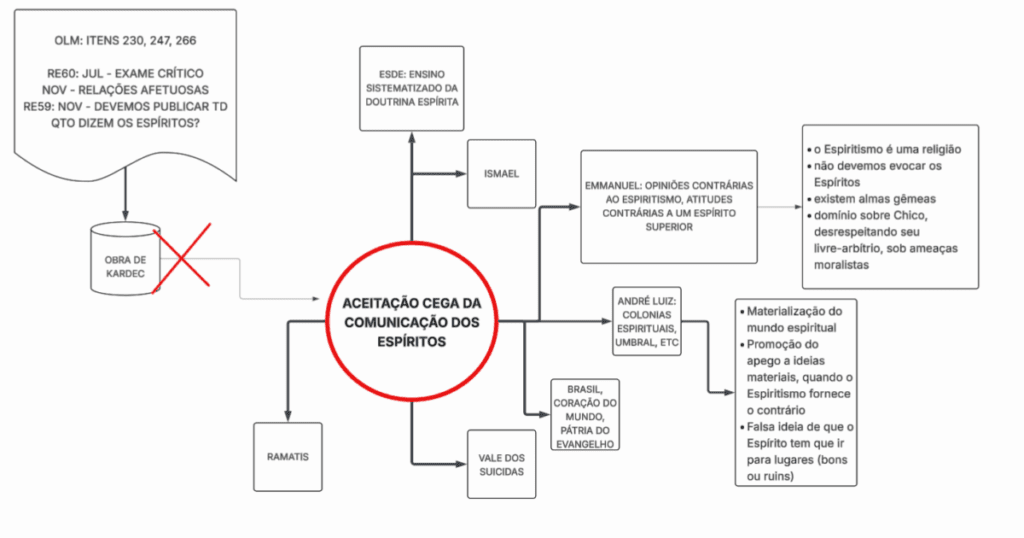
The path of this transformation, its causes and consequences, can be seen in the following diagram.
1. The Starting Point: Kardec and the Spiritist Methodology
It is essential to understand that Kardec did not create Spiritism, but organized its manifestations into a coherent doctrinal body through scientific method. This method was based on:
Direct evocation of Spirits, to test the consistency of the information (cf. The Mediums' Book, items 230, 247, 266).
Critical comparison of messages received in different places and by different mediums (Spiritist Magazine, articles on examination and control).
Submission of all teaching to the sieve of reason (The Gospel According to Spiritism, introduction, item VI).
Distinction between the opinion of Spirits and the principles of the Doctrine (RE, November/1859: “Should we publish everything that the Spirits say?”).
What Kardec left was a method, not a dogmaSpiritism, being a fact of nature, only becomes legitimate when subjected to rational and scientific criteria. Abandoning this guideline paved the way for the indiscriminate acceptance of mediumistic communications.
2. The Break: From Control to Cult
The diagram marks this break with the symbol of X on Kardec's work. Instead of following the method of critical examination, a significant part of the Spiritist movement began to:
Accept communications without comparison or control.
Taking as “superior revelation” messages that, according to Kardec, would only be private opinions of Spirits.
Relativize or disregard the evocation, transforming it into something “forbidden” or “dangerous”, in direct opposition to Kardecian practice.
This rupture opened the way for a dangerous phenomenon: the blind acceptance of communication from Spirits, which became the new axis of the movement.
3. The Consequences of Blind Acceptance
The diagram highlights several developments of this uncritical stance:
3.1 Emmanuel
Presented as Chico Xavier's guide, Emmanuel introduced notions that directly confront the Spiritist Doctrine:
Declaration that the Spiritism would be a religion (Kardec defined it as a science of observation and philosophy of moral consequences).
Prohibition of evocation, in direct contradiction with The Mediums' Book.
Idea of soulmates, rejected by Kardec.
Dominion over Chico, imposing moral conditions and threats, which violate freedom of conscience.
3.2 André Luiz
The series of books psychographed by Chico Xavier, attributed to André Luiz, created representations such as:
Spiritual colonies (Our Home).
threshold as an intermediate region. These concepts materialize the spiritual world, encouraging attachment to spatial and institutional constructions, when Kardec made it clear that Spiritism points to the progressive dematerialization of spiritual existence.
3.3 Ramatis
It introduces communications filled with esoteric theories, mysticism, and catastrophic predictions, inconsistent with Kardec's method. Its acceptance stems from the same logic: any communicating Spirit would be a source of truth.
3.4 Valley of the Suicides
Works such as Memoirs of a Suicide reinforce the notion of “fixed places” in the afterlife, of a punitive or reformatory nature, in contradiction with the idea that the spiritual state is an intimate reflection of consciousness, not of metaphysical geographies.
3.5 Brazil, Heart of the World, Homeland of the Gospel
Work attributed to Humberto de Campos (inspired by Emmanuel), which presents Brazil as a spiritually predestined nation. This conception reinforces a mystical nationalism, strange to the universality of Spiritism.
4. The Role of ESDE
O Systematic Study of the Spiritist Doctrine (ESDE), although structured with good pedagogical intentions, reflects the consolidation of this rupture. By adopting as a basis not only Kardec, but also post-Kardec mediumistic works (Emmanuel, André Luiz, etc.), the ESDE institutionalizes the departure from critical criteria and installs the uncritical eclecticism.
Result: the new generations of Spiritists began to consider as “Spiritist doctrine” that which is merely the opinion of Spirits, reproducing the blind acceptance.
5. Doctrinal Problems Arising
The diagram lists the concrete effects of this deviation:
Materialization of the spiritual world: conception of colonies, cities, hospitals, prisons — reflection of human projections.
Promoting attachment to material ideas, when Spiritism has as its mission precisely free from materiality.
False idea of the geographic destinations of the Spirit (good or bad places), replacing the understanding that “heaven” or “hell” are states of the soul.
6. The Replacement of Criticism by Dogma
The diagram ultimately shows how the Spiritist movement went:
Of critical examination (Kardec, 1857–1869),
For the blind acceptance (post-Kardec, especially in Brazil).
This process transformed Spiritist science into institutionalized religion, with dogmas, moralism and submission to “spiritual guides” not tested by the original method.
7. Conclusion: Restoration of the Spiritist Methodology
The central message of the diagram is clear:
As long as Kardec's work remains excluded as a criterion, Spiritism will live under the dominion of blind acceptance.
The return to the Kardecian method of rational examination, critical evocation and universality of the teachings of the Spirits is the only way to preserve Spiritism as a science of observation.
The diagram, therefore, is not just a historical critique, but a call for methodological restoration: Without criticism, Spiritism dissolves into mysticism; with criticism, it maintains its scientific and philosophical identity.
A stone against the denialism surrounding the adulterations of Allan Kardec's works
Dear reader, we will be brief on the subject, putting an end to the denialism surrounding the adulteration of Allan Kardec's works. The bibliography used is included at the end. The text will be presented in succinct bullet points for ease of reading.
Before you begin, please note that you can obtain Kardec's original works, already released in PDF format by the publisher FEAL, by clicking on here.
1. The figure of Roustaing
Around the 1860s, the figure of Jean-Baptiste Roustaing, an influential and wealthy French lawyer, emerged, seeking to establish himself in the Spiritist community. This gentleman began to receive psychographies, through just one medium, of one or more Spirits who claimed to be the evangelists themselves, reproducing absurd dogmas, among which ((ROUSTAING, The Four Gospels, volumes I to IV, FEB)):
the dogma of the fall into sin, stating that the individual only needs to incarnate after making a mistake;
the dogma of the fluidic body of Jesus, affirming that he was never incarnated among us, being only a materialization;
the dogma of the retrogradation of the soul (“involution”), by affirming that the Spirit that errs a lot incarnates as a slug (“fleshy cryptogam”).
2. Roustaing hated spiritual science
Roustaing and his followers came to hate Spiritist science and Kardec's method, as this method was their Achilles' heel, easily undermining their theory. This hatred is evident in the publication, in 1882, of the pamphlet Les quatre évangiles de JB Roustaing- réponse à ses critiques et à ses adversaires, édité par les élèves by JB Roustaing (The Four Gospels of J.B. Roustaing — a response to his critics and adversaries, edited by his disciples by JB Roustaing), a pamphlet written sixteen years earlier by Roustaing.
Roustaing's intentions are confirmed by the Spirits, when Kardec, on September 16, 1862, questions about this gentleman, who wanted Kardec to go to his house, instead of visiting the worker spiritists:
No, in general, he comes across as an enthusiast, an exalted, wanting to impose itself.
FIGUEIREDO, Paulo Henrique. Neither Heaven nor Hell: the laws of the soul according to Spiritism. Editora FEAL, 2020.
3. The new edition of Heaven and Hell
Soon after Kardec's death, a new edition of Heaven and Hell appeared, containing, among many terrible changes:
THE removal of the preface of the work, where Kardec exposes precisely the scientific method necessary for the Spiritist Doctrine;
THE complete amendment of Chapter VIII, becoming VII, with the creation of the subtitle “Penal Code of the Future Life”, an absurd title, inserting the item 10, where it is said that all the vicissitudes we suffer here would be the result of our imperfections, expiations of mistakes committed, in this or other lives. The effect of this idea is, by force of logic, to admit that all the difficulties we go through would be the result of acquired imperfections, as a kind of punishment, leading to the idea that only imperfect Spirits would incarnate here, needing correction — the same dogma as Roustaing, exhaustedly fought by Kardec and the Spirits.
THE loss of correspondence between the 25 items in chapter VIII with the rest of the book.
4. The new edition of Genesis
In 1872, the new edition of Genesis appeared, which contained very important alterations:
Removed item 2 of chapter IV, where Kardec speaks precisely about the principles of blind faith and passive obedience: “The veneration of sacred books, almost always considered as having descended from heaven, or inspired by divinity, prohibited any examination.”
Regarding the disappearance of Jesus' body, it was removed item 67, in which Kardec addresses the issue of the disappearance of Jesus' body, stating that the issue had not yet been completely resolved by Spiritist science: “Now, until now, none of the [personal opinions] that have been formulated have received the sanction of this double control.” Remember: Roustaing accepted the dogma that Jesus was among us only in the materialization of the fluidic body, and hated the method of double control (“This double control is fundamental and obligatory for the acceptance of any new fundamental concept of the Spiritist doctrine by Kardec. Until this has occurred, it will be considered a simple opinion, whether it came from a man or from a Spirit” — FIGUEIREDO, 2021)).
In chapter XVIII, item 20, it was removed the entire passage in which Kardec says: “Far from replacing one exclusivism with another, Spiritism presents itself as the absolute champion of freedom of conscience.”
In item 24 of the same chapter, the entire item 24 was removed, in which Kardec makes a serious observation about the enemies of moral progress (our emphasis):
To say that humanity is ripe for regeneration does not mean that all individuals are on the same level, but many have, by intuition, the germ of new ideas that circumstances will bring about. Then they will prove to be more advanced than one might suppose, and they will eagerly follow the lead of the majority.
There are, however, those who are essentially resistant to these ideas., even among the most intelligent, and who certainly will not accept them, at least in this lifetime; in some cases, in good faith, out of conviction; in others out of self-interest. These are those whose material interests are tied to the current situation and who are not advanced enough to give them up, because the general good matters less than their personal good—they become apprehensive at the slightest movement toward reform. Truth is a secondary issue for them, or, better said, for some people, truth lies entirely in that which causes them no trouble. All progressive ideas are, from their point of view, subversive ideas, and that is why they dedicate an implacable hatred to them and wage an obstinate war against them.They are intelligent enough to see Spiritism as a tool for progressive ideas and the elements of transformation they fear, and because they don't feel up to it, they strive to destroy it. If they considered it worthless and unimportant, they wouldn't bother with it. We've said this elsewhere:The more grandiose an idea is, the more it encounters adversaries, and its importance can be measured by the violence of the attacks it is subjected to.”.
5. Adulteration published in Posthumous Works
In the publication of Posthumous Works, by Pierre Gaetan Leymarrie, the author inserts a psychograph tampered with, in which Kardec is asking for advice on the new edition of Genesis, which he was, yes, elaborating:
February 22, 1868. Medium M. Desliens.
Allow me to give you some personal advice about your book Genesis. I think that, as you do, it should undergo a rearrangement that will make it gain value in methodical terms; but I would also advise you to review certain comparisons in the first chapters, which, without being inaccurate, can be ambiguous, and which can be used against you in the finishing of words. I don't want to point them out in any particular way, but by carefully analyzing the second and third chapters, they will certainly surprise you. We'll take care of your research. It's only a matter of detail, no doubt, but details sometimes have their importance; that's why I thought it useful to draw your attention to this side.
Question. In the reprint we're going to do, I'd like to add a few things, without increasing the volume. Do you think there are parts that could be removed without inconvenience?
Response. My opinion is that there is absolutely nothing to take away as doctrine; everything is useful and satisfactory in every aspect; but I also believe that you could, without inconvenience, further condense certain ideas which need no development to be understood, having already been sketched elsewhere; in your work of reorganization you will easily achieve this.
We should leave intact all the theories that appear for the first time in the public eye; don't remove anything as ideas, I repeat, but just cut out, here and there, developments that add nothing to clarity
You will be more concise, no doubt, but just as understandable, and it is the ground thus gained that you may have to add new and urgent elements. It's a serious job for this revision, and I urge you not to wait too late to do it, it's better to be prepared ahead of time than if I had to wait after you. Above all, don't rush it. Despite the apparent contradiction of my words, you undoubtedly understand me. Start working promptly, but don't stay too long. Take your time; your ideas will be clearer and your body will be less fatigued.
You can download the original content of this psychography by clicking on here.
Leymarie, seeking to reinforce the idea that the fifth edition of Genesis (already questioned since that time) would have been produced by the hands of Kardec, uses only the final part of this dialogue, discarding the beginning of it and inserting a section that didn't exist, at the beginning:
February 22, 1868. (Private communication — Medium: Mr. D…) the genesis
Following a communication in which Dr. Demeure gave me very wise advice on modifications to be made in the book Genesis, for its reprinting, which he urged me to take care of without delay, I said to him:
"Sales, so brisk so far, will undoubtedly cool; it was an immediate effect. I believe the fourth and fifth editions will take longer to sell. However, since it takes some time for revision and reprinting, I must not be unprepared. Could you tell me how much time, roughly, I have to handle this?"
Answer — This revision is serious work, and I advise you not to delay starting it too long. It's better to have it ready in advance than for it to be left waiting for you. However, don't rush. Despite the apparent contradiction in my words, you certainly understand me. Get to work now, but don't dedicate too much time to it. Do it slowly; your ideas will present themselves more clearly, and your body will benefit, becoming less fatigued.
However, you should expect the volumes to sell out quickly. When we told you this book would be a huge success among your other books, we were referring to both philosophical and material success. As you can see, our predictions were correct. It's important to be ready at any moment; things will happen more quickly than you imagine.
6. The insurmountable legal fact
They are undisputed legal facts at tampering of Genesis and Heaven and Hell, for the mere reason that editions were released, with alterations, after the author's death and without legal deposit — as stated by at least four specialized legal operators: Simoni Private, Julio Nogueira, Lucas Sampaio and Marcelo Henrique. That cool fact it is above of any consideration and, because of this, spiritist federations from other countries, respecting the law, returned to the third edition of the work. Unfortunately, laymen in matters of copyright have found resonance in some individuals and also in the Brazilian Spiritist Federation, working to maintain a denialist thesis and contrary to the law.
7. It barks like a dog, wags its tail like a dog, has the shape of a dog, but is it a bird?
Having arrived here, having given due attention to the facts, verifiable in the indicated bibliography, the dear reader, in addition to everything acting in a rational and logical manner (and respecting the law) will not be able to have any doubt about the facts of adulterationsTo say otherwise would be against the law and deny what is transparent. After all, if it barks like a dog, wags its tail like a dog, and is shaped like a dog, it is definitely a dog, not a bird—but "some" want it to be.
Now, dear reader, to give rise to denialist thesis of these gentlemen, trying to maintain that they were not adulterations, but rather modifications made by Kardec's hands:
it would be necessary, first of all, to go against the law;
it would be necessary to voluntarily ignore that Roustaing hated spiritualist science and wanted to take Kardec's place;
it would be necessary to voluntarily ignore that Guerin, an influential and wealthy follower of Roustaing, offered his influence around the new presidents of the Public Limited Company;
it would be necessary to admit that Kardec, without any possible explanation, removed such important passages precisely at the points of greatest conflict with the Roustainguist theses or his modus operandi;
it would be necessary to admit that Kardec contradicted the spiritist science, that is to say, in adulteration from Heaven and Hell, which all the vicissitudes we suffer here would be the result of our imperfections, expiations of mistakes committed, in this or in other lives. The effect of this idea is, by force of logic, to admit that all the difficulties we go through would be the result of acquired imperfections, as a kind of punishment, leading to the idea that only imperfect Spirits would incarnate here, needing correction — exactly the Roustainguist thesis, “by chance”. This is false and, in fact, is even refuted in the adulterated Genesis, in the analysis of the passage about the Man Born Blind: “If this was not an atonement for the past, it is proof that it should serve their progress.”.
it would be necessary to voluntarily ignore that Leymarie, to support the thesis that the 5th edition of Genesis had been produced by Kardec, published an adulterated psychograph, cutting out the part that touches on the importance of DO NOT REMOVE ANY DOCTRINAL IDEAS, something done in adulteration.
it would be necessary retire rationality in the face of such obvious things, leaving aside Erastus's very important guidance: “It is better to reject ten truths than to admit a single lie, a single false theory” (item 230 of The Mediums' Book).
8. Conclusion
We're not here to try to force understanding on those who don't want to understand and, by willingly admitting sophistries, give rise to fascination—as Roustaing did when faced with such absurd ideas. For those who want to understand, it's crystal clear. Let each person investigate further to reach their own conclusions—after having investigated everything, not before.
Jesus came to bring us the truth that sets us free! He mentioned the devil in the Bible, but did he believe in the literal existence of the devil? The word “Devil” is written in the Bible, but its meaning goes beyond the literal.
Pixabay – Golden Violinist – birds
It really all comes down to interpretation. God and Devil are representations of Good and Evil, respectively. However, viewing the Devil as purely malevolent is a misconception. The Devil is not an entity; it resides in those who embrace this false idea. Mal has no form, is not a real entity. No one is inherently evil. Is there anyone truly evil in this world? No, because evil is a false conception that supports a habit. When someone changes their mindset, they stop acting in evil ways, but overcoming the habit is a long process. However, you never overcome if your mentality doesn't change.
What will really transform the world is genuine education – not that which merely perpetuates false ideas, that decorates teachings, but rather that which is understood, which liberates. The weapons of good are understanding and explanation. How can I make you understand that the future of the world lies in cooperation? Simply explaining and cooperating endlessly, without worrying about the results.
We are introducing a new habit into the world. By overcoming the false idea of evil, we will see global renewal, offering new opportunities for everyone. There is no Spirit that will not, sooner or later, choose the path of good. However, the good is not imposed; everyone must achieve it with their own effort.
True understanding will free us from this false dichotomy between good and evil, leading us to a life of cooperation and harmony. The following passage from Jesus is revealing:
42 Jesus said to them, “If God were your father, you would love me. I came from God and I go [to God]. For I did not come on my own, but He sent me. “
Bible – Volume I: New Testament – The four gospels – Gospel of John (pp. 470-471). Company of Letters. Kindle Edition. Trans. Frederico Lourenço
Jesus said he was sent by God and not by his own means. He came to teach the Law of God.
Doing good is doing the Law of God. That's why there is only one God.
43 Why do you not understand my speech? Why you can't hear my word.
Idem
Science advances mainly through a paradigm shift, that is, a change in ideas.Paradigm comes from the Greek “paradigm”, which means “example” or “model”. Initially, it was applied in grammar (to define its use in a given context) and rhetoric (to refer to a parable or to a fable). From the 1960s onwards, it began to be used to define a model or a standard in any discipline scientific or epistemological context. source: Click here. We have to understand what the new idea looks like. So, after it makes sense, we test it and when we verify its coherence, we adopt it. The key is to share the new idea. But that doesn't mean everyone will become superior, that's not the world's idea. Children do not need to study at school just to get the best grades, generating competition between them. Each person must seek to learn more than they knew before, as we are all spirits at different stages of evolution. There are very intelligent spirits in our world because they have spent more time experiencing the world. However, the intelligent are not superior to the simple, because in other existences they were simple like them. They came to our world because they felt more prepared there. Intelligent spirits are not malevolent or demonic; however, they must cultivate simplicity to serve and contribute, not to be served. This is the great motto of the world.
To move toward happiness in this world, we need to help remove the blinders from the eyes of those who are blinded by false ideas. However, they will not easily accept acting for everyone. Thus, some leave for another world, where they can progress, help many others to progress technologically more quickly and have a new opportunity to rethink their choices. It is not a punishment or punishment to be sent to another world; it is simply a consequence of a choice that did not allow them to evolve. If they reconsider their attitudes in the other world, renewed, they can return here.
This has occurred in our world; the simple ones were on Earth when the exiles arrived. They were given a second chance by coming here, but now they must contribute in useful ways to the advancement of this world. Unfortunately, many have fallen into the false idea that they must be served, thus creating all the mistaken ideas that permeate the world. But whenever we try to explain the truth, because it is a false idea, they resist.
This is the last opportunity both to change your mindset and to fully participate in this world. Those who refuse to cooperate will not understand the truth through force, memorizing orders, or blind obedience. Only through personal effort can someone understand.
Freedom is 100% respected by spirituality
44 You are [children] of your father the devil; and you want to put your father's wishes into practice. He is homicidal from the beginning and was not and is not in the truth, because there is no truth in him. When he utters the lie, he utters it from his own; for he is a liar and is the father [of lies]. 45Me because I tell the truth you don't believe me. 46 Who among you condemns me regarding error? If I speak the truth, why don't you believe me? 47 Whoever belongs to God listens to the words of God. This is why you do not listen to me: because you are not from God.”
Idem
This part of John's Gospel is pointing out that the “devil” is in the false idea of superiority and purity. When we consider ourselves pure and superior, we tend to judge and condemn others who we consider simple and inferior. However, the act of judging is, in itself, a false idea: when we point out the error in another person, we are actually making a mistake, as we are judging the person instead of their specific behavior. This is equivalent to considering the person as “evil” and condemning them unjustly. Nobody has the right to act like that. Not even benevolent spirits condemn others in this way.
Evil reveals itself in the distortion of divine law, when we seek to satisfy our personal interests at the expense of the submission of the simplest, sacrificing their tranquility and happiness. However, we must reject the notion of superiority due to our knowledge.
In this context, our responsibility becomes even more crucial! Those who possess knowledge have a duty not only to help those less knowledgeable, but also to serve.
Reflect on this: The obligation of those who have knowledge is to serve the simplest! We should not use our knowledge for our own benefit, but rather to cooperate.
We must dedicate our efforts to disseminating knowledge and ensuring that many understand it. The future of the world lies in cooperation, not competition. Any new value must be shared globally so that everyone can benefit.
48 The Jews answered and said to him: “Do we not say well that you are a Samaritan and have a demon?”. 49 Jesus answered them: “I do not have a demon, but I honor my Father and you dishonor me. 50 I I do not seek my glory. There is one who seek and judge.51 Amen, amen, I say to you: if anyone observes my word, he will not see death until eternity.”
ibid.
In this part, it is expressed: “You are contaminated by evil! And there’s a devil!” If someone already thinks the other is a devil, there seems to be no solution. Those who are selfish and arrogant label others as inferior, always seeing the evil in others. Religious fanatics see those who are different as inferior. Materialists judge those who think differently as inferior. The crux of the problem is when an individual believes they are superior and is stubborn about not changing their mind, even when faced with the truth. The truth confronts you, questioning your lofty self-image.
Now, if someone considers themselves superior, they will only recognize their error when they reach that conclusion on their own. Often, this person, deep down, does not really believe in their superiority, which is why they feel the need to affirm it so vehemently.
The only factor that makes us equal is our individuality. We are unique Spirits, each with different experiences to develop and understand. However, having more knowledge does not make us superior to others. What truly defines the evolution of a Spirit is not its intelligence or experience, but its ability to understand the law of God. The goal of the Spirit is to give the best of itself.
God's Law is clear: There is no competition, only cooperation!
This article was prepared based on a lecture given by Paulo Henrique de Figueiredo. Click here to meet her.
Has Allan Kardec's book Genesis really been adulterated?
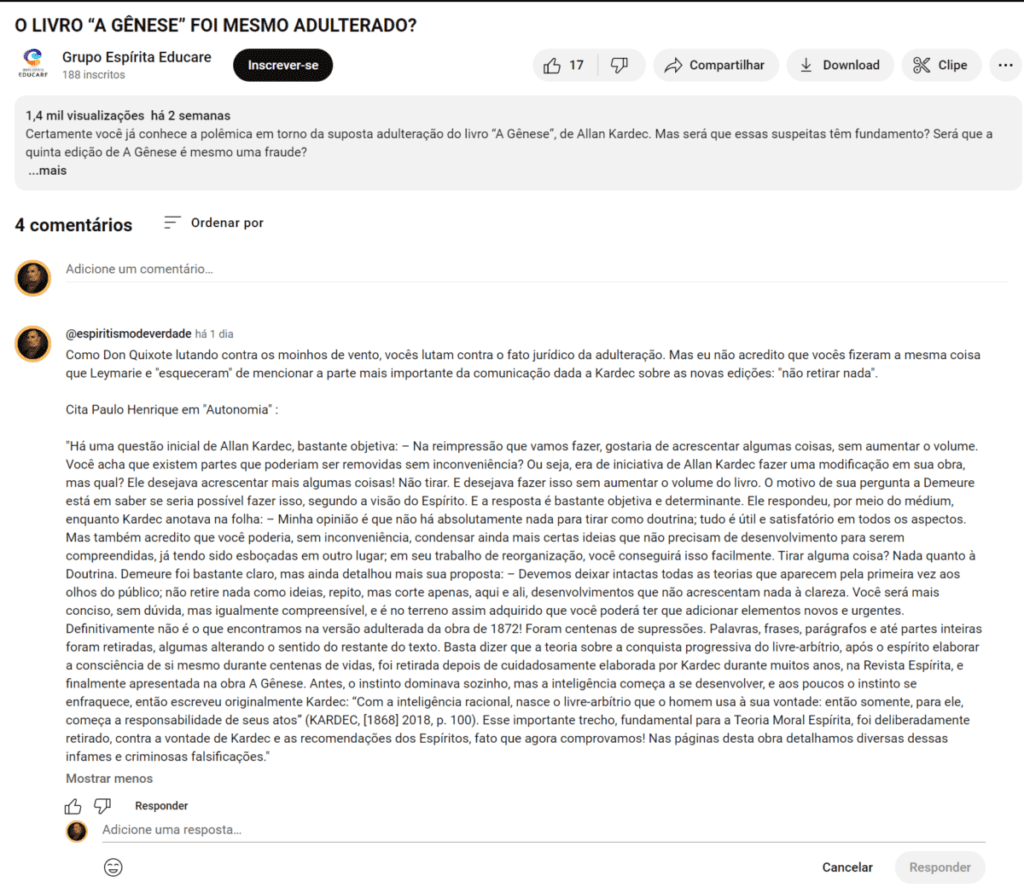
A few days ago, the channel Grupo Espírita Educare published a video very well produced, by the way, with great care and an aesthetic appearance to be envied. This video, entitled "WAS THE BOOK "THE GENESIS" REALLY ADULTERATED?", provides, despite so much care, half-baked information, leaving out details that are so indispensable for the legitimate discussion of the case about Allan Kardec's ultimate work.
In the video, they quote the following passage from a psychograph to Kardec, about the changes he wanted to make to Genesis:
"Allow me to give you some personal advice about your work Genesis. I think, like you, that it should undergo certain modifications that will make it more valuable from a methodical point of view; [...] this revision is a serious job, and I ask you not to wait too long before carrying it out."
There is, however, something substantial in the passage they omitted (in the ellipsis in brackets) which, not by chance, leads the viewer to the wrong conclusion: the communicating Spirit's repeated recommendation that Kardec should not change anything about the Doctrine and the ideas that were appearing for the first time:
Advice on Genesis
February 22, 1868. Medium M. Desliens.
Allow me to give you some personal advice about your book Genesis. I think that, as you do, it should undergo a rearrangement that will make it gain value in methodical terms; but I would also advise you to review certain comparisons in the first chapters, which, without being inaccurate, can be ambiguous, and which can be used against you in the finishing of words. I don't want to point them out in any particular way, but by carefully analyzing the second and third chapters, they will certainly surprise you. We'll take care of your research. It's only a matter of detail, no doubt, but details sometimes have their importance; that's why I thought it useful to draw your attention to this side.
Question. In the reprint we're going to do, I'd like to add a few things, without increasing the volume. Do you think there are parts that could be removed without inconvenience?
Answer. My opinion is that there is absolutely nothing to take away as doctrine; everything is useful and satisfactory in every respect; but I also believe that you could, without inconvenience, further condense certain ideas that don't need development to be understood, having already been outlined elsewhere; in your reorganization work, you will easily achieve this.
We should leave intact all the theories that appear for the first time in the public eye; don't remove anything as ideas, I repeat, but just cut out, here and there, developments that add nothing to clarity
You will be more concise, no doubt, but just as understandable, and it is the ground thus gained that you may have to add new and urgent elements. It's a serious job for this revision, and I urge you not to wait too late to do it, it's better to be prepared ahead of time than if I had to wait after you. Above all, don't rush it. Despite the apparent contradiction of my words, you undoubtedly understand me. Start working promptly, but don't stay too long. Take your time; your ideas will be clearer and your body will be less fatigued.
You can download the original content of this letter by clicking on here.
Did Kardec go against the Spirit's wise advice?
Now, the adulteration of Genesis produced exactly that: it removed important passages that compromise understanding, leaving out doctrinal ideas and leading the reader to an understanding that is sometimes contrary to the previous version - the same thing they did with the adulteration of Heaven and Hell.
He quotes Henri Netto, in the article “In search of doubt: where is the truth?”:
The "new" texts, even if they appear to be true (because the intelligent hands that handled the editions posthumously picked out texts contained in the issues of the "Revue Spirite" (published from January 1858 to April 1869 by Kardec himself), sought the "appearance of truth" when put together with the others, with no basis in any of Kardec's publications. There are absurd passages that contradict not only other theses presented and reinforced by Kardec throughout his coherent and sequential literary production, but also the doctrinal body itself (principles and foundations). The biggest of these, without a shadow of a doubt, was to create a doubt, which didn't exist in the original version (first to fourth editions of "Genesis"), about the physical, material nature of Jesus' body. In this sense, the elimination of item 67 from Chapter XV of the aforementioned work, and the renumbering of item 68 as if it were 67, hides the logical assessment (albeit in terms of suppositions) about the fate of Yeshua's body envelope after his burial. What would be Kardec's reason, after repelling the docetist thesis ("fluidic body" of Jesus), and affirming his human nature, for suppressing his judicious considerations on the subject?
He also quotes Paulo Henrique de Figueiredo in “Autonomia”:
There is an initial question from Allan Kardec, which is quite objective:
Question. In the reprint we're going to do, I'd like to add a few things, without increasing the volume. Do you think there are parts that could be removed without inconvenience?
In other words, it was Allan Kardec's initiative to make a change to his work, but which one? He wanted to add a few more things! Not take away. And he wanted to do this without increasing the volume of the book. The reason for your question to Demeure is to find out whether it would be possible to do this, according to the Spirit's vision. And the answer is quite objective and decisive. He answered, through the medium, while Kardec wrote it down:
Answer. My opinion is that there is absolutely nothing to take away as doctrine; everything is useful and satisfactory in every respect; but I also believe that you could, without inconvenience, further condense certain ideas that don't need development to be understood, having already been outlined elsewhere; in your reorganization work, you will easily achieve this.
Take anything away? Nothing about the Doctrine. Demeure was quite clear, but he went on to detail his proposal:
– We should leave intact all the theories that appear for the first time in the public eye; don't remove anything as ideas, I repeat, but just cut out, here and there, developments that add nothing to clarity. You'll be more concise, no doubt, but just as understandable, and it's on the ground thus acquired that you may have to add new and urgent elements.
This is definitely not what we find in the adulterated version of the 1872 work! There were hundreds of deletions. Words, phrases, paragraphs and even entire sections were removed, some of which altered the meaning of the rest of the text. Suffice it to say that the theory about the progressive conquest of free will, after the Spirit has developed self-awareness over hundreds of lives, was removed after being carefully elaborated by Kardec over many years in the Spiritist Review and finally presented in Genesis. Before, instinct dominated alone, but intelligence begins to develop, and little by little instinct weakens, so Kardec originally wrote: "With rational intelligence, free will is born, which man uses at will: then only, for him, does responsibility for his actions begin" (KARDEC, [1868] 2018, p. 100). This important passage, fundamental to Spiritist Moral Theory, was deliberately removed, against Kardec's wishes and the recommendations of the Spirits, a fact that we have now verified! In the pages of this book we detail several of these infamous and criminal forgeries.
FIGUEIREDO, Paulo Henrique de. Autonomy: the untold story of Spiritism. FEAL publisher.
Not only that, there is an extensive piece of research produced by Marco Milani, demonstrating the fact that the adulteration removed several important doctrinal ideas, as well as adding some exquisite ones, compromising the understanding of the work as a whole and in detail:
As can be seen, various doctrinal ideas have been removed, even though the recommendation of the Spirit, who communicated to Kardec on the subject of the new edition, was not to remove anything related to these issues.
They don't want dialog to get to the truth, but imposition
When Leymarie created the book Obras Póstumas, he inserted into it the psychography presented earlier, but adulterated, removing precisely the Spirit's advice so that nothing concerning the Doctrine would be removed. All to give credit to his version, the fifth edition of Genesis was actually produced by Allan Kardec. Now, in the video mentioned above, the Grupo Espírita Educare channel does the same, but it doesn't stop there.
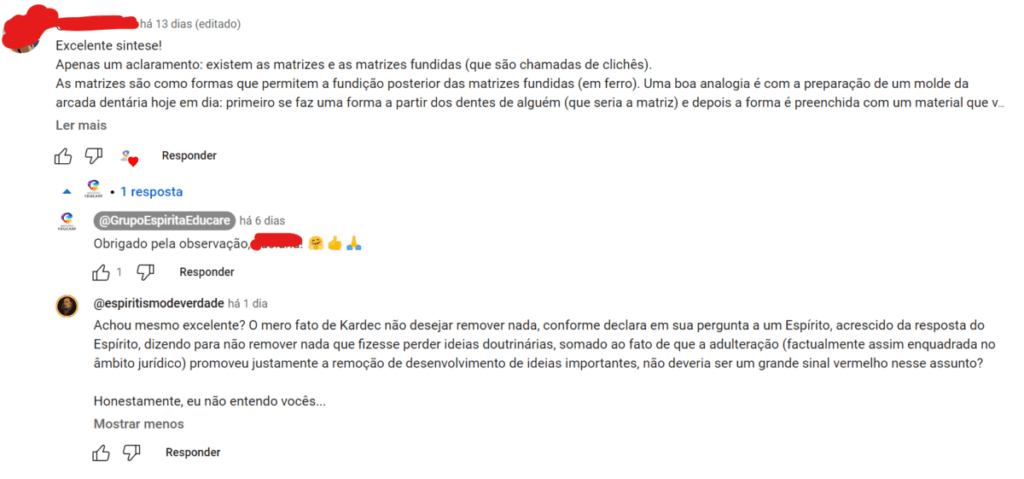
For Leymarie, the facts and the discussion about them didn't matter. In order to maintain his version of events, he sought to dominate the truth with various subterfuges. He tried to take control of Spiritist opinion and hid anything that might contradict his ideas. This is also how those who contradict the facts of the adulteration act with the "siren song", as Marcelo Henrique would say. That's how they finally hid my comments on that video from the public:
It's no coincidence that my comments don't appear to anyone else, as I was hidden on the channel. Apparently, they do not wish to discuss the facts and evidence, which they say are “summarily declassified”.
We can see, therefore, that the animated play is just another attempt to lead the public to the conclusion they want, even if they have to omit important information and make shallow statements. For our part, after encouraging the reader to study The Legacy of Allan Kardec, by Simoni Privato (link below), we can only hope that everyone comes to their own conclusions, in the face of the facts and evidence, of which there is plenty, despite the fallacy of the Spiritism CSI group that all the opposing arguments have been overturned (sic).
Live: Adulterated Genesis – doctrinal analysis of changes between editions
Evil is not making mistakes, then asking for forgiveness and being obedient to good.
O bad it is acting according to personal interest above the collective. To do this, the other must serve him, losing tranquility and happiness, which the selfish person does not want for himself. To submit the other, he must act not out of duty that cooperates, but out of submission that makes him a kind of slave.
God punishes? No! What is punishment?
O punishment, according to divine or natural law, consists of the constant suffering of those who consciously err, acting driven by personal interests, using lies and violence as means to achieve their objectives.
Isn't this concept totally different from what we have learned? Is punishment something that happens in the world? No, the punishment is the person's moral suffering and, if they do not change, they will not find happiness.
No selfish person is happy, because they know, intimately, that they are not doing good. But why would someone be selfish, knowing they are wrong, suffering because of it, and still continuing in the same selfish behavior?
Through Spiritism, we uncover the roots of selfishness and pride. Spiritism does not confront people or ideas; he confronts selfishness and pride as concepts that harm spiritual progress.
The guilty Spirit first suffers in spiritual life due to the degree of its imperfections, and is then granted bodily life as a means of reparation. That is why the Spirit finds in her, either the people she offended, or situations similar to those in which she committed evil, or even situations opposite to those she experienced, for example, facing misery if she was a bad rich person, or a humiliating condition if was proud. This is not a double punishment, but the same one that is continued on Earth, as a complement, with a view to facilitating your progress towards effective work. It depends on the Spirit himself to make it profitable. Isn't it better for him to return to Earth, with the possibility of gaining Heaven, than to be condemned without remission when he leaves it? This freedom that is granted to him is proof of the wisdom, goodness and justice of God, who wants man to owe everything to his own efforts, thus being the architect of his future. If you are unhappy, whether you are unhappy for a longer or shorter period of time, complain only to yourself – the path to progress is always open to you.
Allan Kardec. Heaven and Hell: Or divine justice according to Spiritism, publisher Feal (p. 78). Kindle Edition.
However, it is crucial to fully understand what selfishness entails in order to combat it effectively. Recognizing your mistakes and feeling guilty is the first step towards change. Otherwise, the individual will continue to suffer.
The false idea that God is the cause of our suffering is wrong. In fact, we are judges and prisoners of ourselves and our own thoughts. Spiritism teaches us this. Knowing this, will you choose to remain trapped or free yourself? To be a slave or free? It's your choice.
No one is obligated to act for the good. Freedom is fundamental to acting in good ways. God does not put anyone to watch anyone. When you do good, you will do it with all your effort. The moment you act with integrity, other spirits approach to do the same: the network of kindness is created.
If you are acting with ulterior motives, other spirits notice and you isolate yourself by choice. That's the mechanism!
Is someone really watching us in the spiritual world? No! Is there a specific place to be punished? No! This is false! Does Emmanuel mention the threshold? Yes, he mentions it, but they are deluded spirits that gather there. Good spirits see bad spirits as sick people to be cured and not as adversaries to be fought. The fight between good and evil is a false idea!
This article was prepared based on a lecture given by Paulo Henrique de Figueiredo. Click here to meet her.
The Mesa Girante channel and the adulterations in Heaven and Hell
Recently, the Mesa Girante channel on YouTube produced a video where it addresses another video, by Paulo Henrique de Figueiredo, talking about the work “Neither Heaven nor Hell”, from about 3 years ago. The work deals with the legal fact ((São legal fact at tampering of A Gênesis and O Céu e o Inferno, for the mere reason that editions were released, with changes, after the death of the author and without legal deposit. That cool fact it is above of any consideration and, because of this, spiritist federations from other countries, respecting the law, returned to the third edition of the work.)) from adulteration of Heaven and Hell and the context of the betrayal plot around Kardec.
In this video, the author of the Mesa Girante channel mockingly tries to invalidate the importance of the work due to Paulo Henrique's supposed rashness when dealing with the topic, on video. I wonder why he, the owner of the Mesa Girante channel, didn't dedicate himself firstly to read this work, which would have enriched too much the debate? Why did he only focus on what seemed incongruous to him, based on Paulo Henrique's speeches, without paying attention to the other relevant points of the work? I say this because I sought it out myself, through the comments, to demonstrate that the adulteration of Heaven and Hell is the unquestionable product of Roustainuist dogmas, in addition to the legal fact.
The next day, I produced a video, under the influence of irritation at the way the topic was approached, with a mocking tone and without any intention of cooperation, but of competition, since I didn't go looking for Paulo Henrique to talk about the differences. of understandings. I decided to delete this video, which I produced, because I ended up treating with affectation a topic where there should be absolutely nothing like that. Instead of this video, I recorded a new one, where I talk about the central focus of tampering, as you can see at the end of this article.
It turns out, however, that as soon as I recorded it, a live broadcast with Lucas Sampaio, co-author of the book Neither Heaven, Nor Hell, came to my attention, where he explains in detail all the issues involved in this topic of adulteration. The content is very explanatory in itself, so I reproduce the same video below and take the opportunity to comment on its content.
Comments on Lucas Sampaio's live
IT'S legal fact at tampering of A Gênesis and O Céu e o Inferno, for the mere reason that editions were released, with changes, after the death of the author and without legal deposit. That cool fact it is above of any consideration and, because of this, spiritist federations from other countries, respecting the law, returned to the third edition of the work.
Kardec was, indeed, making revisions to these works, preparing new editions. This is recorded in letters. However, less than a month after the letter mentioning the translation work into German, there is a letter from Kardec to a friend of his, saying that, due to health problems, he needed Suspend all activities that are not strictly necessary.
The Spirits, evoked by Kardec, say that he nothing should be removed from new editions. Exactly the opposite was done in the editions published after his death, with the deletion of points important in the works.
The original psychography, where the Spirits told Kardec not to suppress anything in the new editions, was tampered with by Leymarrie in Posthumous Works, removing precisely this advice, to give credibility to the 5th edition of A Gênesis. This happened after Henry Sausse's complaint.
Those who deny legal facts and evidence of adulteration even use testimonies from people linked to Leymarie to support their theses.
It is extremely important to read the work The Legacy of Allan Kardec, which provides diverse evidence about the facts surrounding the adulteration of A Gênesis.
There is talk of the Society's accounting records, signed by Kardec's wife, three years after his death, where the costs of printing O Céu e o Inferno in February 1869 would be recorded. Anonymous (company)? Does it make sense to trust documents from the Sociedade Anônima, the same company that carried out the post-mortem coup on Kardec? As we will see below, official documents show that the work was not printed on that date.
In the legal records of the National Library, printer's declaration no. 8,584 with a request for authorization from the typographer Rouge registered on 7/9/1869 to print 2,000 copies of the same fourth edition of Heaven and Hell, according to page 294 of document F/18(II)/128, more than three months after the disembodiment of Allan Kardec.
In the Revista Espírita of June 1869, the Sociedade Anônima published the article titled “On sale on June 1, 1869”, dealing with the edition that was ready only on the 19th of the following month. And the notice further explains:
Fourth edition of Heaven and Hell or divine justice according to Spiritism, containing numerous examples on the situation of Spirits in the spiritual world and on Earth; 1 vol. in-12, price: 3 fr. 50.
Note – The doctrinal part of this new edition, entirely revised and corrected by Allan Kardec, went through significant changes. Some chapters in particular have been entirely reworked and considerably expanded.
(SOCIETY ANONYMOUS, [RE] 1869, jul., p. 224)
Everything indicates that Amelie, over 70 years old, in mourning, was deceived by the Public Limited Society, and trusted what they said or presented to her. Berthe Froppo mentions that she believed that the SA would sell Kardec's books at popular prices (and they did the opposite). Sweet Gabi, as Kardec called her, gave everything, believing that the best would be done, as he did not have a leadership spirit. She was removed from any decision-making role in the SA. In short, deceived. She did not oppose the new editions, as she knew that her husband was working on them. He chose to hand over all of Kardec's work to the SA, as he thought, following Kardec's purposes, that Spiritism should belong to everyone, and no longer be centered on anyone. It was the promise of Society, finally unfulfilled.
There is a lack of will (and here I reiterate: including by the CSI of Espiritismo and the owner of the Mesa Girante channel) to carry out a careful and applied study, including comparative. No: we just keep focusing on the surface of affirmations and simple denials, in a desire to deny what we see to be obvious to our eyes.
Denial theses do not respect the legal fact; they don't care about Kardec's plans for the future of Spiritism; they do not care about the various blows suffered by Kardec and Spiritism; they do not care about the blow to the unity of method and organization, necessary for doctrinal continuity; they do not carry out doctrinal analyzes of the previous content and changes; do not care about the fact that the Public Limited Company has set on fire a large number of Kardec's manuscripts, after his death; they do not talk about the real plot being formed around Kardec, by Roustaing and his followers; do not bring to light the countless facts and evidence of interests contrary to good, by people around Kardec.
No, and they cannot, because paying attention to the fact of the disasters suffered by Kardec and Spiritism would be feeding the arguments of adulteration, which would not be in their interest. On the contrary: they strive to place unjustifiable doubt on people like Berthe Froppo, a close friend of the Kardec couple, who made some serious accusations against Leymarie and the limited company! No, for them Froppo's testimony is not valid, but the allegations of the adulterer, Leymarie, and his wife, as well as the others involved, out of interest, in their affairs are valid. spiritual business!
The preface to Genesis and the introduction to chapter 8 of Heaven and Hell (3rd edition) deal precisely with the method of Spiritism, which protects it from becoming a personal system, which greatly bothered Roustaing and Pezzani, his personal friend , which had their own conceptions of what Spiritism should be. Is it chance that both were removed in the new editions?
The excerpts removed in the adulteration of Genesis they denounce exactly how people think and act enemies of the true idea.
Each of the 25 items in chapter VIII of Heaven and Hell had a basis in the rest of the work. In the 4th edition, which was tampered with, many items lost this correspondence, as demonstrated in O Céu e o Inferno, from the publisher FEAL (click on here to download for free).
Live with Lucas Sampaio about Tampering in Kardec's works
Video from my channel talking about the video from the Mesa Girante channel
We can, however, add Kardec's thoughts, in The Book of Mediums:
Finally, there are exalted spiritists. The human species would be perfect if it always preferred the bright side of things. Exaggeration is harmful in everything. In Spiritism it produces a blind and often childish trust in the manifestations of the invisible world, making people accept very easily and without control what reflection and examination would demonstrate to be absurd or impossible, as enthusiasm does not clarify, it obfuscates. This type of followers is more harmful than useful to the cause of Spiritism. They are the least capable of convincing, because their judgment is rightly suspicious. They are easily deceived by mystifying spirits or by people who seek to exploit their gullibility. If only they had to suffer the consequences, the harm would be less, but the worst thing is that they offer, although unintentionally, reasons to unbelievers who seek to mock rather than convince themselves and never fail to impute to everyone the ridiculousness of some. This is not fair or rational, without a doubt, but the opponents of Spiritism, as we know, only recognize their reason as good and do not care to know in depth what they are talking about.
KARDEC, Allan. The Book of Mediums, Lake, 23The Edition. Emphasis added.
Their position is clear: careless people who, with enthusiasm (and vanity) blindly believe in everything, do more harm than good to the Doctrine.
Exaggerations, some say
It is the opinion of some that we have exaggerated. According to them, we must “respect” each person’s faith, limiting ourselves to carrying out our work. Firstly, we need to demonstrate that there is no disrespect to anyone's faith. Everyone has free will and the right to believe whatever they want, rationally or not. But, here, we are dealing with spiritist science, and this is where the biggest problem with these people's ideas arises: the lack of knowledge of this science. Just read the Revista Espírita and other works by Kardec and you will see not only him, but also the good Spirits, often highlighting the need to expose the errors and, above all, the charlatans and enemies of the Spiritist Doctrine who, dressing their ideas under the guise of Spiritism, voluntarily or not promote the error that feeds the general discredit in Spiritism, as if it were another religion born of someone's ideas. We have already sufficiently demonstrated why Spiritism is a science, and not a religion.
Spiritism arrived in Brazil distorted
The fact is that Spiritism has already been established in Brazil, adulterated by the fledgling Spiritist Movement ((facts amply presented in Endand, in the FEB (Brazilian Spiritist Federation), the self-styled “home mater” of Brazilian Spiritism, far from finding ground for its restoration, it was replaced by the doctrine of Roustaing, completely based on old religious dogmas. This institution, which ended up dictating the direction of Brazilian Spiritism for a long time, never dedicated itself to recovering Spiritist science and the method necessary for the continuity of the Doctrine, with private evocations (and even in Spiritist centers), an essential tool for the scientific study, were abandoned. Without Kardec's method, and due to the interest in printing and selling mediumistic works, any idea coming from any Spirit began to be conveyed and, thus, slowly formed the general belief of the Spiritist Movement, today completely lost in ideas that, in fact, , are fundamentally anti-doctrinal.
We need to recognize, of course, that part of these ideas were founded even before the arrival of Spiritism in Brazil, with the adulteration of the works Heaven and Hell (mainly) and A Gênesis, after Kardec's death. Unfortunately, FEB is the first to defend the idea that these works have not been tampered with, a fact that, especially in relation to Heaven and Hell, is sufficiently evidenced and irrefutable.
Is talking about adulteration creating disbelief?
Here, finally, we come to another criticism from certain people: "To say there was adulteration would be to throw mud at Kardec, to incite disbelief in Spiritism." "Besides," they say, "what Doctrine is this that the Spirits allow such a thing, without warning?" It's a completely illogical thought.
We begin by remembering that the words of Christ himself were adulterated and distorted in favor of religious dogmas, and this fact was precisely what led to countless people's disbelief in Christianity. Voltaire was one of the most evident exponents of this disbelief, which still prevails today. We ask: would it be “throwing mud” at Jesus to highlight the adulterations? Would it “raise disbelief” in Christianity, highlighting distortions, while demonstrating original ideas? Obviously not. If the problem has occurred, we need to face it head on (a scientific and truly Kardecian attitude), and not sweep it under the rug while its overwhelming effects persist.
To the idea that “the Spirits would not have permitted adulterations,” we oppose the strong recommendation to study the Doctrine, which evidently was not done by these people. The Spirits warned several times about the plots of the enemies of the Doctrine, as we demonstrated in Prophecy of the Spirit of Truth. Based on the warnings and evidence, Kardec also predicted the future of Spiritism, as highlighted in the Spiritist Magazine of December 1863, in the article “Period of Struggles”:
The struggle will determine a new phase of Spiritism and will lead to the fourth period, which will be the religious period. Then the fifth will come, the intermediate period, natural consequence of the precedent and which, later, will receive its characteristic name. The sixth and final period will be the social renewal, which will open the era of the twentieth century. At that time, all obstacles to the new order of things desired by God for the transformation of the Earth will have disappeared. The generation that emerges, imbued with new ideas, will be in all its strength and will prepare the way for what must inaugurate the definitive victory of union, peace and fraternity among men, united in the same belief, through the practice of the evangelical law.
KARDEC, Allan. Spiritist Magazine, December 1863.
Unfortunately, the forecast for the sixth period is delayed by more than a century, due to several unpredictable facts at that time, such as the abandonment of Rational Spiritualism and Spiritist Science, in addition to the adulteration of the works cited. Then, the wars, the forgetfulness of the Doctrine in France and Europe and its installation in Brazil, completely distorted.
Spirits do not impede human free will
We remember, to finish, that the core of the Spiritist Doctrine, always demonstrated by the Spirits, is free will, which the Spirits cannot interfere with. They can advise, but they cannot hinder the human will. They did so: they advised extensively on the need for care that, unfortunately, was lacking from those who should take care of the master's legacy. It seems that the French Spiritist Movement was very comfortable with Kardec's direction and, when this was supposed to change, from mid-1869 (as exposed in the Spiritist Magazine of December 1868, “Transitional Constitution of Spiritism”) Kardec died, and all they were left aimless. Leymarie assuming the direction of the Spiritist Society, distorted the purpose of the Spiritist Magazine, admitting the Roustainuist doctrine in exchange for money, and the reader can find out the rest by reading the works Allan Kardec's Legacy, by Simoni Privato, Neither Heaven nor Hell, by Paulo Henrique de Figueiredo and End, by Wilson Garcia.
Good in the midst of mistakes
Many say: “the Spiritist Movement, in the midst of many mistakes, still produces good. It’s not wrong at all.” We couldn't disagree with that. We do not say that there is error or mistake in everything and that no good is produced. A mediumistic romance, even though it is full of wrong ideas, can be the gateway to the questioning individual go after more information, ending up getting to know Kardec's works, in short. But, we ask: wouldn't it be better if Spiritism were presented as it is, simple and rational, without the absurdities that produce so many setbacks and that very often lead to disbelief? We cannot fail to highlight that, when space is created for a mistake, within a science, and this mistake is not remedied by theory and doctrinal facts, it gives rise to many others. That's what has happened.
Restoration
The time has come to restore Spiritism, which has already begun in Brazil and will spread throughout the world. The first step is to learn Spiritism as it truly is, moving away from errors. Those who, called “spiritists”, do not wish to do so, will join a new religion, if they wish, as dogmatic as the others. Let's let time take care of them, but that doesn't mean we stop doing our part, presenting the errors, in the face of the Spiritist Doctrine, without personalism. Then, the time will come to restore Kardec's method. These two steps will give rise to the possibility of the sixth period foreseen by Kardec: that of social renewal.
Be part of this journey, which is collective and will only happen through the collaboration of many.
The strongest evidence of tampering with Allan Kardec's Heaven and Hell
They are undisputed legal facts at tampering of A Gênesis and O Céu e o Inferno, for the mere reason that editions were released, with changes, after the death of the author and without legal deposit – this is what at least four specialized legal operators say: Simoni Private, Julio Nogueira, Lucas Sampaio and Marcelo Henrique. That cool fact it is above of any consideration and, because of this, spiritist federations from other countries, respecting the law, returned to the third edition of the work. Unfortunately, the Brazilian Spiritist Federation, having a lot to recapitulate when taking this attitude (since the original text of A Gênesis contradicts a multitude of errors that populate most of the publications edited and printed by it) still resists these facts, basing itself in layman arguments on copyright matters.
In addition to the legal fact and the necessary respect for the law, through the study we have just identified another piece of evidence, perhaps the most decisive of all, of the adulteration of Heaven and Hell, the work of Allan Kardec, precisely in the part that expressed the doctrinal philosophy in its clearest and purest face.
In The Spirits' Book, Kardec deals with the issue of spirits who have always chosen the path of good (we also dealt with this in the article "Intimate Reform and Spiritism“:
There are spirits who have always chosen the path of good
121. Why do some Spirits follow the path of good and others the path of evil?
“Don’t they have free will? God did not create evil spirits; He created them simple and ignorant, that is, having as much aptitude for good as for evil. Those who are evil became so of their own free will.”
133. The Spirits who From the beginning they followed the path of good?
“All are created simple and ignorant and are instructed in the struggles and tribulations of bodily life. God, who is just, could not make some happy, without toil and work, therefore without merit.”
The) - But, then, what is the use of spirits to have followed the path of good, if this does not exempt them from the sufferings of bodily life?
"They reach the end faster. Furthermore, the afflictions of life are often the consequence of the imperfection of the Spirit. The fewer imperfections, the less torment. He who is not envious, nor jealous, nor avaricious, nor ambitious, will not suffer the tortures that originate from these defects.”
The Spirits' Book. Emphasis added.
Confirmed by the Spirits, there are those who have always chosen the path of goodness, which does not free them from the need to incarnate for their development. Thus, they have nothing to atone for, since atonement is the conscious choice of tests and opportunities that help them to let go of imperfections they have consciously acquired (remembering that merely making a mistake is not acquiring imperfections, as long as the mistake is overcome through learning. What generates imperfections is the conscious repetition of the mistake).
Furthermore, it is only logical that those who have overcome an acquired imperfection through atonement have nothing more to atone for, except if they develop new imperfections. Even so, they may need to be born on a planet like Earth, simply because their current needs demand it or because they choose to incarnate on a mission. Jesus Christ himself is the ultimate example of the latter, and even though he was a pure Spirit, he still faced the vicissitudes of matter without having anything to atone for. Look where admitting these false ideas leads: to the dogma of Spirits created apart and who have never actually been among us (a dogma supported by Roustaing)!
Strong evidence of tampering with Heaven and Hell
And here we come to the proof of the adulteration of Heaven and Hell, which, in the edition released after Kardec's death, introduced two items in chapter VIII (which became chapter VII):
9th — Every fault committed, every evil done, is a debt contracted that must be paid; If it is not so in one existence, it will be so in the next or subsequent ones, because all existences are in solidarity with each other. Whoever pays it off in the present existence will not have to pay a second time.
10 - The Spirit suffers the penalty of its imperfections, whether in the spirit world or in the corporeal world. All the miseries, all the vicissitudes we endure in corporeal life are the result of our imperfections, expiations of faults committed, whether in the present existence or in previous ones.
Heaven and Hell, fourth edition. FEB. My emphasis.
These two items, I repeat, did not exist in the third edition of the work, released and printed by Kardec during his lifetime. To admit that Kardec included these items in that edition, especially item 10, would be to admit that Kardec contradicted everything he had developed up to that point.
To support this false idea, the following paragraphs were removed in the adulteration, in chapter IX (formerly chapter X):
In the first stages of their existence, spirits are subject to material incarnation, which is necessary for their development, until they have reached a certain level. The number of incarnations is indeterminate and is subordinate to the speed of progress, which occurs in direct proportion to the work and good will of the spirit, who always acts according to their free will. Those who, due to their carelessness, negligence, obstinacy or bad will, remain in the lower classes for longer, suffer the consequences, and the habit of evil makes it difficult for them to get out of this state. One day, however, they get tired of this painful existence and the suffering that comes with it. Then, when they compare their situation to that of the good spirits, they realize that their interest lies in doing good and they try to improve themselves, but they do so of their own free will, without being forced to do so. They are subject to the law of progress because of their ability to progress, but they don't do it against their will. God constantly provides them with the means to progress, but they are free to take advantage of them or not. If progress were obligatory, spirits would have no merit, and God wants everyone to have the merit of their works, privileging no one with the first place, a position granted to all, but which they achieve only through their own efforts. The highest angels earned their position by traveling the same route as everyone else. Everyone, from the top to the bottom, has belonged or still belongs to humanity.
Men are therefore more or less advanced incarnate spirits, and spirits are the souls of men who have left their material shell. Spiritual life is the normal life of the spirit. The body is nothing more than a temporary garment, appropriate to the functions it must perform on Earth, just as a warrior puts on his armor and chain mail for the moment of combat, then takes them off after the battle, only to put them on again when the time comes for a new fight. Corporeal life is the battle that spirits must face in order to advance, so they put on this armor which is both an instrument of action and an embarrassment.
When they incarnate, spirits bring with them their inherent qualities. Imperfect spirits therefore make up imperfect people; those who are more advanced, good, intelligent, educated, are instinctively good, intelligent people who can easily acquire new knowledge. In the same way, when people die, they provide the spirit world with good or bad, advanced or backward spirits. The corporeal world and the spiritual world thus constantly supply each other.
Among the evil spirits there are those who have all the perversity of demons, to whom we can perfectly apply the image we have of the latter. When they are incarnate, they are perverse and cunning men who delight in evil, seemingly created for the misfortune of all those who are drawn into their intimacy, and of whom it can be said - without it being offensive - that they are demons incarnate.
Having reached a certain degree of purification, spirits are given missions compatible with their advancement, thus performing all the functions attributed to angels of different orders. As God has always created, there have always been enough spirits to meet all the needs of the government of the Universe. A single species of intelligent beings, subject to the law of progress, is therefore sufficient for everything. This unity in creation, together with the idea that everyone has the same common origin, the same path to follow, and that they all rise by their own merit, corresponds much better to God's justice than the creation of different species, more or less favored by natural gifts, equivalent to privileges.
Heaven and Hell – Editora FEAL
Note, also, the following excerpt from The Spirits' Book (emphasis added):
Being the vicissitudes of bodily life expiation of past faults and, at the same time, trials with a view to the future, it will follow that from the nature of such vicissitudes it can be inferred what kind of existence was the previous one?
" Very often this is possible , since each one is punished for what he sinned. However, there is no absolute rule to be drawn from this.. Instinctive tendencies constitute a more reliable indication, since the tests that the Spirit goes through are determined both by what concerns the past and by what concerns the future.”
This is very important. Kardec, in his works, always builds on the foundations, repeatedly repeating what was already understood as fact in Spiritist science. When he needed to contradict a point, to correct his understanding, he was very clear about it. Thus, "out of nowhere," Kardec would have contradicted the Doctrine to say the following, establishing a rule:
“By the nature of the sufferings and vicissitudes endured in corporeal life , one can judge the nature of the faults committed in a previous existence, and the imperfections that are their cause.” (Allan Kardec, Heaven and Hell, 4th edition, adulterated).
Do you see how inconsistent this is with Kardec's understanding of Spiritism and his approach? He would have done the same in the paragraph preceding this one, which is impossible, since he would later contradict these erroneous opinions again in Genesis. This is crucial, as this idea is directly linked to the Roustainguist influence in the adulteration of this work, in the chapter that is essentially the core, the foundation of Spiritist moral theory.
More evidence of the original idea
Below are some more excerpts from Kardec's work that show the true understanding of the subject (incarnation is not exclusively the result of atonement):
According to a system that is somewhat specious at first glance, spirits were not created to incarnate and incarnation would only be the result of their lack. Such a system is undermined by the mere fact that if no spirit had failed, there would be no human beings on Earth or on other worlds. Now, since man's presence is necessary for the material improvement of the worlds; since he contributes by his intelligence and activity to the general work, he is one of the essential cogs in Creation. God could not subordinate the accomplishment of this part of his work to the eventual fall of his creatures, unless he counted on an ever-sufficient number of guilty people to provide laborers for the worlds created and yet to be created. Common sense rejects such an idea.
KARDEC. Spiritist Review - 1863 > June > On the principle of the non-retrogradation of the Spirit. Emphases added.
In this article, in this passage, Kardec is evidently firmly refuting the same idea conveyed in Roustaing's Four Gospels (which would only be released in 1865), that incarnation would only take place for atonement, that is, when the Spirit is "guilty":
The idea of incarnation as punishment, we said, is an idea totally linked to Roustaing's dogmas:
N. 59. Which is what we should think of the opinion that goes like this: "In the same way that, for the Spirit in a state of formation, materialization in the mineral and vegetable kingdoms and in the intermediate species, and likewise incarnation in the animal kingdom and in the intermediate species, is a necessity and not a punishment resulting from a fault committed, so, too, for the formed Spirit, which already has independent intelligence, awareness of its faculties, awareness and freedom of its actions, free will and is in a state of innocence and ignorance, incarnation, first in primitive lands, then in the lower and higher worlds, until it has reached perfection, is a necessity and not a punishment"?
"No, human incarnation is not a necessity, it's a punishment, we've already said that. And punishment cannot precede guilt."
The Spirit is not humanized, we have already explained this, before the first lack subjected it to human incarnation. Only then is he prepared, as we have already shown, to suffer the consequences.
ROUSTAING, Jean B. Four Gospels, Tome I, item 59
It's easy to see the similarity between this idea and the one introduced in the 4th edition of Heaven and Hell: that incarnation only takes place when the Spirit is guilty of a previous error.
Let's continue with the evidence of Kardec's original idea and the Doctrine:
132. What is the purpose of the incarnation of spirits?
"God imposes the incarnation on them in order to bring them to perfection. For some, it is an atonement; for others, it is a mission. But in order to reach this perfection, they have to suffer all the vicissitudes of bodily existence: that's the atonement [...].
The Book of Spirits
For some, it's atonement; for others, it's a mission. "In order to achieve this perfection, they have to suffer all the vicissitudes of bodily existence: that is what the atonement is," in other words, the atonement, treated in the religious world as a process of remission of sins by divine punishment, here, for Spiritism, is just the process of learning and development of the Spirit.
However, fatality is not an empty word. It exists in the position man occupies on Earth and in the functions he performs there, as a result of the kind of life his Spirit has chosen as a test, atonement or mission. He fatally suffers all the vicissitudes of this existence and all the good or bad tendencies that are inherent to it.
The Book of Spirits
The Spirit suffers the vicissitudes of the existence chosen by the Spirit, as a test, atonement or mission.
Is incarnation a punishment and are only guilty spirits subject to it?
Spirits' passage through corporeal life is necessary so that they can fulfill, through material action, the designs that God has entrusted to them. It is necessary for their own sake, since the activity they are obliged to carry out helps them to develop their intelligence. Being sovereignly just, God has to distribute everything equally to all his children; that's why he has established for everyone the same starting point, the same aptitude, the same obligations to fulfill and the same freedom to proceed. Any privilege would be a preference, an injustice. But incarnation is only a temporary state for all spirits. It is a task that God imposes on them when they begin life, as their first experience of the use they will make of their free will. Those who perform this task with zeal quickly and less painfully pass through the first stages of initiation and enjoy the fruits of their labors sooner. On the other hand, those who misuse the freedom that God has given them slow down their progress and, no matter how obstinate they are, they can prolong the need for reincarnation indefinitely, in which case it becomes a punishment. - St. Louis (Paris, 1859)
KARDEC. The Gospel according to Spiritism > Chapter IV - No one can see the kingdom of God unless they are born again > Instructions from the Spirits. > Necessities of incarnation. > 25. Our emphasis.
Of course, the Spirits show that incarnation is necessary for everyone, so that while they develop, they play their part in Creation.
Examples of immediate punishment are less rare than you might think. If we were to go back to the source of all the vicissitudes of life, we would almost always see the natural consequence of some fault committed. Man receives terrible lessons at every moment, which unfortunately he makes very little use of.
The Spiritist Review, 1864
Almost always the sources of all the vicissitudes of life go back to the natural consequence of some fault committed.
[The good man] Knows that all the vicissitudes of life, all the pain, all the disappointments, are trials or atonements, and accepts them without murmuring.
The Gospel According to Spiritism
All the vicissitudes of life are trials or atonements. Trial: everything that helps us learn, all of life's difficulties. Atonement: certain types of trials, chosen to exercise detachment from an acquired imperfection.
"The disciples' question 'Is this man's sin the cause of his being born blind' indicates an intuition of a previous existence. Otherwise, it wouldn't make sense, because the sin that would be the cause of a birth defect would have to have been committed before birth and, consequently, in a previous existence. If Jesus had seen a false idea there, he would have said: "How could this man have sinned before he was among us?" Instead, he told them that if the man is blind, it doesn't mean that he has sinned, but in order for God's power to shine in him; it's like saying that he should be the instrument of a manifestation of God's power. If this was not an atonement for the past, it was a test that should serve his progress, because God, who is just, could not impose suffering on him without compensation."
KARDEC, Allan. The Genesis. 4th edition. “Blind from Birth”. Emphasis added.
In this passage, where Kardec deals with Jesus' healing of blindness, he makes the following observation: "If this was not an atonement for the past, it is proof that it should serve your progress". This means that for him, and in accordance with Spiritism, vicissitudes are not only an atonement, but also a learning tool. This passage even appears in the 5th edition of Genesis (the adulterated edition), and Kardec cannot have contradicted himself in his ideas in each of his works. This is not the Kardec we know.
Reason for adulteration
Anyone who is seriously investigating the subject, and who has also investigated the adulteration of Genesis, will notice something in common between the two adulterations: the principle of the dogma of incarnation as the result of punishment for sin - a strongly limiting and imprisoning dogma, echoed by Roustaing and taught by the mystifying spirits who communicated with him through the medium Emilie Collignon. Contra a sua teoria, existe um simples detalhe: Jesus.
Jesus, the most evolved Spirit ever to incarnate among us, had nothing to "pay", since he was a pure Spirit. How can this problem be solved? By saying that Jesus didn't incarnate, but was in fact an agenere, that is, a materialized Spirit, who simply deceived us throughout his trajectory.
The point is that, in Heaven and Hell, the doctrinal ideas that showed incarnation as necessary for everyone, good and bad, were removed, and the idea that everything we go through is the result of atonement for mistakes in past lives was added (item 10, chapter 7, Penal Code of the Future Life); in the adulteration of Genesis, not by chance, item 67 of chapter XV was removed and, as Henri Netto demonstrates,
[…] the renumbering of item 68 as if it were item 67 hides the logical assessment (albeit in terms of suppositions) of the fate of Yeshua's bodily envelope after his burial. What would be Kardec's reason, after repelling the docetist thesis ("fluidic body" of Jesus), and affirming his human nature, for suppressing his judicious considerations on the subject?
In other words: in Genesis, in order to support the adulterations of Heaven and Hell, the idea that demonstrates, by unequivocal example, that incarnation is not just for atonement (adding here that atonement is the conscious act of choosing trials with the aim of returning to goodness, for those Spirits who, in the minority, chose to be attached to error and thus developed imperfections) was attacked. A doctrinal idea has been removed, even though the recommendation of the Spirit who communicated to Kardec on the subject of the new edition was not to remove anything related to doctrinal ideas.
Conclusion
Either Kardec made this change, or he didn't make this change. If he made this change himself, then he contradicted his entire previous understanding and, furthermore, he demonstrates an altered state of mental health, since he contradicted this idea in A Gênese, including in its fifth edition, as we demonstrated above.
Now, knowing that Kardec makes his understanding very clear that incarnation cannot be the exclusive result of atonement, and knowing his state of sound mental health up until the day of his death, we can only come to one conclusion: this work has been tampered with.
The change is very clear: "All the miseries, all the vicissitudes that we endure in corporeal life are the result of our imperfections, expiations of faults committed." This is clearly Roustaing's idea. This is clearly Roustaing's idea, and the essence of this chapter has been lost with the alteration, in order to implement the same dogmas that this gentleman accepted and defended:
"No, human incarnation is not a necessity, it's a punishment, we've already said that. And punishment cannot precede guilt."
ROUSTAING, Jean B. Four Gospels, Tome I, item 59
Many will say that item 16 of chapter VII of Heaven and Hell (the adulterated version) contains the same principle removed from the original item 8:
16 - Repentance is the first step towards perfection; but it alone is not enough; atonement and reparation are still needed.
Repentance, atonement and reparation are the three conditions necessary to erase the traces of a fault and its consequences.
El arrepentimiento suaviza el dolor de la expiación, dando esperanza y preparando el camino para la rehabilitación; pero sólo la reparación puede anular el efecto destruyendo la causa; el perdón sería una gracia, no una anulación.
However, we ask: what do repentance, atonement and reparation become, when subjected to the ideas inserted by adulteration, if not the fulfillment of a sentence or a punishment? What does error, part of learning, become if not a condemnation? And, looking at it from this angle, we ask: the individual who is led to think this way, how does he act towards life? Does he or she act austerely, trying to overcome the mistake, or, believing himself or herself condemned, does he or she submit to inaction or, worse, slip into even more mistakes? What about your neighbor, who is suffering the vicissitudes of life? Do you see in them a brother or sister who needs our support, a being capable of overcoming their difficulties through learning, or do you see in them another condemned person, about whom nothing can be done, since they are serving their sentence? Finally: does all this lead to a state of cooperation, in search of progress, or does it lead to materialism and selfishness?
These are questions that everyone has to ask themselves, in possession of the knowledge that, for me, took three years to clarify and establish. Maybe, with all this, I can help to shorten that time for you.
Enemies of good strive to delay it
It is very clear that the most important chapter of Heaven and Hell, precisely the one that contained the essence of the doctrinal philosophy, was deliberately adulterated. The ideas originally established were completely remodeled according to dogmas linked to the idea of the fall through sin, delaying the development of Spiritism on the face of the Earth by more than 150 years. Enough. Now it's time to recover and study. We recommend reading our Recommended Works.
The efforts of those who try to master the truth are linked to old-world conceptions. They are spirits who are still incapable of understanding the essence of Spiritism and who, consciously or not, are fighting against its ideas of autonomy and freedom. As Kardec would say, let time take care of them.
They claim to have summarily proved that there was no tampering and thus refuted all evidence to the contrary. I therefore ask these individuals to explain this illogical and contradictory alteration to the whole doctrine.
How priests act
For Leymarie, the facts and the discussion about them did not matter. To maintain his version, he aimed to dominate the truth with various subterfuges. He tried to take control of spiritualist opinion and hid everything he could testify against his ideas. Those who contradict the facts of adulteration with a “siren song”, as Marcelo Henrique would say, also act in this way.
A few days ago, I commented on the video “Was the Book of Genesis really tampered with?”, published on the Grupo Espírita Revelare channel, on YouTube:
It's no coincidence that my comments don't appear to anyone else, as I'm hidden on the channel.
Ego Sum Via Veritas et Vita (I am the Way, the Truth and the Life) pixabay – didgeman
For a time, they despised Kardec's message, bringing false ideas into their doctrine. His concluding works had their best adulterated ideas. A persistent disclosure of false principles by refractors (( “22. Alongside the materialists strictly speaking, there is a third class of unbelievers who, although spiritualists, at least in name, are no less refractory to Spiritism: they are the unwilling unbelievers. These do not want to believe, because it gives them it would disturb the enjoyment of pleasures. They fear finding condemnation of their ambition, their selfishness and the human vanities in which they delight. They close their eyes so as not to see and cover their ears so as not to hear them. .” A. Kardec, The Books of Mediums, Preliminary Notions, chapter III Method)), implanted the lie among many spiritists, causing division.
However, in an increasing sequence, Allan Kardec's original documents, facts and ideas returned to light. His works were recovered, like the works Heaven and hell from 1865 and The Genesis of 1868 in their translations of their original versions. The contents presented are extremely important, as they are ideas that are much more in-depth by Kardec.
New times are already upon us, reforming ideas are spreading around the world. It is interesting to note how through study enlightened by sincere and disinterested dedication, the spiritist message, which is that of Jesus, will reach everyone. And the Spiritism will be the lever of the moral revolution, which will regenerate humanity, paving the way for a happy world.
Evil in the world represents the false mentality, which divides the world in order to justify the pride and selfishness of those who consider themselves superior and privileged. In this way, they manage to dominate and, even worse, abuse the masses. They consider her inferior and impure. The good, the good news or true mentality aims to awaken duty through reason and freedom, choosing solidarity through cooperation and mutual support, aiming for the happiness of all humanity, at all levels. By the guidance and direction of the good spirits, who are ministers of God. Everyone follows the path of good that leads to God. Spiritism, finally, explains and develops the idea of Jesus, a true mentality or good news. Like all revelations, it faces opposition from the proud and selfish who defend the false mentality.
What is the idea of false mindset? Falsely spreading that we have 2 Gods in the world, God and the Devil; spread the idea that the spiritual world is divided into 2 parts, heaven and hell; that people are divided into pure and impure, superior and inferior, etc. This is the FALSE IDEA.
In order for us to overcome the false idea, we cannot use the “same weapons” as the false idea. It uses imposition, violence, division, lies, the chosen who understand the teachings as non-existent intellectual superiority: it says that if you don't understand you are inferior, only superiors understand
THE TRUE IDEA It depends on everyone's effort! Each of us needs to understand the true idea!!
You just have to be indifferent and you help maintain the False Idea!
There is a very interesting article from 1859 that we will highlight some points regarding this idea of Jesus also described by Spiritism:
“Thus, Spiritism is based on general principles independent of any dogmatic issue. It is true that it has moral consequences, like all philosophical sciences. These consequences are compatible with Christianity, because Christianity is, of all doctrines, the most enlightened, the purest, which is why, of all the religious sects in the world, the Christian ones are the most capable of understanding Spiritism in its true essence.
A. Kardec, Revista Espirita, 1859 – Refutation of an article by “L 'Univers” ((https://kardecpedia.com/roteiro-de-estudos/893/revista-espirita-jornal-de-estudos-psicologicos-1859 /4547/may/refutation-of-an-article-from-l-univers ))
Spiritism is not, therefore, a religion. (…) Spiritism is concerned with observing facts and not the particularities of this or that belief; researching the causes; of the explanation that facts can give of known phenomena, both in the moral and physical order, and does not impose any cult on its supporters, in the same way that Astronomy does not impose the cult of the stars, nor Pyrotechnics the cult of fire. (…)
Today, thanks to the lights of Christianity, we can judge it with more certainty. He puts us on our guard against wrong systems, the fruits of ignorance. And religion itself can draw from it tangible proof of many truths contested by certain opinions. This is why, contrary to most philosophical sciences, one of its effects is to return to religious ideas those who have strayed into exaggerated skepticism.
Heaven and Hell and the strange campaign of the CSI of Spiritism and the Portal Luz Espírita
The Luz Espírita portal, supported by biased surveys Carlos Seth and others, continues to wage a "weird campaign" ((I take the liberty of using the same term they use against those they disagree with)) against those who conclude differently from them, based on reams of evidence they choose to disregard. It's worth noting that, "on this side," far from dismissing the evidence they found, we merely verify that it doesn't prove the impossibility of the tampering having occurred. All they have is evidence that Kardec had begun producing new editions of Heaven and Hell and Genesis, but not that he completed them, nor that the works printed after his death were unchanged. Furthermore, they fail to address the most important issue: explaining the absurd, unannounced, and even contradictory differences between one edition and another.
The point is that we do not want to obtain a monopoly on common sense and truth, thing they insist on doing, without trying to do what matters most: explain the reason for the grotesque differences between the editions in question. We highlight, for example, some differences between the fourth edition of Heaven and Hell, recorded after Kardec's death, and the third edition (same as the first). Respectively:
Fourth edition of Heaven and Hell
Registered after Kardec's death.
Chapter VIII became chapter VII;
Most of the philosophical rhetoric with which Kardec opened the chapter was removed
The title “Future punishments according to Spiritism” became “Criminal code of the future life“".
7th — The Spirit suffers for the evil he has done, so that his attention is incessantly focused on the consequences of that evil, he better understands its inconveniences and is motivated to correct himself.
8th — Since God's justice is infinite, a rigorous account of good and evil is kept; if there is not a single bad action, a single bad thought that does not have its fatal consequences, there is not a single good action, a single good movement of the soul, the slightest merit, in a word, that is lost, even in the most perverse, because it is a beginning of progress.
9th — Every fault committed, every evil done, is a debt contracted that must be paid; If it is not so in one existence, it will be so in the next or subsequent ones, because all existences are in solidarity with each other. Whoever pays it off in the present existence will not have to pay a second time.
10 - The Spirit suffers the penalty of its imperfections, whether in the spirit world or in the corporeal world. All the miseries, all the vicissitudes we endure in corporeal life are the result of our imperfections, expiations of faults committed, whether in the present existence or in previous ones.
Heaven and Hell, 4th edition.
Item 10 is, perhaps, the biggest proof of tampering (click to read the article).
Third edition of Heaven and Hell
Published and registered by Allan Kardec.
Chapter VIII — Future penalties according to Spiritism
7. God's justice being infinite, a strict account of good and evil is kept; if there is not a single bad action, a single bad thought that does not have its fatal consequences, there is not a single good action, not a single good movement of the soul – in short, the simplest merit – that is lost, even in the most perverse , because it is a beginning of progress.
8. The duration of the punishment is subject to the perfection of the guilty spirit. No sentence for a fixed time is pronounced against him. What God requires to put an end to suffering is repentance, atonement and reparation — in short: a serious, effective improvement, as well as a sincere return to goodness.
The spirit is thus always the arbiter of its own destiny; he can prolong his sufferings by his hardening in evil, alleviate them or abbreviate them by his efforts to do good. A sentence for any given period of time would have the double disadvantage of either continuing to affect the spirit that had been perfected, or ending while it was still in evil. God, who is just, punishes evil while it exists; and ends punishment when evil no longer exists. Thus this expression is confirmed: I do not want the sinner to die, but for him to live, and I will accuse him UNTIL HE REPENTS.
9. Since the duration of the punishment is subordinated to repentance, it follows that the guilty spirit that did not repent and never perfected itself would always suffer, and that, for it, the punishment would be eternal. The eternity of punishment must then be understood in a relative sense, and not in an absolute sense.
We can notice a stark difference between the editions. Likewise, the fifth edition of A Gênesis contains inexplicable changes between the edition published by Allan Kardec and the edition recorded almost three years after his death.
We spare no effort
We have already addressed the topic several times. Those mentioned above do not spare words and derogatory terms to try to discredit those who conclude differently from them. We, therefore, do our part, based on abundant evidence, and with the certainty that the other party never took the time to read and calmly reflect on all of it. We do not say: “this is the final truth”, but we say: “do not be guided by anyone who tries to take a monopoly on the truth”.
It is interesting to note how the other party's texts are always in love, that is, they carry a great note of emotion and apparent anger or envy. This already denotes an urgency to provoke belief by means other than those of reason. In fact, in his desire to dominate the truth, Carlos Seth has already committed gaffes as banal as wanting to say that Talking about Rational Spiritualism would be bringing a division to the spiritist environment.
It is even more interesting to note that they Never they mention the name of Paulo Henrique de Figueiredo, nor do they bring their evidence and arguments to the discussion. They just say that they have already refuted everything — which we profoundly disagree with. They do the same with Simoni Privato, although they still mention its name.
Well, without trying to prolong this subject in a tiring manner, we are always grateful for the free propaganda that they themselves carry out against ideas that they cannot accept.