Punishment through remorse and return to good through repentance
The concept of punishment, little understood in the Spiritist context today, was widely understood and disseminated among Rational Spiritualists and Spiritists in Allan Kardec's time, representing nothing more than the consequence of our actions. We discuss this in the article "Punishment and reward: you need to study Paul Janet to understand Allan Kardec“Until recently, however, the understanding of the topic was not perfectly clear to me — not until we approached the study of the article Remorse and regret, in the Spiritist Magazine of May 1860:
“[…] Remember that sincere repentance obtains forgiveness for all sins, so great is God's goodness. Remorse has nothing in common with repentance. Remorse, my brothers, is already the prelude to punishment. Repentance, charity, and faith will lead you to the happiness reserved for good spirits.“
This small, profound passage sparked in us the idea of researching the term “remorse” throughout Kardec’s work, and oh, how much we learned from it.
Remorse, dear reader, is the divine tool that leads the Spirit back to goodness. It is the result of consciousness of having disrespected divine law, and the worse it will be the more this disrespect is conscious. That is why remorse depends on the development of moral sense:
Remorse is a consequence of the development of the moral sense; it does not exist where the moral sense is still latent. This is why savage and barbaric peoples commit the worst actions without remorse. Anyone who claims to be inaccessible to remorse would be like a brute. As man progresses, the moral sense becomes more refined; it becomes clouded at the slightest deviation from the straight path. Hence remorse, which is the first step toward returning to goodness.
Spiritist Magazine, August 1867
That is why, revisiting the evocation of the Assassin Lemaire, in the Spiritist Magazine of March 1858, we will find the following:
6. Immediately after your execution, were you aware of your new existence?
—I was plunged into an immense disturbance, from which I have not yet emerged. I felt great pain; it seems like my heart felt itfelt it. I saw something roll at the foot of the scaffold. I saw the blood flow and my pain became more acute.
7. Was it a purely physical pain, similar to that caused by a serious injury, such as the amputation of a limb?
- No. Imagine remorse, great moral pain.
8. When did you start feeling this pain?
— Since I got free.
9. Was the physical pain caused by the torture felt by the body or by the Spirit?
—The moral pain was in my Spirit. The body felt the physical pain, but, separated, the Spirit still felt it.
[…]
41. Could we give some relief to your sufferings?
— Make wishes that it may come to atonement.
Since atonement is the result of the sincere repentance of the Spirit, which then choose new tests, and a new life, aiming to overcome the imperfection acquired by his departure conscious of good. It has nothing to do with the false idea of “law of return” or punishment, although the Spirit, when evoked, may refer to his atonement as a punishment, imposed, however, by himself:
[…]; if I returned to endure this trial of poverty, it was to punish me of a vain pride that had made me reject what was poor and miserable. Then I suffered this just law of retaliation, which made me the most horrible poor person in this region; and, as if to prove to me the goodness of God, I was not rejected by everyone: this was all my fear; thus I endured my trial without murmuring, foreseeing a better life from which I would never again return to this land of exile and calamity.
Thus, through prayer or evocation, help a guilty Spirit to awaken remorse, without judging him, it is a great charity that we can do and that the Spiritist Movement practically no longer does:
And if, on the one hand, I suffer less, on the other, the tortures increase due to remorse. But, at least, I have hope.
The Story of a Damned Man — Spiritist Magazine, February 1860
For our part, this entire study brings enormous learning about our attitude toward suffering Spirits, toward hardened Spirits, but also, and most importantly, toward ourselves. When our conscience shout While we choose to do wrong, we must not stifle these cries. On the contrary, we must listen to them and heed them, taking care to correct our attitudes and make better choices. Otherwise, we will be consciously cultivating imperfections, and the day will come when the conscience, once stifled, will throw us into a true personal hell, that will seem to have no end — until we surrender to ourselves and repentance.
It remains to be remembered that sincere repentance leads the Spirit back to goodness and happiness, as we find in the original, unadulterated edition of Heaven and Hell, by Allan Kardec (which you can download by clicking on here):
“8º) The duration of the punishment is subordinated to the improvement of the guilty spirit. No condemnation for a fixed time is pronounced against him. What God requires to put an end to suffering is repentance, atonement, and reparation—in short: a serious, effective improvement, as well as a sincere return to the good.”
The spirit is thus always the arbiter of its own destiny; he can prolong his sufferings by his hardening in evil, alleviate them or abbreviate them by his efforts to do good.
Kardec criticizing the ideas of a Spirit: what we are not doing.
Brief article: In the July 1860 issue of the Spiritist Review, Kardec presents the article "Of Animals," in which a spirit, presenting himself as the spirit of Charlet, the painter, begins to discuss the subject at hand. Up to a point, everything seems to make sense; however, near the end, and especially in the ninth paragraph, the spirit apparently "loses a screw" and begins to spout nonsense. Charlet claims that the development of ferocity in animals is the fault of humans, when they fall into sin, at the moment Cain kills Abel (sic!), which would have set a bad example that, through human magnetism, which dominates the animal, causes ferocity to emerge within it (sic!).
It seemed absurd for Kardec to publish this article… But then the impatient reader is surprised by the subsequent article, “Critical Examination (of Charlet’s Dissertations on Animals)”, where, paragraph by paragraph, Kardec goes on to question the Spirit about his understanding of certain points. After all, Kardec addresses the infamous ninth paragraph, saying:
In this passage Charlet seems to have been carried away by his imagination, for the picture he paints of the animal's moral degradation is more fantastic than scientific.
[…]
What does Charlet think of these reflections?
─ I can only approve them. I was a painter, not a man of letters or a scientist.. So, from time to time I let myself be carried away by the pleasure, new to me, of writing beautiful sentences, even to the detriment of the truth. But what you say is very fair and inspired […]. However, I agree that I was wrong. I acted recklessly, and This proves to you the extent to which you must control the communications you receive.
The depth of this lesson is easily understood on its own. However, it can be supplemented by item 247 of The Mediums' Book:
247. Spirits given to systems are generally scribblers, so they seek out mediums who write easily and whom they try to make docile and, above all, enthusiastic instruments, fascinating them. They are almost always verbose, very wordy, seeking to compensate for quality with quantity. They delight in dictating to their interpreters voluminous, indigestible writings [...]. Truly superior spirits are sparing with words; they say a lot in a few sentences. It follows that such prodigious fecundity should always be suspect.
One can never be too circumspect when publishing such writings. The utopias and eccentricities that sometimes abound in them and shock common sense produce a regrettable impression on people still new to the doctrine, giving them a false idea of Spiritism, without even considering that they are weapons used by its enemies to ridicule it. Among such publications, there are some that, without being bad or stemming from an obsession, can be considered imprudent. untimely, or unlucky.
Therefore, we highlight the importance of passing on ALL spiritual communications, no matter why mediums came, through the sieve of reason, never failing to question points that seem to contradict reason or common sense. The superior Spirits don't mind it. On the contrary: they recommend that this be done, because, having nothing to fear, they know that those who fear such control are systematic and, above all, mystifying Spirits, who will end up moving away from the group where their mystifications fool no one. This is an excellent way to keep the group, including the mediums, free from fascinating and deceiving Spirits.
By not having accomplished this task, the Spiritist Movement blindly accepted serious mystifications, such as those in Brazil, Heart of the World, Homeland of the Gospel, or the imaginations of André Luiz, in Nosso Lar — a case that would most likely be similar to the one presented above.
The Evolution of Moral Intellect
DE explains the evolution of humankind in the world. Many philosophers and current science advocate that humankind was born selfish, that selfishness is in nature. This, then, reverses the truth. The simple and ignorant act according to instinct, and instinct is harmonious. But do they do both good and evil?
The Article The Evolution of Moral Intellect is Continuation of the article Evil in Civilizations
In reality, in the evolution of humanity, the first phase is of the simple, who act naturally through harmony, acting by instinct. But the simple and ignorant age. Later, with the arrival of the exiles, they will spread the false mentality, which reverses the true idea taught by Jesus' precursors.
In their first human lives, the spirit simple and ignorant does neither good nor evil, acts according to instinct, which leads him to harmony. As the spirit gains awareness of its individuality over hundreds of incarnations, it begins to act according to its faculties: feeling, reason and willFrom there, he makes his choices between good and evil, therefore the cause of his actions, and his responsibility, stems from the mindset he adopts. The true idea lies in understanding the law of love, which is divine and natural. All spirits at the beginning of their evolution deal with personal interests, as they act in the world and need to take care of their survival. Balance lies in cooperation and the collective good. Becoming habits, they are the virtues.
The understanding of evil and the choice of good
Through trial and error, the spirit is initiated into the knowledge of good and evil. When the spirit at the beginning of evolution eventually acts according to the interests of its personality, it commits a fault. Every fault is associated with moral suffering, as the divine law is in everyone's conscience, indicating that the act is contrary to good. A fault occurs when the individual knows it is wrong, their conscience tells them it is wrong. But if the individual does not know it is wrong, they will not experience moral suffering.
Moral suffering is associated with how much an individual knows. If one knows a lot, there is much more moral suffering than if one knows little. Moral suffering doesn't occur with every mistake, because the individual already knows they will make a mistake the next time, so their suffering becomes constant. The selfish suffer constantly. They constantly know they are doing wrong; they can only change their habits, which is perhaps more difficult than overcoming the mistake. Through the exercise of reason and the effort of will, the spirit decides to act differently and remains on the path of good. In moral autonomy, understanding error allows one to choose the truth.
Teaching what is good and what is evil is the premise for the individual to act by free choice; otherwise, he or she will simply be obeying. Those who obey are not choosing!
The imperfections and the moral suffering
Moral suffering is inherent in imperfections, and the spirit, yearning for happiness, rethinks and chooses good. When an individual insists on acting out of self-interest, seeking immediate sensations, the lack becomes a habit, creating a condition of attachment. In this deviation, the individual uses reason and will to possess possessions and abuse the simple things. When attachment is stronger than the effort to return to goodness, it becomes an acquired habit, selfishness. Moral suffering associated with the lack, according to natural law, due to bad habit, it remains constant and will last until the imperfection is overcome.
It is the person who blames himself, it is not God punishing.
When the spirit at the beginning of evolution eventually acts according to the interests of its personality, it commits a fault. Every fault is associated with moral suffering, as the divine law is in everyone's conscience, indicating that the act is contrary to good. A fault occurs when the individual knows it is wrong, their conscience tells them it is wrong. But if the individual does not know it is wrong, they will not experience moral suffering.
Moral suffering is associated with how much the individual knows.
If one knows a lot, there is much more moral suffering than if one knows little. Moral suffering doesn't occur with every mistake, because the individual already knows they will make a mistake the next time, so their suffering becomes constant. The selfish suffer constantly. They constantly know they're doing wrong; they can only do so by changing the habit, which is perhaps more difficult than overcoming the mistake.
the false idea
The selfish person, when his conscience weighs on him, must overcome his imperfections. But when attachment dominates, he creates false ideas to quench the light of his conscience. This happens because those who act out of selfishness suffers morally, feels guilty, knows he's wrong, and his goal is to overcome it. But when the horizon of recovery recedes, the spirit feels defeated and the goal difficult. To endure the pain and low self-esteem, he justifies himself by pride. Inverting the truth, he tells himself: I am superior, I deserve privileges; others are inferior, they must serve me. Thus arises the false idea. The more the proud believe in this lie and imposes it on the simple, but by violence will defend your false rights.
The false idea in the spiritual world
Deluded by the false idea he has adopted to govern his actions, the proud man blindfolds himself, and when he reaches spirituality, he does not see the happiness of good. So he wanders and suffers, inertia of the soul. No matter how active it is in the corporeal world, spiritually, the imperfect spirit (selfish and proud) becomes inactive, disconnecting itself from its fellow beings and superiors who are on the path of good, as it acts in its own interests, and not for everyone else. To alleviate unbearable moral suffering, the spirit creates antipathy towards fellow beings and superiors who are on the path of good, fights against and distorts the truth or divine law, creating or defending false ideas to circumvent their reason and conscience.
This article was prepared based on a lecture given by Paulo Henrique de Figueiredo. Click here to meet her.
False comforting letters and incorrect mediumistic work
The search for communication with the Spirits of loved ones and acquaintances, by all who are aware of this possibility, has always occurred. This search is neither wrong nor improper, as long as it is done with utility and seriousness, as Allan Kardec always demonstrated to us. The way she is being “attended to”, however, through the famous “consoling letters” is incorrect and, sometimes, misleading, as we will demonstrate below.
We begin by saying that correct mediumistic work must adhere to some essential rules, as we have learned from studying Spiritist science:
Mediumistic work must be carried out anonymously, so that the shadow of vanity does not obscure the medium's work.
Mediumistic work must be carried out in private, that is, it must not be exposed to the public, since open access to anyone can expose the group and the medium to malevolent or frivolous Spirits, attracted by individuals with less or no constructive purposes, who find free access to the mediumistic group.
Any supposed medium who claims to have the Spirits at his disposal is already betraying his charlatanism.
The mediumistic faculty, even when restricted to the limits of physical manifestations, was not granted for fairground displays. Anyone who seeks to have Spirits at their command for public display may be rightly suspected of charlatanism or the practice of more or less skillful sleight of hand. Let this be remembered every time advertisements for supposed Spiritism or Spiritualism sessions with paid admission appear, and remember the right one acquires upon entry. From all that has been said, we conclude that absolute disinterest is the best guarantee against charlatanism. While it does not always ensure the veracity of intelligent communications, it deprives bad Spirits of a powerful means of action and shuts the mouths of certain detractors.
Allan Kardec – The Mediums’ Book
One should not wait for "consoling letters." The work is one of dialogue, through evocations, which, first and foremost, must be directed to the group's guiding Spirit, who can determine whether or not the Spirit to be evoked is ready for dialogue.
When one wishes to communicate with a particular Spirit, it is absolutely necessary to evoke him (see no. 203). If he is able to respond, one generally receives the response: "yes" or "here I am," or even "what do you want from me?" Sometimes he enters directly into the matter, answering in advance the questions one intends to ask.
Allan Kardec – The Mediums’ Book
The medium should not place himself in the role of a “fax machine of the spiritual world,” being available to whoever arrives, without any control.
“[…] not calling anyone in particular is opening the door to everyone who wants to come in.”
“Spontaneous communications have no drawbacks when we control the Spirits and are sure not to let the bad ones dominate”
Allan Kardec — The Mediums' Book
The person interested in the evocation, that is, the person who knew the individual he seeks to evoke, must be present, participating in the dialogue. It is she who will be able to attest to the identity of the Spirit, who will provide evidence of her own free will (see Spiritist Magazine — Journal of Psychological Studies — 1858 > January > Private Evocations. > Mom, here I am).
It is also advisable to only make evocations with great prudence in the absence of the people who request them, and most of the time it is preferable not to do them. Because only these people are able to control the responses, to judge the spirit's identity, to elicit the clarifications that the answers may elicit, and to ask the occasional questions that circumstances may lead to. Furthermore, their presence is a source of attraction for the spirit, who is generally unwilling to communicate with strangers for whom they have no sympathy. In short, the medium must avoid anything that could transform them into a tool for consultation, which, for many people, is equivalent to fortune-telling.
Allan Kardec — The Mediums' Book.
To carry out the formal evocation, no more than the individual's name and date of death are required. One should be suspicious from the excess of questions asked in advance, especially well in advance, which can give rise to charlatans looking for information exposed on the Internet.
Excessive evidence and the lack of usefulness of alleged communications should be taken into account.: Any Spirit, other than a frivolous or malicious Spirit, will not waste time talking about pleasantries and gossip from the Spiritual world. The interest will be to help or seek help, depending on the Spirit's elevation. Alleged "letters" that never go beyond "Mommy, I'm fine, I was in the Umbral, but I was rescued, taken to a hospital, and now I'm working at Nosso Lar" are mystifications by frivolous Spirits or charlatans and would-be mediums, trying to gain a foothold in the minds of religious fanatics. Furthermore, one can perceive in many "letters" a excessive desire to prove, in each sentence, that the Spirit is himself, without going further into the deeper questions, something that Spirits do not do.
All communications must be judged, whether spontaneous or the result of evocations. This avoids the completely absurd habit of blindly believing what the Spirits say.
[…] Mr. Allan Kardec proposes a thorough and detailed examination of certain spontaneous messages and others, which could be analyzed and commented on, as is done with literary criticism. This kind of study would have the dual advantage of exercising appreciation for the value of spiritist communications and, secondly, and as a consequence of this same appreciation, of discouraging deceptive spirits who, seeing their words summarized, controlled by reason, and ultimately rejected, as long as they have a suspicious tone, would eventually realize they are wasting their time. As for serious spirits, could be called upon to give explanations and developments on the points of their communications that required clarification”
Allan Kardec – RE60/May
It is worth remembering that the question of the identity of spirits, especially in private communications, is of paramount importance. The fruits of charlatanism, or even mystification, can undermine the faith of certain people, especially on occasions when, seeking such consolation, they are often desolate.
It is important to highlight that the abolition of evocations, by the Spiritist Movement, diverted from its essence by strong Roustainguist influence of the Brazilian Spiritist Federation throughout the 20th century, was the greatest mistake facing Spiritism. Without evocations, we cease to dialogue with the Spirits, to question, to investigate, which is precisely the necessary tool for the development of Spiritist science, now replaced by individual opinions of Spirits, blindly accepted.
Finally, we remind you that the medium's job should not be to centralize attention. They are tools of the Spirits (when they are true mediums) and should use the communications they receive, first and foremost, for their own moral development. It is not up to them, nor anyone else, to place themselves at the center of attention. The mediumistic group—again: private, small, harmonious—should be an organism in which each cell does its part, in harmony and with trust in the others.
Evil in civilizations begins with the belief in false ideas, in those who act motivated by selfishness and pride, prioritizing their own interests. When many individuals adopt this mentality, it transforms into a collective malaise. The mistaken view of this false idea permeates social relations. This problem is exacerbated when leaders, religions, philosophies, and sciences propagate this false mentality, influencing and shaping the entire culture.
The first is summed up in these words of Christ: 'Do unto others as you would have them do unto you.' In short, it applies without exception to all social relations. We must agree that if all members of a society acted in accordance with this principle, there would be fewer disappointments in life. As soon as two people are together, they thereby contract reciprocal duties; if they wish to live in peace, they will be obliged to make mutual concessions. These duties increase with the number of individuals; agglomerations form a collective whole that also has its respective obligations. You therefore have, in addition to the relations between individual and individual, those between city and city, between country and country. These relations can have two motives that negate each other: selfishness and charity, since there is also national selfishness.
Allan Kardec, Spiritist Journey, 1862
There is selfishness in science, in religion. Everywhere there is the false idea.
With selfishness, self-interest prevails; each person lives for themselves, seeing others as merely an antagonist, a rival who can compete with us, whom we can exploit, or who can exploit us; someone who will do everything possible to get there before us: victory goes to the smartest, and society—sad to say—often consecrates this victory, which divides it into two main classes: the exploiters and the exploited. This results in a perpetual antagonism that makes life a torment, a veritable hell. Replace selfishness with charity, and everything will change; no one will seek to harm their neighbor; hatred and jealousy will die out for lack of fuel, and men will live in peace, helping one another instead of tearing each other apart. If charity replaces selfishness, all social institutions will be founded on the principle of solidarity [cooperation] and reciprocity [mutual support]; the strong will protect the weak, instead of exploiting them.
Idem
If the individual considers the other weak, he will exploit him.
If the individual considers the other strong, he becomes an adversary to be fought. The change lies in what the individual chooses to do.
This article was prepared based on a lecture given by Paulo Henrique de Figueiredo. Click here to meet her.
A stone against the denialism surrounding the adulterations of Allan Kardec's works
Dear reader, we will be brief on the subject, putting an end to the denialism surrounding the adulteration of Allan Kardec's works. The bibliography used is included at the end. The text will be presented in succinct bullet points for ease of reading.
Before you begin, please note that you can obtain Kardec's original works, already released in PDF format by the publisher FEAL, by clicking on here.
1. The figure of Roustaing
Around the 1860s, the figure of Jean-Baptiste Roustaing, an influential and wealthy French lawyer, emerged, seeking to establish himself in the Spiritist community. This gentleman began to receive psychographies, through just one medium, of one or more Spirits who claimed to be the evangelists themselves, reproducing absurd dogmas, among which ((ROUSTAING, The Four Gospels, volumes I to IV, FEB)):
the dogma of the fall into sin, stating that the individual only needs to incarnate after making a mistake;
the dogma of the fluidic body of Jesus, affirming that he was never incarnated among us, being only a materialization;
the dogma of the retrogradation of the soul (“involution”), by affirming that the Spirit that errs a lot incarnates as a slug (“fleshy cryptogam”).
2. Roustaing hated spiritual science
Roustaing and his followers came to hate Spiritist science and Kardec's method, as this method was their Achilles' heel, easily undermining their theory. This hatred is evident in the publication, in 1882, of the pamphlet Les quatre évangiles de JB Roustaing- réponse à ses critiques et à ses adversaires, édité par les élèves by JB Roustaing (The Four Gospels of J.B. Roustaing — a response to his critics and adversaries, edited by his disciples by JB Roustaing), a pamphlet written sixteen years earlier by Roustaing.
Roustaing's intentions are confirmed by the Spirits, when Kardec, on September 16, 1862, questions about this gentleman, who wanted Kardec to go to his house, instead of visiting the worker spiritists:
No, in general, he comes across as an enthusiast, an exalted, wanting to impose itself.
FIGUEIREDO, Paulo Henrique. Neither Heaven nor Hell: the laws of the soul according to Spiritism. Editora FEAL, 2020.
3. The new edition of Heaven and Hell
Soon after Kardec's death, a new edition of Heaven and Hell appeared, containing, among many terrible changes:
THE removal of the preface of the work, where Kardec exposes precisely the scientific method necessary for the Spiritist Doctrine;
THE complete amendment of Chapter VIII, becoming VII, with the creation of the subtitle “Penal Code of the Future Life”, an absurd title, inserting the item 10, where it is said that all the vicissitudes we suffer here would be the result of our imperfections, expiations of mistakes committed, in this or other lives. The effect of this idea is, by force of logic, to admit that all the difficulties we go through would be the result of acquired imperfections, as a kind of punishment, leading to the idea that only imperfect Spirits would incarnate here, needing correction — the same dogma as Roustaing, exhaustedly fought by Kardec and the Spirits.
THE loss of correspondence between the 25 items in chapter VIII with the rest of the book.
4. The new edition of Genesis
In 1872, the new edition of Genesis appeared, which contained very important alterations:
Removed item 2 of chapter IV, where Kardec speaks precisely about the principles of blind faith and passive obedience: “The veneration of sacred books, almost always considered as having descended from heaven, or inspired by divinity, prohibited any examination.”
Regarding the disappearance of Jesus' body, it was removed item 67, in which Kardec addresses the issue of the disappearance of Jesus' body, stating that the issue had not yet been completely resolved by Spiritist science: “Now, until now, none of the [personal opinions] that have been formulated have received the sanction of this double control.” Remember: Roustaing accepted the dogma that Jesus was among us only in the materialization of the fluidic body, and hated the method of double control (“This double control is fundamental and obligatory for the acceptance of any new fundamental concept of the Spiritist doctrine by Kardec. Until this has occurred, it will be considered a simple opinion, whether it came from a man or from a Spirit” — FIGUEIREDO, 2021)).
In chapter XVIII, item 20, it was removed the entire passage in which Kardec says: “Far from replacing one exclusivism with another, Spiritism presents itself as the absolute champion of freedom of conscience.”
In item 24 of the same chapter, the entire item 24 was removed, in which Kardec makes a serious observation about the enemies of moral progress (our emphasis):
To say that humanity is ripe for regeneration does not mean that all individuals are on the same level, but many have, by intuition, the germ of new ideas that circumstances will bring about. Then they will prove to be more advanced than one might suppose, and they will eagerly follow the lead of the majority.
There are, however, those who are essentially resistant to these ideas., even among the most intelligent, and who certainly will not accept them, at least in this lifetime; in some cases, in good faith, out of conviction; in others out of self-interest. These are those whose material interests are tied to the current situation and who are not advanced enough to give them up, because the general good matters less than their personal good—they become apprehensive at the slightest movement toward reform. Truth is a secondary issue for them, or, better said, for some people, truth lies entirely in that which causes them no trouble. All progressive ideas are, from their point of view, subversive ideas, and that is why they dedicate an implacable hatred to them and wage an obstinate war against them.They are intelligent enough to see Spiritism as a tool for progressive ideas and the elements of transformation they fear, and because they don't feel up to it, they strive to destroy it. If they considered it worthless and unimportant, they wouldn't bother with it. We've said this elsewhere:The more grandiose an idea is, the more it encounters adversaries, and its importance can be measured by the violence of the attacks it is subjected to.”.
5. Adulteration published in Posthumous Works
In the publication of Posthumous Works, by Pierre Gaetan Leymarrie, the author inserts a psychograph tampered with, in which Kardec is asking for advice on the new edition of Genesis, which he was, yes, elaborating:
February 22, 1868. Medium M. Desliens.
Allow me to give you some personal advice about your book Genesis. I think that, as you do, it should undergo a rearrangement that will make it gain value in methodical terms; but I would also advise you to review certain comparisons in the first chapters, which, without being inaccurate, can be ambiguous, and which can be used against you in the finishing of words. I don't want to point them out in any particular way, but by carefully analyzing the second and third chapters, they will certainly surprise you. We'll take care of your research. It's only a matter of detail, no doubt, but details sometimes have their importance; that's why I thought it useful to draw your attention to this side.
Question. In the reprint we're going to do, I'd like to add a few things, without increasing the volume. Do you think there are parts that could be removed without inconvenience?
Response. My opinion is that there is absolutely nothing to take away as doctrine; everything is useful and satisfactory in every aspect; but I also believe that you could, without inconvenience, further condense certain ideas which need no development to be understood, having already been sketched elsewhere; in your work of reorganization you will easily achieve this.
We should leave intact all the theories that appear for the first time in the public eye; don't remove anything as ideas, I repeat, but just cut out, here and there, developments that add nothing to clarity
You will be more concise, no doubt, but just as understandable, and it is the ground thus gained that you may have to add new and urgent elements. It's a serious job for this revision, and I urge you not to wait too late to do it, it's better to be prepared ahead of time than if I had to wait after you. Above all, don't rush it. Despite the apparent contradiction of my words, you undoubtedly understand me. Start working promptly, but don't stay too long. Take your time; your ideas will be clearer and your body will be less fatigued.
You can download the original content of this psychography by clicking on here.
Leymarie, seeking to reinforce the idea that the fifth edition of Genesis (already questioned since that time) would have been produced by the hands of Kardec, uses only the final part of this dialogue, discarding the beginning of it and inserting a section that didn't exist, at the beginning:
February 22, 1868. (Private communication — Medium: Mr. D…) the genesis
Following a communication in which Dr. Demeure gave me very wise advice on modifications to be made in the book Genesis, for its reprinting, which he urged me to take care of without delay, I said to him:
"Sales, so brisk so far, will undoubtedly cool; it was an immediate effect. I believe the fourth and fifth editions will take longer to sell. However, since it takes some time for revision and reprinting, I must not be unprepared. Could you tell me how much time, roughly, I have to handle this?"
Answer — This revision is serious work, and I advise you not to delay starting it too long. It's better to have it ready in advance than for it to be left waiting for you. However, don't rush. Despite the apparent contradiction in my words, you certainly understand me. Get to work now, but don't dedicate too much time to it. Do it slowly; your ideas will present themselves more clearly, and your body will benefit, becoming less fatigued.
However, you should expect the volumes to sell out quickly. When we told you this book would be a huge success among your other books, we were referring to both philosophical and material success. As you can see, our predictions were correct. It's important to be ready at any moment; things will happen more quickly than you imagine.
6. The insurmountable legal fact
They are undisputed legal facts at tampering of Genesis and Heaven and Hell, for the mere reason that editions were released, with alterations, after the author's death and without legal deposit — as stated by at least four specialized legal operators: Simoni Private, Julio Nogueira, Lucas Sampaio and Marcelo Henrique. That cool fact it is above of any consideration and, because of this, spiritist federations from other countries, respecting the law, returned to the third edition of the work. Unfortunately, laymen in matters of copyright have found resonance in some individuals and also in the Brazilian Spiritist Federation, working to maintain a denialist thesis and contrary to the law.
7. It barks like a dog, wags its tail like a dog, has the shape of a dog, but is it a bird?
Having arrived here, having given due attention to the facts, verifiable in the indicated bibliography, the dear reader, in addition to everything acting in a rational and logical manner (and respecting the law) will not be able to have any doubt about the facts of adulterationsTo say otherwise would be against the law and deny what is transparent. After all, if it barks like a dog, wags its tail like a dog, and is shaped like a dog, it is definitely a dog, not a bird—but "some" want it to be.
Now, dear reader, to give rise to denialist thesis of these gentlemen, trying to maintain that they were not adulterations, but rather modifications made by Kardec's hands:
it would be necessary, first of all, to go against the law;
it would be necessary to voluntarily ignore that Roustaing hated spiritualist science and wanted to take Kardec's place;
it would be necessary to voluntarily ignore that Guerin, an influential and wealthy follower of Roustaing, offered his influence around the new presidents of the Public Limited Company;
it would be necessary to admit that Kardec, without any possible explanation, removed such important passages precisely at the points of greatest conflict with the Roustainguist theses or his modus operandi;
it would be necessary to admit that Kardec contradicted the spiritist science, that is to say, in adulteration from Heaven and Hell, which all the vicissitudes we suffer here would be the result of our imperfections, expiations of mistakes committed, in this or in other lives. The effect of this idea is, by force of logic, to admit that all the difficulties we go through would be the result of acquired imperfections, as a kind of punishment, leading to the idea that only imperfect Spirits would incarnate here, needing correction — exactly the Roustainguist thesis, “by chance”. This is false and, in fact, is even refuted in the adulterated Genesis, in the analysis of the passage about the Man Born Blind: “If this was not an atonement for the past, it is proof that it should serve their progress.”.
it would be necessary to voluntarily ignore that Leymarie, to support the thesis that the 5th edition of Genesis had been produced by Kardec, published an adulterated psychograph, cutting out the part that touches on the importance of DO NOT REMOVE ANY DOCTRINAL IDEAS, something done in adulteration.
it would be necessary retire rationality in the face of such obvious things, leaving aside Erastus's very important guidance: “It is better to reject ten truths than to admit a single lie, a single false theory” (item 230 of The Mediums' Book).
8. Conclusion
We're not here to try to force understanding on those who don't want to understand and, by willingly admitting sophistries, give rise to fascination—as Roustaing did when faced with such absurd ideas. For those who want to understand, it's crystal clear. Let each person investigate further to reach their own conclusions—after having investigated everything, not before.
The deviation of the Brazilian Spiritist Federation: how Roustainguism distanced the Spiritist Movement from Spiritism
What is known about Spiritism in Brazil necessarily involves the image of a Spiritist Movement formed mainly by the influence of the Brazilian Spiritist Federation. However, the more we study, the more strange we find the unquestionable distance between this Movement and original Spiritism. We then began to ask ourselves: “what happened?” Recently discovered information has made us aware of what, for some, has been very clear for a long time.
Roustaing — Jean-Baptiste Roustaing — for those who don't know, he was a powerful lawyer at the time of Kardec. In short, he began to receive spiritual communications through a medium — yes, just a medium. In these communications, “the Spirits” (probably there was just one) presented themselves as the four evangelists and said that he, Roustaing, was the Revealer of Revelations. Needless to say, this was a blatant mystification, is it? We will say: this was a blatant mystification, easily recognized by someone who deeply knew spiritist science. This someone, Kardec, criticizes the work transmitted by these Spirits, “The Gospels”, and, thus, touching on that gentleman's blatant pride and vanity, creates a new enemy.
Among the dogmas admitted by this gentleman was the idea that a Spirit who makes a lot of mistakes is sent to an inferior planet, where he would incarnate as a slug (“fleshy cryptogams”). There was also the dogma of the fall through sin, where the human being would only have to incarnate after making a mistake and, thus, acquiring a guilt that would project him to a punishment, through incarnation — the same idea inserted in adulteration of Heaven and Hell — as well as the dogma that Jesus was just an agender, that is, he never incarnated among us.
Mystical ideas, for some reason that we do not understand, appeal to many, no matter how complicated and meaningless they may seem to us, given the unbreakable crystallinity of Spiritism. Thus, these ideas found support even in French territory, including by Leymarrie, most responsible for the adulteration of the purposes of the Sociedade Anônima and the Revista Espírita, after Kardec's death. Soon, these ideas were imported to Brazilian soil, where the Sayão Group was founded. worshiped by FEB)), or the Humble Group, or the Ismael Group. In this group, in fact, the Spirit of the “Angel” Ismael communicated, reproducing various mysticist absurdities, the same “Angel” Ismael who appears in “Brazil, Heart of the World, Homeland of the Gospel”, a work produced by a mystifying Spirit, and full of mysticistic absurdities and even lies. The well-known Dr. Bezerra de Menezes was also part of this group. AND.
The “angel” Ishmael
This much-lauded "angel" Ismael is so cynical, so hypocritical, that, demonstrating his imperfection, he goes so far as to say that Kardec would have had a isolated opinion Regarding the incarnation of Jesus:
If the isolated opinion of your good master Allan Kardec could, in some way, influence the understanding of some, making them believe that the Redeemer of the world came to clothe himself in the gross matter of common bodies, to give an example of the greatest virtues, guiding all of humanity towards the promised land, today, when all well-enlightened Spirits affirm that the birth of Jesus was entirely apparent, that his body was only constituted of fluids concentrated in the womb of the ever-Virgin Mary, there is no longer any reason for two opinions on the matter.
The Virtues of Heaven: The Admirable Collection of Messages Received in the Early Days of the Ismael Group and Included in the Second Edition of Evangelical Elucidations, by Antônio Luiz Sayão / edited by Marco Aurélio L. de Assis. — Rio de Janeiro: CRBBM, 2012.
It's interesting to see how, despite his being an isolated opinion, he tries to turn the tables by lying and saying that today, "all enlightened Spirits affirm that the birth of Jesus was entirely apparent." This is the old dogma of Roustaing, that the body is unclean, that incarnation is a punishment, and that therefore Jesus could not have incarnated. It's important to say that this conception of incarnation as punishment has largely taken root in the Febiano-Spiritist Movement, as the idea that an individual who goes through any difficulty, even when imposed by others (as in the case of a crime) or due to illness, is merely "redeeming debts from past lives," is repeated everywhere.
FEB, roustainuist
Before the Sayão Group, the Confúcio Group was founded. This Group included, among others, Dr. Siqueira Dias, Dr. Francisco Leite de Bittencourt Sampaio, Dr. Antonio da Silva Neto, Dr. Joaquim Carlos Travassos, Prof. Casimir Lieutaud. Many of these you will see in the material available, declaring their “faith” in Roustaing and his four Gospels. This group was followed by the Society for Spiritist Studies “God, Christ and Charity”, founded in March 1876. “God, Christ and Charity” is, to this day, the motto of the FEB.
“Accepting Bezerra de Menezes to accept the Presidency of the Federation, in 1895, the 'Ismael Group' accompanied the apostle, supported him in the direction of the House and joined it”, as read on the FEB portal itself (A FEB – Origens), accessed on 06/23/2024. Thus, a Roustainuist group came to dominate the FEB, which established itself and created roots that would cross the 20th century, enter the 21st century and, in the first years of that, in 2018, although they left the Febian status, which previously required study and dissemination of these works, continued in its bowels, even though to this day this institution has not publicly acknowledged its deviations and committed itself to reparation.
The coordinator of the CFN's legal consultancy, Francisco Ferraz Batista, presented the results of the proceedings in the 29th Civil Court of the District of Rio de Janeiro, regarding the withdrawal, from the FEB Statute, of the part of the item referring to the disclosure and study of works of JB Roustaing. The results were favorable to FEB, for the removal of the aforementioned section of the item from its Statute, which should formally occur at a General Assembly meeting.
The removal of this section from the FEB statute obviously did not remove Roustaing from its depths, since it still requires the study of “Brazil, Heart of the World,” a work that continues to support the lie about Roustaing, highlighted by us in bold:
“According to the work plans of the invisible world, the great missionary, in his wonderful effort of synthesis, would count on the cooperation of a multitude of assistants to his work, particularly designated to assist him, in the individualities of João-Batista Roustaing, who would organize the work of faith; by Léon Denis, who would effect the philosophical unfolding”.
This is how, “to be a spiritist”, most of the spiritist centers you step into will direct you to the Febian catechization, studying “Spiritism” not in the works of Kardec, but in the booklets of the Brazilian Spiritist Federation, where, bringing as a work basic to the probably adulterated “Brazil, Heart of the World”, the lie about the figure of Roustaing and the mysticism of the “angel” Ismael are validated at the same time. Therefore, the entire Febian tradition is validated and the entire methodology and organization necessary for the continued development of Spiritism are discarded, replacing all spiritist science with blind belief in the Spirits and in the personalities endorsed by the FEB...
Sérgio Aleixo quotes:
As predicted by the so-called “Golden Pact” (05/10/1949), “it is up to the spiritists of Brazil to put into practice the exposition contained in the book Brazil, Heart of the World, Homeland of the Gospel, in order to accelerate the evolutionary march of Spiritism”. Well done! This passed into art. 63 of the statute of the Mother House of Rustenism in the world, which records:
The Council [National Federation of FEB] will make it clear to all spiritist societies in Brazil that it is up to them to put into practice the exposition contained in the book Brazil, Heart of the World, Homeland of the Gospel, by Francisco Cândido Xavier.
Among other jokes from beyond the grave, in chapter I of this work, “the divine bitterness” of Jesus “excites” a whole “beautiful assembly of cherubim and archangels” and he, “who directs this globe”,[1] does not even know where is Brazil.
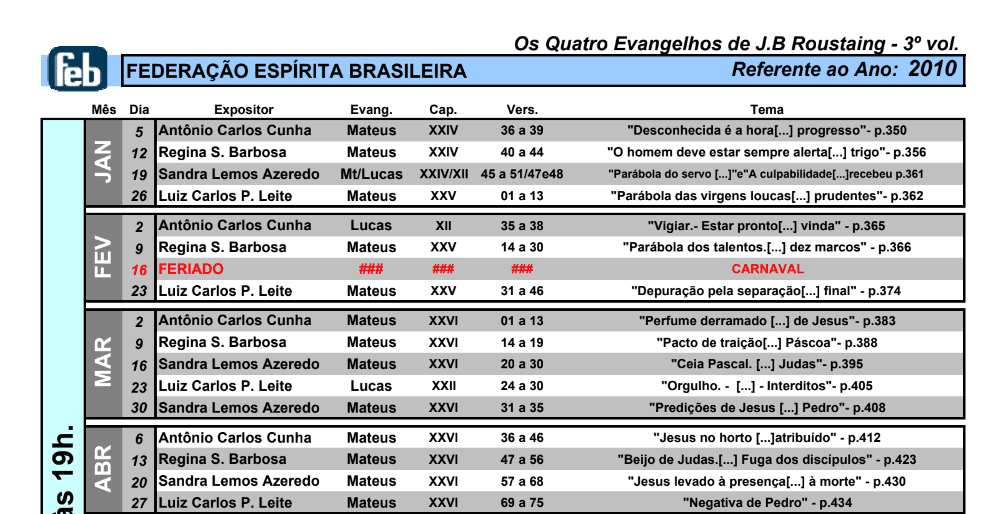
We could extend this article at length, demonstrating that the presidents of this institution have always been Roustainuists; that the FEB, as read in O Reformador, placed Roustaing above Kardec several times; that FEB, at the beginning of the 20th century, published the work The Gospels, by Roustaing, bringing, in the preface, a true affront to Kardec, Spiritism and confessed Spiritists. We will leave this observation to the dear reader, who will find material available here, largely obtained from the FEB website itself (on Google, search like this: “site:febnet.org.br Roustaing”), proof of what we now say. We limit ourselves to highlighting the following image, obtained from a document from the FEB website:
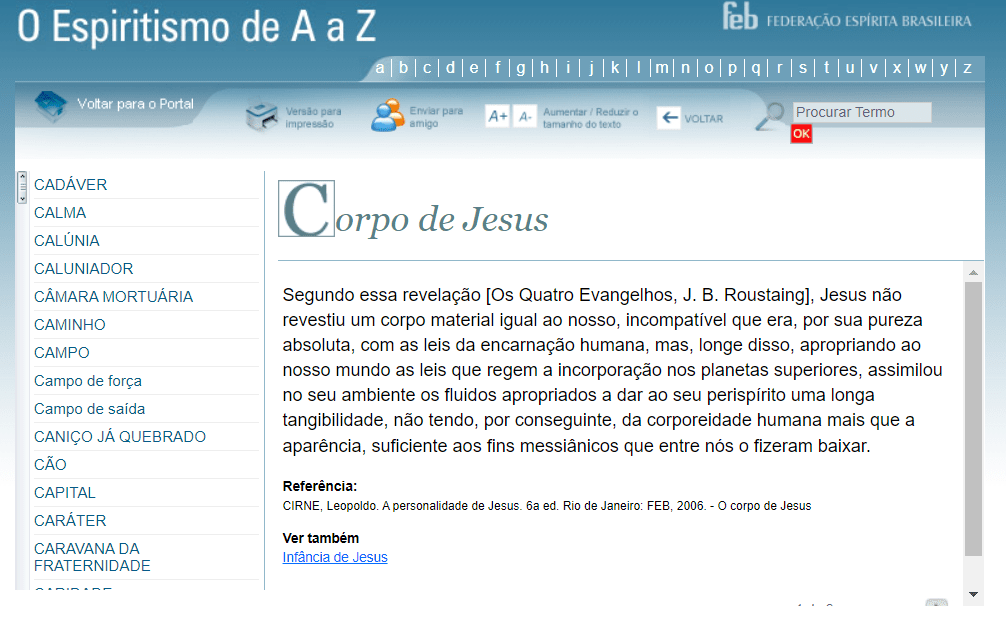
It is also important to highlight that, in the FEB domain, there is a glossary, “Spiritism from A to Z”, containing an explanation of terms and words — in the light of Spiritism, obviously? No. In the shadow of Roustaining:
No, the FEB (Brazilian Spiritist Federation) hasn't abandoned Roustainguism. As you can see in the image below, obtained from the official FEB Instagram account, on May 19th, two lectures (not yet published) based on QE (Questionnaire Experimental), which is nothing more than... Roustaing's Four Gospels!
Spiritist Movement away from Spiritism
We will, however, focus on evaluating the effects of a Spiritist Movement formed by the FEB:
Spiritists who are unaware of Spiritism; spiritists who are afraid of Spirits; spiritists who do not evoke the Spirits, questioning the obviously misleading communications; spiritists who blindly believe in the communications of Spirits, accepting everything as a “doctrinal complement”; spiritists who do not practice mediumship at home, believing that this would attract obsessors and that – an absurdity – only in the spiritist center would they have protection from good Spirits, if they did not go to the homes of well-intentioned people; spiritists, in short, who reproduce various false ideas, gleaned from blindly accepted communications and the opinions of idolized mediums, causing real embarrassment to Spiritism and giving ammunition to its critics.
We should mention that, among these idolized mediums, is Divaldo Franco, who, in the words of Augusto dos Anjos:
Divaldo Pereira Franco, the first centenarian, made the statement to me personally more than once that there is no way to explain the Gospels except in the light of the “Revelation of Revelation”. Would it be a reserved position, just for my private knowledge? Of course. First of all because good men do not have to, under any pretext, form dubious positions, one public and the other for private friends. This aphibological behavior does not belong to spirits of good morals. Afterwards, because the esteemed Bahian medium has already made the same statement from the platform, at the top of his lungs, from the height of authority and resounding that we recognize in him and that have served so much to the spiritual enlightenment of all of us, spiritists from Brazil and outside Brazil . To prove this, I transcribe below, «verb ad verbum», the most recent words of Divaldo Pereira Franco spoken from the top of the rostrum of the Grupo Espírita Fabiano (one of the most serious and well-oriented groups that exist in Guanabara), in night of October 6, 1969, with the auditorium being overcrowded as usual. Here is an excerpt from the memorable speech, recorded on magnetic tape, with the speaker's knowledge:
“For many years I didn’t understand. I went to Roustaing, which is my inexhaustible source of evangelical study! For almost twenty years I have been reading the benefactor João Batista Roustaing, meditating on his little words, on Mrs. Collignon's beautiful information, coming from Spirituality. But it’s a wonderful interpretation!”
ANJOS, Luciano dos. One taste and 4 cents. Reformer, Rio de Janeiro, p. 9-11, Jan. 1970. Extracted from the book The Zero Position.
Unfortunately, this was not the only case of an idolized medium or his psychographics defending the figure of Roustaing and his ideas, as you will see in this article. We remember that, here, we are discussing ideas, and not judging people.
It is evident that, although not all of the Spiritist Movement is affiliated with the FEB, the tentacles of Roustainuism and mysticism have enveloped the entire Brazilian Spiritist Movement. Unfortunately, these tentacles also crossed the oceans…
Campaign Plan
We see, finally, the “prophecy” made in 1867 and presented in the Revista Espírita of August of the same year, article “Campaign Plan” fulfilled:
Annihilating it is, therefore, an impossible thing, because it would be necessary to annihilate it not in one point, but in the entire world; and then, aren't ideas carried on the wings of the wind? And how to achieve them? You can pick up packages of goods at customs, but ideas are intangible.
What to do, then? Trying to take control of them, to accommodate them to your will… Well then! It is the party for which they decided. They said to themselves: Spiritism is the precursor of an inevitable moral revolution; before it is completely realized, let us try to divert it to our advantage; let us do it in a way that happens with it as with certain political revolutions; By denaturing its spirit, another course could be given to it.
So, the campaign plan has changed… You will see spiritist meetings being formed whose confessed objective will be the defense of the Doctrine, and whose secret objective will be its destruction; supposed mediums who will have communications ordered, suitable for the purpose they propose; publications that, under the cloak of Spiritism, will strive to demolish it; doctrines that will take some ideas from him, but with the thought of supplanting him. This is the fight, the real fight that he will have to sustain, and that will be fiercely pursued, but from which he will emerge victorious and stronger.
The much-desired unity of the Spiritist Movement will not occur through affiliation with an institution that is more similar to the Catholic clergy. No. This, in fact, goes against the plans for Spiritism, idealized by Kardec in the Spiritist Magazine of December 1868 — Transitional Constitution of Spiritism. This unity will only occur among those who, willingly, delve into the study of spiritist science, returning to, after that, practice mediumship at home, in small, harmonious, cohesive groups, carrying out the analysis of communications and evocations. These groups, spread far and wide, collaborating with each other, without any submission to the control of an institution, but rather to the control of the generality of the teachings of the Spirits, subjected to the sieve of reason, they will then be able to return to work on doctrinal development. Not before, not without it.
Therefore, we highlight the need the formation of study groups – at home, over the internet, at the spiritist center – for the dedicated study of Kardec’s works unadulterated and contextualization works. We leave here our modest collaboration in this regard: Semear Project — Formation of Study Groups.
On the day that the Brazilian Spiritist Federation accepts its deviation, committing itself to reparation and withdrawing from the purpose of determining the direction of Spiritism in Brazil, we will once again value it. Not before, not without this.
Semear Project — Formation of Study Groups
Welcome
Welcome to this journey, friends of Kardec! What a satisfaction to see you here, dear souls, seeking the learning that is so important and from which the spiritists have strayed a long time ago….
Pay attention to the formation of this group or others. The initiative is serious and the matter is serious. The enemies of the doctrine are once again agitated, as it now returns, with all its strength, to fulfill what it set out to do, more than a century ago. Humanity screams: my God, where are the answers? Not finding the desired happiness, day after day, without obtaining satisfactory answers, they throw themselves into the hardships of unbridled materialism, sensualism, addictions and, many, unable to bear it or not having greater prospects, end up taking their own lives, to discover After all, it was of no use.
The matter, you see, is serious, and serious is the responsibility of all those who withdraw from study, out of pride and vanity, to give others the dismal aspect of opinions built on distortions and adulterations.
The time has come, my friends, to reestablish what was left behind. The time has come to multiply efforts and sow seeds everywhere. But be careful, because the enemies of good, sad individuals who have not yet managed to understand the hole they are digging for themselves to fall into, will try to establish themselves among you. Keep your guard up, therefore, and do not shy away from the responsibility of maintaining harmony in the group, approaching each person who brings disharmony or disorder.
Trust this group, The Legacy of Allan Kardec, which has the particularity of being a rare group, on this planet, formed with so much identity, so much harmony, so many serious purposes, established in the past, to work for the recovery of this forgotten Doctrine.
Be walking prayers, for your internal dispositions and for the application of the principles learned to your own lives, and you will maintain, with you, the company of good Spirits, incarnate or disembodied. Do not forget: the good Spirits, your guardian angels or protective Spirits, bless this endeavor and will be with each one of you, inspiring and intuiting you.
Union, faith, love and charity: this is the motto that each individual must carry in their chest, applied in all their understanding and in all its extension, to themselves and in contact with others.
Union: the unity guaranteed by the legitimate purposes and adequate understanding of Spiritism
Faith: reasoned faith, so forgotten by the Spiritist Movement, built from the rational understanding, without possible doubt, of the principles of the Spiritist Doctrine.
Love: love for others, as well as for yourself. It takes patience and perseverance with oneself, as well as recognition of the steps already taken, the path already taken. The same should be applied to others.
Charity: true charity is a moral duty, fulfilled without hope of reward or recognition. It's sharing, learning and teaching. This is good, happiness, and it is by removing oneself from this role that the individual throws himself into the cliffs of personalism, selfishness, pride.
From now on, forget the novels, forget what you learned in the Spiritist Movement or at the Spiritist Center. From now on, you're starting from scratch and will learn Spiritism the right way!
General orientations
The idea is to help in the formation of a new group or more, where the participants will take care of organizing themselves in this regard. We will provide all the necessary guidance and support. We need one or more people to present themselves as initiators of the group's central nucleus, in a proactive way.
The proposal is that you create one or more groups, organizing yourselves among yourselves. We will be, together with my group, in the role of supporters and advisors.
From time to time, we may prepare special studies, with the participation of the Study Group The Legacy of Allan Kardec, or you and us.
Start by studying “Autonomy: the untold story of Spiritism” and “Mesmer: the denied science of animal magnetism”, by Paulo Henrique de Figueiredo. Alternatively, watch the videos highlighted in the topic Study materials.
We encourage you to necessarily start by studying the Revista Espírita. After studying the first two years, while continuing this study, you may see the need to create a new schedule to study The Book of Mediums. In this point, you will be much more mature for this study.
The study must be live, via video or in person. WhatsApp is a support tool.
There must be no teachers. Everyone must put themselves in the position of a student who knows nothing about Spiritism. That's how we started.
Suggestion:
Divide the topics of the month between us, where each one will be specifically responsible for “presenting” an article.
Everyone will have their responsibility to try to read everything.
At the time of the meeting, the person in charge will highlight what he understood, points of interest, doubts, may ask questions to stimulate, etc. This way the group leaves the boring reading.
Anyone who does not study beforehand will end up having the possibility of not adequately understanding the content. This is a stimulus to study.
Studies seen as requiring special attention may also be seen in a special way, with everyone's contribution.
Evocations and spontaneous communications, as well as texts of special importance, can be read in full, but, if studied in the proposed way, they will bring many more contributions;
Create rules. See our suggestions in the following topic, Rules suggestion.
Learn not to systematize conclusions about the articles in Revista Espírita. Kardec makes it very clear when any study is properly completed, at least for the moment. Many articles are presented as hypotheses only.
Create documents on Google Drive with the content of each study, and carry out a prior study, making notes and comments in this document. This helps to enrich learning.
Don't aim for numbers. Prefer quality. Study in small, cohesive, harmonious groups, and do not be afraid to draw the attention, with firmness and charity, of those who may disagree with the rules and harmony of the group.
Leave mediumistic novels and other works aside. Studying the contextualization works and the works of Kardec will already take years.
Do not seek practical Spiritism (mediumistic meetings) at first. If there are mediums among you, especially those with very strong mediumship, it is important to form a separate group, even more cohesive and harmonious. A lot of care will be needed. In this case, do not hesitate to seek support from us.
Above all, don't forget to keep in touch with us. We will take care of registering your initiative(s) on our website and we will be very happy to be able to exchange experiences and learnings with you.
Just avoid producing long videos for YouTube. Focus, mainly, as learning is established, on producing short videos and, mainly, texts on blogs, in a collaborative way (texts on blogs are easily found in Google searches).
As much as possible, also involve young people in this learning work, either in their own groups or by encouraging them to form new groups. Spread this purpose.
Rules suggestion
Studies of the Spiritist Magazine, in a group
PURPOSE OF THE GROUP
Our main objective is to meet Spiritism in its essence and apply this knowledge in our own lives. At the same time, however, we want to do this in a simple, clear and friendly way, so that our studies are easily understood by the public, which is why we carry out a preliminary study and the elaboration of content, so that we can extract the best from each subject.
After each study, we aim to produce articles on this site that complement and formalize the study, but also allow the inclusion of hearing impaired people. This is mainly why the studies need to be simple and, at the same time, profound as possible.
Unlike other studies on Spiritism, which start from conclusive works, we are starting from a journal that demonstrates Allan Kardec's method of exploration, reasoning and deduction, in the construction of Spiritism (here understood in the human part of this science). There is enormous gain in doing so, but we are not unaware of the issues that need be complemented with subsequent conclusions, so as not to be “lame”, as is the case with fluid theory, abandoned by Kardec in his final work, A Genesis.
The Spiritist Magazine, unlike other works, is a periodical that combines:
subjects and “stories” of the time — which, far from being uninteresting, served to support the Doctrine, based on the daily life of spiritist facts experienced among the world population, but which, from the current point of view, is often not very relevant to our study.
writings much denser and well elaborated by Kardec, with extreme perspicacity, that little by little, and in a very organized way, build all this science that is Spiritism — a science that is currently unknown and forgotten.
The importance of Revista Espírita is not only moral, but also practical. By studying it, we see a constant construction of knowledge, at the same time that we constantly see a deconstruction of current false concepts, as you it needs understand in the article “What is the Spiritist Magazine and how to study it?". Here is one more reason for the format of our study, because false concepts are not broken by blows.
Spiritism needs to be rescued and known in its essence, both moral and practical, so that we can resume the studies of this Doctrine, together with the Spirits. This study plays an important role in this regard.
Today we know, after all, that this science did not walk alone: far from it, it was a development of the Rational Spiritualism and a “twin sister”, as Kardec said, from Magnetism. That is why, in due course, we approach this knowledge, in a simple, practical and punctual way, since, to delve deeper into these two themes, we always recommend reading the works Autonomy: the untold story of Spiritism and Mesmer: the denied science of animal magnetism, both by Paulo Henrique de Figueiredo, among others (see our list of recommended works).
Premises
In this group, we start from the conclusion that Kardec's last two works, O Céu e o Inferno and A Gênese, were adulterated. We can indicate why we reached this conclusion, but we will not argue about it, since the facts are there for everyone to verify.
In this group, Spiritism is studied based on the works of Kardec, necessarily. This does not mean that other works and other authors cannot be treated, but this will be done as long as what is sought is the search for understanding and approximation, based on Spiritism, and not for mere confrontation.
The most basic premise of all is the study. Having randomly read The Spirits' Book or The Gospel According to Spiritism is not study. We are far from having fully understood the doctrine, but there are fundamental points that require dedication to be understood. Count on the group to indicate and suggest paths and contents of importance.
TECHNICAL RULES
Join our groups Whatsapp It's from telegram. It is through them that we will maintain direct communication with the other members. If you have both, enter both.
will not be given To nobody the right to give final words on what is not duly established in the Doctrine. However, care will be taken to ensure that, in order to comply with this rule, rules no. 4, 5 and 6.
Just as Kardec dealt with the opinions of disembodied spirits, we treat the opinions of incarnated souls, that is, what is just an opinion will be treated only as a simple opinion and we will not make systems out of it.
We must avoid that any theme that deviates from that main one or any point of discord is exhaustively approached during the study, so that there are no deviations and monopoly of words or opinions. What to do in these cases: seek to study, in Kardec, the subject in question and present, at a new opportunity, the results found. Failure to comply with this rule of good manners will be promptly stopped through the intercession of administrators.
Everyone is free to come to their own conclusions, guided by their own reason, safeguarding the objectives of the study and the doctrinal basis. For example, the theme about the existence of spiritual colonies is not properly consolidated, but the issue of reincarnation is. If what is consolidated, in the Doctrine, was not accepted by the reason of a certain person, he will certainly feel inclined to leave the studies, since they do not speak to reason. What will not be accepted will be the systematization of personal opinions in the group, as explained above.
Political and religious themes will not be addressed (this one, in the sense that it may bring any disquiet or humiliation. We remind you that Spiritism is open to people of all beliefs). Here, we paraphrase Kardec, in Spiritist Journey in 1862:
"[…] one should refrain, in meetings, from discussing particular dogmas, which would certainly offend certain consciences, while questions of morality are of all religions and all countries. Spiritism is neutral ground on which all religious opinions can meet and join hands. Now, disunity could be born of controversy. Do not forget that disunity is one of the means by which the enemies of Spiritism seek to attack it; it is for this purpose that they often induce certain groups to occupy themselves with irritating or compromising issues, under the specious pretext that one should not put light under a bushel. Do not allow yourselves to be trapped in this trap, and that the leaders of groups be firm in rejecting all suggestions of this type, if they do not want to pass as accomplices in these machinations”.
The group does not currently aim to carry out any type of “mediumistic work”, which, if it ever happens, will require the creation of private meetings and with due care to do so.
For the same reason as above, we do not see the need to be so restrictive with regard to new adhesions, that is, new adherents do not need to be versed in Spiritism, but they must, on their part, carry out the necessary basic studies, when they do not know the essence of the Spiritist Doctrine (which is not the one acquired by reading novels). For this purpose, we recommend at least reading the brochures What is Spiritism and Spiritism in its simplest expression.
Our study meetings are broadcast live on Youtube, or are recorded for later publication on this platform and others. Everyone who participates in the studies must be aware of and agree with this fundamental point.
The Group uses the website https://www.geolegadodeallankardec.com.br and various virtual platforms to promote Spiritism. Anyone who feels interested in being part of this, creating texts that can help, should contact the Group's administrators.
All digital media have other collaborators, also placed in management roles, who can take care of the continuation in the eventual absence, for a limited or indefinite period, on my part.
We will take the liberty of stopping any audio or cameras that are interfering with the meeting.
By participating in the Zoom meeting room, you are aware that your audio and/or video will be shared publicly over the Internet (more information in the registration form, below).
The official start time of studies, with the broadcast via YouTube, is 19:25.
The period allowed for the entry of participants, in the waiting room (where we will or will not approve your entry, depending on whether or not you fill in the form below) runs from 19:10 to 19:25. After that, entry permission will be at the sole discretion of the group hosts.
The meeting is expected to end at around 20:40, sometimes extending a little longer.
Before entering, make sure you are in a favorable environment for participation., both visually and sonically, in addition to being dressed appropriately.
Preferably, use a computer for participation, where it will be easier to interact through the group chat.
For organizational reasons, the Zoom meeting and its didactic content are conducted by a member, who will coordinate the participation of one and the other who wish to express themselves.
When taking the floor, be careful not to extend the subject too far into areas that deviate from the main theme. Remember: there are 11 years of Journal to cover, among accessory articles and fundamental articles, often with contents intrinsically linked between different editions, and, even more, together with complementary doctrinal contents, both by Kardec and by other authors. We don't want to run but we can't waste time.
All those who wish to actively participate, questioning or giving their opinion on the articles in question, must observe the following organization:
— Read articles related to the topic BEFORE the study meeting. This will allow you to always be on top of issues as they can be addressed in the time available and the scope of each issue. We reiterate: the Spiritist Magazine, for group studies, is not something that can be read line by line, without a previous reading, since many subjects present a formidable extension.
Suggestion:
Divide the topics of the month between us, where each one will be specifically responsible for “presenting” an article.
Everyone will have their responsibility to try to read everything.
At the time of the meeting, the person in charge will highlight what he understood, points of interest, doubts, may ask questions to stimulate, etc. This way we get out of boring reading
Studies seen as requiring special attention may also be seen in a special way, with everyone's contribution, as was the case with remorse and as could be the case, perhaps, with phrenology (RE60/jun)
Evocations and spontaneous communications, as well as texts of special importance, we believe should be read in full, but, if studied in the proposed way, they will bring many more contributions.
22. Don't get discouraged if you need to get away for a while or if you can't always be there. It happens to everyone. Continue your studies on your part and come back as soon as possible.
23. Finally, I reiterate our objective of building on dialogue. So, help us to establish this dialogue, using social networks for this too.
Fill in the following form with the data necessary for admission to the meeting. We will not accept entries from unregistered persons.
Photo by Greta Hoffman: https://www.pexels.com/pt-br/foto/jardim-fazenda-sitio-chacara-7728883/
Karma does not exist: the laws of the soul according to Spiritism
According to the original work by Allan Kardec, Heaven and Hell, before adulteration ((The original work, from Editora FEAL, can be downloaded by clicking on here )), the laws of the soul are simple, logical and completely consistent with divine goodness. There is no karma, law of return, etc.
Briefly:
Happiness and Unhappiness
Joy, pain, pleasure, fear, sadness are emotions generated by physiological reactions. Good and bad Spirits pass through all of them, so that one can be good and be sad or bad and be happy.
Happiness and unhappiness are conditions of the Spirit. Happiness is being in good — the only thing that exists in Divine Creation — corresponding to being in a state of collaboration: learning, assisting, helping, teaching.
True charity, therefore, is doing good out of moral duty, without expecting a return or trying to control the result. That is why Kardec says that the motto of Spiritism would be “outside of charity there is no salvation”.
The problem is that the error persists
In the development process, making mistakes is part of it, coming from choice, from trying. The problem is persisting in the error, willingly.
When the individual persists in error, because he enjoys his false ideas, he moves away from good. Pride, selfishness and all other imperfections arising from them arise. Not everyone does this.
By repeating the error, the individual acquires an imperfection that settles in them. Far from the good, where happiness exists, he becomes unhappy, as he cannot find satisfaction. He may be happy, distracted by material things, but he is not happy. Not infrequently, he even commits suicide…
It is in this state that evil exists, and only in it: for the individual far from good, WHILE he is far from good.
Conscience: our only judge and executioner
The divine law is engraved in our consciousness (The Spirits' Book, q. 621). The individual remains in this state, knowing that they are making a mistake, but ignoring their conscience, for more or less time, until it awakens for some reason.
When conscience awakens, remorse comes, the awareness of having made the mistake. This causes great moral suffering and, even worse, when people make mistakes voluntarily.
The moral suffering caused by remorse lasts as long as the Spirit refuses to sincere repentance. It can last centuries.
Repentance leads the Spirit back to happiness
When the Spirit sincerely repents, moral suffering ends and happiness resurfaces with the will to return to good, with decision. The need for repair arrives.
Repair consists of CHOOSING a new incarnation, with certain tests and opportunities, aiming to overcome the imperfection created by one's own will. This is atonement, and is therefore not a divine punishment.
Repairing does not NECESSARILY mean being reborn with your victims, as they may already be long gone, while you were left behind, attached to the error. To repair is to correct the deviation taken, in the effort of detachment.
In this way, we see that autonomy and free will are the only rule of divine law. Everything according to our choices and our time, within divine law. But the Law determines that we will all achieve happiness, without exception.
Teachings of Jesus
We see, then, the figure of the parable of the prodigal son: despite the father's warnings, the son goes to the world of pleasures. He loses everything, becomes remorseful, suffers, regrets and then returns home, humiliated...
His father welcomes him not with a punishment, but with open arms, AND STILL HAS A PARTY, and then RESUMES WORK. Your son has already had the punishment, caused by his own conscience, true judge and executioner of ourselves.
Jesus always demonstrated a God of full love, not a God of revenge. It was like that with the thief nailed to the cross next door, it was like that with the adulterous woman and with so many others...
Spiritism, as a result of spiritist science, only reinforces what Jesus already demonstrated: there is no karma, there is no punitive God. The punishment is carried out by the individual himself, for deciding to move away from good.
True Spiritism does not teach karma, it does not judge the individual's past based on their present physical suffering, it does not affirm that physical suffering is deserving or repaying debts.
Recommended Books
– Heaven and Hell, from FEAL (unadulterated edition – link in bio)
– Autonomy: the untold story of Spiritism, by Paulo Herinque de Figueiredo
– Neither Heaven nor Hell: the laws of the soul according to Spiritism, by Paulo Herinque de Figueiredo and Lucas Sampaio
Photo by Olga: https://www.pexels.com/pt-br/foto/mulher-de-vestido-amarelo-em-pe-no-campo-de-flores-de-petalas-rosa-1146242/
Floods in Rio Grande do Sul: collective rescue? Debts from other lives? Karma? What does Spiritism say?
Once again, with some concern, we find ourselves forced to go public to defend the victims of these disasters and their families, as well as Spiritism, from the true absurdities uttered by certain irresponsible mouths. This time, the victims of this terrible disaster related to the floods in Rio Grande do Sul did not escape:
In other words: the idea, for these individuals careless, is that the people who lost their lives or who suffered the effects of the floods, are guilty Spirits, involved with the Farrapos War and who, now, would be “paying their debts” through this suffering. Terrible thought, lacking charity, logic and rationality, uttered by individuals who are very lacking in the true knowledge of Spiritism! Do they forget that many of the soldiers involved in all the battles didn't even want to be there? That they were forced to kill in order not to die?
We have already talked about this topic several times, directing the reader to appreciate the articles
Here we limit ourselves to reinforcing that is part of our evolutionary stage, incarnated on this planet, being subject to natural calamities, which affect the good and the bad, without distinction, causing changes, learning, etc. and that, as demonstrated in the articles cited, our relationship with God is not one of debit and credit, error and punishment, etc.
It is worth recovering, here, the important and clear questions on the topic, according to The Spirits’ Book:
737. To what end does God hurt humanity through destructive scourges?
“To make it progress faster. Haven't we already said that destruction is a necessity for the moral regeneration of Spirits, who, in each new existence, move up a step on the scale of improvement? I need to see the objective, so that the results can be appreciated. Only from your personal point of view do you appreciate them; hence why you classify them as scourges, due to the harm they cause you. These subversions, however, are often necessary so that a better order of things can emerge more quickly and so that what would have required many centuries can be accomplished in a few years.” (744.)
738. To achieve the improvement of humanity, couldn't God use other means than destructive scourges?
“Yes, and he employs them daily, since he has given each one the means to progress through the knowledge of good and evil. Man, however, does not take advantage of these means. It is necessary, therefore, that he be punished in his pride and that his weakness be made to be felt.”
The) - But both the good and the wicked man succumb to these scourges. Will this be fair?
“During life, man refers everything to his body; however, he thinks differently after death. Now, as we have said, the life of the body is very little. A century in your world is nothing more than a lightning in eternity. Therefore, nothing is the suffering of a few days or a few months, about which you complain so much. They represent teaching that is given to you and that will serve you in the future. Spirits, which pre-exist and survive everything, form the real world (85). These are the children of God and the object of all their solicitude. Bodies are mere disguises with which they appear in the world. On the occasion of great calamities that decimate men, the spectacle is similar to that of an army whose soldiers, during the war, had their uniforms damaged, torn, or lost. The general cares more about his soldiers than about their uniforms.”
B) - But that doesn't mean they are no longer victims of these scourges.
“If you considered life for what it is, and how little it represents in relation to infinity, you would give less importance to it. In another life, these victims will find ample compensation for their sufferings, if they know how to bear them without murmuring.”
Whether death comes from a scourge, or from a common cause, no one stops dying as long as the hour of departure has struck. The only difference, in the case of a scourge, is that a greater number leave at the same time.
If, through thought, we could rise to contemplate all of humanity and embrace it as a whole, these terrible scourges would seem to us to be no more than passing storms in the destiny of the world.
739. Are destructive scourges useful from a physical point of view, despite the harm they cause?
"He has; conditions in a region sometimes change. But in many cases, the good that results from them is only experienced by future generations.”
740. Aren't scourges also moral tests for man, tests that confront them with the most distressing needs?
“Scourges are tests that give man the opportunity to exercise his intelligence, to demonstrate his patience and resignation before the will of God, and that offer him the opportunity to manifest his feelings of abnegation, disinterest and love for others, if not is dominated by selfishness.”
We reinforce again: Spiritism demonstrates that there is no karma, law of return, punitive God, etc. We offer our prayers for all the victims of these tragedies, we declare our perplexity at those who are deliberately making it difficult the rescue work, carried out by citizens, and we ask God to enlighten the thoughts of those who mock the tragedy or wish harm on others, as the path to good will be theirs costly.
Our sincere condolences to the fatal victims of the floods in Rio Grande do Sul and to those who lost everything. May they never lose sight of what true good is, the face of which we have seen in the attitudes of the citizens acting there.