The path is winding, long, rocky and full of thorns, but we have to walk it.
Dear friends, brothers who are attached to this initiative,
Once again, we invite each of you to participate actively in our group and to spread the essential ideas of Spiritism that, little by little, are beginning to be rediscovered and understood. It is in the interest and responsibility of all of us to restore, peacefully and patiently, but persistently and firmly, the original truths of this Doctrine born from the rational observation of the Spiritist teachings given everywhere and for all times! No longer an adulterated Spiritism, after Kardec's death, in order to give space to the retarding ideas of sin, fall and punishment, of karma, of rescues, but the Doctrine in its essence, based on the realization of free will, of choice of proofs and atonements, finally, the Doctrine that shows us that our step is always towards learning and spiritual progress, making part of this journey the mistakes and setbacks of each one, the same Doctrine that showed us, in its essence , not a pure soul created and deviated by sin, a simple and ignorant created Spirit and that, as it advances in its experiences, through mistakes and successes, joys and sufferings, it purifies itself of its imperfections and its materiality towards the true happiness of the superior spirits, already detached from these same imperfections and materiality through the acquisition of better habits and moral values.
It is natural, however, that such liberating and renewing ideas find resistance both in proud ignorance, closed to the reform of ideas, and in knowledge interested in keeping the class of faithful to the old doctrines under their wing. Even within Spiritism, such ideas of fall, sin and redemption are deeply rooted, as the adulterations come from a few months or years after the death of the worthy professor Rivail.
It will not be on the basis of wars and disputes, however, that we will discover this path full of briars and thorns, but on the basis of lucid understanding and a firm but friendly word. Let us avoid wasting time with those who make up the classes highlighted above, because both have no interest in changing their ideas in the face of irrefutable truth. For these, only time will have an effect. Let us invest our time, however, in the class of all those to whom these ideas not only please, but to whom they are substantial: those who no longer see any pleasure in life, those who think of giving it up, those who do not understand a vengeful God, who, in short, do not understand the reasons for day-to-day difficulties, or even to those who, of good will, wish to study Spiritism in its essence, in order to transmit, to all who can, the reforming and consoling ideas of this Doctrine in its originality.
Let us roll up our sleeves, therefore, dear brothers. Inaction does no one any good. Let's do our part. I, the author of this text, am here today, for a much loved Spirit who reached out to me in the most difficult moment of my life and for another, incarnate, who insisted on, daily and without any thanks, to spread a spiritist reflection in a WhatsApp group that was and still is forgotten why they formed a family in the spiritist center that, because of the pandemic, is now closed.
A gesture is often enough to change a life, an opinion, and, from there, start a movement. Onward, dear ones, and may God enlighten us all so that, in this process, we never let ourselves be contaminated by personalism, vanity, selfishness and pride.
The path is winding, long, rocky and full of thorns, but we have to walk it and clean it for the next generations, of which we will probably be a part again.
ANOMALIES AND DEFORMITIES FROM THE SPIRITIST PERSPECTIVE
Views: 66 Various anomalies and deformities. Cretinism, mental, physical, intellectual disabilities. When questioning the reason for such physical complications, in the spiritist world, how many times have we heard: “it’s because so-and-so is repaying a past debt”. And for how long do we take comfort in this malicious and slanderous statement, made in a generic way?! But not anymore today. […]
After the irrefutable confirmation of changes to the two final – and fundamental – works by Allan Kardec, Heaven and Hell and Genesis[1], we were able to verify that such concepts were never part of the Doctrine of Spirits, being it originally and essentially based on free will, that is, on each one's ability to choose. However, such ideas still face great resistance, as many are those who come from a creation, including a spiritist one, which affirms the concepts of fall, sin, punishment, ransom, karma, etc.
O article of the same title, presented in Blog Spiritist Letters, hits on many points, but also brings this type of concept (debt and redemption), at a certain point, when using a statement by Suely C. Schubert (“The sick spirit, in debt“) and also when using a text from O Céu e o Inferno, based on the adulterated 4th edition.
Action and Reaction – what is it?
It is one thing to identify, as Kardec found in the law of successive reincarnations, that every effect has a cause, and that, almost always, this cause is found in previous lives. Another thing, quite different, is to say that every morally negative action will have a reaction in order to punish the original action in order to repair an alleged sin. This, within the scope of the Spiritist Doctrine, is a fallacy. Action and reaction is a material law of physics, not a moral law. So much so that there is no such law among those presented in The Spirits' Book.
Rescue?
Unfortunately, many modern spiritualists and spiritualists insist on preaching in people's heads that their pain, difficulties and current tragedies are "ransoms" of past debts, forgetting that, if on the one hand the Spirit can impose suffering for the purpose of to overcome the imperfections that made him fall before, on the other hand, hard tests can also be imposed that have nothing to do with past mistakes, but only as rich opportunities to learn virtues and to overcome aspects related to imperfections that have nothing to do with them, directly, with the type of evidence chosen. Thus, a Spirit may choose blindness only to be able to deal with the need to depend on the help of others, and not because it has blinded someone in previous lives. In fact, the whys are NOT FOR US TO PROBATE: it is only up to us to be charitable and help everyone along the way.
debts?
We need to understand that the “indebted” Spirit is not indebted to God or to any law, but rather to himself, and for believing so (this is very important). Because we all have the divine Laws in our consciences - a fact that makes us Spirits with free will - as long as we are not in denial, our own conscience accuses us of the mistakes made, for which we blame ourselves, as well as pointing out imperfections to us. that cause us moral pain. This is how a Spirit who, in the previous incarnation, had animated a rich and selfish man, often chooses poverty in the next incarnation, in order not to embark on the difficult path and so full of responsibilities that earthly riches bring.
I said “believe yourself like this” (indebted) because, when the Spirit really understands that what happened was a mistake, natural from its ignorance and imperfections, and that these imperfections and ignorance make it suffer, it ceases to believe itself a sinner. and deserving of punishment to understand himself as a Spirit in evolution, seeking, then, new proofs and atonements that give him the opportunity to learn and get rid of his imperfections, developing better virtues. Furthermore, he also understands that everyone is liable to mistakes and, therefore, he stops putting himself in the condition of collector and avenger. This is substantial, and this is what Spiritism essentially came for.
We are not saying, with that, that there are no physical consequences that the disturbed Spirit causes to appear on their body, since we know about the psychosomatic relationships that we keep with our body. But we are stating, based on the study of Spiritism in its originality, that WE CANNOT look at an individual with any deficiencies and affirm that this is because he is a “indebted” Spirit, as much as WE CANNOT (because it would be a mistake as much factual as well as moral) to tell a mother who lost her child by burning in a fire that "this happened because her child must have been a soldier in X's time who burned people". This is terrible, it causes revolt and distances people from Spiritism, a fact about which we will respond – in front of our own conscience.
Based on an error, another error is produced
Finally, I want to point out that the article in question makes the mistake – probably involuntary, due to lack of information – of basing itself on the adulterated version of O Céu e o Inferno, since it has already been duly and undeniably proven that the 4th edition of the work , bringing profound changes in the original thought, was not commissioned until after Kardec's death, not to mention that the careful comparative study of these changes indicates that the content was modified precisely to insert the concepts of sin and punishment that were never in the Doctrine of Spirits and that, although Kardec may have presented some previous thought in the sense of this belief, in the original work, from the first to the third edition (which are the same) it concluded precisely in the opposite direction.
See, in this sense, the differences between the original and what appears in the 4th edition:
[ORIGINAL] “The mentally handicapped are beings punished on Earth for their misuse of powerful faculties. They have the soul imprisoned in a body whose organs are incapable of expressing their thoughts. This intellectual and physical mutism is one of the cruelest punishments on Earth. she is often chosen by the repentant spirits who want EXPIATE your faults”
[4th Edition] “Cretins are beings punished on earth for the misuse they have made of powerful faculties; your soul is imprisoned in a body whose impotent organs cannot express its thoughts; this moral and physical mutism is one of the cruelest earthly punishments; often it is chosen by repentant spirits who want to REDEEM their faults”
Note that the meaning changes completely when talking about “rescuing” and when talking about “expiating”. As Paulo Henrique de Figueiredo says,
“To explain the laws of the soul according to Spiritism, while Christianity revives, restoring the true message of autonomy, as Jesus did, Allan Kardec will resignify terms such as punishment, repentance, atonement, reparation, eternity of penalties. The difference between punishment and atonement is the primordial point to understand the moral theory of Spiritism. For while punishment is a natural response to any thought or act that goes against the moral law present in conscience, atonement is a conscious, voluntary and effective effort to overcome one's own imperfection, through the choice of evidence. Ancestral religions reverse the meaning of these phenomena, dogmatically confusing punishment with atonement, as if they were one and the same. Furthermore, they consider punishment to be a deliberate choice of God and not a natural consequence.”
Figueiredo. Neither Heaven nor Hell: The Laws of the Soul according to Spiritism
There is also something very, but VERY important in practically ALL communications of this type, by the Spirits: the word CHOICE. Yes, there are proofs, there are expiations and there are punishments, even the most severe ones, but they are always CHOICES of the Spirit. See that, further on, in the same message, the Spirit repeats:
“[…] Some revolt against their voluntary torture, regretting having it chosen and feeling a furious desire to return to another life, a desire that makes them forget the resignation with the present life and the remorse of the past life that they keep in their conscience”. (Heaven and Hell, 3rd Edition)
[1] Consult the works O Legado de Allan Kardec, by Simoni Privato, and Neither heaven nor hell: The laws of the soul according to Spiritism, by Lucas Sampaio and Paulo Henrique de Figueiredo
“Do I know who I was in other lives? How can I know what I came to rescue on this journey of mine?”
It is not necessary.
The veil of oblivion has its reason for being and, many times, knowing about the other life brings more trouble than solutionIt's something that a serious person would never do, but unfortunately, there are individuals who are more interested in profit and who, irresponsibly, embark on this type of "work."
By observing ourselves with a very critical and honest look, verifying our own imperfections, we can easily identify what puts us in difficulties in the face of life situations, understanding, then, that these difficult situations are precisely opportunities, often planned by us. ourselves, in order to overcome these imperfections and move towards true happiness.
Finally, I emphasize that, according to the Spiritist Doctrine, there is no “rescue”, there is no payment of debts, there is no such thing as “karma” in this sense: the Spirit, conscious and free, choose trials and atonements (and opportunities) with the purpose set out above – overcoming imperfections and acquiring virtues – never, ever, the difficulties of life being the result of a divine mechanics, a concept linked to the dogma of the fall for sin. The only Spirit that does not choose its proofs is the Spirit in a state of denial., who still reincarnates, but who just lives a life that, by itself, in the face of the contents of this individual, will bring difficulties and moral pain, which one day will make him leave denial and go back to seeking to face these imperfections through conscious choices.
So, when facing a difficult test, don't think, "I'm paying for something or recovering something from the past," but rather, "This is a difficult but important learning opportunity. I'm going to make the most of it." And to that end, understanding Spiritism in depth is substantial!
Theory of Physical Manifestations II
Spiritist Journal — Journal of Psychological Studies — 1858 > June > Theory of Physical Manifestations II
The continuation of physical manifestations
We ask the reader to refer to the first article we published on the subject. This is its continuation and would be barely intelligible if that beginning were not in mind.
As we said, the explanations we have given for the physical manifestations are based on observation of the facts and on their logical deduction: we conclude according to what we have seen. How, however, do the modifications that make it perceptible and tangible take place in etherized matter?
To begin with, we will let the Spirits whom we question about it speak, then add our comments. The answers that follow were given by the Spirit of São Luís and are in agreement with what we were previously told by other Spirits.
the fluid
1. ─ How can a Spirit appear with the solidity of a living body?
─ It combines a part of the universal fluid with the fluid that comes out of the medium suitable for this purpose.. This fluid takes the form that the Spirit desires, but usually this form is impalpable.
2. ─ What is the nature of this fluid?
─ Fluid. This says it all.
3. ─ Is this fluid material?
─ Semi-material.
4. ─ Is it this fluid that makes up the perispirit?
─ Yea, is the connection of Spirit to matter.
5. ─ Is this fluid that gives life, the vital principle?
─ Always him. I said Link.
6. ─ Is this fluid an emanation of the Divinity?
─ No.
7. ─ Is it a creation of the Divinity? ─ Yes. Everything is created except God himself.
8. ─ Does the universal fluid have any relationship with the electric fluid, whose effects we know? ─ Yes. It's your element.
9. ─ Is the ethereal substance that exists between the planets the universal fluid in question? ─ It involves the worlds. Without the vital principle, nothing would live. If a person were to rise beyond the fluidic envelope of the globes, he would perish, because his fluidic envelope of him would withdraw, to join the mass. This fluid animates you. It is he that you breathe.
10. Is this fluid the same on all globes? ─ It is the same principle, more or less ethereal, according to the nature of the worlds. Yours is one of the most material.
11. Since it is this fluid that composes the perispirit, there must be a kind of condensation state that, to a certain extent, brings it closer to matter. ─ Yes, to a certain extent, as it does not have its properties. It is more or less condensed, according to the worlds.
How Spirits Use Fluid
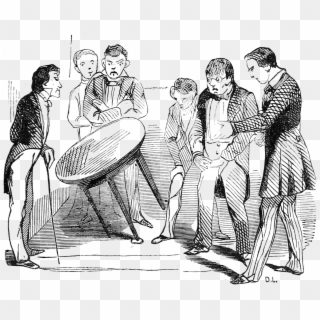
12. ─ Is it the solidified spirits that raise the table? ─ This question will still not lead to the point you want. When a table moves under your hands, the Spirit evoked by your Spirit will withdraw from the universal fluid that which will animate that table with an artificial life. The spirits that produce this type of effects are always inferior spirits not yet completely detached from their fluid or perispirit. The table, thus prepared at its will (at the will of the Beating Spirits), the Spirit attracts and moves it, under the influence of its own fluid, released by its will. When the mass he wants to lift or move is too heavy for him, he calls to his aid Spirits who are in conditions identical to his. I think I explained myself clearly enough to be understood.
13. ─ Are the spirits called to your aid your inferiors? ─ They are almost always the same. They often come by themselves.
14. - We understand that superior spirits do not deal with things that are inferior to them. But we ask if, because they were dematerialized, they would have the power to do so, if they wanted to? ─ They have moral strength, as others have physical strength. When they need that strength, they use those who have it. Have you not been told that they make use of inferior spirits as you make use of carriers?
Mr. home
15. ─ Where does Mr. man? [
─ From your organization.
16. ─ What is special about it? ─ The question is not precise.
17. ─ We ask if it is a question of your physical or moral organization.
─ I said organization.
18. ─ Among the people present there is someone who may have the same faculty as Mr. man? ─ They have it to a certain degree. Was it not one of you who moved the table?
The movement of objects and clothing
19. ─ When a person makes an object move, is it always with the help of a foreign spirit or can such an action be exclusive to the medium? ─ Sometimes the spirit of the medium can act alone. Most of the time, however, he is helped by the evoked Spirits. This is easy to recognize.
20. ─ How do Spirits appear with the clothes they wore on Earth? ─ Often she has only the appearance. Indeed, for how many phenomena among you you have no solution! How does the wind, which is impalpable, uproot and break trees, which are solid matter?
21. ─ What do you mean when you say that his clothing “is just an appearance?”
─ When you touch it, nothing is found.
22. ─ If we understand what you said correctly, the vital principle resides in the universal fluid; From it the Spirit extracts the semi-material envelope that constitutes its perispirit and it is through this fluid that it acts on inert matter. That's right?
─ Yes, that is, it animates matter by a kind of factitious life; matter is animated by animal life. The table that moves under your hands lives and suffers like an animal; obeys by itself to be intelligent. It is not he who directs it, as a man does with a burden. When the table rises, it is not the Spirit that lifts it. It is the animated table that obeys the intelligent Spirit.
23. ─ Since the universal fluid is the source of life, is it at the same time the source of intelligence? ─ No. The fluid just animates matter.
The objects moved, without external interference, before the eyes of the assistants.
Final considerations
This theory of physical manifestations offers several points of contact with the one we have given, although it differs in certain respects. From one to the other, a capital point emerges: the universal fluid, in which the principle of life resides, is the main agent of these manifestations and this agent receives the impulse of the Spirit, whether incarnate or wandering. This condensed fluid constitutes the perispirit or semi-material envelope of the Spirit. When incarnated, the perispirit is united to the matter of the body; when in a state of erraticity, it is free. Now, two questions arise here: that of the appearance of Spirits and that of the movement they impart to solid bodies.
As for the first, we will say that, in the normal state, the etherized matter of the perispirit escapes the perception of our organs; only the soul can see it, whether in dreams or in a somnambulistic state or even half asleep; in a word, whenever there is total or partial suspension of the activity of the senses. When the Spirit is incarnated, the substance of the perispirit is more or less closely linked to the matter of the body; more or less adherent, if we may say so. In some people there is a kind of emanation of this fluid, as a result of their organization and this is what properly constitutes the mediums of physical influences. Emanating from the body, this fluid combines, according to laws that are still unknown to us, with that which forms the semi-material envelope of a foreign Spirit. This results in a certain modification, a kind of molecular reaction that momentarily alters its properties, to the point of making it visible and, in certain cases, tangible. This effect can be produced with or without the help of the medium's will, and this is what distinguishes natural mediums from optional mediums. The emission of the fluid can be more or less abundant: hence the more or less powerful mediums. It is not permanent, which explains the intermittence of that power. Finally, if we take into account the degree of affinity that can exist between the fluid of the medium and that of this or that Spirit, it will be understood that its action can be exercised on some and not on others.
What we have just said evidently applies also to the mediumistic force, with regard to the movement of solid bodies. It remains to be seen how this movement operates.
According to the answers above, the question presents itself under an entirely new aspect. Thus, when an object is set in motion, snatched or thrown into the air, it will not be the Spirit that picks it up, pushes it or lifts it, as we would do with the hand: it, so to speak, saturates with its fluid, by combining with that of the medium and, thus momentarily vivified, the object acts as if it were a living being, with the difference that, having no will of its own, it follows the impulse of the Spirit's will. This will can be either of the spirit of the medium or of a foreign spirit and, sometimes, of both, acting in agreement, according to whether they are sympathetic or not. The sympathy or antipathy that may exist between the medium and the Spirits who deal with these material effects explains why not all are able to provoke them.
Considering that the vital fluid, somehow emitted by the Spirit, gives a factitious and momentary life to inert bodies and that the perispirit is nothing other than the vital fluid itself, it follows that, when incarnated, it is the Spirit that it gives life to the body, through its perispirit: it remains united to it as long as the organization allows it, and when it withdraws, the body dies.
Now if, instead of the table, the wood is carved into a statue, and if we act on it in the same way as on the table, we will have a statue that moves from the place, which will respond by movements and by blows; in a word, a momentarily animated statue of artificial life. What light does this theory throw on a host of hitherto unexplained phenomena! How many wonderful allegories and effects she explains! It's a whole philosophy.
Spiritism and karma (or karma), punishment, sin and punishment
We invite the reader to pay close attention to this group study, with the participation of Paulo Henrique de Figueiredo. It's a big change in our way of thinking, still so rooted in the old concepts of heteronomy (the other's fault). Karma (or karma), action and reaction, rescue... Karma (or karma)action and reaction, debt recovery, all are themes that have never been part of Spiritism. It’s time to understand this!
Parisian Society for Spiritist Studies
Spiritist Magazine — Journal of Psychological Studies — 1858 > May > Parisian Society of Spiritist Studies founded in Paris on April 1, 1858
The extension, so to speak universal, taken daily by spiritist beliefs made the creation of a regular center of observations was strongly desired. This gap has just been filled. The Society whose formation we are pleased to announce, composed exclusively of serious people, free from prejudice and animated by a sincere desire for enlightenment, counted, from the beginning, among its associates, with men eminent for their knowledge and for their social position.
Parisian Society for Spiritist Studies was the first entity of its kind and was founded by Allan Kardec
The Parisian Society for Spiritist Studies and Truth
We are convinced that she is called to render undeniable services to the verification of the truth. Its organic law assures it of a homogeneity without which there will be no possible vitality. It is based on the experience of men and things and on the knowledge of the conditions necessary for the observations that are the object of their research. Coming to Paris, strangers who are interested in the Spiritist Doctrine will thus find a center to which they can go for information and where they can also report their own observations [1].
ALLAN KARDEC
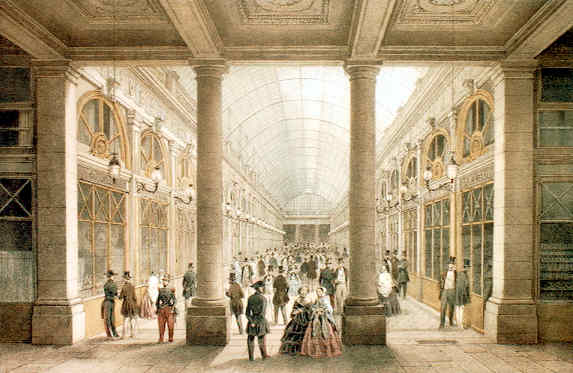
[1] For information regarding the Company, contact Mr. ALLAN KARDEC, rue Sainte-Anne, n. 59, from 3 am to 5 am; or to Mr. LEDOYEN, bookseller, Galleries d'Orléans, n. 31, at the Palais-Royal.
Spiritist magazine — Journal of psychological studies — 1858 > May > Varieties: the fake Mr. home
Mr. Home is the victim of a scammer
Some time ago, in the Lyon newspapers, we read the following advertisement, which was also posted on the city walls:
“Mr. Hume, the famous American medium, who had the honor of experimenting before His Majesty the Emperor, from Thursday, April 1st, will give sessions on spiritualism in the great theater of Lyon. He will produce apparitions, etc., etc. There will be special chairs for doctors and scholars, so that they can make sure that nothing has been prepared. The sessions will be varied, with experiences of the famous seer, Mrs…, a very lucid sleepwalker, who will reproduce all the feelings one by one, at the will of the spectators. Ticket prices: 5 francs in first class, 3 francs in second.”
The antagonists of Mr. Home (some write Hume) did not want to miss this opportunity of exposing him to ridicule. In their ardent desire to find where to bite, they welcomed this gross mystification with an enthusiasm that undermines their balance and even more their respect for the truth, because, before throwing stones at others, it is necessary to verify that they will not hit another target. But passion is blind, it doesn't reason and it is often wrong when it tries to harm others. "Look," they exclaimed jubilantly, "this man so much praised, reduced to appearing on the stage, giving so many shows a head!" And your papers giving credence to the fact, without further scrutiny. Unfortunately for them, their joy didn't last long.
Soon they wrote to us from Lyon, asking for enough information to expose the fraud, which was not difficult, especially thanks to the commitment of the many adepts that Spiritism has in that city. As soon as the theater director learned what it was about, he immediately addressed the following letter to the newspapers: “Mr. Editor. I hasten to inform you that the show announced for Thursday, April 1st, at the grand theater, will no longer take place. I thought I had given the theater to Mr. Home and not to Mr. Lambert Laroche, who calls himself Hume. Persons who have obtained friezes in advance will be able to present themselves at the theater box office for a refund.”
Mr. Lambert Laroche “justifies himself”
On the other hand, the aforementioned Lambert Laroche, born in Langres, questioned as to his identity, felt obliged to respond in the terms that we reproduce in full below, as we do not want to be accused of the slightest alteration.
“Vous m'avez soumis diversse extre de vous correspondence de Paris, desquellesil résulterez that a M. Home qui donne des séancedans quelque salon de la capítalle was trauve at the moment in Italy etne peut para conéquent se trauvir à Lyon. Monsieur gignore 1st la cannaissance de ce M. Home, 2nd je essait quellais son talent 3rd je nais ever rien nue de commun àveck ce M. Home, 4th jait tavaillez et tavaille sout mon nom de gaire qui est hume et dont je vous justi par les article de journaux étrangers et français que je vous est soumis 5th je voyage à vecque deux sugais mon genre d'experriance consists in spiritualism with evocation vision, and in a mot reproduction de ideis du spectateur par un sugais, ma cepécialité est d'operate par c'est proceede sur les personnes étrangere comme on la pue le voir dans les journaux je vien despagne et d'afrique. Seci M. le rédacteur vous démontre que je n'ais poin voulu prendre le nom de ce prétendu Home que vous dites en réputation, le min est sufisant connu par sagrande notoriété et par les expérience que je produi. Agreez M. le redacteur mes salutation empressait”. *
We believe it is useless to say that Mr. Lambert Laroche left Lyon with his head held high. You will certainly go to other places in search of fools to deceive easily. One more word to express our regret at seeing with what deplorable avidity certain creatures who claim to be serious welcome everything that can serve their animosity. Today, Spiritism is highly believed and there is nothing to fear from antics; it is no more debased by charlatans than true medical science by crossroads healers; he finds it everywhere, but mainly among enlightened, zealous people and countless defenders who know how to face the mockery. Far from harming it, the Lyon affair only serves to spread it, drawing the attention of the undecided to reality. Who knows if it was even provoked by a superior force for this purpose? Who can boast of sounding out the designs of Providence?
As for systematic opponents, let them laugh, but not slander. A few more years and we'll see who has the last word. If it is logical to doubt what one does not know, it is always imprudent to manifest oneself falsely against new ideas which, sooner or later, may offer a humiliating denial to our perspicacity. There's history to prove it. Would those who, in their pride, show pity for the adepts of the Spiritist Doctrine be as superior as they think they are? These spirits, whom they seek to ridicule, recommend that good be done and forbid evil, even to enemies; they tell us that we debase ourselves by the only evil desire. Which, then, is higher: the one who seeks to do evil or the one who has neither hatred nor rancor in his heart? Not long ago, Mr. Home has returned to Paris, but will soon leave for Scotland and from there to St. Petersburg.
The faker.
French text translation
(Translation reproducing the writing and language of a semi-illiterate person)
* “You sent me several extras from your Paris correspondence, from which it appears that a Mr. The home which gives sessions in a salon in the capital is currently in Italy and therefore cannot be in Lyon. My lord, I ignore first the knowledge of this Mr. Home, 2nd I don't know what your talent is 3rd I never had anything in common with this Mr. Home, 4th I worked and I work with a name of war which is Hume and that name I justify by the article in the foreign and French pages submitted to you, 5th I travel with two companions my gene of ixpriença consists of spiritualism or evocation vision and, in a word, reproduction of the spectator's idea by a subject, my specialty is to operate through this process in strangers, as can be seen in the newspapers that come from Spain and Africa. With that, its editor, I show you that I never wanted to take the name of that supposed Home that I tell you that he has a reputation, mine is sufficiently known for its great notoriety and for the ixpriença that I have. Receive, sir, my kind greetings.”
A fact at the Civil Hospital of Saintes
L'Independant de la Charente-Inférieure reported, last March, the following event that would have occurred at the Civil Hospital of Saintes:
“For eight days, in this city, the most wonderful stories have been told and nothing is said except about the singular noises that, every night, sometimes imitate the trot of a horse, sometimes the steps of a dog or a cat. Bottles placed over the fireplace are carried across the room. One morning a bundle of rags was found twisted and knotted and impossible to untie. One night a paper was left on the fireplace, on which it had been written: “What do you want? What do you ask?” The next day, in the morning, there was the answer, written in unknown and indecipherable characters. Matches placed on the table during the night disappeared as if by magic. Anyway, all the objects change places and scatter everywhere. Such spells are only performed in the darkness of night. Once there is light, everything returns to silence; extinguishing it, the noises resume immediately. It is a friendly spirit of darkness. Several people, including ecclesiastics and former soldiers, lay down in that enchanted room and it was impossible for them to discover or explain what they were hearing. “A hospital employee suspected of being the author of these pranks has just been fired. It is assured, however, that he is not only not guilty, but, on the contrary, was often the victim himself.
“It feels like this story started over a month ago. For a long time nothing was said, for each distrusted his senses and feared being laughed at. It wasn’t until a few days later that the comments came out.”
NOTE: We have not yet had time to verify the authenticity of the above facts. We publish them with due reservations. We note, however, that, if invented, they are no less possible and there is nothing more extraordinary than many others of the same kind, which have been perfectly verified.
Death of Louis XI (From the manuscript dictated by him to Miss Hermance Dufaux)
Spiritist Review — Journal of Psychological Studies — 1858 > May > Death of Louis XI (From the manuscript dictated by him to Miss Hermance Dufaux)
NOTE: We draw the reader's attention to the remarks made about these remarkable communications in our last March article.
Not feeling strong enough to hear the word death pronounced, I had often recommended to my officers that they only say to me, when they saw me in danger: “Speak little,” and I would know what that meant.
When there was no more hope, Olivier le Daim said to me harshly, in the presence of Francisco de Paula and de Coittier:
─ Your Majesty, we have to relieve ourselves of a duty. Have no more hope in this holy man, nor in any other, for you have come to an end. Think of your conscience. There is no more medicine.
At these cruel words a complete revolution took place in me. I no longer felt like the same man and I admired myself. The past quickly unfolded before my eyes and things appeared to me in a new light. I don't know what kind of strange thing was happening to me. Fixing me, Olivier le Daim's hard gaze seemed to question me. To escape that cold and inquisitive gaze, I replied with apparent tranquility:
─ I hope God helps me. It is possible, perhaps, that I am not as bad as you think.
Louis XI
The monarch dictates his last wishes
I dictated my last wills and sent those who still surrounded me to the young king's side. I found myself alone with my confessor, Francisco de Paula, le Daim and Coittier. Francis gave me a touching exhortation. It seems that with each of his words, my vices were erased and nature resumed its course. I felt relieved and began to regain a little hope in God's mercy.
I received the last rites with a firm and resigned piety. Every moment he repeated: “Our Lady of Embrun [1], my good Lady, help me!”
Tuesday, August 30th, at seven o'clock in the evening, I fell into a new prostration. All present judged me dead and withdrew. Olivier le Daim and Coittier, sensing the public execration, had stayed by my bedside, as they had no alternative.
I soon fully regained consciousness. I got up, sat on the bed and looked around. There was no one in my family; no friendly hand sought mine, in that supreme moment, to soothe my agony in a last contact. At that time maybe my children were playing while their father died. No one thought that the culprit could still count on a heart that understood theirs. I tried to hear a muffled sob and only heard the laughter of the two wretches who were next to me.
In the corner I saw my favorite greyhound, dying of old age. My heart throbbed with joy, for I had a friend, a being who loved me.
I signaled him with my hand. The hare dragged itself with effort to the bedside and came to lick my dying hand. Olivier noticed this movement; he jumped up, cursing, and clubbed the unfortunate dog with a club until she was killed. Breathing out, my only friend gave me a long, painful look.
Olivier pushed me violently onto the bed. I let myself fall and gave my guilty soul to God.
[1 ANDmbru is an ancient city in the south of France, located in the Rhône Basin, in Provence. His old Latin name was Ebraduno. It has about 4,000 inhabitants.
Heir Spirits
Spiritist Magazine — Journal of Psychological Studies — 1858 > May > The Inheriting Spirits
One of our subscribers from The Hague, Holland, informs us of the following event, which occurred in a group of friends who were involved in spiritist manifestations. This proves, he says, once again, and beyond any possible dispute, the existence of an intelligent and invisible element, acting individually and directly on us.
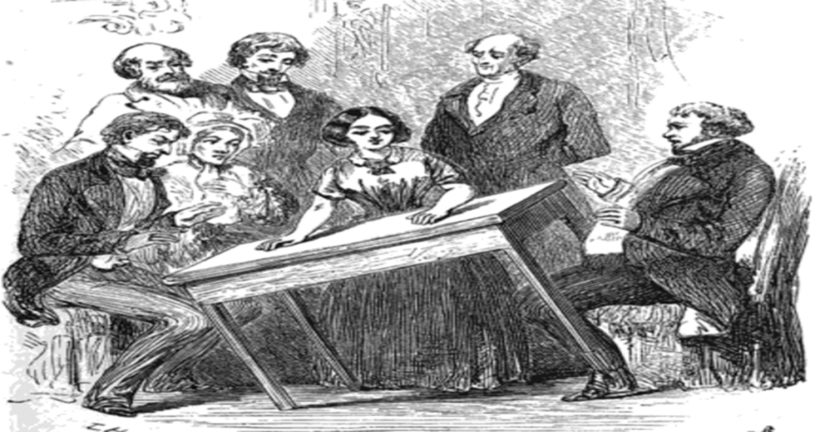
The Spirits announce themselves by moving a heavy table and knocking. We ask for names: are they the late Mr. and Mrs. G…, very fortunate during existence. The husband, from whom the fortune came, had no children and disinherited his close relatives in favor of his wife's family, who died shortly before him. Among the nine people present at the session were two disinherited women, as well as the husband of one of them.
Mr. G… had always been a poor devil and a humble servant to his wife. After her death, his family moved into his home to take care of him. The will was made with a medical certificate, declaring that the dying person enjoyed the fullness of his faculties.
The husband of the disinherited lady, whom we will call R… took the floor in these terms: “How dare you present yourselves here, after the scandalous will you made?” Then, becoming more and more exalted, he ended up cursing him. Then the table jumped and threw the lamp hard at the speaker's head. He apologized to them for that first surge of anger and asked them what they were doing there.
─ We have come to give you an account of the reasons for our conduct.
(Answers were given by tapping indicating the letters of the alphabet).
The spirits announce themselves to the heirss moving a heavy table and banging.
Heirs and companions manifest themselves
Knowing her husband's ineptitude, Mr. R… told him brusquely that he should retire and that he would just listen to his wife.
Then the Spirit of Mrs. G… said that Ms. R… and his sister were quite wealthy and could deprive themselves of their share of the inheritance; that others were bad, and that others, in short, should undergo that test; that for such reasons that fortune suited his own family better. Mr. R… was not satisfied with the explanation and poured out his anger in insulting reproaches. Then the table shook violently, jumped, banged hard on the floor, and threw the lamp once more at Mr. A… After calming down, the Spirit tried to persuade that after his death he had been informed that the testament had been dictated by a superior Spirit. Mr. R… and the ladies, seeing the uselessness of an objection, sincerely forgave him. Soon the table rose beside Mr. R… and landed softly against his chest, as if to hug him. The two ladies received the same show of thanks. The table had a very pronounced vibration. Understanding restored, the Spirit lamented the current heiress, saying that she would end up mad.
Still Mr. R… reproached him, but affectionately, for not having done good in life, when he had so great a fortune, adding that it was not mourned by anyone. “Yes, answered the Spirit; there is a poor widow residing on the street… who sometimes thinks of me, because I have sometimes given her food, clothing and heat.”
As the Spirit had not given the poor woman's name, one of the assistants looked for her, finding her at the indicated address. And what is no less noteworthy is that after the death of Mrs. G…, she had changed domicile. The latter is what was indicated by the Spirit.
Spiritist magazine — Journal of psychological studies — 1858 > May > Family lectures from beyond the grave: the Spirit of Mozart
the composer Mozart
One of our subscribers sent us the following two interviews, with the Spirit of Mozart. We do not know where and when they took place; we do not know the questioner or the medium; we are completely strangers to all this. However, it is remarkable the perfect agreement between the answers obtained and those given by other Spirits on several key points of the Doctrine, in completely different circumstances, both for us and for other people, and which we have transcribed in previous numbers. and not Spirits Book.
We call the attention of our readers to this similarity, who will draw the conclusion that seems most appropriate to them. Those, therefore, who could still think that the answers to our questions are a reflection of our personal opinion, will see whether in this case it was possible for us to exert any influence. We congratulate the people who supported this conversation on the way in which the questions were asked. Despite certain flaws that demonstrate the inexperience of the interlocutors, in general they are formulated with order, clarity and precision and do not deviate from the line of seriousness that constitutes an essential condition for obtaining good communications. Elevated spirits address serious people who in good faith want clarification. The frivolous spirits make fun of frivolous creatures.
first conversation
1. ─ In the name of God, Spirit of Mozart, are you here?
─ Yes.
2.─ Why is it Mozart and not another Spirit?
─ It was me you evoked: so I came.
3.─ What is a medium?
─ The agent that unites mine to your Spirit.
4.─ What are the physiological and psychological changes that, despite himself, the medium undergoes when he enters into an intermediary action?
─ Your body feels nothing, but your Spirit, partially detached from matter, is in communication with mine, uniting me with you.
5. ─ What is happening in him at this moment?
─ Nothing with the body; only a part of your Spirit is attracted to me; I make his hand work by the power that my Spirit exercises over him.
6.─ So, does the medium enter into communication with a spiritual individuality different from his own?
─ For sure. You too, without being a medium, are in contact with me.
7.─ What are the elements that contribute to the production of this phenomenon?
─ The attraction of spirits, in order to instruct men; laws of physical electricity.
8.─ What are the essential conditions?
─ It is a faculty given by God.
9.─ What is the determining principle?
─ I cannot say.
10.─ Could you reveal your laws to us?
─ No, no, not yet. Later you will know everything.
11.─ In what positive terms could the synthetic formula of this wonderful phenomenon be announced?
─ Unknown laws that you could not understand.
12.─ Could the medium put himself in relationship with the soul of a living person? Under what conditions?
─ Easily, if the person is asleep. [1]
13.─ What do you understand by the word soul?
─ Divine spark.
14. ─ And by Spirit?
─ Spirit and soul are the same thing.
15.─ As an immortal Spirit, the soul is aware of the moment of death, aware of itself or of the I immediately after death?
─ The soul knows nothing of the past and does not know the future until after the death of the body. Then he sees his past life and his last proofs; chooses his new atonement for another existence, as well as the test to pass. Thus, no one should regret what he suffers on Earth, but he should bear it with courage.
16.─ After death, is the soul disconnected from every element, from every terrestrial bond?
─ Of every element, no. She also has a fluid of her own, which she extracts from the atmosphere of her planet and which represents the appearance of her last incarnation. Earthly ties are nothing to her anymore.
17.─ Does she know where she comes from and where she is going?
─ The fifteenth answer resolves this question.
18.─ Does nothing take her with her from down here?
─ Nothing but the memory of good works, the regret of their faults and the desire to move on to a better world.
19.─ Does it encompass, in a retrospective glance, the whole of your past life?
─ Yes, to serve your future life.
20.─ She glimpses the purpose of earthly life and its meaning; the meaning of this life, as well as the importance of the destiny that is fulfilled here, in relation to the future life?
─ Yes, she understands the need for purification to reach infinity; wants to purify himself to reach the blissful worlds. I am happy, but I am not yet in the worlds where the vision of God is enjoyed!
21.─ Is there a hierarchy of Spirits in the future life? What's your law?
─ Yes. It is the degree of debugging that characterizes it. Goodness and virtues are the titles of glory.
22.─ As a progressive power, is it the intelligence that determines the ascending march?
─ They are above all the virtues, above all love of neighbor.
23.─ A hierarchy of Spirits implies a hierarchy of residences. She exists? In what form?
─ Intelligence, which is a gift of God, is always the reward of the virtues of charity and love of neighbour. Spirits inhabit different planets, according to their degree of perfection. In them they enjoy greater or lesser happiness.
24.─ What is to be understood by superior spirits?
─ Purified Spirits.
25.─ Is our terrestrial globe the first of these steps, the starting point, or do we still come from a lower point?
─ There are two globes before yours, which is one of the less perfect ones.
26.─ Which world do you inhabits? Are you happy there?
- Jupiter. There I enjoy great calm; I love everyone around me. We don't have the hate.
27.─ If you remember earthly life, you must remember the couple A…, from Vienna. Have you seen them both after your death? In what world and under what conditions?
─ I don't know where they are. I can't tell you. One is happier than the other. Why do you tell me about them?
28.─ By a single word, indicative of a capital fact in your life, and which you cannot have forgotten, you can provide me with certain proof of that memory. I urge you to say such a word.
─ Love; recognition.
second conversation
The interlocutor is no longer the same. It seems, from the nature of the conversation, that this is a musician, happy to be entertained by a master. After several questions, which it seems useless to reproduce, Mozart says:
1. ─ Let's finish with G's questions… I'll talk to you. I will tell you what in our world we mean by melody. Why didn't you summon me sooner? I would have answered you.
2. ─ What is the melody? ─ For you it is often a memory of your past life; your Spirit remembers what he saw in a better world. On the planet Jupiter, where I live, there is melody everywhere: in the murmur of the waters, in the rustle of leaves, in the wind song; the flowers hum and sing; everything produces melodious sounds. Be good and reach this planet by your virtues. You chose well, singing God. Religious music helps uplift the soul. How I wish I could inspire you with the desire to see this world where we are so happy! Here we are all very charitable; everything is beautiful! Nature so admirable! Everything inspires us with the desire to be with God. Courage! Courage! Believe in my spiritist communication. I am the one who finds myself here. I enjoy the power to tell you what we experience. If only I could inspire you enough to love the good, so that you might become worthy of this reward, which is nothing in comparison with others to which I aspire!
3. ─ Is our music the same on other planets? ─ No. No song can give you an idea of what we have here. She is divine! O happiness! He seeks to deserve the enjoyment of such harmonies; fight; has courage! Here we don't have instruments: plants and birds are the choristers. Thought composes and listeners enjoy without material hearing, without the assistance of the word, and this at an immeasurable distance. In the superior worlds this is even more sublime.
4. ─ What is the life span of a Spirit incarnated on another planet than ours? ─ Enjoy on the lower planets; longest in worlds like this where I have the happiness to be. On Jupiter it averages from three to five hundred years.
5. ─ Will there be great advantage in returning to inhabit the Earth? ─ No, unless we are on a mission, because then we advance.
6. ─ Wouldn't we be happier if we stayed like Spirit? ─ No, no! We would be stationary. We ask for reincarnation in order to advance towards God.
7. ─ Is this the first time that I am on Earth?
─ No. But I cannot speak of your Spirit's past.
8. ─ Could I see you in a dream?
- If God allows it, I will make you see my dwelling in a dream, which you will remember.
9. ─ Where are you here?
─ Between you and your daughter. see you. I'm in the shape I was in when I was alive.
10. ─ Could I see you?
─ Yes. Believe and you will see. If you had more faith, we would be allowed to tell you why. Your own profession constitutes a link between us.
Wolfgang Amadeus Mozart was an influential Austrian composer of the classical period who passed away at the age of 35. Mozart showed prodigious musical ability from his childhood.
11. ─ How did you get here?
─ The Spirit permeates everything.
12. ─ Do you still think you are very far from God?
─ Oh! Yea!
13. ─ Do you understand better than we do what eternity is?
─ Yes, yes. In the body you cannot understand it.
14. ─ What do you understand by Universe? Was there a beginning and will there be an end?
─ As you think, the Universe is your Earth. fools! The Universe had no beginning and will have no end. Think that he is entirely the work of God. The Universe is infinity.
15. ─ What should I do to calm down?
─ Don't worry so much about the body. Your spirit is disturbed. Resist this tendency.
16. ─ What is this disturbance?
─ You fear death.
17.─ What can I do to not fear her?
─ To believe in God. Above all, believe that God does not deprive the family of a father useful.
18.─ How to achieve this calm?
─ By will.
19.─ Where to find this will?
─ Take your thoughts away from that through work.
20. – What should I do to improve my ability?
─ You can summon me. I got permission to inspire you.
21.─ When I'm working?
─ Certainly! When you want to work, sometimes I'll be by your side.
22.─ Will you listen to my work? (A musical work by the questioner).
─ You are the first musician who evokes me. I come to you with pleasure and listen to your works.
23.─ How come they didn't evoke you?
─ I was evoked, but not by musicians.
24.─ By whom?
─ By several ladies and amateurs in Marseille.
25.─ Why does the Hail Mary move me to tears?
─ Your spirit is released, it joins mine and that of Pergolese, who inspired that work for me, but I forgot that part.
26.─ How could you forget the music composed by yourself?
─ The one I have here is so beautiful! How to remember what was just matter?
27. ─ Do you see my mother?
─ She is reincarnated on Earth.
28.─ In which body?
─ I can't say anything about it.
29.─ And my father?
─ You are wandering, to help with the good. It will make your mother progress. They will reincarnate together and be happy.
30.─ Does he come to see me?
─ Many times. To him you owe your charitable impulses.
31.─ Was it my mother who asked to be reincarnated?
─ Yes. She had a great desire to reincarnate in order to progress, through a new test, and enter a world superior to Earth. You've already taken a huge step.
32.─ What do you mean by that?
─ She resisted all temptations. His life on Earth was sublime compared to his past, which was that of an inferior Spirit. So he climbed several steps.
33.─ So she had chosen a test above her strength?
─ Yes, that's right.
34.─ When I dream that I see her, is it really her I see?
─ Yes, yes.
35.─ If they had evoked Bichat [2] on the day of the inauguration of his statue, would he have responded? He was there?
─ Yes, it was; and me too.
36.─ Why were you there?
─ Like many other spirits who appreciate the good and who feel happy when you glorify those who care about suffering Humanity.
37.─ Thank you, Mozart. Goodbye.
─ Believe me; believe that I am here... I am happy... Believe that there are worlds above yours... Believe in God... Evoke me more often, in the company of musicians. I will be happy to instruct you, contribute to your progress and help you rise to God. Evoke me. Goodbye.
Subtitle:
[1] If a living person is evoked in a waking state, he may fall asleep at the time of the evocation, or at least suffer a numbness and a suspension of his sensory faculties. Often, however, the evocation produces nothing, especially if it is not done with a serious and benevolent intention.
[2] Marie François Xavier Bichat was a French anatomist and physiologist. Bichat is best remembered as the father of modern tissue histology and pathology. Despite the fact that he worked without a microscope, he was able to significantly advance the understanding of the human body.