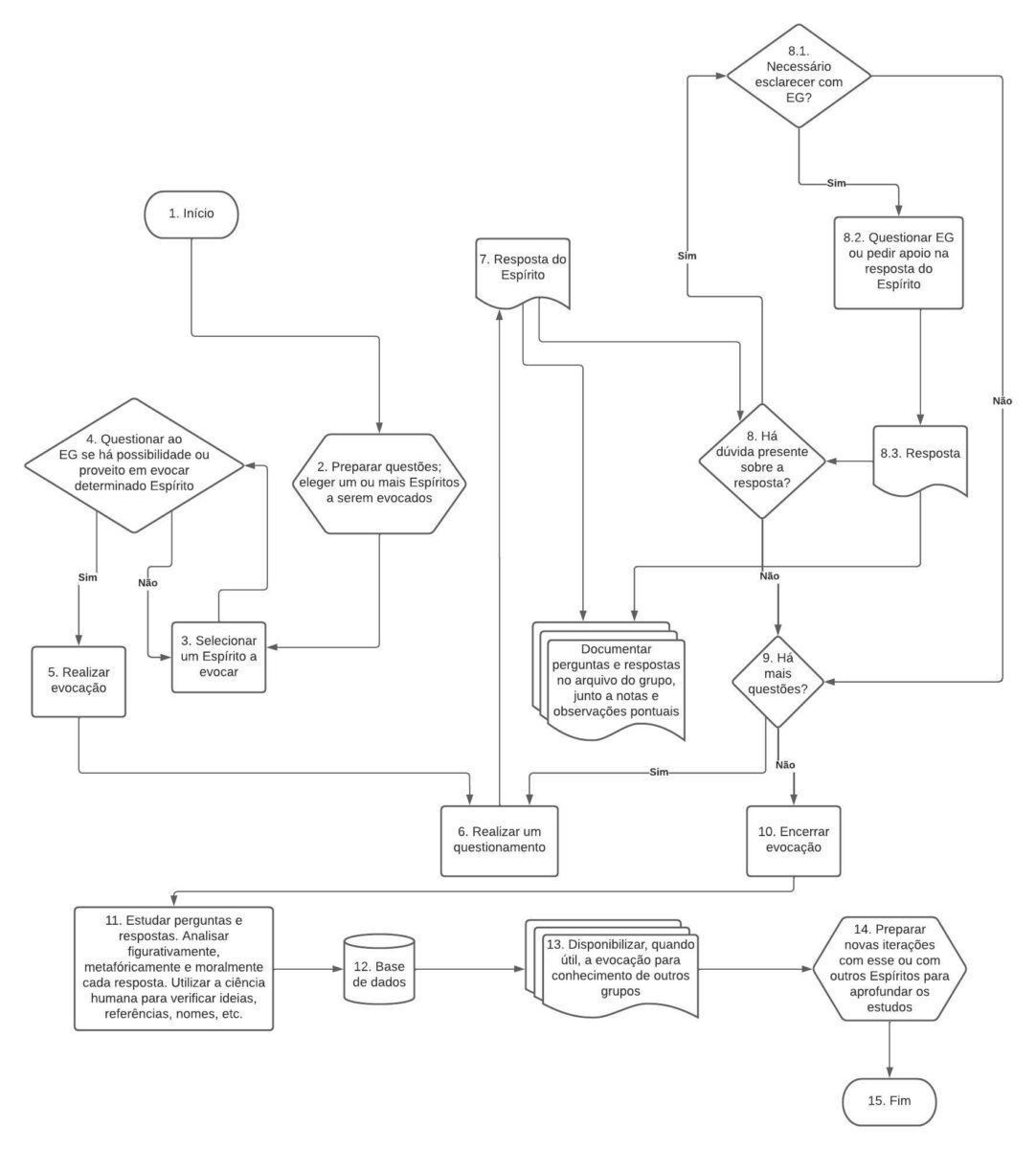
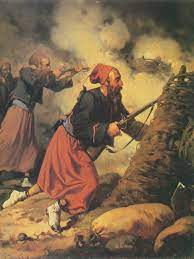
Recently, a series of studies by Revista Espírita gave us an interesting lesson, which goes directly in line with the ideas of cities in the spiritual world, which many believe in and promote. The study was carried out on the following articles from Revista Espírita:
- July 1859:
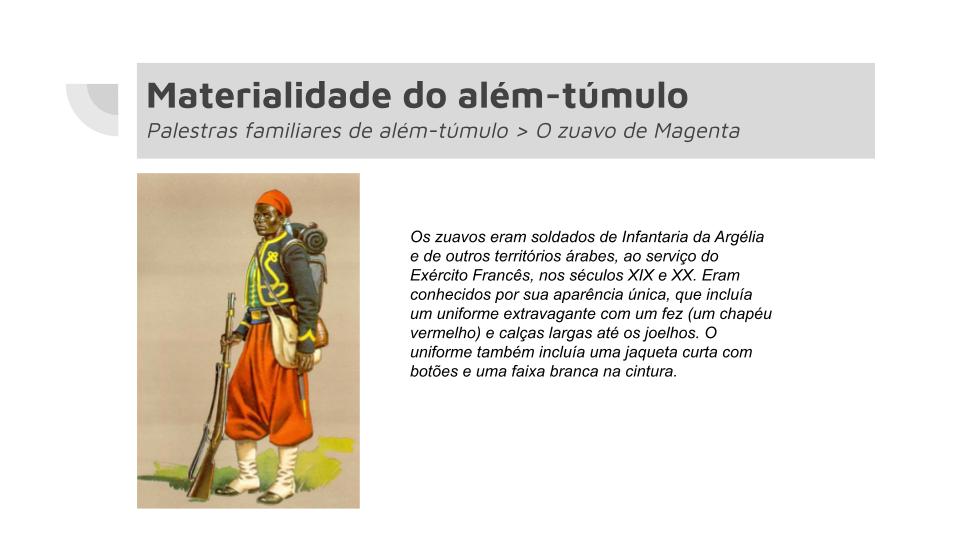
- The Magenta Zouave;
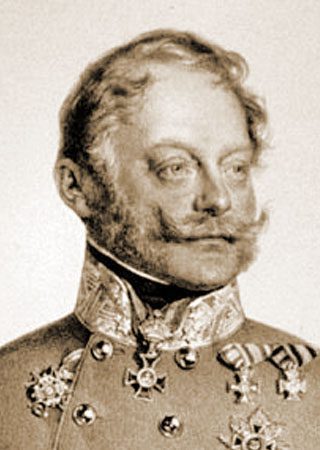
- A senior officer killed in Magenta
- August 1859:
- Furniture from beyond the grave;
- Pneumatography or direct writing;
- A servant spirit;
- Mrs Mally's Guide
In addition, we use Kardec's conclusion in A Gênese (Editora FEAL) — Nature and Property of Fluids.
We will highlight the main points of the study, where we list our comments in square brackets ([comment]).
Magenta's Zouavo
45. ─ Do you know why you see us, while we cannot see you?
─ I think your glasses are too weak.
[He does not know. Hence it uses a metaphor or figure of speech.]
46. ─ Is it not for this same reason that you do not see the general in his uniform?
─ Yes, but he doesn't wear it every day.
47. ─ What days do you wear it?
─ Now that! When they call him to the palace.
[The Spirits, ignorant of certain things, express themselves as best they can, and see the world of Spirits according to their ideas, just as a child, using mental images to describe something that he does not understand, speaks of things that we attribute only to the imagination, but that, deep down, has its meaning. The mistake here would be to take the “palace” as an expression of spiritual truth permanent.]
48. ─ Why are you here dressed as a zuavo if we can't see you?
─ Simply because I am still a Zouavo, even after about eight years, and because among Spirits we conserve that form for a long time. But that's just between us. You understand that when we go to a very different world, like the Moon or Jupiter, we don't take the trouble to do all that toileting.
[This is very interesting. What we understand is that he is referring to the fact that Spirit adopts a perispiritual form according to the world where it goes and according to the existence of a personality in that world, without even realizing it. If he had lived in a distant world, for example, an animal seller, when evoked there, would present himself that way. When moving through space, without being evoked, it does not take a specific shape, that is, “you don’t need to do all that toiletry”.]
49. ─ You speak of the Moon and Jupiter. Were you there after he died?
─ No. You are not understanding me. After death we find out about many things. Didn't they explain to us a lot of problems of our Earth? Don't we know God and other beings much better than we did a fortnight ago? With death, the Spirit undergoes a metamorphosis that you cannot understand.
[He is trying to explain the previous thought, not knowing how to do it.]
A senior officer killed in Magenta
13. ─ At the moment of death, did you immediately recognize yourself?
─ I recognized myself almost immediately, thanks to the vague notions I had of Spiritism.
14. ─ Can you say something about Mr… also killed in the last battle?
─ He is still in the networks of matter. There's more work to get rid of. His thoughts had not turned this way.
OBSERVATION: Thus, knowledge of Spiritism helps in the detachment of the soul after death and shortens the period of disturbance that accompanies separation. This is understandable, as the Spirit knew in advance the world in which it finds itself.
[If this knowledge is so important, how can we conceive that precisely when Spiritism was scientifically studied, at the best possible moment, nothing was said about this materiality that today dominates communications?]
furniture from beyond the grave
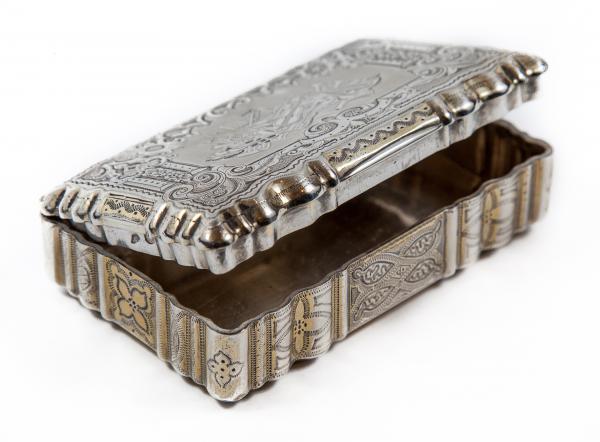
So far no difficulty concerning the personality of the Spirit. We know, however, that they appear in clothes whose appearance changes at will; sometimes they even have certain toilet accessories, jewelry, etc. In the two apparitions mentioned at the beginning, one had a pipe and produced smoke; the other, a tobacco box and took pinches. Note, however, the fact that this spirit was from a living person and that his snuffbox was in everything similar to the one he usually used, and that he had stayed at home. What, then, do this tobacconist, this pipe, these clothes and these jewels mean? Would the material objects that exist on Earth have an ethereal representation in the invisible world? Does the condensed matter that forms such objects have a quintessential part, which escapes our senses?
This is an immense problem, the solution of which may provide the key to a number of things that have not yet been explained. It was this tobacco company that put us on the path, not only of the fact, but of the most extraordinary phenomenon of Spiritism: the phenomenon of pneumatography or direct writing, which we will talk about below.
[Position of the true scientist, in search of the truth, without discarding anything.]
3. ─ This snuffbox had the shape of the one he habitually uses, and which was in his house. What was this snuffbox in the hands of the Spirit?
─ Always looks. It was so that the circumstances would be noticed, as they were, and so that the apparition would not be taken for a hallucination produced by the state of health of the seer. Spirit wanted this lady to believe in the reality of her presence and took on all appearances of reality.
4. ─ You say that it is an appearance, but an appearance has nothing to do with reality; it's like an optical illusion. I would like to know if this snuffbox was nothing more than an unreal image, like, for example, that of an object reflected in a mirror.
(One of the members of the Society, Mr. Sanson, observes that there is something real in the image reproduced by the mirror. If the image does not remain in the mirror, it is because nothing fixes it, but if it is projected onto a daguerreotype plate, leaves an impression, clear proof that it is produced by some substance and that it is not just an optical illusion).
4 (continued) – Mr. Sanson's observation is perfectly fair. Would you be kind enough to tell us if there is any analogy with the tobacco box, that is, if there is anything material in that tobacco box?
─ Certainly. It is with the help of this material principle that the perispirit takes on the appearance of clothing similar to those that the Spirit wore when alive.
[Today, we know the principle of the image reflected in a mirror and its fixation in a photograph: the behavior of waves. The light, as electromagnetic energy, reflects off the mirror and impresses the photography device, whatever it may be. It seems that it is to this same principle (of wave) that the Spirit refers.]
NOTE: Evidently the word appearance it must be taken here in the sense of image, of imitation. The real tobacconist was not there. What Spirit had was just a reproduction. Compared to the original, it was but an appearance, though formed by a material principle.
Experience teaches us that we should not take certain expressions used by spirits literally. Interpreting them according to our ideas, we expose ourselves to great mistakes, so we must deepen the meaning of their words, whenever there is a minimum ambiguity. Here is a recommendation constantly made by the Spirits. Without the explanation we provoke, the word appearance, repeated continuously in similar cases, could give rise to a false interpretation [Since “appearance” could give rise to the idea of something that does not exist.].
5. ─ Would there be an unfolding of inert matter? Would there be, in the invisible world, an essential matter, covering the form of the objects that we see? In a word, would these objects have their ethereal double in the invisible world, as men are represented there in Spirit?
OBSERVATION: Here is a theory like any other, and that was our thought. The Spirit, however, did not take it into account, which absolutely did not humiliate us, because its explanation seemed very logical to us and because it rests on a more general principle, of which we find many explanations.
─ It doesn't happen that way. The Spirit has a power over the material elements disseminated throughout space, in our atmosphere, that you are far from suspecting. He can, at will, concentrate these elements and give them an apparent form, suitable for his designs.
6. ─ I ask the question again categorically, in order to avoid any misunderstanding. Are the clothes with which spirits are covered something?
─ It seems that my previous answer settles the question. Don't you know that the perispirit itself is something?
7. ─ It follows from this explanation that the Spirits make the etherized matter undergo transformations at will and that, therefore, in the case of the tobacconist, the Spirit did not find it perfectly finished; he made it himself at the moment he needed it, and then undid it. The same should happen with all other objects, such as clothing, jewelry, etc.
─ But it is obvious.
8. ─ That tobacco box was so clearly visible to Mrs. R… to the point of deceiving her. Could the Spirit have made it tangible?
─ It could.
9. ─ In that case, could Mrs. R… have taken it in her hands, thinking she was getting an authentic tobacco box?
─ Yes.
10. ─ If I had opened it, I would probably have found snuff. If she had taken it, would it have made her sneeze?
─ Yes.
11. ─ Can the Spirit not only give the form, but even special properties?
─ If you want; It is in virtue of this principle that I have answered affirmatively to the preceding questions. You will have proof of the powerful action that the Spirit exerts on matter and which, as I have already told you, you are far from suspecting.
[We know, today, that Creation is far from being “each for himself”, and that, in fact, it is “one for all and all for one”, with those most inferior being always “led” by the highest .]
12. ─ Let us then suppose that he wanted to make a poisonous substance and that a person had taken it. Could this have been poisoned?
─ I could, but I wouldn't have done it, because I wouldn't have been allowed to do it.
13. ─ Could you have made a salutary substance suitable for healing in case of illness? Has there ever been such a case?
─ Yes; often.
OBSERVATION: A fact of this kind will be found with a very interesting theoretical explanation in the article that we give below under the title A Servant Spirit.
14. ─ In the same way he could make a food substance; let's suppose he had made a fruit or some snack. Could someone eat it and feel fed?
─ Yes, yes. But do not look so hard to find that which is easy to understand. A ray of sunlight is enough to make your gross organs perceptible to those material particles that fill the space in which you live. Do you not know that the air contains water vapour? Condense it and you will bring it to a normal state. Deprive it of heat and behold, its impalpable and invisible molecules will become a solid and very solid body. There are other matters that will lead chemists to present you with even more astonishing marvels. Only the Spirit has instruments more perfect than yours: his own will and God's permission.
OBSERVATION: The issue of satiety is very important here. How can a substance that has only temporary and, in a sense, conventional existence and properties produce satiety? By its contact with the stomach, this substance produces the sensation of satiety, but not the satiety resulting from fullness. If such a substance can act on the organic economy and modify a morbid state, it can also act on the stomach and produce the sensation of satiety. However, we ask pharmacists and restaurant owners not to be jealous, nor to think that the spirits are coming to compete with them. These cases are rare and exceptional and never depend on the will. Otherwise, food and healing would be very cheap.
15. ─ Could the Spirit manufacture coins in the same way?
─ For the same reason.
16. ─ Once made tangible by the will of the Spirit, could these objects have a character of permanence and stability?
─ They could, but this is not done. It's outside the law.
17. ─ Do all spirits have the same degree of power?
─ No, no.
[Because only superior spirits could do it (following answer).]
18. ─ Which ones have this power more particularly?
─ Those to whom God grants it, when this is useful.
19. ─ Does the elevation of a Spirit influence this case?
─ It is certain that the higher the spirit, the more easily it obtains this power. This, however, depends on the circumstances. Lesser spirits can also get it.
[And, in that case, they are supplied by the assistance of superior spirits, often without even knowing it. See The Book of Mediums or Guide for Mediums and Evocators > Part Two — On Spiritist Manifestations > Chapter V — On Spontaneous Physical Manifestations > Throwing Objects.]
20. ─ Does the production of semi-material objects always result from an act of the Spirit's will, or does it sometimes exercise this power despite its own?
─ This often happens in spite of you.
[That is to say: he doesn't even realize, consciously, that he does what he does.]
21. ─ Would this power then be one of the attributes, one of the faculties inherent in the very nature of the Spirit? Would it be, in some way, one of the properties, like that of seeing and hearing?─ Certainly. But sometimes he himself ignores it. Then another exercises it for him, in spite of himself, when circumstances demand it. The Zouavo's tailor was precisely the spirit I just mentioned and to which he alluded in his joking language..
OBSERVATION: We find an example of this faculty in certain animals, as, for example, in the electric fish, which radiates electricity without knowing what it does, nor how, and who does not even know the mechanism that produces it. Don't we ourselves sometimes produce certain effects through spontaneous acts of which we are not aware? Thus, it seems very natural to us that the Spirit operates in this circumstance by a kind of instinct. He works of his own free will, without knowing how, just as we walk without calculating the forces we bring into play.
NOTE: This was, for example, the case of the queen of Oude, whose evocation appears in our issue of March 1858, who still thought she was covered in diamonds.
23. ─ Can two spirits recognize each other by the material appearance they had in life?
─ This is not how they recognize each other, as they will not assume that appearance for each other. If, however, under certain circumstances, they find themselves in the presence of each other, dressed in that appearance, why should they not recognize each other?
[This is important! In mediumistic novels, the fantastic world created is all material or materialistic, and form, in these tales, is fundamental. Here, we have again the confirmation already made before that form is not important for Spirits in general, although it is predominant for Spirits still very attached to matter (that is, with very attached thoughts). It follows that it would make sense for a Spirit in disturbance to “see” itself in a condition like that of André Luiz's threshold, but the same could not happen when already detached from these ideas, which does not seem to be something that far away, according to the reports of several Spirits, given to Kardec.]
24. ─ How can spirits recognize themselves in the midst of the crowd of other spirits, and above all how can they do it when one of them goes to look for in a distant place and often in other worlds, those we call?
─ This is a question whose answer would take a very long way. It is necessary to wait.
You are not advanced enough. For the moment, content yourself with the certainty that this is so, for you have sufficient proof of this.
25. ─ If the Spirit can take from the universal element the materials to make all these things and give them a temporary reality, with its properties, it can also take from there what is necessary to write. Consequently, this gives us the key to the phenomenon of direct writing((Direct writing happens when a Spirit, by will and with the utility of doing so, makes real writing appear on paper, sometimes in graphite, sometimes in ink, sometimes in print format. We recommend reading the following article, “Pneumatography or direct writing”, as well as the article with the same title, in May 1860, and also Chapter XII of The Book of Mediums — “On pneumatography or direct writing”.
Pneuma: among the ancient Greek thinkers, especially the Stoics, designation of the spirit, animating breath or creative force, used by divine reason to vivify and direct all things.)).
─ You finally understand.
[scientific maturation]
26. ─ If the material used by the Spirit is not permanent, how come the traces of direct writing do not disappear?
─ Do not judge by the words. From the start I never said never. In the cases studied, these were bulky material objects; here we are dealing with signs that should be conserved and are conserved.
[I understand that St. Louis states that this matter is not impermeable, and that it falls apart when it is “condensed” only by a temporary effect, by inferior Spirits. In the case of direct writing, if there is an interest in preserving it, it is preserved. Chapter VI – General Uranography – in Genesis, gives the key to this understanding.]
The above theory can be summarized as follows: Spirit acts on matter; it takes from universal primitive matter the necessary elements to, at will, form objects with the appearance of the different bodies existing on Earth. He can also operate on elementary matter, at will, an intimate transformation that gives it certain properties. This faculty is inherent to the nature of the Spirit, which often exercises it, when necessary, as an instinctive act, which it does not realize.
[It is important to note that, afterwards, it seems to be clear that this interaction on matter is never direct, but that it needs the perispiritual fluid of the incarnated person to happen..]
The objects formed by the Spirits have a temporary existence, subordinated to their will or necessity. He can make and break them at will. In certain cases, in the eyes of living people, these objects can have all the appearances of reality, that is, become momentarily visible and even tangible. There is formation, but not creation, since the Spirit cannot bring anything out of nothing. (The Book of Mediums, questions 130 and 131).
Mrs Mally's Guide
The article “A servant spirit”, from the same issue, presents the case of Mrs. Mally, where, around her, many interesting facts happen. From an early age he had the ability to see spirits. Sometimes he saw his guiding Spirit; others, he saw unpleasant apparitions, which were intended to call his attention to remain vigilant. There came to be the materialization of a Spirit (agenere).
“In 1856, Mrs Mally's third daughter, aged four, fell ill. It was in August. The child was continually immersed in a state of drowsiness, interrupted by seizures and convulsions. For eight days myself [the correspondent] I saw the child, who seemed to come out of her dejection, take on a smiling and happy expression, with half-closed eyes, without looking at those around her; extend your hand in a graceful gesture, as if to receive something; take it to your mouth and eat; then say thank you with a charming smile. During those eight days the girl was sustained by this invisible food and her body regained its usual appearance of freshness.”
[The article is interesting and we recommend reading it. Let's move on to the evocation of Mrs. mally.]
The evocation begins with the establishment of the Spirit's relationship with Mrs. Mally: they had an old friendly relationship. The Spirit was that of an eight-year-old boy who had died a long time ago. Kardec asks if he was always the one who appeared to her, and he says no, but asserts that it is he himself who produced certain material phenomena *:
13. ─ So you have the power to make yourself visible at will?
─ Yes, but I said it wasn't me.
14. ─ Don't you also have anything to do with the other material manifestations produced in her house?
─ Sorry! This yes. It was what I imposed on myself, together with her, as material work, but I do other work for her that is much more useful and much more serious.
* Kardec says, in the previous article: “By other manifestations he reveals his moral state. This Spirit has a non-serious character, however, alongside signs of levity, he has shown sensitivity and dedication.”
16. ─ Could you make yourself visible here, to one of us?
─ Yes, if you ask God for it to happen. I can, but I dare not.
17. ─ If you don't want to make yourself visible, could you at least give us a manifestation, such as bringing something onto this table?
─ Certainly, but what would be the use? For her this is how I witness my presence, but for you it would be useless, as we are talking.
18. ─ Wouldn't the obstacle be the lack of a medium, necessary to produce these manifestations?
─ No, this is a small obstacle. Don't you often see sudden apparitions to people without any mediumship?
19. ─ So everyone is able to see spontaneous apparitions?
─ Yes, because every human being is a medium.
20. ─ However, doesn't the Spirit find in the organism of certain people a greater facility to communicate?
─ Yes, but I told you ─ and you must know ─ that the Spirits have the power for themselves. The medium is nothing. Don't you have direct writing? Is a medium necessary for this? No, but only faith and a burning desire. And even sometimes this happens in spite of men, that is, without faith and without desire.
[Here, Kardec is deepening his studies. We cannot take this as conclusive, because, perhaps, what this Spirit says is not the truth, but only what he understands. However, it is not difficult to think that, if Matter is formed by the thought of pure Spirits, very simple material forms can be formed, under that influence and for its usefulness, by less elevated Spirits.]
21. ─ Do you think that manifestations, such as direct writing, for example, will become more common than they are today?
─ Certainly. How do you understand, then, the vulgarization of Spiritism?
22. ─ Can you explain to us what Mrs. Mally's daughter took in her hand and ate when she was sick?
─ Manna, a substance created by us, which contains the principle contained in ordinary manna and the sweetness of confectionery.
23. ─ Is this substance formed in the same way as clothes and other objects that spirits produce by their will and by the action they exert on matter?
─ Yes, but the elements are very different. The ingredients that make up the manna they are not the same ones I got to create wood or clothes.
[“We must not take certain expressions used by Spirits literally”. Let's go, before forming ideas]
24. ─ (To Saint Louis) Were the elements used by the Spirit to form his manna different from those he took to form other things? We have always been told that there is only one primitive universal element, of which the different bodies are mere modifications.
[Here, because there is doubt or inaccuracy in the response of that Spirit, Kardec questions São Luis, Spirit guide of the group. It is the principle we demonstrate in our recent article]
─ Yes. This means that this primitive element is in space, here in one form, there in another. That's what he means. He gets his manna from a part of that element, which he supposes different, but which is always the same.
25. ─ Is the magnetic action by which special properties can be given to a substance, such as water, for example, related to that of the Spirit that creates a substance?
─ The magnetizer employs nothing but his will. It is a Spirit who helps you, who is in charge of preparing the medicine.
Analysis of passage in “Our Home”
In Nosso Lar, we see the following passage. Let's analyze it:
The messenger of good fixed the painting, understood the gravity of the moment and added:
- We have no time to lose.
First of all, he applied comfort passes to the patient, isolating him from the dark shapes, which moved away as if by magic. Then he invited me decisively:
– Let's go to Nature.
I accompanied her without hesitation and she, noticing my strangeness, emphasized:
– Not only man can receive fluids and emit them. The natural forces do the same, in the different realms into which they are subdivided. In the case of our patient, we need trees. They will help us effectively.
Admired by the new lesson, I followed her silently. Arriving at a place where huge fronds were lined up, Narcissa called someone, with expressions that I could not understand.
[Of course, the spirits did not speak through their mouths. That's a figure of speech. The expression is of thought, and André Luiz could not understand these thoughts, yet.]
Moments later, eight spiritual entities answered his call. Immensely surprised, I saw her inquire about the existence of mango and eucalyptus trees. Duly informed by friends, who were complete strangers to me, the nurse explained:
– They are common servants of the plant kingdom, the brothers who attended to us.
[The highest, SERVE. They are not “elves”. They are Spirits, carrying out their activities in nature. They do not live in the middle of the forest, but they take care of this kingdom, as other Spirits will take care of others. They may not be more advanced than us, but they are more advanced than those who are still in the position of the Intelligent Principle. Therefore, they serve their purpose. Mediumistic works need, based on Spiritism, to be re-read and, if there is still doubt, these Spirits must be EVOKED!]
And, seeing my surprise, he concluded:
– As you can see, there is nothing useless in the House of Our Father. Everywhere, if there are those who need to learn, there are those who teach; and where difficulty appears, Providence appears. The only unfortunate person, in the divine work, is the unforeseen spirit, which has condemned itself to the darkness of evil.
[Here, she reinforces the teaching, asserting that the Spirit (therefore, conscious) who voluntarily condemned himself to darkness, that is, who voluntarily clung to imperfection, is the only one who moves away from the “path”, which is the constant relationship of Spirits, learning, cooperating and teaching, towards good.]
Narcissa manipulated, in a few moments, a certain substance with the emanations of the eucalyptus and the hose [“[the] primitive element is in space, here in one form, there in another”] and, throughout the night, we applied the medicine to the sick person , through common breathing and absorption through the pores.
Continuing: Mrs Mally's Guide
26. ─ (To the guide) Some time ago we reported curious facts about manifestations of a Spirit designated by us with the name Duende de Bayonne. Do you know this Spirit?
─ Not particularly, but I followed what you did about him and that was how I came to know about him.
27. ─ Is he a spirit of a lower order?
─ Does inferior mean bad? No. I mean, simply: not entirely good, not very advanced? Yes.
[Inferior spirit is not synonymous with imperfect spirit, because imperfection is something acquired by habit and will. On the Spiritist Scale, this is clear.
All of this is fantastic! Being able to verify, in the RE, the confirmation, given everywhere, of what is concluded in the final works. Little do the resistant know the richness that exists in this study!]
28. ─ We thank you for your kindness in coming and for the explanations you gave us.
─ At your orders.
OBSERVATION: This communication offers us a complement to what we said in the two previous articles about the formation of certain bodies by spirits. The substance given to the child during illness was evidently prepared by them and was intended to restore health. Where did they get their principles from? From the universal element, transformed for the desired use. The very strange phenomenon of properties transmitted by magnetic action, a hitherto unexplained problem, and over which unbelievers have been amused, is now solved. Indeed, we know that it is not only the spirits of the dead who act, but that those of the living also have their share of action in the invisible world. The tobacconist gives us proof of this. What, then, is admirable in that a person's will, acting for the good [Law], can operate a transformation of primitive matter and give it certain properties? In our opinion, this is the key to many supposedly supernatural effects, of which we will have the opportunity to speak.
This is how, through observation, we come to perceive things that are part of reality and the marvelous. But who says this theory is true? Go there! It has at least the merit of being rational and of perfectly agreeing with observed facts. If any human brain finds another more logical than the one given by the Spirits, let them be compared. One day perhaps they will thank us for opening the way to the rational study of Spiritism.
One day someone said to us: “I would very much like to have a servant Spirit at my command, even if I had to endure some pranks that he did to me.”
It is a satisfaction that we enjoy without realizing it, because not all the Spirits who assist us manifest themselves in an ostensive way, but that does not stop them from being by our side and, due to the fact that they are occult, their influence is no less real.
The Genesis (FEAL) > Nature and Property of Fluids
As has already been demonstrated, the universal cosmic fluid is the primitive elementary matter of which the modifications and transformations constitute the innumerable variety of bodies in nature. As an elementary principle of the Universe, it presents two distinct states: that of etherealization or weightlessness, which can be considered as the primitive state, and that of materialization or weightlessness, which becomes, in some way, its consequence. The intermediate point is the transformation of the fluid into tangible matter. But even there, there is no sudden transition, as our imponderable fluids can be considered as an intermediate point between the two states ((To understand Allan Kardec's statements, it is essential to consider that there was in his time, in Physics, the theory of that matter would be made up of two classes: common matter, tangible or ponderable, and imponderable matter or atoms representing light, electricity, heat, etc. (these are luminous, electrical, caloric fluids, etc.). Psychic fluids or spiritual (theme of this chapter) would then be even more subtle states of the universal cosmic fluid than those imponderable fluids accepted at the time. There would then be, in a sequence from greater to lesser subtleties: common matter, imponderable matter, psychic matter. Currently we know that the hypothesis of the imponderable substance is false, and these phenomena are explained as electromagnetic waves.Transposing Kardec's reasoning to Modern Physics, we could conclude that psychic or spiritual matter would be above light. But this hypothesis leads to more complex questions and implications in the current scientific paradigm for which we do not have in this work the developments that allow us to resolve them. (N. do E.) )).
Spirits act on spiritual fluids, not manipulating them as men manipulate gases, but with the help of thought and will, which are, for the Spirit, what the hand is for man. By thought they impress this or that direction on the fluid; they agglomerate, combine or disperse them and form sets with a certain appearance, shape, color; they change their properties, as a chemist changes those of a gas or other bodies, by combining them according to certain laws. It is the great workshop or laboratory of the spiritual life.
Sometimes these transformations are the result of an intention, but often they are the product of an unconscious thought, because the Spirit just thinks about something for it to be done.
This is how, for example, a spirit appears to an incarnate spirit, endowed with spiritual vision, under the appearance he had when he was alive, at the time he met him, although he has already had several other incarnations. He presents himself with clothes, external signs, diseases, scars, amputated limbs, etc. who had; a beheaded one will present himself without his head. I do not say that they preserved such appearances; no, certainly, because, as a Spirit, he is neither lame nor one-armed, nor one-eyed nor decapitated. But his thought, referring to the time when it was like that, his perispirit instantly takes on this appearance, which also changes instantly. If he had been once black and once white, he will present himself as either black or white, according to which of the two incarnations he is evoked and where his thoughts go.
By an analogous effect, the thought of the Spirit fluidly creates the objects it was used to using. A miser will handle gold; a soldier will have his weapons and his uniform; a smoker, his pipe; a workman, his plow and his oxen; an old woman, her distaff.
These fluidic objects are as real for the Spirit as they would be in the material state for the incarnated man. But, due to the fact that they are created by thought, their existence is as ephemeral as it is [here Kardec refers to the article discussed earlier, furniture from beyond the grave].
our observations
- The Spirit materializes, by the action of thought, the fluids, according to its elevation, its attachments and its ideas. This materialization can range from simple objects to, probably, large scenarios, formed in a group.
- Spirits that are sometimes less elevated, but already detached from material attachments, demonstrate that they are not involved in that materiality, so prevalent in others.
- Unenlightened spirits form mental images to describe something they don't understand, just as children can do. The role of a psychology student, in both cases, is to go beyond the images and figures to understand the background of what they say.
- The mistake is in taking the word literally.
- Far from discarding it as nonsense, we will need to be ready, with a resumption of scientific Spiritism, to know how to filter the various atavisms that Spirits, dominated by these widely disseminated ideas, will be able to use.
- As we highlighted in recent article, it is a serious mistake to form systems on metaphors, taken out of context and not understood correctly. To get rid of these errors, it will be necessary to resume Spiritism scientifically, in the same way that Kardec did.
- The “coding” presents all the elements to understand that the materiality of the spiritual world is directly linked to the materialism of the Spirits. Those who are more “spiritualized”, not necessarily enlightened, do not present it, while those who are in a state of disturbance, caused by imperfections, often present ideas of attachment to matter. These examples are plentiful. We ask: how, precisely at the most important moment of Spiritism, this supposed reality of cities and colonies, which would be so important, since it would be immediate to our death, was not clearly established for Kardec? We have already addressed these issues in recent article, and we will not repeat it.