Did you know that most of those who call themselves Spiritists… don't know anything about Spiritism? Nor do they use the specific language of Spiritist science to explain its phenomena and concepts.
Being a spiritualist is not a matter of emotional adherence, nor of consuming supposedly “spiritualist” novels. Being a Spiritist means seriously studying Spiritist Science, understanding its foundations and putting its principles into practice — as Allan Kardec taught.
Spiritism is a doctrine of study, reason, and observation. Replacing this science with fiction is a great harm to Spiritism. As it is a Philosophical Science it must be studied with specific scientific terms.
In Kardec's time, the Philosophical Sciences were part of the teaching.
At the University of Sorbonne in the 19th century, disciplines were divided into: a) Exact or mathematical sciences. b) Natural sciences, which study objects in the physical world (physics, chemistry, biology, etc.). c) The moral sciences, which study the moral world, which comprises the actions and thoughts of the human race. Among the moral sciences, the division was 4: 1. The philosophical sciences, divided into two classes: psychological (psychology, logic, morality, aesthetics) and metaphysical (theodicy, rational psychology, rational cosmology); 2. The historical sciences (history, archaeology, epigraphy, numismatics, geography) study events and human development over time; 3. The philological sciences (philology, etymology, paleography, etc.), which have as their object language and human symbolic expression; 4. The social and political sciences (politics, jurisprudence, political economy), which study the social life of human beings.
When Allan Kardec launched his First Edition of the Spiritist Magazine in 1858, he immediately defined it in his introduction to justify its title Journal of Psychological Studies. Spiritist Science is, according to its time presented in the table above: Moral Science
As a science, its language is specific to the elements of this science so that everyone can understand each other. Terms are extremely important for the adequate communication of spiritual ideas. We see, today, a mixture of the totally materialistic science of our time in which the study of metaphysical hypotheses, for example, is ignored. Furthermore, words from one field are mixed with the other. Because of this, there is a confusion of materialist concepts mixed with the study of spiritual matters, which are also studied metaphysically.
We will give some examples of the mistaken use of materialistic terms that go unnoticed:
USE PSYCHOPHONY – DO NOT USE EMBEDDING: We see many speakers or even descriptions of manifestations in so-called Spiritist texts that use the term "incorporation." Spirit is not matter that occupies a physical place. Spirit does not incorporate any body, nor does your own spirit incorporate you. The Spirit speaks through the medium through a phenomenon called PSYCHOPHONY. The medium's spirit is WITH them and does not incorporate their physical body. This point is very important to avoid creating the false idea that the medium is possessed by another spirit, or that the spirit communally takes over the medium's body, or even that the medium's spirit goes to other places while the medium is in psychophony. This does not exist in Spiritist Science!
THE ACTION OF THE SPIRIT IS SOLELY AND ONLY THROUGH ITS THOUGHT: The spirit does not have a material body. According to studies of Spiritist Science, God created two general elements: SPIRIT and MATTER. Spirit has no analogue in our material world. The perispirit is matter. The material of which the perispirit is made is unknown to us, but even without knowing its characteristics, it is matter. The perispirit is not part of the spirit, just as the perispirit is not spirit. The spirit acts through and solely through thought. How exactly this happens is still unknown to us, but there are several theories in books that explain this mechanism (read Genesis, chap. XIV – The Fluids.)
USE EMANATION OR PROPAGATION– DO NOT USE ENERGY: The term energy is defined in Physics as the capacity of a body, substance, or physical system to perform work. Figuratively (non-scientific) speaking, energy is vigor or moral power; philosophically speaking, according to Aristotle, it is the action of a physical or metaphysical motor (metaphysics is not considered science today) that allows the actualization of a potentiality. Note, all definitions take into account something physical acting on something physical. One of the principles of Spiritist Science is that we are an incarnate soul. If we are a soul, we do not have a body, so it cannot be energy (something physical) leaving the spirit or soul (non-physical) and arriving at a body (physical). The more appropriate term would be an emanation or even propagation.
USE SPIRIT – DO NOT USE MIND: The mind is used in other areas of current materialist science. Some confuse the mind with the brain; the brain is an organ of the body, the brain is matter. Since Materialist Science does not admit the spirit as a hypothesis, it attributes the thinking process to the brain, but that is not what the spirits explained. According to Spiritist Science, through its observation, it is the spirit that controls the body, not the brain. The brain sends the commands. The brain is born, lives, and dies, and the spirit remains and carries with it the knowledge acquired through various incarnations. It is the spirit, not the mind, that possesses and carries knowledge. It is the spirit that thinks. You who understand the Spiritist doctrine know this and always use Spirit instead of Mind, don't you?
USE “AS IF IT WERE A VIBRATION” – DO NOT USE “VIBRATION” IN ITS FORM WHEN TALKING ABOUT SPIRITUAL PHENOMENA: There are hypotheses about the mechanism itself (see item 2) and only hypotheses. Using the term vibration may lead one to believe that the spiritual phenomenon is a wave as studied in Wave Physics, where it presents different types of waves and different vibrations, etc.
USE PERISPIRIT – DO NOT USE GHOST: Those who study Spiritist Science know that there are apparitional phenomena that evoke these figures that impress our imagination. But they are nothing more than spirits and their phenomena, often to play with or frighten the incarnate. There's no such thing as a Spiritist being afraid of spirits!
WE ARE ALWAYS IN THE SPIRITUAL WORLD: According to Spiritist Science, when we are incarnated, we live in a dual world: the world of matter and the world of spirit. When we die, we disincarnate, that is, we leave matter, but we CONTINUE IN THE SPIRITUAL WORLD. Do not use the terms “he died and went to the spiritual homeland” (He was already in the spirit world); “now he will meet his loved ones who have already died” (his loved ones are never far away. Remember that Spirits do not stay in any one place? (see item 1); “he left us”, etc.
USE CAUSE AND EFFECT – DO NOT USE THE LAW OF CAUSE AND EFFECT: Causality is generally considered a fundamental principle, rather than a specific law, in philosophical and scientific contexts. It describes the cause-and-effect relationship between events, where one event (the cause) is understood as the reason behind the occurrence of another event (the effect). Causality is a fundamental principle that helps understand the nature of the relationship between cause and effect, and is used in a variety of fields, from physics and natural sciences to philosophy and law. Although causality is often referred to as the "law of cause and effect," it is not a scientific law in the sense of a quantitative, experimentally verifiable relationship, like the laws of physics. It is more of a concept or principle that describes the nature of the relationship between cause and effect. Causality is important for understanding the world around us, as it allows us to identify the causes of phenomena and predict their effects. It is fundamental to science, technology, and everyday life, as it helps us understand and interact with the world more efficiently. An example: Imagine a hunt, an animal is shot and dies. The effect is death. The cause was the shotgun blast. It wasn't a law. In Spiritist Science, Kardec used many of these principles to explain the intelligent effects of intelligent spirit manifestations. There, he explains that for every intelligent effect, there is an intelligent cause. There are countless accounts of this in his works.
USE TRIALS AND EXPIATIONS – DO NOT USE KARMA: Karma and Spiritism are like oil and water: they do not mix. Be careful with people who preach the doctrine of karma within the spiritist environment, as the understanding of Spiritist Doctrine goes in the opposite direction.(click on the link to read the full explanation).
USE PARKED SPIRIT– DO NOT USE RETROGRADATION: Many people mix other reincarnationist doctrines with spiritual science. According to Spiritual Science, we spirits, when we are immersed in imperfections, such as pride and selfishness, remain stuck in a loop and do not evolve. But this doesn't mean we're going back and reincarnating as animals. It just means we're stuck in the evolutionary process! A human spirit never loses the knowledge it previously had, so it will never reincarnate as an animal because of its imperfections. It simply won't progress until it repents and sincerely returns to goodness.
THOSE WHO WILL REGENERATE WILL BE THE SPIRITS OF PLANET EARTH – PLANET EARTH WILL NOT REGENERATE: The planet will not change, and therefore spirits will have to evolve. There is no deadline, year, century, or anything like that. It's the other way around! The spirits on the planet will evolve. It will simply be when the majority of incarnate spirits are more evolved, no longer needing trials and atonements to evolve. One day, Planet Earth will become extinct, as any other planet will. This is the order of the material universe as we know it.
USE PURE SPIRIT – DO NOT USE PERFECT SPIRIT: The ideal of perfection is God, so a spirit will never be perfect. A spirit will reach perfection relative to its evolutionary level. A pure spirit no longer needs to reincarnate to evolve because it is no longer influenced by matter. Even though they are pure, they will evolve (Law of Progress).
PASS IS NOT ENERGY TRANSFER: see item 3
If you remember any incorrect expression, just leave a comment.
The strongest evidence of tampering with Allan Kardec's Heaven and Hell
They are undisputed legal facts at tampering of A Gênesis and O Céu e o Inferno, for the mere reason that editions were released, with changes, after the death of the author and without legal deposit – this is what at least four specialized legal operators say: Simoni Private, Julio Nogueira, Lucas Sampaio and Marcelo Henrique. That cool fact it is above of any consideration and, because of this, spiritist federations from other countries, respecting the law, returned to the third edition of the work. Unfortunately, the Brazilian Spiritist Federation, having a lot to recapitulate when taking this attitude (since the original text of A Gênesis contradicts a multitude of errors that populate most of the publications edited and printed by it) still resists these facts, basing itself in layman arguments on copyright matters.
In addition to the legal fact and the necessary respect for the law, through the study we have just identified another piece of evidence, perhaps the most decisive of all, of the adulteration of Heaven and Hell, the work of Allan Kardec, precisely in the part that expressed the doctrinal philosophy in its clearest and purest face.
In The Spirits' Book, Kardec deals with the issue of spirits who have always chosen the path of good (we also dealt with this in the article "Intimate Reform and Spiritism“:
There are spirits who have always chosen the path of good
121. Why do some Spirits follow the path of good and others the path of evil?
“Don’t they have free will? God did not create evil spirits; He created them simple and ignorant, that is, having as much aptitude for good as for evil. Those who are evil became so of their own free will.”
133. The Spirits who From the beginning they followed the path of good?
“All are created simple and ignorant and are instructed in the struggles and tribulations of bodily life. God, who is just, could not make some happy, without toil and work, therefore without merit.”
The) - But, then, what is the use of spirits to have followed the path of good, if this does not exempt them from the sufferings of bodily life?
"They reach the end faster. Furthermore, the afflictions of life are often the consequence of the imperfection of the Spirit. The fewer imperfections, the less torment. He who is not envious, nor jealous, nor avaricious, nor ambitious, will not suffer the tortures that originate from these defects.”
The Spirits' Book. Emphasis added.
Confirmed by the Spirits, there are those who have always chosen the path of goodness, which does not free them from the need to incarnate for their development. Thus, they have nothing to atone for, since atonement is the conscious choice of tests and opportunities that help them to let go of imperfections they have consciously acquired (remembering that merely making a mistake is not acquiring imperfections, as long as the mistake is overcome through learning. What generates imperfections is the conscious repetition of the mistake).
Furthermore, it is only logical that those who have overcome an acquired imperfection through atonement have nothing more to atone for, except if they develop new imperfections. Even so, they may need to be born on a planet like Earth, simply because their current needs demand it or because they choose to incarnate on a mission. Jesus Christ himself is the ultimate example of the latter, and even though he was a pure Spirit, he still faced the vicissitudes of matter without having anything to atone for. Look where admitting these false ideas leads: to the dogma of Spirits created apart and who have never actually been among us (a dogma supported by Roustaing)!
Strong evidence of tampering with Heaven and Hell
And here we come to the proof of the adulteration of Heaven and Hell, which, in the edition released after Kardec's death, introduced two items in chapter VIII (which became chapter VII):
9th — Every fault committed, every evil done, is a debt contracted that must be paid; If it is not so in one existence, it will be so in the next or subsequent ones, because all existences are in solidarity with each other. Whoever pays it off in the present existence will not have to pay a second time.
10 - The Spirit suffers the penalty of its imperfections, whether in the spirit world or in the corporeal world. All the miseries, all the vicissitudes we endure in corporeal life are the result of our imperfections, expiations of faults committed, whether in the present existence or in previous ones.
Heaven and Hell, fourth edition. FEB. My emphasis.
These two items, I repeat, did not exist in the third edition of the work, released and printed by Kardec during his lifetime. To admit that Kardec included these items in that edition, especially item 10, would be to admit that Kardec contradicted everything he had developed up to that point.
To support this false idea, the following paragraphs were removed in the adulteration, in chapter IX (formerly chapter X):
In the first stages of their existence, spirits are subject to material incarnation, which is necessary for their development, until they have reached a certain level. The number of incarnations is indeterminate and is subordinate to the speed of progress, which occurs in direct proportion to the work and good will of the spirit, who always acts according to their free will. Those who, due to their carelessness, negligence, obstinacy or bad will, remain in the lower classes for longer, suffer the consequences, and the habit of evil makes it difficult for them to get out of this state. One day, however, they get tired of this painful existence and the suffering that comes with it. Then, when they compare their situation to that of the good spirits, they realize that their interest lies in doing good and they try to improve themselves, but they do so of their own free will, without being forced to do so. They are subject to the law of progress because of their ability to progress, but they don't do it against their will. God constantly provides them with the means to progress, but they are free to take advantage of them or not. If progress were obligatory, spirits would have no merit, and God wants everyone to have the merit of their works, privileging no one with the first place, a position granted to all, but which they achieve only through their own efforts. The highest angels earned their position by traveling the same route as everyone else. Everyone, from the top to the bottom, has belonged or still belongs to humanity.
Men are therefore more or less advanced incarnate spirits, and spirits are the souls of men who have left their material shell. Spiritual life is the normal life of the spirit. The body is nothing more than a temporary garment, appropriate to the functions it must perform on Earth, just as a warrior puts on his armor and chain mail for the moment of combat, then takes them off after the battle, only to put them on again when the time comes for a new fight. Corporeal life is the battle that spirits must face in order to advance, so they put on this armor which is both an instrument of action and an embarrassment.
When they incarnate, spirits bring with them their inherent qualities. Imperfect spirits therefore make up imperfect people; those who are more advanced, good, intelligent, educated, are instinctively good, intelligent people who can easily acquire new knowledge. In the same way, when people die, they provide the spirit world with good or bad, advanced or backward spirits. The corporeal world and the spiritual world thus constantly supply each other.
Among the evil spirits there are those who have all the perversity of demons, to whom we can perfectly apply the image we have of the latter. When they are incarnate, they are perverse and cunning men who delight in evil, seemingly created for the misfortune of all those who are drawn into their intimacy, and of whom it can be said - without it being offensive - that they are demons incarnate.
Having reached a certain degree of purification, spirits are given missions compatible with their advancement, thus performing all the functions attributed to angels of different orders. As God has always created, there have always been enough spirits to meet all the needs of the government of the Universe. A single species of intelligent beings, subject to the law of progress, is therefore sufficient for everything. This unity in creation, together with the idea that everyone has the same common origin, the same path to follow, and that they all rise by their own merit, corresponds much better to God's justice than the creation of different species, more or less favored by natural gifts, equivalent to privileges.
Heaven and Hell – Editora FEAL
Note, also, the following excerpt from The Spirits' Book (emphasis added):
Being the vicissitudes of bodily life expiation of past faults and, at the same time, trials with a view to the future, it will follow that from the nature of such vicissitudes it can be inferred what kind of existence was the previous one?
" Very often this is possible , since each one is punished for what he sinned. However, there is no absolute rule to be drawn from this.. Instinctive tendencies constitute a more reliable indication, since the tests that the Spirit goes through are determined both by what concerns the past and by what concerns the future.”
This is very important. Kardec, in his works, always builds on the foundations, repeatedly repeating what was already understood as fact in Spiritist science. When he needed to contradict a point, to correct his understanding, he was very clear about it. Thus, "out of nowhere," Kardec would have contradicted the Doctrine to say the following, establishing a rule:
“By the nature of the sufferings and vicissitudes endured in corporeal life , one can judge the nature of the faults committed in a previous existence, and the imperfections that are their cause.” (Allan Kardec, Heaven and Hell, 4th edition, adulterated).
Do you see how inconsistent this is with Kardec's understanding of Spiritism and his approach? He would have done the same in the paragraph preceding this one, which is impossible, since he would later contradict these erroneous opinions again in Genesis. This is crucial, as this idea is directly linked to the Roustainguist influence in the adulteration of this work, in the chapter that is essentially the core, the foundation of Spiritist moral theory.
More evidence of the original idea
Below are some more excerpts from Kardec's work that show the true understanding of the subject (incarnation is not exclusively the result of atonement):
According to a system that is somewhat specious at first glance, spirits were not created to incarnate and incarnation would only be the result of their lack. Such a system is undermined by the mere fact that if no spirit had failed, there would be no human beings on Earth or on other worlds. Now, since man's presence is necessary for the material improvement of the worlds; since he contributes by his intelligence and activity to the general work, he is one of the essential cogs in Creation. God could not subordinate the accomplishment of this part of his work to the eventual fall of his creatures, unless he counted on an ever-sufficient number of guilty people to provide laborers for the worlds created and yet to be created. Common sense rejects such an idea.
KARDEC. Spiritist Review - 1863 > June > On the principle of the non-retrogradation of the Spirit. Emphases added.
In this article, in this passage, Kardec is evidently firmly refuting the same idea conveyed in Roustaing's Four Gospels (which would only be released in 1865), that incarnation would only take place for atonement, that is, when the Spirit is "guilty":
The idea of incarnation as punishment, we said, is an idea totally linked to Roustaing's dogmas:
N. 59. Which is what we should think of the opinion that goes like this: "In the same way that, for the Spirit in a state of formation, materialization in the mineral and vegetable kingdoms and in the intermediate species, and likewise incarnation in the animal kingdom and in the intermediate species, is a necessity and not a punishment resulting from a fault committed, so, too, for the formed Spirit, which already has independent intelligence, awareness of its faculties, awareness and freedom of its actions, free will and is in a state of innocence and ignorance, incarnation, first in primitive lands, then in the lower and higher worlds, until it has reached perfection, is a necessity and not a punishment"?
"No, human incarnation is not a necessity, it's a punishment, we've already said that. And punishment cannot precede guilt."
The Spirit is not humanized, we have already explained this, before the first lack subjected it to human incarnation. Only then is he prepared, as we have already shown, to suffer the consequences.
ROUSTAING, Jean B. Four Gospels, Tome I, item 59
It's easy to see the similarity between this idea and the one introduced in the 4th edition of Heaven and Hell: that incarnation only takes place when the Spirit is guilty of a previous error.
Let's continue with the evidence of Kardec's original idea and the Doctrine:
132. What is the purpose of the incarnation of spirits?
"God imposes the incarnation on them in order to bring them to perfection. For some, it is an atonement; for others, it is a mission. But in order to reach this perfection, they have to suffer all the vicissitudes of bodily existence: that's the atonement [...].
The Book of Spirits
For some, it's atonement; for others, it's a mission. "In order to achieve this perfection, they have to suffer all the vicissitudes of bodily existence: that is what the atonement is," in other words, the atonement, treated in the religious world as a process of remission of sins by divine punishment, here, for Spiritism, is just the process of learning and development of the Spirit.
However, fatality is not an empty word. It exists in the position man occupies on Earth and in the functions he performs there, as a result of the kind of life his Spirit has chosen as a test, atonement or mission. He fatally suffers all the vicissitudes of this existence and all the good or bad tendencies that are inherent to it.
The Book of Spirits
The Spirit suffers the vicissitudes of the existence chosen by the Spirit, as a test, atonement or mission.
Is incarnation a punishment and are only guilty spirits subject to it?
Spirits' passage through corporeal life is necessary so that they can fulfill, through material action, the designs that God has entrusted to them. It is necessary for their own sake, since the activity they are obliged to carry out helps them to develop their intelligence. Being sovereignly just, God has to distribute everything equally to all his children; that's why he has established for everyone the same starting point, the same aptitude, the same obligations to fulfill and the same freedom to proceed. Any privilege would be a preference, an injustice. But incarnation is only a temporary state for all spirits. It is a task that God imposes on them when they begin life, as their first experience of the use they will make of their free will. Those who perform this task with zeal quickly and less painfully pass through the first stages of initiation and enjoy the fruits of their labors sooner. On the other hand, those who misuse the freedom that God has given them slow down their progress and, no matter how obstinate they are, they can prolong the need for reincarnation indefinitely, in which case it becomes a punishment. - St. Louis (Paris, 1859)
KARDEC. The Gospel according to Spiritism > Chapter IV - No one can see the kingdom of God unless they are born again > Instructions from the Spirits. > Necessities of incarnation. > 25. Our emphasis.
Of course, the Spirits show that incarnation is necessary for everyone, so that while they develop, they play their part in Creation.
Examples of immediate punishment are less rare than you might think. If we were to go back to the source of all the vicissitudes of life, we would almost always see the natural consequence of some fault committed. Man receives terrible lessons at every moment, which unfortunately he makes very little use of.
The Spiritist Review, 1864
Almost always the sources of all the vicissitudes of life go back to the natural consequence of some fault committed.
[The good man] Knows that all the vicissitudes of life, all the pain, all the disappointments, are trials or atonements, and accepts them without murmuring.
The Gospel According to Spiritism
All the vicissitudes of life are trials or atonements. Trial: everything that helps us learn, all of life's difficulties. Atonement: certain types of trials, chosen to exercise detachment from an acquired imperfection.
"The disciples' question 'Is this man's sin the cause of his being born blind' indicates an intuition of a previous existence. Otherwise, it wouldn't make sense, because the sin that would be the cause of a birth defect would have to have been committed before birth and, consequently, in a previous existence. If Jesus had seen a false idea there, he would have said: "How could this man have sinned before he was among us?" Instead, he told them that if the man is blind, it doesn't mean that he has sinned, but in order for God's power to shine in him; it's like saying that he should be the instrument of a manifestation of God's power. If this was not an atonement for the past, it was a test that should serve his progress, because God, who is just, could not impose suffering on him without compensation."
KARDEC, Allan. The Genesis. 4th edition. “Blind from Birth”. Emphasis added.
In this passage, where Kardec deals with Jesus' healing of blindness, he makes the following observation: "If this was not an atonement for the past, it is proof that it should serve your progress". This means that for him, and in accordance with Spiritism, vicissitudes are not only an atonement, but also a learning tool. This passage even appears in the 5th edition of Genesis (the adulterated edition), and Kardec cannot have contradicted himself in his ideas in each of his works. This is not the Kardec we know.
Reason for adulteration
Anyone who is seriously investigating the subject, and who has also investigated the adulteration of Genesis, will notice something in common between the two adulterations: the principle of the dogma of incarnation as the result of punishment for sin - a strongly limiting and imprisoning dogma, echoed by Roustaing and taught by the mystifying spirits who communicated with him through the medium Emilie Collignon. Contra a sua teoria, existe um simples detalhe: Jesus.
Jesus, the most evolved Spirit ever to incarnate among us, had nothing to "pay", since he was a pure Spirit. How can this problem be solved? By saying that Jesus didn't incarnate, but was in fact an agenere, that is, a materialized Spirit, who simply deceived us throughout his trajectory.
The point is that, in Heaven and Hell, the doctrinal ideas that showed incarnation as necessary for everyone, good and bad, were removed, and the idea that everything we go through is the result of atonement for mistakes in past lives was added (item 10, chapter 7, Penal Code of the Future Life); in the adulteration of Genesis, not by chance, item 67 of chapter XV was removed and, as Henri Netto demonstrates,
[…] the renumbering of item 68 as if it were item 67 hides the logical assessment (albeit in terms of suppositions) of the fate of Yeshua's bodily envelope after his burial. What would be Kardec's reason, after repelling the docetist thesis ("fluidic body" of Jesus), and affirming his human nature, for suppressing his judicious considerations on the subject?
In other words: in Genesis, in order to support the adulterations of Heaven and Hell, the idea that demonstrates, by unequivocal example, that incarnation is not just for atonement (adding here that atonement is the conscious act of choosing trials with the aim of returning to goodness, for those Spirits who, in the minority, chose to be attached to error and thus developed imperfections) was attacked. A doctrinal idea has been removed, even though the recommendation of the Spirit who communicated to Kardec on the subject of the new edition was not to remove anything related to doctrinal ideas.
Conclusion
Either Kardec made this change, or he didn't make this change. If he made this change himself, then he contradicted his entire previous understanding and, furthermore, he demonstrates an altered state of mental health, since he contradicted this idea in A Gênese, including in its fifth edition, as we demonstrated above.
Now, knowing that Kardec makes his understanding very clear that incarnation cannot be the exclusive result of atonement, and knowing his state of sound mental health up until the day of his death, we can only come to one conclusion: this work has been tampered with.
The change is very clear: "All the miseries, all the vicissitudes that we endure in corporeal life are the result of our imperfections, expiations of faults committed." This is clearly Roustaing's idea. This is clearly Roustaing's idea, and the essence of this chapter has been lost with the alteration, in order to implement the same dogmas that this gentleman accepted and defended:
"No, human incarnation is not a necessity, it's a punishment, we've already said that. And punishment cannot precede guilt."
ROUSTAING, Jean B. Four Gospels, Tome I, item 59
Many will say that item 16 of chapter VII of Heaven and Hell (the adulterated version) contains the same principle removed from the original item 8:
16 - Repentance is the first step towards perfection; but it alone is not enough; atonement and reparation are still needed.
Repentance, atonement and reparation are the three conditions necessary to erase the traces of a fault and its consequences.
El arrepentimiento suaviza el dolor de la expiación, dando esperanza y preparando el camino para la rehabilitación; pero sólo la reparación puede anular el efecto destruyendo la causa; el perdón sería una gracia, no una anulación.
However, we ask: what do repentance, atonement and reparation become, when subjected to the ideas inserted by adulteration, if not the fulfillment of a sentence or a punishment? What does error, part of learning, become if not a condemnation? And, looking at it from this angle, we ask: the individual who is led to think this way, how does he act towards life? Does he or she act austerely, trying to overcome the mistake, or, believing himself or herself condemned, does he or she submit to inaction or, worse, slip into even more mistakes? What about your neighbor, who is suffering the vicissitudes of life? Do you see in them a brother or sister who needs our support, a being capable of overcoming their difficulties through learning, or do you see in them another condemned person, about whom nothing can be done, since they are serving their sentence? Finally: does all this lead to a state of cooperation, in search of progress, or does it lead to materialism and selfishness?
These are questions that everyone has to ask themselves, in possession of the knowledge that, for me, took three years to clarify and establish. Maybe, with all this, I can help to shorten that time for you.
Enemies of good strive to delay it
It is very clear that the most important chapter of Heaven and Hell, precisely the one that contained the essence of the doctrinal philosophy, was deliberately adulterated. The ideas originally established were completely remodeled according to dogmas linked to the idea of the fall through sin, delaying the development of Spiritism on the face of the Earth by more than 150 years. Enough. Now it's time to recover and study. We recommend reading our Recommended Works.
The efforts of those who try to master the truth are linked to old-world conceptions. They are spirits who are still incapable of understanding the essence of Spiritism and who, consciously or not, are fighting against its ideas of autonomy and freedom. As Kardec would say, let time take care of them.
They claim to have summarily proved that there was no tampering and thus refuted all evidence to the contrary. I therefore ask these individuals to explain this illogical and contradictory alteration to the whole doctrine.
How priests act
For Leymarie, the facts and the discussion about them did not matter. To maintain his version, he aimed to dominate the truth with various subterfuges. He tried to take control of spiritualist opinion and hid everything he could testify against his ideas. Those who contradict the facts of adulteration with a “siren song”, as Marcelo Henrique would say, also act in this way.
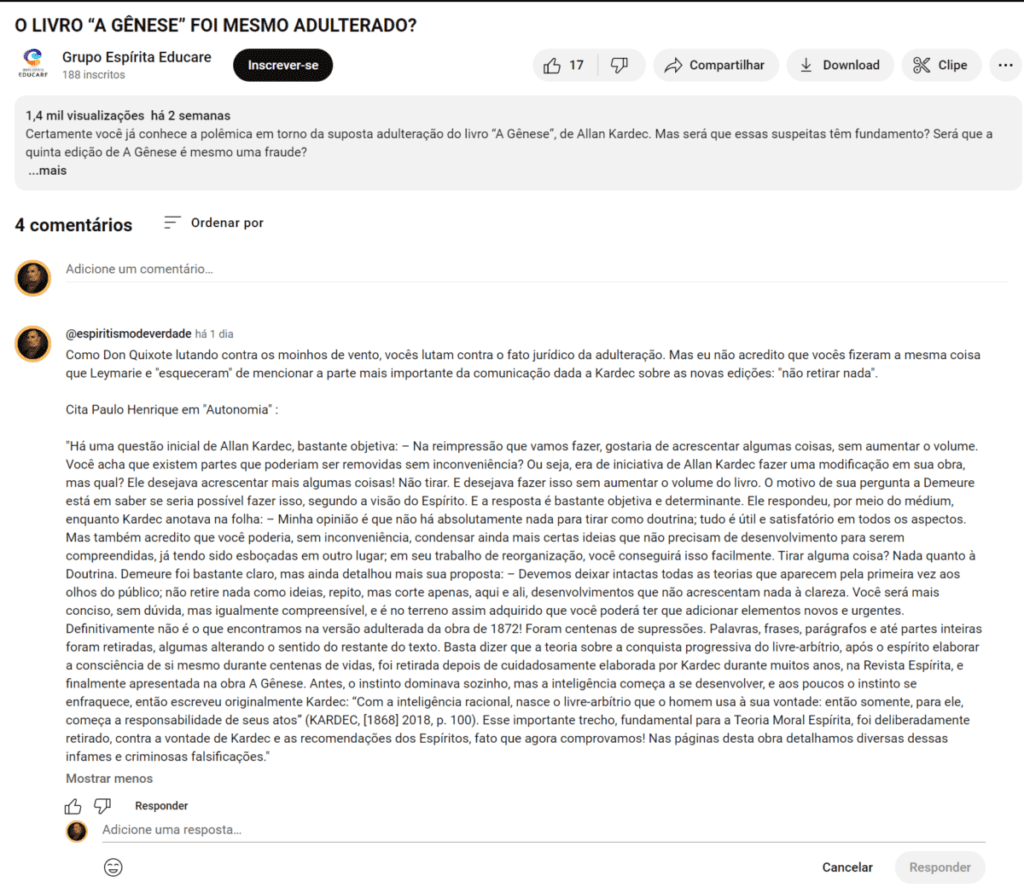
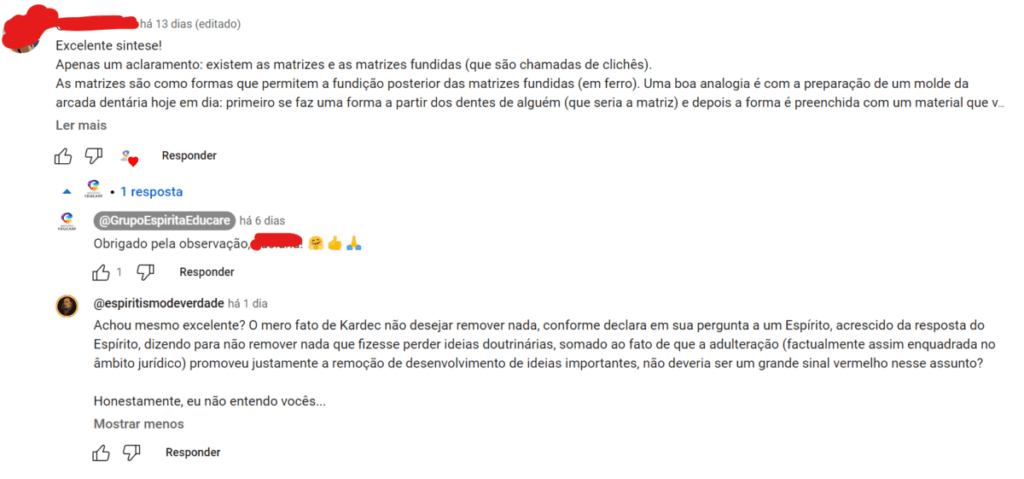
A few days ago, I commented on the video “Was the Book of Genesis really tampered with?”, published on the Grupo Espírita Revelare channel, on YouTube:
It's no coincidence that my comments don't appear to anyone else, as I'm hidden on the channel.
Prophecy of the Spirit of Truth
The Prophecy of the Spirit of Truth has happened.
When the elaboration of the Spiritist Doctrine through dialogue with the spirits was yet to begin, Allan Kardec in 1856 talked to the Spirit of Truth, who presented him with the following Prophecy for Spiritism:
Do not suppose that it is enough for you to publish one book, two books, ten books, and then stay quietly at home. You have to expose yourself. You will stir up terrible hatred against you; bitter enemies will be conjured for your loss; you will see yourself in arms with malevolence, with slander, with treachery even of those who seem to you the most dedicated; your best instructions will be despised and falsified; for more than once you will succumb under the weight of fatigue; in a word: you will have to sustain an almost continuous struggle, with the sacrifice of your rest, your tranquillity, your health and even your life, because without it, you would live much longer. (Posthumous works, pag. 344)
From 1858 to 1869, when Kardec published his books and the Spiritist Magazine spreading Spiritism, there were offences, slanders and defamations. He defended his ideas and the Spirits tooth and nail. After his death in 1869, the series of adulterations in his works, . Furthermore, countless false ideas were spread about the doctrine. Read the article our position where we explain our conclusions.
Unfortunately, major revelations always face these characteristics as consequences: hatred, betrayal, contempt and false ideas. If Spiritism is of great importance, it is natural for it to happen.
Pixbay Image – Ambroo
The other revelations, such as that of Moses and Christ, had the same resistance that the Spirit of Truth mentioned.
Overcoming the false idea of the Egyptians, Moses led to the people who followed him the idea of the one God, and the solidary destiny of humanity. Moses did not speak only to the Hebrew people: he called people from all classes of Egypt. And that’s what made the Egyptian priests bother: it was the imminent danger of a social revolution. Hatred and betrayals began.
And the Jews, who were among those who adopted his thought, deviated from the proposal of universal harmony. They elaborated the exclusivist beliefs and practices, separating pure and impure, those who would be from God and those dominated by the devil. were the false ideas that were far from what Moses proposed. The idea of God, devil, heaven and hell, pure and impure, is not part of this revelation. And that’s what Jesus came to do by putting things in his way.
Jesus came among the Jews to bring the true mentality and denounce the false idea. His good news represented the arrival of the full divine law for mankind. Jesus predicted that his ideas would be distorted. If Jesus predicted this with his own teaching, why would it not occur with the Spiritist Revelation?
26. Meanwhile, Christ adds: "Many of the things I say to you cannot yet understand, and many more I would have to say, but you would not understand; therefore I speak to you in parables; but later I will send you the Comforter, the Spirit Truth who will restore all things and explain them all.
If Jesus announced that it would be necessary to restore the lost teachings, we clearly deduced that something was abandoned, both in the teachings of Moses, in Jesus and in Spiritism.
And Kardec undertook a fight that actually ended up taking away his health, as was the prophecy of the Spirit of Truth. From studies we know that the best instructions of the Spiritist Doctrine were disregarded in many cases, and worse, falsified in others. We need to recover these lost teachings! ((text drawn from the lecture given by Paulo Henrique de Figueiredo, Click here for more details ))
Below is the complete communication of the Spirit of Truth of 1856:
June 12, 1856 (At Mr. C...; medium: Ms. Aline C...) My mission Question (to the Truth) - Good Spirit, I wanted to know what you think of the mission that some Spirits signed me. Tell me, I beg you if it’s evidence of my self-love. I have, as you know, the greatest desire to contribute to the propagation of the truth, but from the role of the simple worker to that of missionary in chief, the distance is great and I do not understand what can justify in me such grace, preferably to so many others who have talent and qualities that I do not have. Answer - I confirm what was said, but I recommend you a lot of discretion if you want to do well. You will later learn things that will explain what surprises you. Do not forget that you can triumph, how you can fail. In the latter case, another would replace you, for God’s designs do not rest on a man’s head. Never, therefore, speak of your mission; it would be the way to make it fail. It can only be justified by the work done and you have done nothing yet. If you fulfill it, men will know how to recognize it, sooner or later, since the quality of the tree is verified by the fruits. P. - I certainly have no desire to boast of a mission I hardly believe in. If I am destined to serve as an instrument for Providence, may it dispose of me. In that case, I claim your assistance and that of the good spirits, in the send
A. - Our assistance will not be lacking, but it will be useless if you do not do what is necessary. You have your free will, which you can use as you see fit. No man is constrained to do anything. Q. - What causes could determine my failure? Would it be the insufficiency of my abilities? A. - No; but the mission of the reformers is pregnant with obstacles and dangers. I warn you that yours is rude because it is about shaking and transforming the whole world. Do not suppose that it is enough to publish a book, two books, ten books, and then be quietly at home. You have to expose yourself. You will stir up terrible hatred against you; bitter enemies will be conjured for your loss; you will see yourself in arms with malevolence, with slander, with treachery even of those who seem to you the most dedicated; your best instructions will be despised and falsified; for more than once you will succumb under the weight of fatigue; in a word: you will have to sustain an almost continuous struggle, with a sacrifice of your rest, your tranquillity, your health and even your life, because without it, you would live much longer. Well! not a few retreat when, instead of a flowery road, only see under the steps heathers, sharp stones and snakes. Intelligence is not enough for such missions. It is necessary, first, to please God, with humility, modesty and disinterest, since He slaughters the proud, the presumptuous and the ambitious. Courage, perseverance and unwavering firmness are indispensable to fight men. Prudence and tact are also necessary in order to conduct things properly and not to compromise their success with untimely words or measures. Finally, devotion, self-denial and willingness to all sacrifices are required. You see, thus, that your mission is subordinate to conditions that depend on you. Spirit of Truth
I - Spirit of Truth, thank your wise counsel. I accept everything, without restriction and without preconceived ideas.
Posthumous Works, pg. 343-5
In Posthumous Works, follows an interesting note made by Allan Kardec more than 10 years later:
NOTE - I write this note on January 1, 1867, ten and a half years after I was given the above communication and I attest that it took place at all points, as I experienced all the vicissitudes that were predicted to me. I fought with hatred of hardened enemies, with slander, slander, envy and jealousy; infamous libels were published against me; my best instructions were falsified; those whom I trusted most betrayed me, I was paid with ingratitude by those to whom I served. The Paris Society was the focus of continuous intrigues against me by those who declared themselves in my favour and who, in good face in my presence, hit me in the back. They said that those who kept me faithful were my soldiers and that I paid them with the money I earned from Spiritism. I was never given to know what rest is; more than once I succumbed to overwork, had shaken health and compromised existence. Thanks, however, to the protection and assistance of the good spirits who incessantly gave me manifest proofs of solicitude, I have the fortune to recognize that I have never felt the slightest faintness or discouragement and that I have continued, always with the same ardour, in the performance of my task, without worrying about the wickedness of which I was the object. According to the communication of the Spirit of Truth, I had to rely on all this and everything was verified. But also, along with these vicissitudes, which I experienced of satisfaction, seeing the work grow so prodigiously! I am fortunate to recognize that I never felt the slightest weakness or discouragement and that I continued, always with the same ardor, in the performance of my task, without worrying about the wickedness of which I was the object. According to the communication of the Spirit of Truth, I had to rely on all this and everything was checked. But also, along with these vicissitudes, which I experienced of satisfactions, seeing the work grow so prodigiously!
SUMMARY OF THE LAW OF SPIRITIST PHENOMENA by Allan Kardec
SUMMARY OF THE LAW OF SPIRITIST PHENOMENA is one of Kardec's not-so-publicized works (Click here For download). It was written in 1864, and would be a summary of the summary of the Book of Spirits and Book of Mediums, I think. Because it is a compact work, only 20 pages, it conveys the very general concept of what the Spiritist Doctrine and the Spiritist Phenomena are.
It is divided into 5 parts: Preliminary Observations, On Spirits, Manifestations of Spirits, On Mediums, On Spiritist Meetings.
I highlight, as an example, one of the items he makes belongs to the “Manifestations of Spirits” part:
23. Spiritist evocations do not consist, as some imagine, in bringing back the dead with a gloomy aspect of the tomb. It is only in novels, in fantastic tales of ghosts and in the theater that one sees the emaciated dead emerge from their tombs dressed in sheets and making their bones crack. Spiritism, which has never performed miracles, this one as well as others, has never revived a dead body; when the body is in the grave, it is definitely there; but the spiritual, fluidic, intelligent being is not involved with its gross envelope; he separated from him at the moment of death, and once the separation has been effected, it no longer has anything in common with him.”
Summary of the Law of Spiritist Phenomena, page 12, A. Kardec
It is worth knowing it or simply sending it to that friend who wants to understand what Kardec's Spiritism is in a nutshell...