The Deviation of Spiritism After Kardec: From France to Brazil, and the Rescue of Autonomy
Spiritism was not born to be just another religion constrained by dogma or a closed sect. When Allan Kardec codified the doctrine in the 19th century, he established it as a... philosophical science with moral consequences. Its foundation was Rational Spiritualism—an avant-garde movement that replaced blind faith with reasoned faith and crude materialism with a scientific understanding of the soul. The goal was clear and ambitious: to promote a moral revolution and the social renewal of humanity, based on the absolute freedom and intellectual autonomy of the individual.
However, history reveals that this light of reason was deliberately obscured. Kardec, foreseeing that his work would be subject to distortions, left rigorous archives so that the truth could be recovered. What followed his death in 1869 was not the natural evolution of his thought, but a true institutional coup.
Treason in France: The Adulteration of Knowledge
Immediately after Kardec's death, the Spiritist movement in France was invaded by unscrupulous interests. The Parisian Society for Spiritist Studies was marginalized and... Spiritist Magazine It fell into the hands of those who, although feigning friendship, worked to distort the work.
These changes were not editorial errors, but maneuvers orchestrated by the Sociedade Anônima da Caixa Geral e Central do Espiritismo (São Paulo State Limited Company), which transformed the dissemination of knowledge into a lucrative business. The influence of Jean-Baptiste Roustaing was decisive in this process. By proposing Spiritism as a formal religion, with reincarnation seen as "divine punishment," Roustaing moved in the opposite direction to everything Kardec preached. Only the heroic resistance of figures like Amélie Boudet, Léon Denis, and Gabriel Delanne prevented the flame of doctrinal integrity from being completely extinguished in France.
The Echo of Error in Brazil: The Institutionalization of Dogma
Unfortunately, while Roustainguism was losing strength in Europe, it found fertile ground in Brazil. The deep Catholic heritage and the lack of a systematized critical thought made the Brazilian population vulnerable to a "sweetened" Spiritism, which mixed Kardec's reason with the dogmas of the Old World.
The Brazilian Spiritist Federation (FEB), although founded with progressive ideals in 1884, ended up succumbing to this influence. In 1902, Roustaing's work was preferred to... “"The Gospel According to Spiritism"”, under the false promise of being a "complete revelation." Even the magazine Reformer, once secular and free-thinking, has become a vehicle for dogmatic propaganda.
In this context, Bezerra de Menezes, by aligning himself with the Roustaingist groups and asserting that "Spiritism is a religion," contributed to an intellectual regression. This view was later legitimized by psychographed works that attempted to portray Roustaing as an auxiliary missionary of Kardec—a thesis contested by rigorous scholars, such as Herculano Pires, given the evidence that originals were incinerated to erase contradictions.
The Struggle for Truth: The Legacy of Canuto Abreu
In the face of this scenario of misinformation, the fundamental figure of emerges. Silvino Canuto Abreu. With the precision of a historian and the passion of a seeker of truth, Canuto Abreu dedicated his life to denouncing the dogmatic drift of the FEB (Brazilian Spiritist Federation). Through exhaustive research in France and Brazil, he recovered thousands of manuscripts and testimonies that proved the abysmal distance between the freedom proposed by Kardec and the mystical traditionalism imposed by Brazilian institutions.
His work, though silenced for decades, is key to understanding that Spiritism was hijacked by a retrograde vision. He showed us that Brazilian vulnerability occurred because we ignored the... Rational Spiritualism — the philosophical basis that, in France, protected spiritualists from dogmatism and defended secular morality and conscientious duty.
Conclusion: The Call to Awakening
The deviation of Spiritism was not an accident, but a process of distortion that transformed a science of liberation into a sect of obedience. Today, the restoration of historical truth, driven by researchers such as Canuto Abreu and Simoni Privato Goidanich, is not merely an academic exercise, but an urgent necessity.
It's time to break free from the shackles of the past and return to... reasoned faith. Only by reclaiming the universality of the Spirits' teachings and moral autonomy can Spiritism resume its original mission: to elevate humanity intellectually and morally. The invitation has been made: let us abandon the comfort zone of dogma and rediscover the courage of reason.
In 1869, Kardec estimated that there were 6 to 7 million Spiritists, according to statistics he compiled. He compiled them based on data from subscribers to his magazines and his correspondence. This is how he explains the Spiritist Magazine of January 1869. He did not provide an approximate measurement because:
An exact enumeration of Spiritists would be impossible, as we have already said, for a very simple reason: Spiritism is neither an association nor a congregation; its adherents are not registered in any official registry. It is well known that one cannot assess the number by the number and importance of the societies, attended only by a tiny minority. Spiritism is an opinion that does not require any profession of faith and can extend to all or part of the principles of the Doctrine. It is enough to sympathize with the idea to be a Spiritist. Now, since this quality is not conferred by any material act, and implies only moral obligations, there is no fixed basis for determining the number of followers with precision. It can only be estimated approximately, based on relationships and the greater or lesser ease with which the idea spreads. This number increases daily, at a considerable rate; this is a positive fact, recognized by even its adversaries; opposition diminishes, clear proof that the idea finds more sympathy.
Meanwhile, it can be said, without exaggeration, that, in short, the number of adherents has increased a hundredfold in ten years, despite the maneuvers employed to stifle the idea and contrary to the predictions of all those who boasted of having buried it. This is a fait accompli, of which the antagonists must be made aware.
Idem
Kardec addresses two categories of people in relation to Spiritism: those who consciously accept it after studying it and those who, although they do not yet identify as Spiritists, have intuitions and beliefs aligned with the doctrine. He emphasizes that Spiritist ideas arise naturally in many individuals, even without prior contact with Spiritism, which proves that these ideas are part of nature and tend to spread. Opposition to Spiritism, in many cases, is due to misperceptions based on distorted criticism. Once these people learn about the true doctrine, they will tend to accept it, becoming Spiritists in the future. Despite these considerations, Kardec did not include them in the study.
He also explains that, while it is impossible to obtain exact numerical statistics on the number of Spiritists, it is possible to analyze their distribution based on professions, social status, nationalities, and religious beliefs. Considering the variation in the number of people in each profession, it is possible to identify in which categories Spiritism has the most followers. In some cases, the proportion was calculated as percentages with good precision, although without mathematical rigor, while in other categories, the classification was based on the relative number of followers. These conclusions were obtained from over ten thousand observations.
world and people
Let's look at the (relative) numbers presented in the January 1869 edition:
I. ─ Regarding nationalities:- There is, so to speak, no civilized country in Europe or America where there are no Spiritists. They are most numerous in the United States of America. Their number there is estimated by some at four million, which is already a lot, and by others at ten million. This last figure is evidently exaggerated, as it would comprise more than a third of the population, which is unlikely. In Europe, the number can be estimated at one million, and France has six hundred thousand. The number of Spiritists worldwide can be estimated at six or seven million. Even if it were half, history offers no example of a doctrine that in less than fifteen years could have gathered such a number of followers spread across the entire surface of the globe. If we included unconscious Spiritists, that is, those who are so only intuitively and later become true Spiritists, in France alone one could count several million.
From the point of view of the diffusion of Spiritist ideas and the ease with which they are accepted, the main countries of Europe can be classified as follows: 1st France. ─ 2nd Italy. ─ 3rd Spain. ─ 4th Russia. ─ 5th Germany. ─ 6th Belgium. ─ 7th England. ─ 8th Sweden and Denmark. ─ 9th Greece. ─ 10th Switzerland.
II. ─ In relation to the sex:70% men and 30% women.
III. ─ Regarding age: from 30 to 70 years, maximum; from 20 to 30, medium; from 70 to 80, minimum.
V. ─ Regarding instruction:The level of education is very easy to assess through correspondence. Careful instruction, 30%; simple scholars, 30%; higher education, 20%; ─ semi-literate, 10%; ─ illiterate, 6%; ─ wise officers, 4%.
V. ─ Regarding religious ideas: Roman Catholics, freethinkers, not bound by dogma, 50%; ─ Greek Catholics, 15%; ─ Jews, 10%; ─ liberal Protestants, 10%; ─ Catholics linked to dogmas, 10%; ─ Orthodox Protestants, 3%; ─ Muslims, 2%.
Of the 11 items, we want to highlight this one, which deals with religious ideas. Here, Kardec makes clear the distance between Spiritism and religion. Once again, Spiritism was never a religion; Spiritism is a philosophical science. As a science, it investigates everything rationally; it can remain a religion and study Spiritism. Those with free thought and reasoned faith do not cling to dogma.
VI. ─ Regarding fortune: mediocrity, 60%; ─ average fortunes, 20%; ─ indigence 15%; ─ large fortunes, 5%.
VII. ─ In relation to the moral state, abstraction made of fortune: afflicted, 60%; ─ without restlessness, 30%; ─ happy in the world, 10%; ─ sensualists ((sensualists are those who follow the doctrine of sensualism, that is, the doctrine of those who attribute the origin of all ideas to the senses, opposing idealism.))
VIII. In relation to social class: Without being able to establish any proportion within this category, it is clear that Spiritism counts among its adherents several sovereigns and princes-regents; members of sovereign families; and a large number of titled figures. In general, Spiritism has the most adherents among the middle classes. In Russia, it is more or less exclusively among the nobility and upper aristocracy. In France, Spiritism spread among the petite bourgeoisie and the working class.
IX. ─ Military state, according to the degree: 1st - lieutenants and warrant officers; 2nd - non-commissioned officers; 3rd - captains; 4th - colonels; 5th - doctors and surgeons; 6th - generals; 7th - municipal guards; 8th - soldiers of the guard; 9th - soldiers of the line. NOTE: Almost all Spiritist lieutenants and warrant officers are active; among the captains, about half are active and the other half are in reserve; the colonels, doctors, surgeons and generals are mostly in reserve.
X. ─ Navy:1st. ─ military navy; 2nd. ─ merchant navy.
XI. ─ Liberal professions and various functionsWe grouped them into ten categories, classified according to the proportion of adherents they provided to Spiritism: 1st - Homeopathic doctors. 2nd - MagnetistsOVocabulum magnetizerawakens the idea of action; that of magnetist an idea of adhesion. The magnetizer is the one who practices it by profession or something else. One can be a magnetist without being a magnetizer. It will be said; aexperienced magnetizer and a convinced magnetist.)) 2nd ─ Engineers. ─ Teachers: boarding school principals and headmistresses. ─ Free teachers. 3rd ─ Consuls. ─ Catholic priests. 4th ─ Petty employees. ─ Musicians. ─ Lyrical artists. ─ Dramatic artists. 5th ─ Bailiffs. ─ Police commissioners. 6th ─ Allopathic physicians. ─ Men of letters. ─ Students. 7th ─ Magistrates. ─ Senior officials. ─ Officials and high school teachers. ─ Protestant pastors. 8th ─ Journalists. ─ Painters. ─ Architects. ─ Surgeons. 9th ─ Notaries. ─ Lawyers. ─ Attorneys. ─ Business agents. 10th ─ Exchange agents. ─ Bankers.
We were impressed that doctors and engineers topped this list. Kardec states in the article that for every hundred Spiritist doctors, at least eighty are homeopaths. This is because the principle of homeopathy brings them closer to spiritualism, and it is rare to find materialists among them, unlike allopaths. Homeopaths understand Spiritism better, identifying the properties of the perispirit as the basis of their system. Spiritists, in turn, recognize the rationality of homeopathy and defend it against unfair criticism, maintaining a balanced stance toward allopathy.
Since Magnetism and Spiritism are complementary sciences that explain each other, neither can fully evolve without the support of the other, functioning in an integrated manner, much like Physics and Chemistry or Anatomy and Physiology. Many magnetists intuitively recognize this connection and use their knowledge of magnetism as a way to approach Spiritism.
XII. ─ Industrial, manual and commercial professions, equally grouped into ten categories. 1st ─ Tailors. ─ Seamstresses. 2nd ─ Mechanics. ─ Railway employees. 3rd ─ Weavers. ─ Small traders. ─ Porters. 4th ─ Pharmacists. ─ Photographers. ─ Watchmakers. ─ Commercial travelers. 5th ─ Planters. ─ Shoemakers. 6th ─ Bakers. ─ Butchers. ─ Sausage makers. 7th ─ Carpenters. ─ Typographers. 8th ─ Large industrialists and heads of establishments. 9th ─ Booksellers. ─ Printers. 10th ─ House painters. ─ Bricklayers. ─ Locksmiths. ─ Grocers. ─ Domestic workers.
It's more difficult to understand the position occupied by certain industrial professions in this classification. One wonders, for example, why tailors rank first, while booksellers and printers, much more intellectual professions, are near the bottom. This is a fact that has been established for a long time, and we still haven't grasped the cause.
idem
There are a number of consequences of these results that Kardec found. Among them, we highlight:
That there are spiritists at all levels of the social scale.Furthermore, the vast majority of Spiritists are found among enlightened people, not among the ignorant. And nowhere did it first develop in the lower classes.
That Spiritism finds easier access among non-believers in religious matters than among those who have a consolidated faith.
Finally, after fanatics, those most resistant to spiritualist ideas are sensualists and people whose only thoughts are focused on material possessions and pleasures, regardless of their class, regardless of their level of education.
THE Affliction and unhappiness are the great recruiters of Spiritism, as a result of the consolations and hopes it gives to those who cry and lament.
The curious thing is that after Kardec published his statistics on Spiritism, he presents, in the February 1869 edition, the assessment of these same statistics made by the newspaper Solidarity of January 15, 1869. In the article he refutes the numbers presented by Kardec, saying that Kardec made a big mistake because he did not count the followers from Asia.
We will highlight only a few excerpts, and leave the complete reading of this article to the reader. To read the article Click here
"We regret that we cannot reproduce, due to lack of space, the very wise reflections that Mr. Allan Kardec adds to these statistics. We will limit ourselves to noting with him that there are Spiritists at all levels of the social ladder; that the vast majority of Spiritists are found among enlightened people and not among the ignorant; that Spiritism has spread everywhere, from top to bottom on the social ladder; that affliction and unhappiness are the greatest recruiters of Spiritism, as a result of the consolations and hopes it gives to those who mourn and lament; that Spiritism finds easier access among nonbelievers in religious matters than among people with a fixed faith; finally, that, after fanatics, those most resistant to Spiritist ideas are those whose thoughts are entirely focused on possessions and material pleasures, regardless of their condition."
idem
“It is very wrong to Spiritist Magazine when she estimates the number of Spiritists for the entire world at only six or seven million. She obviously forgets to count Asia.
"If the term 'spiritists' refers to people who believe in life beyond the grave and in the relationships between the living and the souls of the dead, they must be counted in the hundreds of millions. Belief in spirits exists among all followers of Buddhism, and it can be said that it constitutes the foundation of all the religions of the Far East. It is widespread, especially in China. The three ancient sects that have long divided the populations of the Middle Kingdom believe in manes, in spirits, and profess their worship. ─ It can even be said that this is a common ground for them. The worshippers of So and of Fo there they meet the followers of philosopher Confucius.
“The priests of the sect of Lao-Tseu, and particularly the Tao-Tse, or doctors of Reason, owe a large part of their influence over the populations to spiritualist practices. These religious people interrogate the Spirits and obtain written answers that are no more or less valuable than those of our mediums. These are advice and warnings considered to be given to the living by the Spirit of a dead person. There are revelations of secrets known only to the one questioning, sometimes predictions that come true or not, but which are of a nature to shock the attendants and greatly stimulate their desires, so that they take charge. to carry out, themselves, the oracle.
“This correspondence is obtained by processes that do not differ much from the processes of our spiritists, but which, however, must be further perfected, if we consider the long experience of the operators who traditionally practice them.
The deviation of the Brazilian Spiritist Federation: how Roustainguism distanced the Spiritist Movement from Spiritism
What is known about Spiritism in Brazil necessarily involves the image of a Spiritist Movement formed mainly by the influence of the Brazilian Spiritist Federation. However, the more we study, the more strange we find the unquestionable distance between this Movement and original Spiritism. We then began to ask ourselves: “what happened?” Recently discovered information has made us aware of what, for some, has been very clear for a long time.
Roustaing — Jean-Baptiste Roustaing — for those who don't know, he was a powerful lawyer at the time of Kardec. In short, he began to receive spiritual communications through a medium — yes, just a medium. In these communications, “the Spirits” (probably there was just one) presented themselves as the four evangelists and said that he, Roustaing, was the Revealer of Revelations. Needless to say, this was a blatant mystification, is it? We will say: this was a blatant mystification, easily recognized by someone who deeply knew spiritist science. This someone, Kardec, criticizes the work transmitted by these Spirits, “The Gospels”, and, thus, touching on that gentleman's blatant pride and vanity, creates a new enemy.
Among the dogmas admitted by this gentleman was the idea that a Spirit who makes a lot of mistakes is sent to an inferior planet, where he would incarnate as a slug (“fleshy cryptogams”). There was also the dogma of the fall through sin, where the human being would only have to incarnate after making a mistake and, thus, acquiring a guilt that would project him to a punishment, through incarnation — the same idea inserted in adulteration of Heaven and Hell — as well as the dogma that Jesus was just an agender, that is, he never incarnated among us.
Mystical ideas, for some reason that we do not understand, appeal to many, no matter how complicated and meaningless they may seem to us, given the unbreakable crystallinity of Spiritism. Thus, these ideas found support even in French territory, including by Leymarrie, most responsible for the adulteration of the purposes of the Sociedade Anônima and the Revista Espírita, after Kardec's death. Soon, these ideas were imported to Brazilian soil, where the Sayão Group was founded. worshiped by FEB)), or the Humble Group, or the Ismael Group. In this group, in fact, the Spirit of the “Angel” Ismael communicated, reproducing various mysticist absurdities, the same “Angel” Ismael who appears in “Brazil, Heart of the World, Homeland of the Gospel”, a work produced by a mystifying Spirit, and full of mysticistic absurdities and even lies. The well-known Dr. Bezerra de Menezes was also part of this group. AND.
The “angel” Ishmael
This much-lauded "angel" Ismael is so cynical, so hypocritical, that, demonstrating his imperfection, he goes so far as to say that Kardec would have had a isolated opinion Regarding the incarnation of Jesus:
If the isolated opinion of your good master Allan Kardec could, in some way, influence the understanding of some, making them believe that the Redeemer of the world came to clothe himself in the gross matter of common bodies, to give an example of the greatest virtues, guiding all of humanity towards the promised land, today, when all well-enlightened Spirits affirm that the birth of Jesus was entirely apparent, that his body was only constituted of fluids concentrated in the womb of the ever-Virgin Mary, there is no longer any reason for two opinions on the matter.
The Virtues of Heaven: The Admirable Collection of Messages Received in the Early Days of the Ismael Group and Included in the Second Edition of Evangelical Elucidations, by Antônio Luiz Sayão / edited by Marco Aurélio L. de Assis. — Rio de Janeiro: CRBBM, 2012.
It's interesting to see how, despite his being an isolated opinion, he tries to turn the tables by lying and saying that today, "all enlightened Spirits affirm that the birth of Jesus was entirely apparent." This is the old dogma of Roustaing, that the body is unclean, that incarnation is a punishment, and that therefore Jesus could not have incarnated. It's important to say that this conception of incarnation as punishment has largely taken root in the Febiano-Spiritist Movement, as the idea that an individual who goes through any difficulty, even when imposed by others (as in the case of a crime) or due to illness, is merely "redeeming debts from past lives," is repeated everywhere.
FEB, roustainuist
Before the Sayão Group, the Confúcio Group was founded. This Group included, among others, Dr. Siqueira Dias, Dr. Francisco Leite de Bittencourt Sampaio, Dr. Antonio da Silva Neto, Dr. Joaquim Carlos Travassos, Prof. Casimir Lieutaud. Many of these you will see in the material available, declaring their “faith” in Roustaing and his four Gospels. This group was followed by the Society for Spiritist Studies “God, Christ and Charity”, founded in March 1876. “God, Christ and Charity” is, to this day, the motto of the FEB.
“Accepting Bezerra de Menezes to accept the Presidency of the Federation, in 1895, the 'Ismael Group' accompanied the apostle, supported him in the direction of the House and joined it”, as read on the FEB portal itself (A FEB – Origens), accessed on 06/23/2024. Thus, a Roustainuist group came to dominate the FEB, which established itself and created roots that would cross the 20th century, enter the 21st century and, in the first years of that, in 2018, although they left the Febian status, which previously required study and dissemination of these works, continued in its bowels, even though to this day this institution has not publicly acknowledged its deviations and committed itself to reparation.
The coordinator of the CFN's legal consultancy, Francisco Ferraz Batista, presented the results of the proceedings in the 29th Civil Court of the District of Rio de Janeiro, regarding the withdrawal, from the FEB Statute, of the part of the item referring to the disclosure and study of works of JB Roustaing. The results were favorable to FEB, for the removal of the aforementioned section of the item from its Statute, which should formally occur at a General Assembly meeting.
The removal of this section from the FEB statute obviously did not remove Roustaing from its depths, since it still requires the study of “Brazil, Heart of the World,” a work that continues to support the lie about Roustaing, highlighted by us in bold:
“According to the work plans of the invisible world, the great missionary, in his wonderful effort of synthesis, would count on the cooperation of a multitude of assistants to his work, particularly designated to assist him, in the individualities of João-Batista Roustaing, who would organize the work of faith; by Léon Denis, who would effect the philosophical unfolding”.
This is how, “to be a spiritist”, most of the spiritist centers you step into will direct you to the Febian catechization, studying “Spiritism” not in the works of Kardec, but in the booklets of the Brazilian Spiritist Federation, where, bringing as a work basic to the probably adulterated “Brazil, Heart of the World”, the lie about the figure of Roustaing and the mysticism of the “angel” Ismael are validated at the same time. Therefore, the entire Febian tradition is validated and the entire methodology and organization necessary for the continued development of Spiritism are discarded, replacing all spiritist science with blind belief in the Spirits and in the personalities endorsed by the FEB...
Sérgio Aleixo quotes:
As predicted by the so-called “Golden Pact” (05/10/1949), “it is up to the spiritists of Brazil to put into practice the exposition contained in the book Brazil, Heart of the World, Homeland of the Gospel, in order to accelerate the evolutionary march of Spiritism”. Well done! This passed into art. 63 of the statute of the Mother House of Rustenism in the world, which records:
The Council [National Federation of FEB] will make it clear to all spiritist societies in Brazil that it is up to them to put into practice the exposition contained in the book Brazil, Heart of the World, Homeland of the Gospel, by Francisco Cândido Xavier.
Among other jokes from beyond the grave, in chapter I of this work, “the divine bitterness” of Jesus “excites” a whole “beautiful assembly of cherubim and archangels” and he, “who directs this globe”,[1] does not even know where is Brazil.
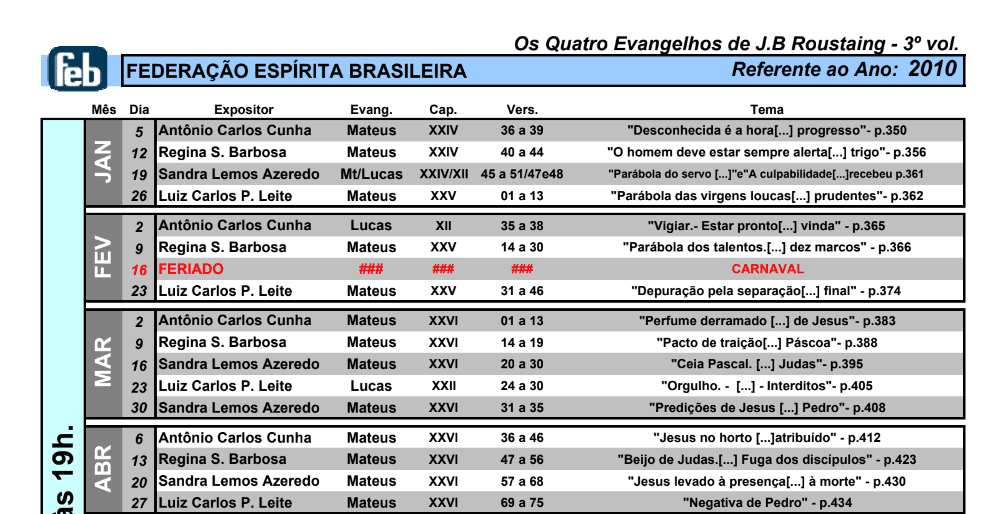
We could extend this article at length, demonstrating that the presidents of this institution have always been Roustainuists; that the FEB, as read in O Reformador, placed Roustaing above Kardec several times; that FEB, at the beginning of the 20th century, published the work The Gospels, by Roustaing, bringing, in the preface, a true affront to Kardec, Spiritism and confessed Spiritists. We will leave this observation to the dear reader, who will find material available here, largely obtained from the FEB website itself (on Google, search like this: “site:febnet.org.br Roustaing”), proof of what we now say. We limit ourselves to highlighting the following image, obtained from a document from the FEB website:
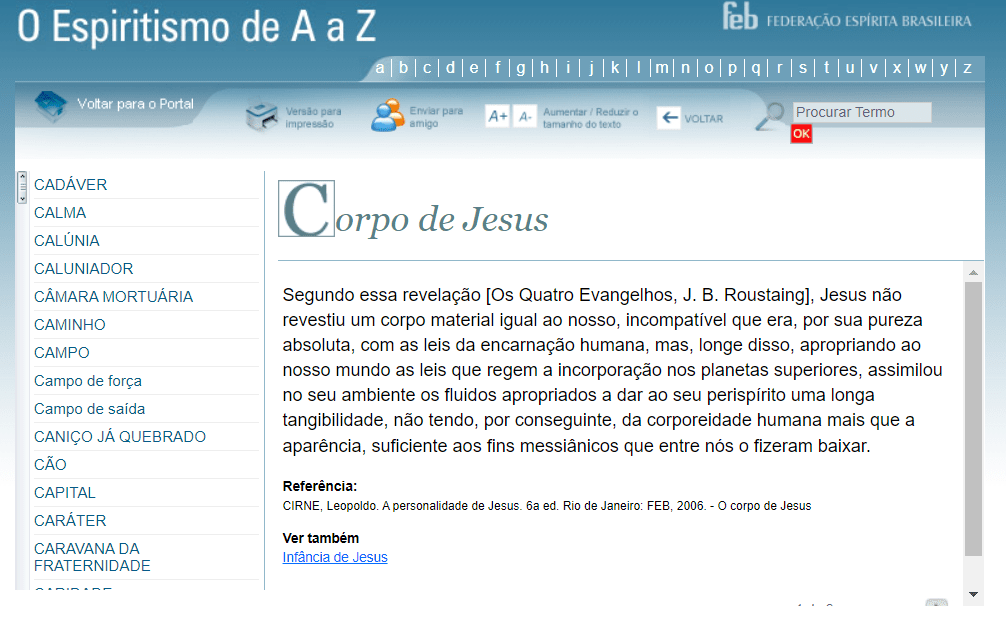
It is also important to highlight that, in the FEB domain, there is a glossary, “Spiritism from A to Z”, containing an explanation of terms and words — in the light of Spiritism, obviously? No. In the shadow of Roustaining:
No, the FEB (Brazilian Spiritist Federation) hasn't abandoned Roustainguism. As you can see in the image below, obtained from the official FEB Instagram account, on May 19th, two lectures (not yet published) based on QE (Questionnaire Experimental), which is nothing more than... Roustaing's Four Gospels!
Spiritist Movement away from Spiritism
We will, however, focus on evaluating the effects of a Spiritist Movement formed by the FEB:
Spiritists who are unaware of Spiritism; spiritists who are afraid of Spirits; spiritists who do not evoke the Spirits, questioning the obviously misleading communications; spiritists who blindly believe in the communications of Spirits, accepting everything as a “doctrinal complement”; spiritists who do not practice mediumship at home, believing that this would attract obsessors and that – an absurdity – only in the spiritist center would they have protection from good Spirits, if they did not go to the homes of well-intentioned people; spiritists, in short, who reproduce various false ideas, gleaned from blindly accepted communications and the opinions of idolized mediums, causing real embarrassment to Spiritism and giving ammunition to its critics.
We should mention that, among these idolized mediums, is Divaldo Franco, who, in the words of Augusto dos Anjos:
Divaldo Pereira Franco, the first centenarian, made the statement to me personally more than once that there is no way to explain the Gospels except in the light of the “Revelation of Revelation”. Would it be a reserved position, just for my private knowledge? Of course. First of all because good men do not have to, under any pretext, form dubious positions, one public and the other for private friends. This aphibological behavior does not belong to spirits of good morals. Afterwards, because the esteemed Bahian medium has already made the same statement from the platform, at the top of his lungs, from the height of authority and resounding that we recognize in him and that have served so much to the spiritual enlightenment of all of us, spiritists from Brazil and outside Brazil . To prove this, I transcribe below, «verb ad verbum», the most recent words of Divaldo Pereira Franco spoken from the top of the rostrum of the Grupo Espírita Fabiano (one of the most serious and well-oriented groups that exist in Guanabara), in night of October 6, 1969, with the auditorium being overcrowded as usual. Here is an excerpt from the memorable speech, recorded on magnetic tape, with the speaker's knowledge:
“For many years I didn’t understand. I went to Roustaing, which is my inexhaustible source of evangelical study! For almost twenty years I have been reading the benefactor João Batista Roustaing, meditating on his little words, on Mrs. Collignon's beautiful information, coming from Spirituality. But it’s a wonderful interpretation!”
ANJOS, Luciano dos. One taste and 4 cents. Reformer, Rio de Janeiro, p. 9-11, Jan. 1970. Extracted from the book The Zero Position.
Unfortunately, this was not the only case of an idolized medium or his psychographics defending the figure of Roustaing and his ideas, as you will see in this article. We remember that, here, we are discussing ideas, and not judging people.
It is evident that, although not all of the Spiritist Movement is affiliated with the FEB, the tentacles of Roustainuism and mysticism have enveloped the entire Brazilian Spiritist Movement. Unfortunately, these tentacles also crossed the oceans…
Campaign Plan
We see, finally, the “prophecy” made in 1867 and presented in the Revista Espírita of August of the same year, article “Campaign Plan” fulfilled:
Annihilating it is, therefore, an impossible thing, because it would be necessary to annihilate it not in one point, but in the entire world; and then, aren't ideas carried on the wings of the wind? And how to achieve them? You can pick up packages of goods at customs, but ideas are intangible.
What to do, then? Trying to take control of them, to accommodate them to your will… Well then! It is the party for which they decided. They said to themselves: Spiritism is the precursor of an inevitable moral revolution; before it is completely realized, let us try to divert it to our advantage; let us do it in a way that happens with it as with certain political revolutions; By denaturing its spirit, another course could be given to it.
So, the campaign plan has changed… You will see spiritist meetings being formed whose confessed objective will be the defense of the Doctrine, and whose secret objective will be its destruction; supposed mediums who will have communications ordered, suitable for the purpose they propose; publications that, under the cloak of Spiritism, will strive to demolish it; doctrines that will take some ideas from him, but with the thought of supplanting him. This is the fight, the real fight that he will have to sustain, and that will be fiercely pursued, but from which he will emerge victorious and stronger.
The much-desired unity of the Spiritist Movement will not occur through affiliation with an institution that is more similar to the Catholic clergy. No. This, in fact, goes against the plans for Spiritism, idealized by Kardec in the Spiritist Magazine of December 1868 — Transitional Constitution of Spiritism. This unity will only occur among those who, willingly, delve into the study of spiritist science, returning to, after that, practice mediumship at home, in small, harmonious, cohesive groups, carrying out the analysis of communications and evocations. These groups, spread far and wide, collaborating with each other, without any submission to the control of an institution, but rather to the control of the generality of the teachings of the Spirits, subjected to the sieve of reason, they will then be able to return to work on doctrinal development. Not before, not without it.
Therefore, we highlight the need the formation of study groups – at home, over the internet, at the spiritist center – for the dedicated study of Kardec’s works unadulterated and contextualization works. We leave here our modest collaboration in this regard: Semear Project — Formation of Study Groups.
On the day that the Brazilian Spiritist Federation accepts its deviation, committing itself to reparation and withdrawing from the purpose of determining the direction of Spiritism in Brazil, we will once again value it. Not before, not without this.
Jesus came to bring us the truth that sets us free! He mentioned the devil in the Bible, but did he believe in the literal existence of the devil? The word “Devil” is written in the Bible, but its meaning goes beyond the literal.
Pixabay – Golden Violinist – birds
It really all comes down to interpretation. God and Devil are representations of Good and Evil, respectively. However, viewing the Devil as purely malevolent is a misconception. The Devil is not an entity; it resides in those who embrace this false idea. Mal has no form, is not a real entity. No one is inherently evil. Is there anyone truly evil in this world? No, because evil is a false conception that supports a habit. When someone changes their mindset, they stop acting in evil ways, but overcoming the habit is a long process. However, you never overcome if your mentality doesn't change.
What will really transform the world is genuine education – not that which merely perpetuates false ideas, that decorates teachings, but rather that which is understood, which liberates. The weapons of good are understanding and explanation. How can I make you understand that the future of the world lies in cooperation? Simply explaining and cooperating endlessly, without worrying about the results.
We are introducing a new habit into the world. By overcoming the false idea of evil, we will see global renewal, offering new opportunities for everyone. There is no Spirit that will not, sooner or later, choose the path of good. However, the good is not imposed; everyone must achieve it with their own effort.
True understanding will free us from this false dichotomy between good and evil, leading us to a life of cooperation and harmony. The following passage from Jesus is revealing:
42 Jesus said to them, “If God were your father, you would love me. I came from God and I go [to God]. For I did not come on my own, but He sent me. “
Bible – Volume I: New Testament – The four gospels – Gospel of John (pp. 470-471). Company of Letters. Kindle Edition. Trans. Frederico Lourenço
Jesus said he was sent by God and not by his own means. He came to teach the Law of God.
Doing good is doing the Law of God. That's why there is only one God.
43 Why do you not understand my speech? Why you can't hear my word.
Idem
Science advances mainly through a paradigm shift, that is, a change in ideas.Paradigm comes from the Greek “paradigm”, which means “example” or “model”. Initially, it was applied in grammar (to define its use in a given context) and rhetoric (to refer to a parable or to a fable). From the 1960s onwards, it began to be used to define a model or a standard in any discipline scientific or epistemological context. source: Click here. We have to understand what the new idea looks like. So, after it makes sense, we test it and when we verify its coherence, we adopt it. The key is to share the new idea. But that doesn't mean everyone will become superior, that's not the world's idea. Children do not need to study at school just to get the best grades, generating competition between them. Each person must seek to learn more than they knew before, as we are all spirits at different stages of evolution. There are very intelligent spirits in our world because they have spent more time experiencing the world. However, the intelligent are not superior to the simple, because in other existences they were simple like them. They came to our world because they felt more prepared there. Intelligent spirits are not malevolent or demonic; however, they must cultivate simplicity to serve and contribute, not to be served. This is the great motto of the world.
To move toward happiness in this world, we need to help remove the blinders from the eyes of those who are blinded by false ideas. However, they will not easily accept acting for everyone. Thus, some leave for another world, where they can progress, help many others to progress technologically more quickly and have a new opportunity to rethink their choices. It is not a punishment or punishment to be sent to another world; it is simply a consequence of a choice that did not allow them to evolve. If they reconsider their attitudes in the other world, renewed, they can return here.
This has occurred in our world; the simple ones were on Earth when the exiles arrived. They were given a second chance by coming here, but now they must contribute in useful ways to the advancement of this world. Unfortunately, many have fallen into the false idea that they must be served, thus creating all the mistaken ideas that permeate the world. But whenever we try to explain the truth, because it is a false idea, they resist.
This is the last opportunity both to change your mindset and to fully participate in this world. Those who refuse to cooperate will not understand the truth through force, memorizing orders, or blind obedience. Only through personal effort can someone understand.
Freedom is 100% respected by spirituality
44 You are [children] of your father the devil; and you want to put your father's wishes into practice. He is homicidal from the beginning and was not and is not in the truth, because there is no truth in him. When he utters the lie, he utters it from his own; for he is a liar and is the father [of lies]. 45Me because I tell the truth you don't believe me. 46 Who among you condemns me regarding error? If I speak the truth, why don't you believe me? 47 Whoever belongs to God listens to the words of God. This is why you do not listen to me: because you are not from God.”
Idem
This part of John's Gospel is pointing out that the “devil” is in the false idea of superiority and purity. When we consider ourselves pure and superior, we tend to judge and condemn others who we consider simple and inferior. However, the act of judging is, in itself, a false idea: when we point out the error in another person, we are actually making a mistake, as we are judging the person instead of their specific behavior. This is equivalent to considering the person as “evil” and condemning them unjustly. Nobody has the right to act like that. Not even benevolent spirits condemn others in this way.
Evil reveals itself in the distortion of divine law, when we seek to satisfy our personal interests at the expense of the submission of the simplest, sacrificing their tranquility and happiness. However, we must reject the notion of superiority due to our knowledge.
In this context, our responsibility becomes even more crucial! Those who possess knowledge have a duty not only to help those less knowledgeable, but also to serve.
Reflect on this: The obligation of those who have knowledge is to serve the simplest! We should not use our knowledge for our own benefit, but rather to cooperate.
We must dedicate our efforts to disseminating knowledge and ensuring that many understand it. The future of the world lies in cooperation, not competition. Any new value must be shared globally so that everyone can benefit.
48 The Jews answered and said to him: “Do we not say well that you are a Samaritan and have a demon?”. 49 Jesus answered them: “I do not have a demon, but I honor my Father and you dishonor me. 50 I I do not seek my glory. There is one who seek and judge.51 Amen, amen, I say to you: if anyone observes my word, he will not see death until eternity.”
ibid.
In this part, it is expressed: “You are contaminated by evil! And there’s a devil!” If someone already thinks the other is a devil, there seems to be no solution. Those who are selfish and arrogant label others as inferior, always seeing the evil in others. Religious fanatics see those who are different as inferior. Materialists judge those who think differently as inferior. The crux of the problem is when an individual believes they are superior and is stubborn about not changing their mind, even when faced with the truth. The truth confronts you, questioning your lofty self-image.
Now, if someone considers themselves superior, they will only recognize their error when they reach that conclusion on their own. Often, this person, deep down, does not really believe in their superiority, which is why they feel the need to affirm it so vehemently.
The only factor that makes us equal is our individuality. We are unique Spirits, each with different experiences to develop and understand. However, having more knowledge does not make us superior to others. What truly defines the evolution of a Spirit is not its intelligence or experience, but its ability to understand the law of God. The goal of the Spirit is to give the best of itself.
God's Law is clear: There is no competition, only cooperation!
This article was prepared based on a lecture given by Paulo Henrique de Figueiredo. Click here to meet her.
To achieve dominance over others, the strategy is often used to make them believe that the error or failure lies in not obeying, therefore deserving punishment. At the same time, the illusion is propagated that obeying will bring rewards. This is the trap of evil, known as heteronomy. Those who submit are then controlled through conditioning, and this is where the true violence of evil lies.
Evil acts through violence and lies. She proclaims: “You must obey! If you don’t obey, you will receive punishment!” Then she states: “This is the only way to deal with those who refuse to obey.” This is an inversion of values.
Evil manifests itself in the false idea that distorts divine law, seeking the satisfaction of interests and personal joy at the expense of the submission of the simplest, sacrificing their tranquility and happiness. However, we must not be fooled into thinking that we are superior because we have knowledge. And do you know the error of the one who knows? Indifference! Having values and not using values for good.
In this sense, our duty, which you already know, intensifies! The responsibility of those who have knowledge goes beyond simply helping those who are less educated; they must also serve. Reflect: The duty of those who know is to serve the simplest!
We should not think about taking advantage of our knowledge, but rather about cooperating. We must use our efforts to disseminate this knowledge and make many people understand it. The future of the world lies in cooperation, not competition.
Any new value, such as COOPERATION instead of competition, must be shared across the world so that everyone can benefit.
This article was prepared based on a lecture given by Paulo Henrique de Figueiredo. Click here to meet her.
Evil is not making mistakes, then asking for forgiveness and being obedient to good.
O bad it is acting according to personal interest above the collective. To do this, the other must serve him, losing tranquility and happiness, which the selfish person does not want for himself. To submit the other, he must act not out of duty that cooperates, but out of submission that makes him a kind of slave.
God punishes? No! What is punishment?
O punishment, according to divine or natural law, consists of the constant suffering of those who consciously err, acting driven by personal interests, using lies and violence as means to achieve their objectives.
Isn't this concept totally different from what we have learned? Is punishment something that happens in the world? No, the punishment is the person's moral suffering and, if they do not change, they will not find happiness.
No selfish person is happy, because they know, intimately, that they are not doing good. But why would someone be selfish, knowing they are wrong, suffering because of it, and still continuing in the same selfish behavior?
Through Spiritism, we uncover the roots of selfishness and pride. Spiritism does not confront people or ideas; he confronts selfishness and pride as concepts that harm spiritual progress.
The guilty Spirit first suffers in spiritual life due to the degree of its imperfections, and is then granted bodily life as a means of reparation. That is why the Spirit finds in her, either the people she offended, or situations similar to those in which she committed evil, or even situations opposite to those she experienced, for example, facing misery if she was a bad rich person, or a humiliating condition if was proud. This is not a double punishment, but the same one that is continued on Earth, as a complement, with a view to facilitating your progress towards effective work. It depends on the Spirit himself to make it profitable. Isn't it better for him to return to Earth, with the possibility of gaining Heaven, than to be condemned without remission when he leaves it? This freedom that is granted to him is proof of the wisdom, goodness and justice of God, who wants man to owe everything to his own efforts, thus being the architect of his future. If you are unhappy, whether you are unhappy for a longer or shorter period of time, complain only to yourself – the path to progress is always open to you.
Allan Kardec. Heaven and Hell: Or divine justice according to Spiritism, publisher Feal (p. 78). Kindle Edition.
However, it is crucial to fully understand what selfishness entails in order to combat it effectively. Recognizing your mistakes and feeling guilty is the first step towards change. Otherwise, the individual will continue to suffer.
The false idea that God is the cause of our suffering is wrong. In fact, we are judges and prisoners of ourselves and our own thoughts. Spiritism teaches us this. Knowing this, will you choose to remain trapped or free yourself? To be a slave or free? It's your choice.
No one is obligated to act for the good. Freedom is fundamental to acting in good ways. God does not put anyone to watch anyone. When you do good, you will do it with all your effort. The moment you act with integrity, other spirits approach to do the same: the network of kindness is created.
If you are acting with ulterior motives, other spirits notice and you isolate yourself by choice. That's the mechanism!
Is someone really watching us in the spiritual world? No! Is there a specific place to be punished? No! This is false! Does Emmanuel mention the threshold? Yes, he mentions it, but they are deluded spirits that gather there. Good spirits see bad spirits as sick people to be cured and not as adversaries to be fought. The fight between good and evil is a false idea!
This article was prepared based on a lecture given by Paulo Henrique de Figueiredo. Click here to meet her.
Several times in his works, Kardec mentions Passive obedience and blind faith. Now let us reflect on why they are the principles of False Idea.
The false prophets, in order to conquer through passive obedience, needed to prevent the masses from learning through their own efforts without the experience of trial and error to learn. They, the false prophets, condemned error, as if error were the cause of evil in the world.
However, we all know that You can only learn when you try. From trying, errors and successes are produced. From there, we evaluate and understand the best way to act. And God does not condemn error, because error is part of learning. Think about it: it's very different to make mistakes unconsciously than to persist in making mistakes consciously.
“To rise, man must be tested. Preventing their action and putting an obstacle to their free will would be going against God and in this case the tests would become useless, because the Spirits would not commit faults.. The Spirit was created simple and ignorant. To reach happy spheres, it is necessary for him to progress and rise in knowledge and wisdom, and it is only in adversity that he acquires an elevated heart and better understands the greatness of God.”
Allan Kardec. Spiritist Magazine — Journal of Psychological Studies — 1858 – November
At the same time, when someone does something, whether at work or in everyday life, they have to know what they are doing and what the results of what they are doing are. So, this someone may be doing evil without knowing it or even participating in evil without being aware of the evil. Therefore, the ideal would be to never carry out an activity without understanding it.
The good thing is to try to act with conscience, understanding.
The false idea, through the two principles of passive obedience and blind faith, leads us to believe that the error is evil. Consequently, error generates fear. Is it better to obey without understanding and have faith?
Since ancient times, priests have determined people's behavior, as they themselves claim that God chose them to determine His Law. Priests created the false teaching that the right thing is to obey God to receive divine rewards and be saved. They also propagate that error represents action inspired by the devil, who attacks man to take possession of him. Kardec shows this understanding in A Genesis:
Religion was, at that time, a powerful brake on governing. The people voluntarily bowed before the invisible powers, in the name of which they were subjugated and whose rulers claimed to possess their dominion, when they did not pretend to be equivalent to these powers. To give more strength to religion, it was necessary to present it as absolute, infallible and immutable, without which it would have lost its ascendancy over these almost primitive beings, just initiated towards rationality. It could not be discussed, just like the orders of a sovereign. This resulted in the principle of blind faith and passive obedience, which had, in origin, its reason for being and its usefulness. The veneration of sacred books, almost always considered to have come down from heaven, or inspired by divinity, prohibited any examination65.
Allan Kardec. GENESIS – Miracles and Predictions According to Spiritism (Portuguese Edition) . chapter IV, item 2. Kindle edition. ((Genesis – Miracles and Predictions According to Spiritism: https://amzn.to/3RM91hF ))
What is the thesis of the priests: if you do what we tell you, you will do what God tells you, then you will do right and you will be saved. If you do things differently using your own reason and conscience, you will not do the same as God, so you will do things wrong. The consequence is that the person will stop thinking. You will only obey. For priests, evil is not obeying. The good thing is to obey.
Whoever disobeys or does not repent will be handed over to the devil, suffering punishment, vicissitudes and pain. Through this false idea, the priests conditioned the masses to believe without reasoning — Blind Faith — claiming that reason does not understand the divine will. Obeying without understanding — Passive Obedience.
What are the instruments to make a person submissive? Believing without reasoning!Obey without understanding! Any understanding that starts from these two principles is a False Idea!
Blind faith and passive obedience occur in any area of activity: science, philosophy, religion, at work, at home, in relationships. In the Middle Ages, the religious dogma to guide actions. Today we use the materialistic dogma. In this way, it's like the middle ages of science!
If a person believes that their work is not and cannot be spiritualized, they are excluded from the environment. Exclusion is the same instrument that the church used, with condemnation, excommunication, persecution, etc. It is true that the church's condemnation led to death, but today exclusion by society is practically dying, becoming marginalized. There are graduates of higher education (or even technical education) who tend to believe in materialism; the others are the excluded. And the fight of the superior versus inferior. Spiritualism is the devil of science! And Materialism is the god of science!
Finally, currently, due to the false idea, those who think differently, whether from other countries or other religions, are enemies, they are controlled by the Devil, and must be fought and destroyed. Those who obey are protected by Good God. Thus, they create exclusivism and war. It is a MATERIALIST exclusivism!
Spiritism is not exclusivist. Spiritism is an idea. And it is through this idea that he will transform the world.
This article was prepared based on a lecture given by Paulo Henrique de Figueiredo. Click here to meet her.
Continuation of the article Spiritism: The Idea of Jesus. Are we going to better understand the differences between the true mentality and the false idea?
Over time, the true mindset and false idea have taken root in the world's traditions in various ways. Religions have always embedded competition, dispute and the law of the strongest into their teachings.
Pixabay Photo: Mohamed_hassan
The Christian tradition considers that Jesus was announced by John the Baptist and foreshadowed by repentance: “repent, for the kingdom of heaven has come near”. With this thought, we had to repent of our sins, of our mistakes. This education leaves us full of guilt, because if I made a mistake, I need forgiveness to be saved.
TO MAKE AN ERROR IS A SIN, says Christianity.
Religions used this idea to say that only God's forgiveness saves those who make mistakes, and those who disobey are eternally punished and handed over to the devil. This thought was not only implemented by religions: at work, if you make a mistake you will be fired, in the family, if you make a mistake you will be ignored, and this happens in countless situations. In life, you can't go wrong! People use pretense, hide, camouflage mistakes, falsehood, because remember: making mistakes is a Sin. This triggers several consequences, including that people are not as they truly are, nor do they feel included, lost, aimless.
That's why we have to understand Spiritism's message of belonging, of being part, of collaboration. We have to seek this understanding. We have to put aside the idea that the strongest will save the simple, the ignorant, that the strong and outstanding are bigger and better.
To make the truth count, you have to do good! But it is necessary to reform the way these teachings are taught, changing how and what is taught to children, with structural changes in schools. Competition cannot be the stimulus for learning. False ideas are taught when children are told that fighting serves to stand out, to be superior, to be better than others, to be “among the superiors”, so as not to be rejected by society. This mentality is false!
Cooperation is the key to changing the world! It is not the superior that makes the world move forward, but everyone's cooperation! says Spiritism
However, the most recent translation work on the gospels makes it clear that the Greek verb methaneô, linked to the noun metanoia, has the meaning of “changing mentality”. Frederico Lourenço explains: “At the heart of the word is the word nous (“mind”): hence the fact that the essence of the idea is anchored in mental change (of which regret is a symptom)” (New Testament).
Verse 14 of chap. 1, by Mark, goes like this:
14 After John [the Baptist] was betrayed, Jesus went to Galilee to proclaim the good news of God, 15 saying: “The time has come and the kingdom of God has come near. Change your mentality and believe in the good news.”
Mark: 1:14-15
With this simple passage from the Bible, we completely transform the understanding of the meaning of Repentance: there is a need to change our mentality to overcome a false mentality! It is not regretting the mistake, but changing the way of understanding, Change your mindset.
This article was prepared based on a lecture given by Paulo Henrique de Figueiredo. Click here to meet her.
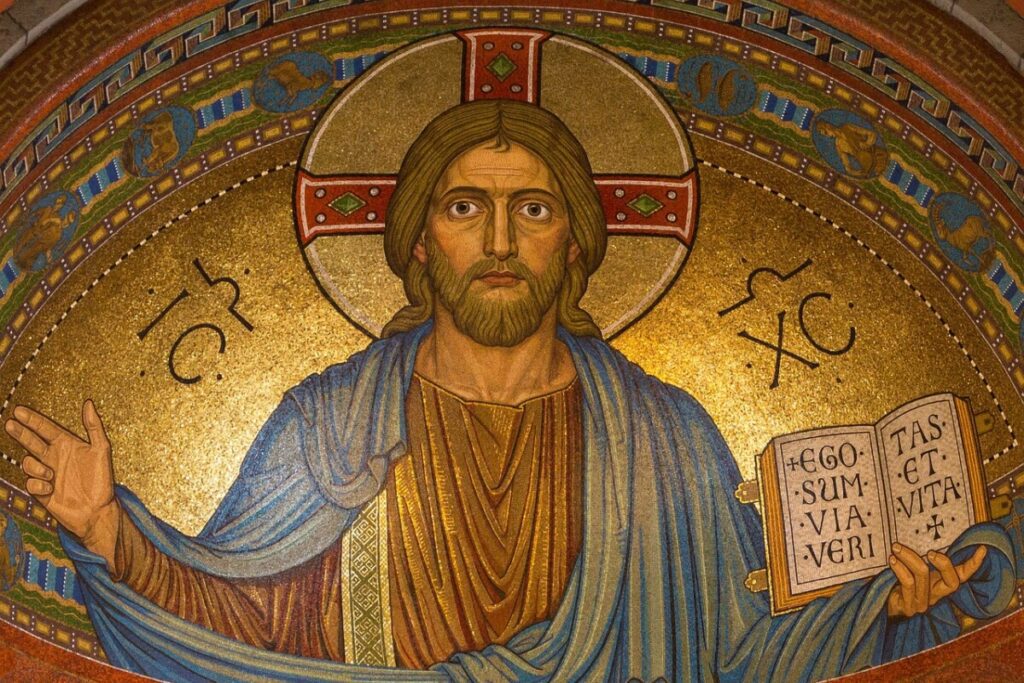
Ego Sum Via Veritas et Vita (I am the Way, the Truth and the Life) pixabay – didgeman
For a time, they despised Kardec's message, bringing false ideas into their doctrine. His concluding works had their best adulterated ideas. A persistent disclosure of false principles by refractors (( “22. Alongside the materialists strictly speaking, there is a third class of unbelievers who, although spiritualists, at least in name, are no less refractory to Spiritism: they are the unwilling unbelievers. These do not want to believe, because it gives them it would disturb the enjoyment of pleasures. They fear finding condemnation of their ambition, their selfishness and the human vanities in which they delight. They close their eyes so as not to see and cover their ears so as not to hear them. .” A. Kardec, The Books of Mediums, Preliminary Notions, chapter III Method)), implanted the lie among many spiritists, causing division.
However, in an increasing sequence, Allan Kardec's original documents, facts and ideas returned to light. His works were recovered, like the works Heaven and hell from 1865 and The Genesis of 1868 in their translations of their original versions. The contents presented are extremely important, as they are ideas that are much more in-depth by Kardec.
New times are already upon us, reforming ideas are spreading around the world. It is interesting to note how through study enlightened by sincere and disinterested dedication, the spiritist message, which is that of Jesus, will reach everyone. And the Spiritism will be the lever of the moral revolution, which will regenerate humanity, paving the way for a happy world.
Evil in the world represents the false mentality, which divides the world in order to justify the pride and selfishness of those who consider themselves superior and privileged. In this way, they manage to dominate and, even worse, abuse the masses. They consider her inferior and impure. The good, the good news or true mentality aims to awaken duty through reason and freedom, choosing solidarity through cooperation and mutual support, aiming for the happiness of all humanity, at all levels. By the guidance and direction of the good spirits, who are ministers of God. Everyone follows the path of good that leads to God. Spiritism, finally, explains and develops the idea of Jesus, a true mentality or good news. Like all revelations, it faces opposition from the proud and selfish who defend the false mentality.
What is the idea of false mindset? Falsely spreading that we have 2 Gods in the world, God and the Devil; spread the idea that the spiritual world is divided into 2 parts, heaven and hell; that people are divided into pure and impure, superior and inferior, etc. This is the FALSE IDEA.
In order for us to overcome the false idea, we cannot use the “same weapons” as the false idea. It uses imposition, violence, division, lies, the chosen who understand the teachings as non-existent intellectual superiority: it says that if you don't understand you are inferior, only superiors understand
THE TRUE IDEA It depends on everyone's effort! Each of us needs to understand the true idea!!
You just have to be indifferent and you help maintain the False Idea!
There is a very interesting article from 1859 that we will highlight some points regarding this idea of Jesus also described by Spiritism:
“Thus, Spiritism is based on general principles independent of any dogmatic issue. It is true that it has moral consequences, like all philosophical sciences. These consequences are compatible with Christianity, because Christianity is, of all doctrines, the most enlightened, the purest, which is why, of all the religious sects in the world, the Christian ones are the most capable of understanding Spiritism in its true essence.
A. Kardec, Revista Espirita, 1859 – Refutation of an article by “L 'Univers” ((https://kardecpedia.com/roteiro-de-estudos/893/revista-espirita-jornal-de-estudos-psicologicos-1859 /4547/may/refutation-of-an-article-from-l-univers ))
Spiritism is not, therefore, a religion. (…) Spiritism is concerned with observing facts and not the particularities of this or that belief; researching the causes; of the explanation that facts can give of known phenomena, both in the moral and physical order, and does not impose any cult on its supporters, in the same way that Astronomy does not impose the cult of the stars, nor Pyrotechnics the cult of fire. (…)
Today, thanks to the lights of Christianity, we can judge it with more certainty. He puts us on our guard against wrong systems, the fruits of ignorance. And religion itself can draw from it tangible proof of many truths contested by certain opinions. This is why, contrary to most philosophical sciences, one of its effects is to return to religious ideas those who have strayed into exaggerated skepticism.
We have two aspects currently defended by the spiritist movement: that Spiritism is a science and that it is a religion. Uniting these two aspects, some claim that it has a triple aspect: science, philosophy and religion.
First of all, we need to highlight that Spiritism can only be seen as religion in the philosophical aspect, and not in the ecumenical aspect.
And the fact that it is a religion in the philosophical sense, stated by Kardec, is directly linked to the fact that the Spiritist Doctrine is a development of Rational Spiritualism, a Philosophical Movement that outlined French moral sciences and teaching, in that country, for a large part of the 19th century.
If so, you will ask, is Spiritism a religion? Why, yes, without a doubt, gentlemen; In the philosophical sense, Spiritism is a religion, and we glorify ourselves for this, because it is the doctrine that founds the bonds of fraternity and communion of thoughts, not on a simple convention, but on the most solid foundations: the laws of Nature.
KARDEC, Allan. Revista Espírita, December 1868. Annual session commemorating the dead.
Spiritism, therefore, is not a religion as we currently understand it. This is precisely why Allan Kardec argues that the term should not be used, so as not to cause misinterpretations and not place Spiritism in a field in which it does not fit and where, ceasing to be science, it is defeated by the dispute between religions and between science and religion. No, this is neither appropriate nor deserved for this doctrine born of the scientific method and present in nature itself.
Why, then, have we declared that Spiritism is not a religion? Because there is no one word to express every idea, and because, in general opinion, the word religion it is inseparable from the idea of worship; because it exclusively awakens an idea of form, which Spiritism does not have. If Spiritism called itself a religion, the public would see nothing more than a new edition, a variant, if you like, of the absolute principles in matters of faith; a priestly caste with its procession of hierarchies, ceremonies and privileges; he would not separate it from the ideas of mysticism and the abuses against which public opinion has so often risen.
Since Spiritism does not have any of the characteristics of a religion, in the usual sense of the word, it could not and should not adorn itself with a title about the value of which people would inevitably have been mistaken. This is why it is simply said: philosophical and moral doctrine.
ibid.
Spiritism-Religion
Spiritism-religion hides, as a religion, in spiritist centers, just as other religions live in their churches and temples (there are even those who are already calling the spiritist center a “temple”). He does not practice evocations and blindly accepts what mediums or isolated Spirits say, or even what institutions such as the FEB – Brazilian Spiritist Federation determine. Spiritism-religion became dogmatic and left aside the doctrinal and scientific principles born from the long and exhaustive study of Allan Kardec. He buried his legacy, in large part, to be left with the most diverse false modern ideas, originating from mysticism, which he allowed to settle within his heart.
To be a follower of Spiritualism-religion, the individual is led to believe that it depends on leaving aside their own religion, because that is how it works in this sense. You can study mathematics or botany as a Catholic or evangelical, but that's not the case with a religion, right?
But, often, this sincere adherent, thirsty for knowledge, finds in Spiritism-religion nothing more than a new religion, full of dogmas. Sometimes, Spiritism-religion even becomes prejudiced and drives away new followers, by being categorical in pointing out people with certain characteristics and saying that they are like that because they would be paying debts from past lives, among other ideas that border on the absurd.
But this does not correspond at all to Spiritualism-science.
Spiritism-Science
Spiritism-science did not hide. Climbed in the strength of Rational Spiritualism, which was developed by Experimental Psychology, it spread like gunpowder, like any other science. It was not only accepted, but studied, in person, by people from the most educated layers of society. Princes, princesses, kings, queens, philosophers, scientists, doctors, doctors. It spread, as something purely clear and rational, among religious people of all faiths, finding, among its numbers, even orthodox Catholics and Muslims.
IV. ─ Regarding instruction:The level of education is very easy to assess through correspondence. Careful instruction, 30%; simple scholars, 30%; higher education, 20%; ─ semi-literate, 10%; ─ illiterate, 6%; ─ wise officers, 4%.
V. ─ Regarding religious ideas: Roman Catholics, freethinkers, not bound by dogma, 50%; ─ Greek Catholics, 15%; ─ Jews, 10%; ─ liberal Protestants, 10%; ─ Catholics linked to dogmas, 10%; ─ Orthodox Protestants, 3%; ─ Muslims, 2%.
KARDEC, Allan. Spiritist Magazine, January 1869. Statistics of Spiritism.
Ah! how wonderful and, at the same time, simple, Spiritism-science was. It was practiced in homes. Families carried out private evocations of their loved ones, and learned and comforted themselves from them. Sometimes, they evoked suffering Spirits, and helped them to calm down, with new understandings. They often sent the notes of these evocations to Allan Kardec, who analyzed them with the other SPEE associates. How many times have these particular evocations given rise to new hypotheses and new investigations!
Spiritualism-science was seen seriously. New doctrinal principles were not admitted without being verified by the double control method: the communication of the same principle everywhere, with these communications being evaluated in the light of logic and reason. Nothing was denied or accepted without carrying out this process. How many times has Kardec gone back and abandoned a hypothesis, seeing it as invalid in the face of the evidence?
In Spiritualism-science, the centers They were serious centers of study. They practiced evocations for the purpose of learning and, in the most serious cases, according to Kardec's precepts, neither neophytes nor curious people were admitted to mediumistic meetings.
Spiritism-science is needed. In it, Kardec found very clear and rational arguments to discard the most absurd and unfounded criticisms against Spiritism. Today, Spiritism-religion often loses followers to disbelief, because ideas born from blind acceptance cannot face reason.
We would do better if we didn't even talk about “Spiritism-religion”, but just about “Religious Spiritist Movement”, perhaps. But it is important to highlight the incongruity between the two concepts, as we need to make efforts to return to “Spiritism-science”, the one that everyone can study, without abandoning their religions; he who gives reasoned faith, who can face reason at any time; the one, finally, that didn't end with Kardec, and that needs to continue.
Spiritism-science finds its formation largely recorded in the Spiritist Magazine from 1858 to 1869, the result of exhaustive work of more than 12 years on spontaneous communications, evocations and manifestations of thousands of Spirits, by thousands of mediums, in thousands of groups, by all over the world. “Spiritism-religion” is predominantly found in novels, the result of the opinion of a Spirit, who does not question himself through the necessary method.
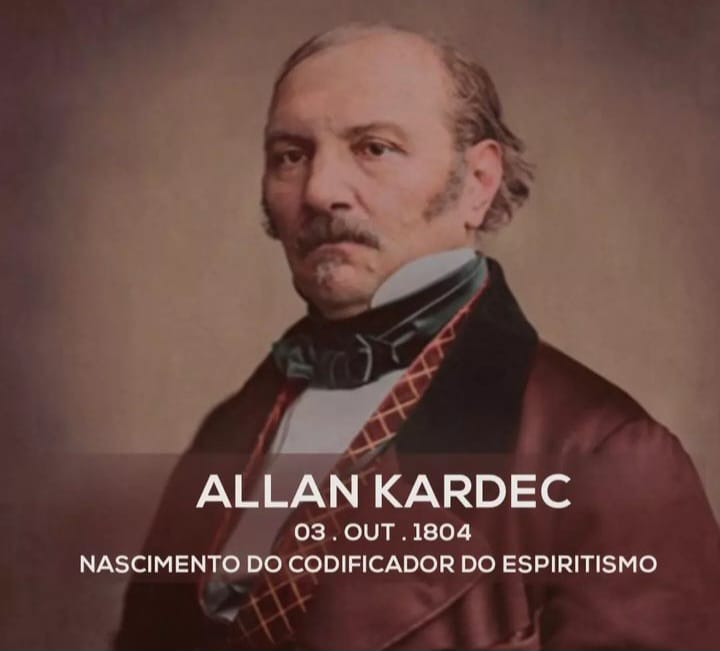
On the date on which Allan Kardec's birth is celebrated, I think we need to do much more to defend his legacy, which, far from being a religious creation to lead believers, encompasses the the entire community of incarnating Spirits on planet Earth. This legacy is bigger than me, than you, than our group. It does not and should not depend on anyone’s opinion. It needs to be recovered at its source. Here's the job.
Until the last moment of his physical existence, Allan Kardec left deep teachings. He died as he lived: working for Spiritism. His industrious hands said goodbye to this world delivering the Spiritist Magazine — a periodical in which he recorded his teachings, his struggles, his victories and, in that last moment, his immortality.
[…]
In the cemetery, the curious tried to position themselves in the places where they could listen to the speeches. However, when the coffin descended to the bottom of the grave, emotion silenced the words; there was a great silence.