THRESHOLD, "OUR HOME" AND OTHER IMAGES: SYSTEMATIC DEMOLITION

Thesis: Images of a materialized spiritual plane—walled colonies, a geographical threshold, armed spirits, an economy of "bonus-hours," soup kitchens, small houses, and hospitals—are myths incompatible with the central principles of Spiritist Doctrine. Kardec submitted such ideas to analysis—he never consolidated them.

1. Spiritual Colonies and "Our Home"“
Common assertion: the afterlife is structured in cities and colonies, with walls, ministries, and permanent residences (as in Our home).
Refutation: Spiritual identity is moral, not architectural. Form and environment are fluidic creations, shaped by thought and evocation. Lucid spirits describe the spiritual environment as states of consciousness, not as built cities. Conclusion: Myth of walled colonies—debunked.

2. The threshold as a geographical location of suffering
Common assertion: the "threshold" is an intermediate region, a dense and purgatorial zone.
Refutation: suffering stems from a guilty conscience and mental fixation on error. Spirits remain bound to the places of their crimes until they are morally renewed, not by territorial imprisonment, but by mental affinity. "Umbral" is a metaphor for the state of post-death disturbance, not a physical space. Conclusion: myth of the geographical Umbral — debunked.

3. Spiritual battles and energetic defenses
Common claim: Spirits protect themselves from attacks with electric darts, force fields, or walls.
Refutation: Lower spirits cannot tolerate the presence of higher ones. Interpersonal interaction is moral, not warlike. The mere radiance of good dissolves any attempt at hostility. Conclusion: myth of spiritual weapons — debunked.

4. Spiritual economy and "bonus-hours"“
Common saying: good deeds generate quantifiable spiritual credits.
Refutation: merit is not quantifiable. Good is spontaneous, free, and selfless. Replacing morality with accounting corrupts the principle of freedom of conscience. Conclusion: myth of the "bonus-hour" — debunked.

5. Spirits feeding on subtle substances
Common claim: Spirits "drink soup" or "drink juice" in spiritual realms.
Refutation: spiritual "hunger" is a moral desire, not an organic need. Spirits attached to matter project food illusions until they are freed. Conclusion: the soup myth — debunked.

6. Need for physical shelter
Common belief: Spirits reside in houses, with furniture, beds, and utensils.
Refutation: There is no cold, heat, or physical fatigue. The idea of a physical dwelling expresses only a mental analogy. Spirits live in communities of affinity, without material dependence. Conclusion: myth of the little house — debunked.

7. Body shape and spiritual identity
Common belief: Spirits retain fixed features and bodies.
Refutation: Form is a product of thought; it only persists when evoked or desired. Spiritual recognition occurs through essence, not appearance. Conclusion: Myth of fixed form—debunked.

8. Spiritual Hospitals
Common claim: There are hospitals and infirmaries in the spiritual realm, where "sick" Spirits receive medical treatment.
Refutation: Spiritual pain is moral, not organic. There are no bodies to medicate, nor tissues to regenerate. The so-called "treatment" is moral assistance and enlightenment, conducted through the influence of good Spirits and the education of the will. The descriptions of rooms, beds, and instruments are symbolic translations of the fluidic and pedagogical action on Spirits still bound to the impressions of matter. Conclusion: Myth of spiritual hospitals — debunked.

Overall conclusion
The Spiritist Doctrine, based on Kardecism, is dematerializing. The spiritual world does not replicate the physical world: it is a field of consciousness, morality, and vibratory affinity. Kardec never consolidated the idea of colonies, astral planes, hospitals, or spiritual economies—because, under comparative and rational analysis, such conceptions do not hold up. To insist on them is to abandon observation and return to materialism in the form of religious fantasy.


The Methodological Crisis of Post-Kardec Spiritism: A Critical Study Based on the Blind Acceptance of Spirit Communication

After Allan Kardec's death, the Spiritist movement underwent a decisive methodological shift. The critical examination of communications, controlled evocation, and systematic comparison—foundations established in the Codification—were gradually replaced by an attitude of unrestricted acceptance of mediumistic messages. This process paved the way for conceptions alien to the Doctrine to gain traction, transforming Spiritist science into something closer to a dogmatic religion.

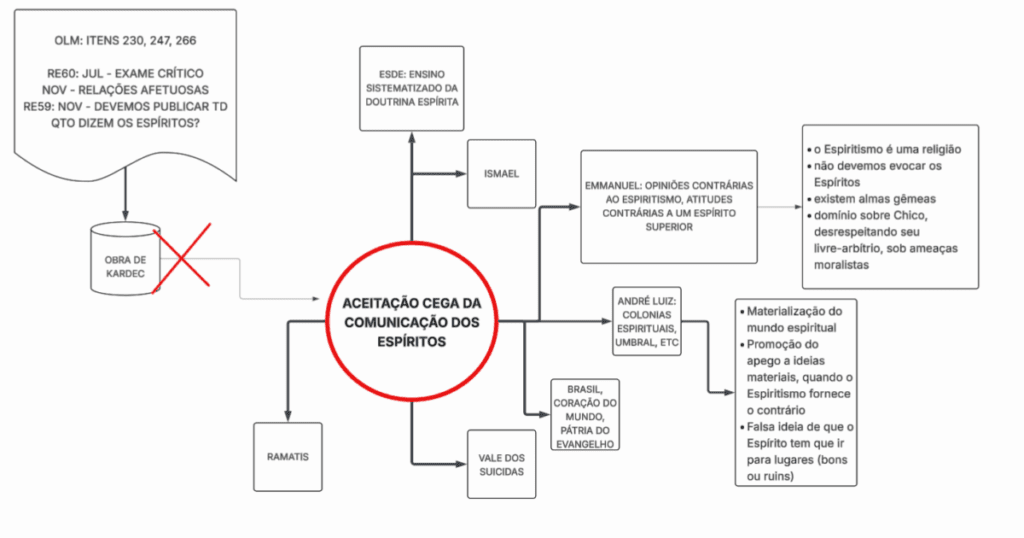
The path of this transformation, its causes and consequences, can be seen in the following diagram.

The Methodological Crisis of Post-Kardec Spiritism: A Critical Study Based on the Blind Acceptance of Spirit Communication

1. The Starting Point: Kardec and the Spiritist Methodology

It is essential to understand that Kardec did not create Spiritism, but organized its manifestations into a coherent doctrinal body through scientific method. This method was based on:

  • Direct evocation of Spirits, to test the consistency of the information (cf. The Mediums' Book, items 230, 247, 266).
  • Critical comparison of messages received in different places and by different mediums (Spiritist Magazine, articles on examination and control).
  • Submission of all teaching to the sieve of reason (The Gospel According to Spiritism, introduction, item VI).
  • Distinction between the opinion of Spirits and the principles of the Doctrine (RE, November/1859: “Should we publish everything that the Spirits say?”).

What Kardec left was a method, not a dogmaSpiritism, being a fact of nature, only becomes legitimate when subjected to rational and scientific criteria. Abandoning this guideline paved the way for the indiscriminate acceptance of mediumistic communications.


2. The Break: From Control to Cult

The diagram marks this break with the symbol of X on Kardec's work. Instead of following the method of critical examination, a significant part of the Spiritist movement began to:

  • Accept communications without comparison or control.
  • Taking as “superior revelation” messages that, according to Kardec, would only be private opinions of Spirits.
  • Relativize or disregard the evocation, transforming it into something “forbidden” or “dangerous”, in direct opposition to Kardecian practice.

This rupture opened the way for a dangerous phenomenon: the blind acceptance of communication from Spirits, which became the new axis of the movement.


3. The Consequences of Blind Acceptance

The diagram highlights several developments of this uncritical stance:

3.1 Emmanuel

Presented as Chico Xavier's guide, Emmanuel introduced notions that directly confront the Spiritist Doctrine:

  • Declaration that the Spiritism would be a religion (Kardec defined it as a science of observation and philosophy of moral consequences).
  • Prohibition of evocation, in direct contradiction with The Mediums' Book.
  • Idea of soulmates, rejected by Kardec.
  • Dominion over Chico, imposing moral conditions and threats, which violate freedom of conscience.

3.2 André Luiz

The series of books psychographed by Chico Xavier, attributed to André Luiz, created representations such as:

  • Spiritual colonies (Our Home).
  • threshold as an intermediate region.
    These concepts materialize the spiritual world, encouraging attachment to spatial and institutional constructions, when Kardec made it clear that Spiritism points to the progressive dematerialization of spiritual existence.

3.3 Ramatis

It introduces communications filled with esoteric theories, mysticism, and catastrophic predictions, inconsistent with Kardec's method. Its acceptance stems from the same logic: any communicating Spirit would be a source of truth.

3.4 Valley of the Suicides

Works such as Memoirs of a Suicide reinforce the notion of “fixed places” in the afterlife, of a punitive or reformatory nature, in contradiction with the idea that the spiritual state is an intimate reflection of consciousness, not of metaphysical geographies.

3.5 Brazil, Heart of the World, Homeland of the Gospel

Work attributed to Humberto de Campos (inspired by Emmanuel), which presents Brazil as a spiritually predestined nation. This conception reinforces a mystical nationalism, strange to the universality of Spiritism.


4. The Role of ESDE

O Systematic Study of the Spiritist Doctrine (ESDE), although structured with good pedagogical intentions, reflects the consolidation of this rupture. By adopting as a basis not only Kardec, but also post-Kardec mediumistic works (Emmanuel, André Luiz, etc.), the ESDE institutionalizes the departure from critical criteria and installs the uncritical eclecticism.

Result: the new generations of Spiritists began to consider as “Spiritist doctrine” that which is merely the opinion of Spirits, reproducing the blind acceptance.


5. Doctrinal Problems Arising

The diagram lists the concrete effects of this deviation:

  • Materialization of the spiritual world: conception of colonies, cities, hospitals, prisons — reflection of human projections.
  • Promoting attachment to material ideas, when Spiritism has as its mission precisely free from materiality.
  • False idea of the geographic destinations of the Spirit (good or bad places), replacing the understanding that “heaven” or “hell” are states of the soul.

6. The Replacement of Criticism by Dogma

The diagram ultimately shows how the Spiritist movement went:

  • Of critical examination (Kardec, 1857–1869),
  • For the blind acceptance (post-Kardec, especially in Brazil).

This process transformed Spiritist science into institutionalized religion, with dogmas, moralism and submission to “spiritual guides” not tested by the original method.


7. Conclusion: Restoration of the Spiritist Methodology

The central message of the diagram is clear:

  • As long as Kardec's work remains excluded as a criterion, Spiritism will live under the dominion of blind acceptance.
  • The return to the Kardecian method of rational examination, critical evocation and universality of the teachings of the Spirits is the only way to preserve Spiritism as a science of observation.

The diagram, therefore, is not just a historical critique, but a call for methodological restoration: Without criticism, Spiritism dissolves into mysticism; with criticism, it maintains its scientific and philosophical identity.


Specific Language of Spiritist Science

Did you know that most of those who call themselves Spiritists… don't know anything about Spiritism? Nor do they use the specific language of Spiritist science to explain its phenomena and concepts.

Being a spiritualist is not a matter of emotional adherence, nor of consuming supposedly “spiritualist” novels.
Being a Spiritist means seriously studying Spiritist Science, understanding its foundations and putting its principles into practice — as Allan Kardec taught.

Spiritism is a doctrine of study, reason, and observation. Replacing this science with fiction is a great harm to Spiritism. As it is a Philosophical Science it must be studied with specific scientific terms.

In Kardec's time, the Philosophical Sciences were part of the teaching.

When Allan Kardec launched his First Edition of the Spiritist Magazine in 1858, he immediately defined it in his introduction to justify its title Journal of Psychological Studies. Spiritist Science is, according to its time presented in the table above: Moral Science

As a science, its language is specific to the elements of this science so that everyone can understand each other. Terms are extremely important for the adequate communication of spiritual ideas. We see, today, a mixture of the totally materialistic science of our time in which the study of metaphysical hypotheses, for example, is ignored. Furthermore, words from one field are mixed with the other. Because of this, there is a confusion of materialist concepts mixed with the study of spiritual matters, which are also studied metaphysically.

We will give some examples of the mistaken use of materialistic terms that go unnoticed:

  1. USE PSYCHOPHONY – DO NOT USE EMBEDDING: We see many speakers or even descriptions of manifestations in so-called Spiritist texts that use the term "incorporation." Spirit is not matter that occupies a physical place. Spirit does not incorporate any body, nor does your own spirit incorporate you. The Spirit speaks through the medium through a phenomenon called PSYCHOPHONY. The medium's spirit is WITH them and does not incorporate their physical body. This point is very important to avoid creating the false idea that the medium is possessed by another spirit, or that the spirit communally takes over the medium's body, or even that the medium's spirit goes to other places while the medium is in psychophony. This does not exist in Spiritist Science!
  2. THE ACTION OF THE SPIRIT IS SOLELY AND ONLY THROUGH ITS THOUGHT: The spirit does not have a material body. According to studies of Spiritist Science, God created two general elements: SPIRIT and MATTER. Spirit has no analogue in our material world. The perispirit is matter. The material of which the perispirit is made is unknown to us, but even without knowing its characteristics, it is matter. The perispirit is not part of the spirit, just as the perispirit is not spirit. The spirit acts through and solely through thought. How exactly this happens is still unknown to us, but there are several theories in books that explain this mechanism (read Genesis, chap. XIV – The Fluids.)
  3. USE EMANATION OR PROPAGATION – DO NOT USE ENERGY: The term energy is defined in Physics as the capacity of a body, substance, or physical system to perform work. Figuratively (non-scientific) speaking, energy is vigor or moral power; philosophically speaking, according to Aristotle, it is the action of a physical or metaphysical motor (metaphysics is not considered science today) that allows the actualization of a potentiality. Note, all definitions take into account something physical acting on something physical. One of the principles of Spiritist Science is that we are an incarnate soul. If we are a soul, we do not have a body, so it cannot be energy (something physical) leaving the spirit or soul (non-physical) and arriving at a body (physical). The more appropriate term would be an emanation or even propagation.
  4. USE SPIRITDO NOT USE MIND: The mind is used in other areas of current materialist science. Some confuse the mind with the brain; the brain is an organ of the body, the brain is matter. Since Materialist Science does not admit the spirit as a hypothesis, it attributes the thinking process to the brain, but that is not what the spirits explained. According to Spiritist Science, through its observation, it is the spirit that controls the body, not the brain. The brain sends the commands. The brain is born, lives, and dies, and the spirit remains and carries with it the knowledge acquired through various incarnations. It is the spirit, not the mind, that possesses and carries knowledge. It is the spirit that thinks. You who understand the Spiritist doctrine know this and always use Spirit instead of Mind, don't you?
  5. USE “AS IF IT WERE A VIBRATION” DO NOT USE “VIBRATION” IN ITS FORM WHEN TALKING ABOUT SPIRITUAL PHENOMENA: There are hypotheses about the mechanism itself (see item 2) and only hypotheses. Using the term vibration may lead one to believe that the spiritual phenomenon is a wave as studied in Wave Physics, where it presents different types of waves and different vibrations, etc.
  6. USE PERISPIRIT – DO NOT USE GHOST: Those who study Spiritist Science know that there are apparitional phenomena that evoke these figures that impress our imagination. But they are nothing more than spirits and their phenomena, often to play with or frighten the incarnate. There's no such thing as a Spiritist being afraid of spirits!
  7. WE ARE ALWAYS IN THE SPIRITUAL WORLD: According to Spiritist Science, when we are incarnated, we live in a dual world: the world of matter and the world of spirit. When we die, we disincarnate, that is, we leave matter, but we CONTINUE IN THE SPIRITUAL WORLD. Do not use the terms “he died and went to the spiritual homeland” (He was already in the spirit world); “now he will meet his loved ones who have already died” (his loved ones are never far away. Remember that Spirits do not stay in any one place? (see item 1); “he left us”, etc.
  8. USE CAUSE AND EFFECT – DO NOT USE THE LAW OF CAUSE AND EFFECT: Causality is generally considered a fundamental principle, rather than a specific law, in philosophical and scientific contexts. It describes the cause-and-effect relationship between events, where one event (the cause) is understood as the reason behind the occurrence of another event (the effect). Causality is a fundamental principle that helps understand the nature of the relationship between cause and effect, and is used in a variety of fields, from physics and natural sciences to philosophy and law. Although causality is often referred to as the "law of cause and effect," it is not a scientific law in the sense of a quantitative, experimentally verifiable relationship, like the laws of physics. It is more of a concept or principle that describes the nature of the relationship between cause and effect. Causality is important for understanding the world around us, as it allows us to identify the causes of phenomena and predict their effects. It is fundamental to science, technology, and everyday life, as it helps us understand and interact with the world more efficiently. An example: Imagine a hunt, an animal is shot and dies. The effect is death. The cause was the shotgun blast. It wasn't a law. In Spiritist Science, Kardec used many of these principles to explain the intelligent effects of intelligent spirit manifestations. There, he explains that for every intelligent effect, there is an intelligent cause. There are countless accounts of this in his works.
  9. USE TRIALS AND EXPIATIONS – DO NOT USE KARMA: Karma and Spiritism are like oil and water: they do not mix. Be careful with people who preach the doctrine of karma within the spiritist environment, as the understanding of Spiritist Doctrine goes in the opposite direction.(click on the link to read the full explanation).
  10. USE PARKED SPIRIT – DO NOT USE RETROGRADATION: Many people mix other reincarnationist doctrines with spiritual science. According to Spiritual Science, we spirits, when we are immersed in imperfections, such as pride and selfishness, remain stuck in a loop and do not evolve. But this doesn't mean we're going back and reincarnating as animals. It just means we're stuck in the evolutionary process! A human spirit never loses the knowledge it previously had, so it will never reincarnate as an animal because of its imperfections. It simply won't progress until it repents and sincerely returns to goodness.
  11. THOSE WHO WILL REGENERATE WILL BE THE SPIRITS OF PLANET EARTH – PLANET EARTH WILL NOT REGENERATE: The planet will not change, and therefore spirits will have to evolve. There is no deadline, year, century, or anything like that. It's the other way around! The spirits on the planet will evolve. It will simply be when the majority of incarnate spirits are more evolved, no longer needing trials and atonements to evolve. One day, Planet Earth will become extinct, as any other planet will. This is the order of the material universe as we know it.
  12. USE PURE SPIRIT – DO NOT USE PERFECT SPIRIT: The ideal of perfection is God, so a spirit will never be perfect. A spirit will reach perfection relative to its evolutionary level. A pure spirit no longer needs to reincarnate to evolve because it is no longer influenced by matter. Even though they are pure, they will evolve (Law of Progress).
  13. PASS IS NOT ENERGY TRANSFER: see item 3

If you remember any incorrect expression, just leave a comment.


A stone against the denialism surrounding the adulterations of Allan Kardec's works

Dear reader, we will be brief on the subject, putting an end to the denialism surrounding the adulteration of Allan Kardec's works. The bibliography used is included at the end. The text will be presented in succinct bullet points for ease of reading.

Before you begin, please note that you can obtain Kardec's original works, already released in PDF format by the publisher FEAL, by clicking on here.

1. The figure of Roustaing

Around the 1860s, the figure of Jean-Baptiste Roustaing, an influential and wealthy French lawyer, emerged, seeking to establish himself in the Spiritist community. This gentleman began to receive psychographies, through just one medium, of one or more Spirits who claimed to be the evangelists themselves, reproducing absurd dogmas, among which ((ROUSTAING, The Four Gospels, volumes I to IV, FEB)):

  • the dogma of the fall into sin, stating that the individual only needs to incarnate after making a mistake;
  • the dogma of the fluidic body of Jesus, affirming that he was never incarnated among us, being only a materialization;
  • the dogma of the retrogradation of the soul (“involution”), by affirming that the Spirit that errs a lot incarnates as a slug (“fleshy cryptogam”).

2. Roustaing hated spiritual science

Roustaing and his followers came to hate Spiritist science and Kardec's method, as this method was their Achilles' heel, easily undermining their theory. This hatred is evident in the publication, in 1882, of the pamphlet Les quatre évangiles de JB Roustaing- réponse à ses critiques et à ses adversaires, édité par les élèves by JB Roustaing (The Four Gospels of J.B. Roustaing — a response to his critics and adversaries, edited by his disciples by JB Roustaing), a pamphlet written sixteen years earlier by Roustaing.

Roustaing's intentions are confirmed by the Spirits, when Kardec, on September 16, 1862, questions about this gentleman, who wanted Kardec to go to his house, instead of visiting the worker spiritists:

No, in general, he comes across as an enthusiast, an exalted, wanting to impose itself.

FIGUEIREDO, Paulo Henrique. Neither Heaven nor Hell: the laws of the soul according to Spiritism. Editora FEAL, 2020.

3. The new edition of Heaven and Hell

Soon after Kardec's death, a new edition of Heaven and Hell appeared, containing, among many terrible changes:

  • THE removal of the preface of the work, where Kardec exposes precisely the scientific method necessary for the Spiritist Doctrine;
  • THE complete amendment of Chapter VIII, becoming VII, with the creation of the subtitle “Penal Code of the Future Life”, an absurd title, inserting the item 10, where it is said that all the vicissitudes we suffer here would be the result of our imperfections, expiations of mistakes committed, in this or other lives. The effect of this idea is, by force of logic, to admit that all the difficulties we go through would be the result of acquired imperfections, as a kind of punishment, leading to the idea that only imperfect Spirits would incarnate here, needing correction — the same dogma as Roustaing, exhaustedly fought by Kardec and the Spirits.
  • THE loss of correspondence between the 25 items in chapter VIII with the rest of the book.

4. The new edition of Genesis

In 1872, the new edition of Genesis appeared, which contained very important alterations:

Removed item 2 of chapter IV, where Kardec speaks precisely about the principles of blind faith and passive obedience: “The veneration of sacred books, almost always considered as having descended from heaven, or inspired by divinity, prohibited any examination.”

  • Regarding the disappearance of Jesus' body, it was removed item 67, in which Kardec addresses the issue of the disappearance of Jesus' body, stating that the issue had not yet been completely resolved by Spiritist science: “Now, until now, none of the [personal opinions] that have been formulated have received the sanction of this double control.” Remember: Roustaing accepted the dogma that Jesus was among us only in the materialization of the fluidic body, and hated the method of double control (“This double control is fundamental and obligatory for the acceptance of any new fundamental concept of the Spiritist doctrine by Kardec. Until this has occurred, it will be considered a simple opinion, whether it came from a man or from a Spirit” — FIGUEIREDO, 2021)).
  • In chapter XVIII, item 20, it was removed the entire passage in which Kardec says: “Far from replacing one exclusivism with another, Spiritism presents itself as the absolute champion of freedom of conscience.”
  • In item 24 of the same chapter, the entire item 24 was removed, in which Kardec makes a serious observation about the enemies of moral progress (our emphasis):

To say that humanity is ripe for regeneration does not mean that all individuals are on the same level, but many have, by intuition, the germ of new ideas that circumstances will bring about. Then they will prove to be more advanced than one might suppose, and they will eagerly follow the lead of the majority.

There are, however, those who are essentially resistant to these ideas., even among the most intelligent, and who certainly will not accept them, at least in this lifetime; in some cases, in good faith, out of conviction; in others out of self-interest. These are those whose material interests are tied to the current situation and who are not advanced enough to give them up, because the general good matters less than their personal good—they become apprehensive at the slightest movement toward reform. Truth is a secondary issue for them, or, better said, for some people, truth lies entirely in that which causes them no trouble. All progressive ideas are, from their point of view, subversive ideas, and that is why they dedicate an implacable hatred to them and wage an obstinate war against them.They are intelligent enough to see Spiritism as a tool for progressive ideas and the elements of transformation they fear, and because they don't feel up to it, they strive to destroy it. If they considered it worthless and unimportant, they wouldn't bother with it. We've said this elsewhere:The more grandiose an idea is, the more it encounters adversaries, and its importance can be measured by the violence of the attacks it is subjected to.”.

5. Adulteration published in Posthumous Works

In the publication of Posthumous Works, by Pierre Gaetan Leymarrie, the author inserts a psychograph tampered with, in which Kardec is asking for advice on the new edition of Genesis, which he was, yes, elaborating:

February 22, 1868.
Medium M. Desliens.

Allow me to give you some personal advice about your book Genesis. I think that, as you do, it should undergo a rearrangement that will make it gain value in methodical terms; but I would also advise you to review certain comparisons in the first chapters, which, without being inaccurate, can be ambiguous, and which can be used against you in the finishing of words. I don't want to point them out in any particular way, but by carefully analyzing the second and third chapters, they will certainly surprise you. We'll take care of your research. It's only a matter of detail, no doubt, but details sometimes have their importance; that's why I thought it useful to draw your attention to this side.

Question. In the reprint we're going to do, I'd like to add a few things, without increasing the volume. Do you think there are parts that could be removed without inconvenience?

Response. My opinion is that there is absolutely nothing to take away as doctrineeverything is useful and satisfactory in every aspect; but I also believe that you could, without inconvenience, further condense certain ideas which need no development to be understood, having already been sketched elsewhere; in your work of reorganization you will easily achieve this.

We should leave intact all the theories that appear for the first time in the public eye; don't remove anything as ideas, I repeat, but just cut out, here and there, developments that add nothing to clarity

You will be more concise, no doubt, but just as understandable, and it is the ground thus gained that you may have to add new and urgent elements. It's a serious job for this revision, and I urge you not to wait too late to do it, it's better to be prepared ahead of time than if I had to wait after you.
Above all, don't rush it. Despite the apparent contradiction of my words, you undoubtedly understand me. Start working promptly, but don't stay too long. Take your time; your ideas will be clearer and your body will be less fatigued.

You can download the original content of this psychography by clicking on here.

Leymarie, seeking to reinforce the idea that the fifth edition of Genesis (already questioned since that time) would have been produced by the hands of Kardec, uses only the final part of this dialogue, discarding the beginning of it and inserting a section that didn't exist, at the beginning:

February 22, 1868.
(Private communication — Medium: Mr. D…)
the genesis

Following a communication in which Dr. Demeure gave me very wise advice on modifications to be made in the book Genesis, for its reprinting, which he urged me to take care of without delay, I said to him:

"Sales, so brisk so far, will undoubtedly cool; it was an immediate effect. I believe the fourth and fifth editions will take longer to sell. However, since it takes some time for revision and reprinting, I must not be unprepared. Could you tell me how much time, roughly, I have to handle this?"

Answer — This revision is serious work, and I advise you not to delay starting it too long. It's better to have it ready in advance than for it to be left waiting for you. However, don't rush. Despite the apparent contradiction in my words, you certainly understand me. Get to work now, but don't dedicate too much time to it. Do it slowly; your ideas will present themselves more clearly, and your body will benefit, becoming less fatigued.

However, you should expect the volumes to sell out quickly. When we told you this book would be a huge success among your other books, we were referring to both philosophical and material success. As you can see, our predictions were correct. It's important to be ready at any moment; things will happen more quickly than you imagine.

6. The insurmountable legal fact

They are undisputed legal facts at tampering of Genesis and Heaven and Hell, for the mere reason that editions were released, with alterations, after the author's death and without legal deposit — as stated by at least four specialized legal operators: Simoni PrivateJulio NogueiraLucas Sampaio and Marcelo Henrique. That cool fact it is above of any consideration and, because of this, spiritist federations from other countries, respecting the law, returned to the third edition of the work. Unfortunately, laymen in matters of copyright have found resonance in some individuals and also in the Brazilian Spiritist Federation, working to maintain a denialist thesis and contrary to the law.

7. It barks like a dog, wags its tail like a dog, has the shape of a dog, but is it a bird?

Having arrived here, having given due attention to the facts, verifiable in the indicated bibliography, the dear reader, in addition to everything acting in a rational and logical manner (and respecting the law) will not be able to have any doubt about the facts of adulterationsTo say otherwise would be against the law and deny what is transparent. After all, if it barks like a dog, wags its tail like a dog, and is shaped like a dog, it is definitely a dog, not a bird—but "some" want it to be.

Now, dear reader, to give rise to denialist thesis of these gentlemen, trying to maintain that they were not adulterations, but rather modifications made by Kardec's hands:

  • it would be necessary, first of all, to go against the law;
  • it would be necessary to voluntarily ignore that Roustaing hated spiritualist science and wanted to take Kardec's place;
  • it would be necessary to voluntarily ignore that Guerin, an influential and wealthy follower of Roustaing, offered his influence around the new presidents of the Public Limited Company;
  • it would be necessary to admit that Kardec, without any possible explanation, removed such important passages precisely at the points of greatest conflict with the Roustainguist theses or his modus operandi;
  • it would be necessary to admit that Kardec contradicted the spiritist science, that is to say, in adulteration from Heaven and Hell, which all the vicissitudes we suffer here would be the result of our imperfections, expiations of mistakes committed, in this or in other lives. The effect of this idea is, by force of logic, to admit that all the difficulties we go through would be the result of acquired imperfections, as a kind of punishment, leading to the idea that only imperfect Spirits would incarnate here, needing correction — exactly the Roustainguist thesis, “by chance”. This is false and, in fact, is even refuted in the adulterated Genesis, in the analysis of the passage about the Man Born Blind: “If this was not an atonement for the past, it is proof that it should serve their progress.”.
  • it would be necessary to voluntarily ignore that Leymarie, to support the thesis that the 5th edition of Genesis had been produced by Kardec, published an adulterated psychograph, cutting out the part that touches on the importance of DO NOT REMOVE ANY DOCTRINAL IDEAS, something done in adulteration.
  • it would be necessary retire rationality in the face of such obvious things, leaving aside Erastus's very important guidance: “It is better to reject ten truths than to admit a single lie, a single false theory” (item 230 of The Mediums' Book).

8. Conclusion

We're not here to try to force understanding on those who don't want to understand and, by willingly admitting sophistries, give rise to fascination—as Roustaing did when faced with such absurd ideas. For those who want to understand, it's crystal clear. Let each person investigate further to reach their own conclusions—after having investigated everything, not before.

9. Bibliography


Spiritism in Brazil and criticism of spiritists

We have talked a lot about the great distance between Spiritism, or spiritist science, and what the Spiritist Movement learns and disseminates in Brazil, each day more contaminated by distortions and mysticism. I do not believe it necessary to repeat the facts in this regard. We limit ourselves to recommending the reader to articles The distance between Spiritism and the Spiritist Movement, Prophecy of the Spirit of Truth, The Spiritist Channel and Spiritism, The boy and the oasis: a fable of hope, an interesting dialogue, An invitation to self-criticism of the Spiritist Movement, among others.

We can, however, add Kardec's thoughts, in The Book of Mediums:

Finally, there are exalted spiritists. The human species would be perfect if it always preferred the bright side of things. Exaggeration is harmful in everything. In Spiritism it produces a blind and often childish trust in the manifestations of the invisible world, making people accept very easily and without control what reflection and examination would demonstrate to be absurd or impossible, as enthusiasm does not clarify, it obfuscates. This type of followers is more harmful than useful to the cause of Spiritism. They are the least capable of convincing, because their judgment is rightly suspicious. They are easily deceived by mystifying spirits or by people who seek to exploit their gullibility. If only they had to suffer the consequences, the harm would be less, but the worst thing is that they offer, although unintentionally, reasons to unbelievers who seek to mock rather than convince themselves and never fail to impute to everyone the ridiculousness of some. This is not fair or rational, without a doubt, but the opponents of Spiritism, as we know, only recognize their reason as good and do not care to know in depth what they are talking about.

KARDEC, Allan. The Book of Mediums, Lake, 23The Edition. Emphasis added.

Their position is clear: careless people who, with enthusiasm (and vanity) blindly believe in everything, do more harm than good to the Doctrine.

Exaggerations, some say

It is the opinion of some that we have exaggerated. According to them, we must “respect” each person’s faith, limiting ourselves to carrying out our work. Firstly, we need to demonstrate that there is no disrespect to anyone's faith. Everyone has free will and the right to believe whatever they want, rationally or not. But, here, we are dealing with spiritist science, and this is where the biggest problem with these people's ideas arises: the lack of knowledge of this science. Just read the Revista Espírita and other works by Kardec and you will see not only him, but also the good Spirits, often highlighting the need to expose the errors and, above all, the charlatans and enemies of the Spiritist Doctrine who, dressing their ideas under the guise of Spiritism, voluntarily or not promote the error that feeds the general discredit in Spiritism, as if it were another religion born of someone's ideas. We have already sufficiently demonstrated why Spiritism is a science, and not a religion.

Spiritism arrived in Brazil distorted

The fact is that Spiritism has already been established in Brazil, adulterated by the fledgling Spiritist Movement ((facts amply presented in Endand, in the FEB (Brazilian Spiritist Federation), the self-styled “home mater” of Brazilian Spiritism, far from finding ground for its restoration, it was replaced by the doctrine of Roustaing, completely based on old religious dogmas. This institution, which ended up dictating the direction of Brazilian Spiritism for a long time, never dedicated itself to recovering Spiritist science and the method necessary for the continuity of the Doctrine, with private evocations (and even in Spiritist centers), an essential tool for the scientific study, were abandoned. Without Kardec's method, and due to the interest in printing and selling mediumistic works, any idea coming from any Spirit began to be conveyed and, thus, slowly formed the general belief of the Spiritist Movement, today completely lost in ideas that, in fact, , are fundamentally anti-doctrinal.

We need to recognize, of course, that part of these ideas were founded even before the arrival of Spiritism in Brazil, with the adulteration of the works Heaven and Hell (mainly) and A Gênesis, after Kardec's death. Unfortunately, FEB is the first to defend the idea that these works have not been tampered with, a fact that, especially in relation to Heaven and Hell, is sufficiently evidenced and irrefutable.

Is talking about adulteration creating disbelief?

Here, finally, we come to another criticism from certain people: "To say there was adulteration would be to throw mud at Kardec, to incite disbelief in Spiritism." "Besides," they say, "what Doctrine is this that the Spirits allow such a thing, without warning?" It's a completely illogical thought.

We begin by remembering that the words of Christ himself were adulterated and distorted in favor of religious dogmas, and this fact was precisely what led to countless people's disbelief in Christianity. Voltaire was one of the most evident exponents of this disbelief, which still prevails today. We ask: would it be “throwing mud” at Jesus to highlight the adulterations? Would it “raise disbelief” in Christianity, highlighting distortions, while demonstrating original ideas? Obviously not. If the problem has occurred, we need to face it head on (a scientific and truly Kardecian attitude), and not sweep it under the rug while its overwhelming effects persist.

To the idea that “the Spirits would not have permitted adulterations,” we oppose the strong recommendation to study the Doctrine, which evidently was not done by these people. The Spirits warned several times about the plots of the enemies of the Doctrine, as we demonstrated in Prophecy of the Spirit of Truth. Based on the warnings and evidence, Kardec also predicted the future of Spiritism, as highlighted in the Spiritist Magazine of December 1863, in the article “Period of Struggles”:

The struggle will determine a new phase of Spiritism and will lead to the fourth period, which will be the religious period. Then the fifth will come, the intermediate period, natural consequence of the precedent and which, later, will receive its characteristic name. The sixth and final period will be the social renewal, which will open the era of the twentieth century. At that time, all obstacles to the new order of things desired by God for the transformation of the Earth will have disappeared. The generation that emerges, imbued with new ideas, will be in all its strength and will prepare the way for what must inaugurate the definitive victory of union, peace and fraternity among men, united in the same belief, through the practice of the evangelical law.

KARDEC, Allan. Spiritist Magazine, December 1863.

Unfortunately, the forecast for the sixth period is delayed by more than a century, due to several unpredictable facts at that time, such as the abandonment of Rational Spiritualism and Spiritist Science, in addition to the adulteration of the works cited. Then, the wars, the forgetfulness of the Doctrine in France and Europe and its installation in Brazil, completely distorted.

Spirits do not impede human free will

We remember, to finish, that the core of the Spiritist Doctrine, always demonstrated by the Spirits, is free will, which the Spirits cannot interfere with. They can advise, but they cannot hinder the human will. They did so: they advised extensively on the need for care that, unfortunately, was lacking from those who should take care of the master's legacy. It seems that the French Spiritist Movement was very comfortable with Kardec's direction and, when this was supposed to change, from mid-1869 (as exposed in the Spiritist Magazine of December 1868, “Transitional Constitution of Spiritism”) Kardec died, and all they were left aimless. Leymarie assuming the direction of the Spiritist Society, distorted the purpose of the Spiritist Magazine, admitting the Roustainuist doctrine in exchange for money, and the reader can find out the rest by reading the works Allan Kardec's Legacy, by Simoni Privato, Neither Heaven nor Hell, by Paulo Henrique de Figueiredo and End, by Wilson Garcia.

Good in the midst of mistakes

Many say: “the Spiritist Movement, in the midst of many mistakes, still produces good. It’s not wrong at all.” We couldn't disagree with that. We do not say that there is error or mistake in everything and that no good is produced. A mediumistic romance, even though it is full of wrong ideas, can be the gateway to the questioning individual go after more information, ending up getting to know Kardec's works, in short. But, we ask: wouldn't it be better if Spiritism were presented as it is, simple and rational, without the absurdities that produce so many setbacks and that very often lead to disbelief? We cannot fail to highlight that, when space is created for a mistake, within a science, and this mistake is not remedied by theory and doctrinal facts, it gives rise to many others. That's what has happened.

Restoration

The time has come to restore Spiritism, which has already begun in Brazil and will spread throughout the world. The first step is to learn Spiritism as it truly is, moving away from errors. Those who, called “spiritists”, do not wish to do so, will join a new religion, if they wish, as dogmatic as the others. Let's let time take care of them, but that doesn't mean we stop doing our part, presenting the errors, in the face of the Spiritist Doctrine, without personalism. Then, the time will come to restore Kardec's method. These two steps will give rise to the possibility of the sixth period foreseen by Kardec: that of social renewal.

We cannot fail to recommend how essential reading The work Autonomy – The Untold Story of Spiritism, by Paulo Henrique de Figueiredo.

Be part of this journey, which is collective and will only happen through the collaboration of many.


The strongest evidence of tampering with Allan Kardec's Heaven and Hell

They are undisputed legal facts at tampering of A Gênesis and O Céu e o Inferno, for the mere reason that editions were released, with changes, after the death of the author and without legal deposit – this is what at least four specialized legal operators say: Simoni Private, Julio Nogueira, Lucas Sampaio and Marcelo Henrique. That cool fact it is above of any consideration and, because of this, spiritist federations from other countries, respecting the law, returned to the third edition of the work. Unfortunately, the Brazilian Spiritist Federation, having a lot to recapitulate when taking this attitude (since the original text of A Gênesis contradicts a multitude of errors that populate most of the publications edited and printed by it) still resists these facts, basing itself in layman arguments on copyright matters.

In addition to the legal fact and the necessary respect for the law, through the study we have just identified another piece of evidence, perhaps the most decisive of all, of the adulteration of Heaven and Hell, the work of Allan Kardec, precisely in the part that expressed the doctrinal philosophy in its clearest and purest face.

In The Spirits' Book, Kardec deals with the issue of spirits who have always chosen the path of good (we also dealt with this in the article "Intimate Reform and Spiritism“:

There are spirits who have always chosen the path of good

121. Why do some Spirits follow the path of good and others the path of evil?

“Don’t they have free will? God did not create evil spirits; He created them simple and ignorant, that is, having as much aptitude for good as for evil. Those who are evil became so of their own free will.”

133. The Spirits who From the beginning they followed the path of good?

“All are created simple and ignorant and are instructed in the struggles and tribulations of bodily life. God, who is just, could not make some happy, without toil and work, therefore without merit.”

The) - But, then, what is the use of spirits to have followed the path of good, if this does not exempt them from the sufferings of bodily life?

"They reach the end faster. Furthermore, the afflictions of life are often the consequence of the imperfection of the Spirit. The fewer imperfections, the less torment. He who is not envious, nor jealous, nor avaricious, nor ambitious, will not suffer the tortures that originate from these defects.”

The Spirits' Book. Emphasis added.

Confirmed by the Spirits, there are those who have always chosen the path of goodness, which does not free them from the need to incarnate for their development. Thus, they have nothing to atone for, since atonement is the conscious choice of tests and opportunities that help them to let go of imperfections they have consciously acquired (remembering that merely making a mistake is not acquiring imperfections, as long as the mistake is overcome through learning. What generates imperfections is the conscious repetition of the mistake).

Furthermore, it is only logical that those who have overcome an acquired imperfection through atonement have nothing more to atone for, except if they develop new imperfections. Even so, they may need to be born on a planet like Earth, simply because their current needs demand it or because they choose to incarnate on a mission. Jesus Christ himself is the ultimate example of the latter, and even though he was a pure Spirit, he still faced the vicissitudes of matter without having anything to atone for. Look where admitting these false ideas leads: to the dogma of Spirits created apart and who have never actually been among us (a dogma supported by Roustaing)!

Strong evidence of tampering with Heaven and Hell

And here we come to the proof of the adulteration of Heaven and Hell, which, in the edition released after Kardec's death, introduced two items in chapter VIII (which became chapter VII):

9th — Every fault committed, every evil done, is a debt contracted that must be paid; If it is not so in one existence, it will be so in the next or subsequent ones, because all existences are in solidarity with each other. Whoever pays it off in the present existence will not have to pay a second time.

10 - The Spirit suffers the penalty of its imperfections, whether in the spirit world or in the corporeal world. All the miseries, all the vicissitudes we endure in corporeal life are the result of our imperfections, expiations of faults committed, whether in the present existence or in previous ones.

Heaven and Hell, fourth edition. FEB. My emphasis.

These two items, I repeat, did not exist in the third edition of the work, released and printed by Kardec during his lifetime. To admit that Kardec included these items in that edition, especially item 10, would be to admit that Kardec contradicted everything he had developed up to that point.

To support this false idea, the following paragraphs were removed in the adulteration, in chapter IX (formerly chapter X):

In the first stages of their existence, spirits are subject to material incarnation, which is necessary for their development, until they have reached a certain level. The number of incarnations is indeterminate and is subordinate to the speed of progress, which occurs in direct proportion to the work and good will of the spirit, who always acts according to their free will. Those who, due to their carelessness, negligence, obstinacy or bad will, remain in the lower classes for longer, suffer the consequences, and the habit of evil makes it difficult for them to get out of this state. One day, however, they get tired of this painful existence and the suffering that comes with it. Then, when they compare their situation to that of the good spirits, they realize that their interest lies in doing good and they try to improve themselves, but they do so of their own free will, without being forced to do so. They are subject to the law of progress because of their ability to progress, but they don't do it against their will. God constantly provides them with the means to progress, but they are free to take advantage of them or not. If progress were obligatory, spirits would have no merit, and God wants everyone to have the merit of their works, privileging no one with the first place, a position granted to all, but which they achieve only through their own efforts. The highest angels earned their position by traveling the same route as everyone else. Everyone, from the top to the bottom, has belonged or still belongs to humanity.

Men are therefore more or less advanced incarnate spirits, and spirits are the souls of men who have left their material shell. Spiritual life is the normal life of the spirit. The body is nothing more than a temporary garment, appropriate to the functions it must perform on Earth, just as a warrior puts on his armor and chain mail for the moment of combat, then takes them off after the battle, only to put them on again when the time comes for a new fight. Corporeal life is the battle that spirits must face in order to advance, so they put on this armor which is both an instrument of action and an embarrassment.

When they incarnate, spirits bring with them their inherent qualities. Imperfect spirits therefore make up imperfect people; those who are more advanced, good, intelligent, educated, are instinctively good, intelligent people who can easily acquire new knowledge. In the same way, when people die, they provide the spirit world with good or bad, advanced or backward spirits. The corporeal world and the spiritual world thus constantly supply each other.

Among the evil spirits there are those who have all the perversity of demons, to whom we can perfectly apply the image we have of the latter. When they are incarnate, they are perverse and cunning men who delight in evil, seemingly created for the misfortune of all those who are drawn into their intimacy, and of whom it can be said - without it being offensive - that they are demons incarnate.

Having reached a certain degree of purification, spirits are given missions compatible with their advancement, thus performing all the functions attributed to angels of different orders. As God has always created, there have always been enough spirits to meet all the needs of the government of the Universe. A single species of intelligent beings, subject to the law of progress, is therefore sufficient for everything. This unity in creation, together with the idea that everyone has the same common origin, the same path to follow, and that they all rise by their own merit, corresponds much better to God's justice than the creation of different species, more or less favored by natural gifts, equivalent to privileges.

Heaven and Hell – Editora FEAL

Note, also, the following excerpt from The Spirits' Book (emphasis added):

  1. Being the vicissitudes of bodily life expiation of past faults and, at the same time, trials with a view to the future, it will follow that from the nature of such vicissitudes it can be inferred what kind of existence was the previous one?

" Very often this is possible , since each one is punished for what he sinned. However, there is no absolute rule to be drawn from this.. Instinctive tendencies constitute a more reliable indication, since the tests that the Spirit goes through are determined both by what concerns the past and by what concerns the future.”

This is very important. Kardec, in his works, always builds on the foundations, repeatedly repeating what was already understood as fact in Spiritist science. When he needed to contradict a point, to correct his understanding, he was very clear about it. Thus, "out of nowhere," Kardec would have contradicted the Doctrine to say the following, establishing a rule:

“By the nature of the sufferings and vicissitudes endured in corporeal life , one can judge the nature of the faults committed in a previous existence, and the imperfections that are their cause.” (Allan Kardec, Heaven and Hell, 4th edition, adulterated).

Do you see how inconsistent this is with Kardec's understanding of Spiritism and his approach? He would have done the same in the paragraph preceding this one, which is impossible, since he would later contradict these erroneous opinions again in Genesis. This is crucial, as this idea is directly linked to the Roustainguist influence in the adulteration of this work, in the chapter that is essentially the core, the foundation of Spiritist moral theory.

More evidence of the original idea

Below are some more excerpts from Kardec's work that show the true understanding of the subject (incarnation is not exclusively the result of atonement):

According to a system that is somewhat specious at first glance, spirits were not created to incarnate and incarnation would only be the result of their lack. Such a system is undermined by the mere fact that if no spirit had failed, there would be no human beings on Earth or on other worlds. Now, since man's presence is necessary for the material improvement of the worlds; since he contributes by his intelligence and activity to the general work, he is one of the essential cogs in Creation. God could not subordinate the accomplishment of this part of his work to the eventual fall of his creatures, unless he counted on an ever-sufficient number of guilty people to provide laborers for the worlds created and yet to be created. Common sense rejects such an idea.

KARDEC. Spiritist Review - 1863 > June > On the principle of the non-retrogradation of the Spirit. Emphases added.

In this article, in this passage, Kardec is evidently firmly refuting the same idea conveyed in Roustaing's Four Gospels (which would only be released in 1865), that incarnation would only take place for atonement, that is, when the Spirit is "guilty":

The idea of incarnation as punishment, we said, is an idea totally linked to Roustaing's dogmas:

N. 59. Which is what we should think of the opinion that goes like this: "In the same way that, for the Spirit in a state of formation, materialization in the mineral and vegetable kingdoms and in the intermediate species, and likewise incarnation in the animal kingdom and in the intermediate species, is a necessity and not a punishment resulting from a fault committed, so, too, for the formed Spirit, which already has independent intelligence, awareness of its faculties, awareness and freedom of its actions, free will and is in a state of innocence and ignorance, incarnation, first in primitive lands, then in the lower and higher worlds, until it has reached perfection, is a necessity and not a punishment"?

"No, human incarnation is not a necessity, it's a punishment, we've already said that. And punishment cannot precede guilt."

The Spirit is not humanized, we have already explained this, before the first lack subjected it to human incarnation. Only then is he prepared, as we have already shown, to suffer the consequences.

ROUSTAING, Jean B. Four Gospels, Tome I, item 59

It's easy to see the similarity between this idea and the one introduced in the 4th edition of Heaven and Hell: that incarnation only takes place when the Spirit is guilty of a previous error.

Let's continue with the evidence of Kardec's original idea and the Doctrine:

132. What is the purpose of the incarnation of spirits?

"God imposes the incarnation on them in order to bring them to perfection. For some, it is an atonement; for others, it is a mission. But in order to reach this perfection, they have to suffer all the vicissitudes of bodily existence: that's the atonement [...].

The Book of Spirits

For some, it's atonement; for others, it's a mission. "In order to achieve this perfection, they have to suffer all the vicissitudes of bodily existence: that is what the atonement is," in other words, the atonement, treated in the religious world as a process of remission of sins by divine punishment, here, for Spiritism, is just the process of learning and development of the Spirit.

However, fatality is not an empty word. It exists in the position man occupies on Earth and in the functions he performs there, as a result of the kind of life his Spirit has chosen as a test, atonement or mission. He fatally suffers all the vicissitudes of this existence and all the good or bad tendencies that are inherent to it.

The Book of Spirits

The Spirit suffers the vicissitudes of the existence chosen by the Spirit, as a test, atonement or mission.

  1. Is incarnation a punishment and are only guilty spirits subject to it?

Spirits' passage through corporeal life is necessary so that they can fulfill, through material action, the designs that God has entrusted to them. It is necessary for their own sake, since the activity they are obliged to carry out helps them to develop their intelligence. Being sovereignly just, God has to distribute everything equally to all his children; that's why he has established for everyone the same starting point, the same aptitude, the same obligations to fulfill and the same freedom to proceed. Any privilege would be a preference, an injustice. But incarnation is only a temporary state for all spirits. It is a task that God imposes on them when they begin life, as their first experience of the use they will make of their free will. Those who perform this task with zeal quickly and less painfully pass through the first stages of initiation and enjoy the fruits of their labors sooner. On the other hand, those who misuse the freedom that God has given them slow down their progress and, no matter how obstinate they are, they can prolong the need for reincarnation indefinitely, in which case it becomes a punishment. - St. Louis (Paris, 1859)

KARDEC. The Gospel according to Spiritism > Chapter IV - No one can see the kingdom of God unless they are born again > Instructions from the Spirits. > Necessities of incarnation. > 25. Our emphasis.

Of course, the Spirits show that incarnation is necessary for everyone, so that while they develop, they play their part in Creation.

Examples of immediate punishment are less rare than you might think. If we were to go back to the source of all the vicissitudes of life, we would almost always see the natural consequence of some fault committed. Man receives terrible lessons at every moment, which unfortunately he makes very little use of.

The Spiritist Review, 1864

Almost always the sources of all the vicissitudes of life go back to the natural consequence of some fault committed.

[The good man] Knows that all the vicissitudes of life, all the pain, all the disappointments, are trials or atonements, and accepts them without murmuring.

The Gospel According to Spiritism

All the vicissitudes of life are trials or atonements. Trial: everything that helps us learn, all of life's difficulties. Atonement: certain types of trials, chosen to exercise detachment from an acquired imperfection.

"The disciples' question 'Is this man's sin the cause of his being born blind' indicates an intuition of a previous existence. Otherwise, it wouldn't make sense, because the sin that would be the cause of a birth defect would have to have been committed before birth and, consequently, in a previous existence. If Jesus had seen a false idea there, he would have said: "How could this man have sinned before he was among us?" Instead, he told them that if the man is blind, it doesn't mean that he has sinned, but in order for God's power to shine in him; it's like saying that he should be the instrument of a manifestation of God's power. If this was not an atonement for the past, it was a test that should serve his progress, because God, who is just, could not impose suffering on him without compensation."

KARDEC, Allan. The Genesis. 4th edition. “Blind from Birth”. Emphasis added.

In this passage, where Kardec deals with Jesus' healing of blindness, he makes the following observation: "If this was not an atonement for the past, it is proof that it should serve your progress". This means that for him, and in accordance with Spiritism, vicissitudes are not only an atonement, but also a learning tool. This passage even appears in the 5th edition of Genesis (the adulterated edition), and Kardec cannot have contradicted himself in his ideas in each of his works. This is not the Kardec we know.

Reason for adulteration

Anyone who is seriously investigating the subject, and who has also investigated the adulteration of Genesis, will notice something in common between the two adulterations: the principle of the dogma of incarnation as the result of punishment for sin - a strongly limiting and imprisoning dogma, echoed by Roustaing and taught by the mystifying spirits who communicated with him through the medium Emilie Collignon. Contra a sua teoria, existe um simples detalhe: Jesus.

Jesus, the most evolved Spirit ever to incarnate among us, had nothing to "pay", since he was a pure Spirit. How can this problem be solved? By saying that Jesus didn't incarnate, but was in fact an agenere, that is, a materialized Spirit, who simply deceived us throughout his trajectory.

The point is that, in Heaven and Hell, the doctrinal ideas that showed incarnation as necessary for everyone, good and bad, were removed, and the idea that everything we go through is the result of atonement for mistakes in past lives was added (item 10, chapter 7, Penal Code of the Future Life); in the adulteration of Genesis, not by chance, item 67 of chapter XV was removed and, as Henri Netto demonstrates,

[…] the renumbering of item 68 as if it were item 67 hides the logical assessment (albeit in terms of suppositions) of the fate of Yeshua's bodily envelope after his burial. What would be Kardec's reason, after repelling the docetist thesis ("fluidic body" of Jesus), and affirming his human nature, for suppressing his judicious considerations on the subject?

NETTO, Henri. In search of doubt: where is the truth? Published on the Espiritismo com Kardec – ECK website, on 12/24/2023. Available in comkardec.net.br/a-procura-da-duvida-onde-esta-a-verdade-por-henri-netto

In other words: in Genesis, in order to support the adulterations of Heaven and Hell, the idea that demonstrates, by unequivocal example, that incarnation is not just for atonement (adding here that atonement is the conscious act of choosing trials with the aim of returning to goodness, for those Spirits who, in the minority, chose to be attached to error and thus developed imperfections) was attacked. A doctrinal idea has been removed, even though the recommendation of the Spirit who communicated to Kardec on the subject of the new edition was not to remove anything related to doctrinal ideas.

Conclusion

Either Kardec made this change, or he didn't make this change. If he made this change himself, then he contradicted his entire previous understanding and, furthermore, he demonstrates an altered state of mental health, since he contradicted this idea in A Gênese, including in its fifth edition, as we demonstrated above.

Now, knowing that Kardec makes his understanding very clear that incarnation cannot be the exclusive result of atonement, and knowing his state of sound mental health up until the day of his death, we can only come to one conclusion: this work has been tampered with.

The change is very clear: "All the miseries, all the vicissitudes that we endure in corporeal life are the result of our imperfections, expiations of faults committed." This is clearly Roustaing's idea. This is clearly Roustaing's idea, and the essence of this chapter has been lost with the alteration, in order to implement the same dogmas that this gentleman accepted and defended:

"No, human incarnation is not a necessity, it's a punishment, we've already said that. And punishment cannot precede guilt."

ROUSTAING, Jean B. Four Gospels, Tome I, item 59

Many will say that item 16 of chapter VII of Heaven and Hell (the adulterated version) contains the same principle removed from the original item 8:

16 - Repentance is the first step towards perfection; but it alone is not enough; atonement and reparation are still needed.

Repentance, atonement and reparation are the three conditions necessary to erase the traces of a fault and its consequences.

El arrepentimiento suaviza el dolor de la expiación, dando esperanza y preparando el camino para la rehabilitación; pero sólo la reparación puede anular el efecto destruyendo la causa; el perdón sería una gracia, no una anulación.

However, we ask: what do repentance, atonement and reparation become, when subjected to the ideas inserted by adulteration, if not the fulfillment of a sentence or a punishment? What does error, part of learning, become if not a condemnation? And, looking at it from this angle, we ask: the individual who is led to think this way, how does he act towards life? Does he or she act austerely, trying to overcome the mistake, or, believing himself or herself condemned, does he or she submit to inaction or, worse, slip into even more mistakes? What about your neighbor, who is suffering the vicissitudes of life? Do you see in them a brother or sister who needs our support, a being capable of overcoming their difficulties through learning, or do you see in them another condemned person, about whom nothing can be done, since they are serving their sentence? Finally: does all this lead to a state of cooperation, in search of progress, or does it lead to materialism and selfishness?

These are questions that everyone has to ask themselves, in possession of the knowledge that, for me, took three years to clarify and establish. Maybe, with all this, I can help to shorten that time for you.

Enemies of good strive to delay it

It is very clear that the most important chapter of Heaven and Hell, precisely the one that contained the essence of the doctrinal philosophy, was deliberately adulterated. The ideas originally established were completely remodeled according to dogmas linked to the idea of the fall through sin, delaying the development of Spiritism on the face of the Earth by more than 150 years. Enough. Now it's time to recover and study. We recommend reading our Recommended Works.

The efforts of those who try to master the truth are linked to old-world conceptions. They are spirits who are still incapable of understanding the essence of Spiritism and who, consciously or not, are fighting against its ideas of autonomy and freedom. As Kardec would say, let time take care of them.

They claim to have summarily proved that there was no tampering and thus refuted all evidence to the contrary. I therefore ask these individuals to explain this illogical and contradictory alteration to the whole doctrine.

How priests act

For Leymarie, the facts and the discussion about them did not matter. To maintain his version, he aimed to dominate the truth with various subterfuges. He tried to take control of spiritualist opinion and hid everything he could testify against his ideas. Those who contradict the facts of adulteration with a “siren song”, as Marcelo Henrique would say, also act in this way.

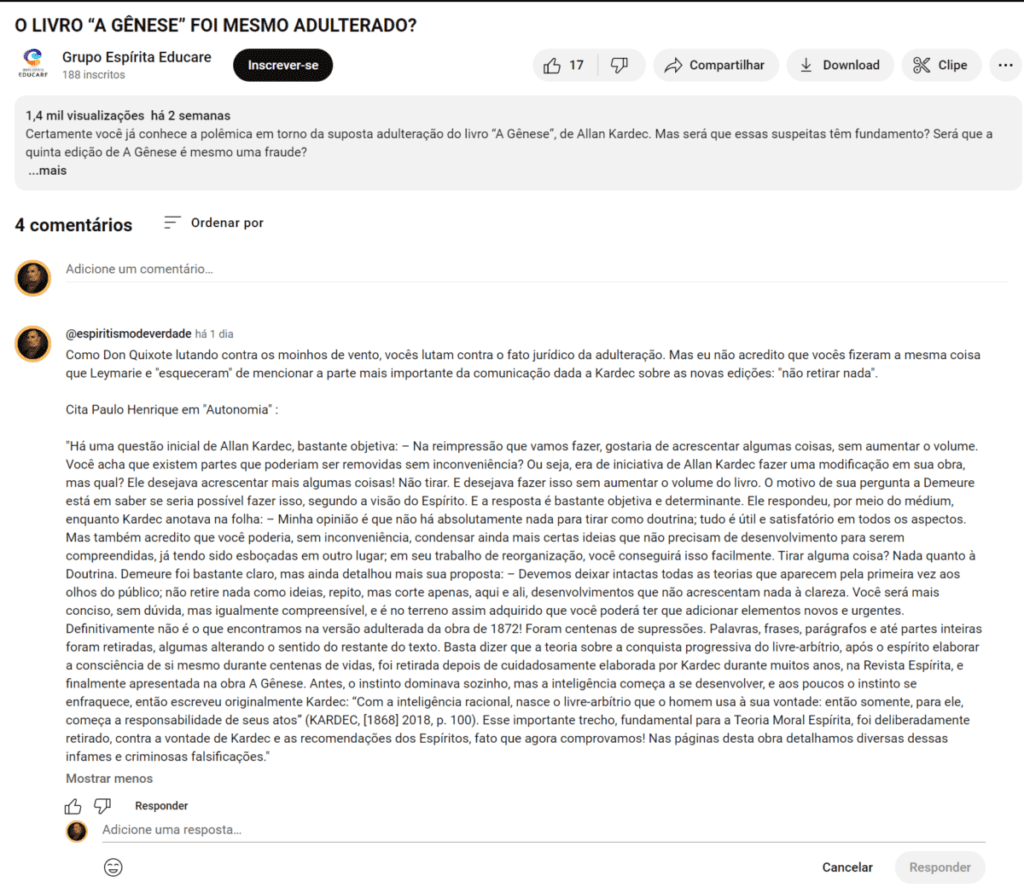
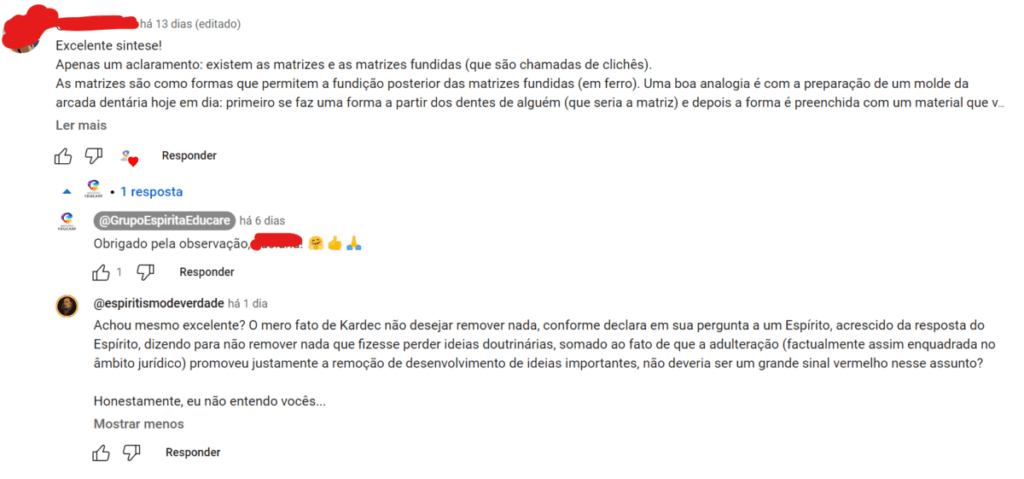
A few days ago, I commented on the video “Was the Book of Genesis really tampered with?”, published on the Grupo Espírita Revelare channel, on YouTube:

It's no coincidence that my comments don't appear to anyone else, as I'm hidden on the channel.


The problems of belief in nothingness (nihilism) and punishment

The belief in punishment, even within Spiritism (or the Spiritist Movement) and the belief in nothingness lead man into two very complicated situations. Let's see:

When you believe in nothingness, you focus on enjoying the present at any cost. This is what Kardec shows us in Heaven and Hell (FEAL):

Is there anything more desperate than the idea of absolute destruction? Sacred affections, intelligence, progress, knowledge laboriously acquired, all would be undone, all would be lost! What is the need for the effort to become better, to repress passions, to enrich our spirit, if we are not to reap any fruit from it, especially given the idea that tomorrow, perhaps, it will no longer serve us for anything? If that were so, man's lot would be a hundred times worse than that of the savage, who lives entirely in the present, in the satisfaction of his material appetites, without aspirations for the future. A secret intuition tells us that this is not possible.

By believing in nothingness, man inevitably focuses his thoughts on the present life. In fact, there would be no need to worry about a future from which nothing is expected. This exclusive concern with the present naturally leads you to think about yourself before everything else; It is, therefore, the most powerful stimulus to selfishness. The unbeliever is coherent when he reaches the conclusion: “Let us enjoy while we are here, let us enjoy as much as possible, because after us, everything will be over; let us enjoy quickly, because we don’t know how long it will last”, as well as this other one, much more serious for society: “Let us enjoy, no matter at whose expense; every man for himself; Happiness, down here, is the most cunning.” If religious scruple restricts the actions of some, what restraint will there be for those who believe in nothing? For these, human law only reaches fools, and that is why they dedicate their talent to ways of dodging it. If there is a harmful and anti-social doctrine, it is certainly that of neantism ((Doctrine of nothingness, nihilism)), because it breaks the true bonds of solidarity and fraternity, the foundation of social relations.”

KARDEC, Allan. Heaven and Hell, Editora FEAL.

Something diametrically opposed to the nihilistic thinking glorified by Nietzsche:

The discovery of Christian morality is an unparalleled event, a true catastrophe. The sacred pretext of making humanity better appears as the cunning to exhaust life itself, to make it anemic. The concept of the afterlife was invented to devalue the only world that exists - to strip our earthly reality of all purpose, all reason, all purpose! The concept of the soul, of the spirit, and finally of the immortal soul, was invented to despise the body. Finally - and this is the most terrible thing - in the concept of the good man, one sides with everything that is weak, sick, a failure, everything that is passive in itself, everything that must perish - the law of natural selection is contradicted, and an ideal is made out of the opposition to the haughty and successful man, the man who says yes, the man who guarantees and is certain of the future - this now becomes the bad man... And all of this was believed to be moral.

NIETZSCHE, 2008, p. 99-100

On the other hand, when man believes in the idea of the fall through sin or in human life as a way of “paying debts”; in other words: when he believes in the idea of divine punishment, he becomes unable to proactively deal with his problems. A woman who, for example, lives with a bad partner, who attacks her, physically or morally, may believe (and many tell her this) that she is living a “recovery” from past lives. He must, therefore, submit to inhumane conditions, in order, as they say, to “pay off his debts”.

This way of thinking is often taught from a child's earliest days, when they are subjected to punishment instead of being encouraged to develop their own rational autonomy. We've already dealt with this in the article "Punishment irritates and imposes. Don't educate for reason.


The fanaticism of credulity creates unbelievers, because it answers nothing. It takes the individual out of control of their responsibility: if they do evil, it's the devil's fault; if they do good, it's divine grace.

The fanaticism of unbelief, on the other hand, goes in the same direction and produces the same thing as the first: the individual, whether he does evil or good, is because of his DNA.

Both turn people into automatons who are left with nothing but worldly pleasures and the prospect of nothingness or eternal damnation. The middle way, in its rational excellence, is Rational Spiritualism and Spiritism (in its origin). See this study: https://www.youtube.com/watch?v=OCD2_iAQySw.


We recommend the following study to everyone:


The history of Spiritism and the Spiritist Movement

Spiritism today, or rather what the Spiritist Movement knows and transmits about it, is very far from being reality, and this is very serious, as it is precisely because of these distortions that false ideas were created that repel individuals and create fights, not only internally, but also with spiritualist religions.

A very well-known case is that of Umbanda, which was created because an individual was prohibited from “receiving” a Spirit from an “old black man” in a spiritist center. Not only that: nowadays, people of any religion who have any interest in Spiritism are led to the question: “do I need to abandon my religion to be a Spiritist?”. This is because “being a Spiritist”, in modern times, means attending a Spiritist center which, according to false concepts, is where Spiritism “lives”.

I am here to demonstrate how wrong these conceptions are and that, far from a dispute of truths, it is possible to have union and that, in truth, this is how Spiritism developed.

The history of Spiritism like almost no one has known

It is logical to say that, before Spiritism became established as a doctrine, no one was a Spiritist. How was it possible, then, to form this science, with a philosophical aspect and moral consequences?

Anyone who says or thinks that it was Allan Kardec who created Spiritism is wrong. No: Spiritism is in nature, just like the other sciences. It would behoove someone to study, with scientific methodology and seriousness, the principles of this science, and that is what Kardec did. He never gave himself the right to take the truth for himself, simply because, as an honest scientist, he knew that science does not deal with truths, but with theories that come closest to the truth.

Thus, Kardec dedicated himself to studying the phenomena and communications of Spirits, using the main tool available: evocations, through mediums. And he didn't do it alone: at that time, study groups spread across France and other nearby countries and, in fact, preceded Kardec in evocations. When he became interested in Spiritism, there were already several evocations recorded on paper, which he gathered, analyzed and organized, which gave rise to the first edition of The Spirits' Book, about half the size of its second edition.

Kardec quickly realized that this initial effort in the Doctrine would require development, like all science. Thus, in 1858, the Spiritist Magazine — Journal of Psychological Studies, a monthly periodical where he presented to the public results of studies on evocations and spontaneous communications within the scope of the Parisian Society of Spiritist Studies, as well as pertinent content sent by other groups. He also used the Magazine to reinforce the true face of Spiritism, often presenting counterpoints to opinions and articles full of ignorance and, at times, evil.

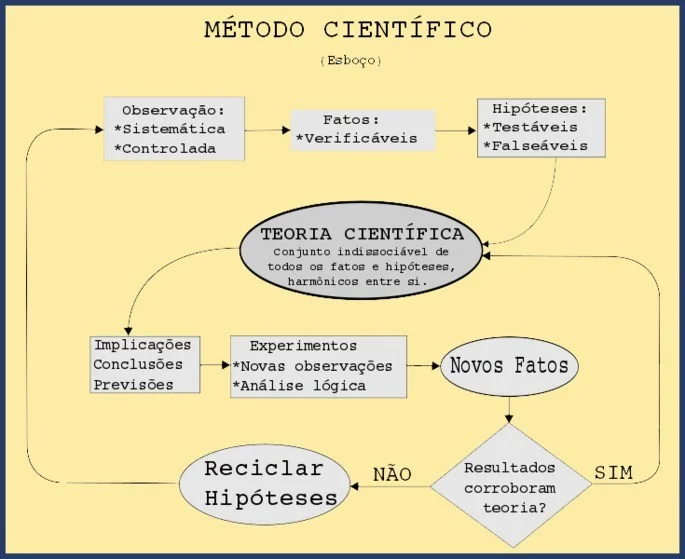
We talk about scientific methodology: well, Spiritism was born like all science: from a systematic and controlled observation of verifiable facts (although not under our will), from which hypotheses were created. From the hypotheses, a theory was created, which was then subjected to experiments (evocations). From the experiments, the results were verified and, from there, the hypotheses were evaluated: if they were corroborated, they were incorporated into the theory; if not, they were reevaluated and new observations were made.

Untruths

One of the biggest untruths that reign over the current Spiritist Movement is that evocations should not be carried out, which is in opposition to the historical characteristics of Spiritism. Anyone who studies the first year of Revista Espírita understands how indispensable for spiritist science, which, as it is a science, should not be taken as sacred content, which should remain untouched. On the contrary: Spiritism needs development, but this development can only be done through scientific methodology, which necessarily depends on the resumption of evocations. An example of a practice lacking method, or taken for false principles, is that it is enough to evoke one or more Spirits, in an isolated group, and ask (or listen) to them about everything, making this a doctrinal principle.

Another big untruth is the assumption that mediumship belongs to the Spiritist Doctrine. So much so, that we demonstrate that Spiritism was born through the joint effort of groups that could not be Spiritists, since the doctrine did not yet exist. At that time, people of various beliefs and religions practiced mediumship in their homes, in small groups, and reaped good or bad results from evocations depending on their efforts to reason about communications. Kardec mentions, in the Magazine, that the followers of Spiritism included Catholics, Protestants, Muslims, Buddhists, etc., carrying out evocations and studies and often sending them to the Parisian Society of Spiritist Studies, where, together with other collaborators, they were evaluated, analyzed and separated those that could represent an interest for the general public.

Here we have two more untruths of the modern Spiritist Movement: the one that says that mediumship can only be practiced in the spiritist center and the one that says that we should just wait for the free communication of the Spirits. From these, perhaps, is born the biggest mistake of modern spiritists and followers: the blind and unreasoned acceptance of everything the Spirits say.

Another untruth, which we cannot fail to mention, is the one that says that Spiritism is a religion. We have already demonstrated that it is a science and that it can only be taken as a religion in the philosophical sense of natural religion, approached in a metaphysical and moral way by Rational Spiritualism, which we will talk about in a moment. This is the reason for finding, in Kardec's time, followers among religions, who did not leave their religions, with their particularities, to practice Spiritism. Regarding this, stay with us until the end, as understanding is extremely important.

Unfortunately, the Spiritist Movement erased science and transformed Spiritism into a religion, which started to create false ideas and dogmas that, if they please some, please for a while, but cannot face reason in the most critical moments of life, creating, thus, disbelievers. They forgot that Spirits do not become wise by leaving the material body and that, among them, there are good and bad, wise and ignorant, etc., and that it is above all when it is simply made available, without dialogue, that anyone presents themselves .

There are countless false ideas, which feed the Spiritist Movement and followers in general, which have not gone through the necessary screening, which have not been investigated and questioned, even if they were opposed to what, with method, was transformed in principle by psychological observation in thousands of Spirits, of all “types”.

We invite the reader, if they have not already done so, to start studying the Revista Espírita from 1858 and 1859 (it runs until May 1869). This publication, which should be taken as a laboratory where one can follow the development of the Spiritist Doctrine, through the method highlighted above, and not as a final idea in each article, demonstrates what Spiritism actually is and how much our society is far from this reality.

Notice what we say untruths, and not “lies”, since most of those who spread them, speak from what they were taught. But where did these untruths come from?

The materialist turn of the 19th century

Spiritism was not born out of nowhere. The ground was very well prepared before that and, at the beginning of the 19th century, the movement known as Rational Spiritualism was born, which, based on metaphysics, sought to study the human psyche through its most elementary and inseparable aspect: the soul. Authors such as Maine de Biran, Victor Cousin and Paul Janet were its main exponents.

You probably don't know, but Rational Spiritualism defined French Moral Sciences in the middle of this century, forming part of French teaching and defining its structure. I will leave information in the description. But ER approached this study only through metaphysics, and not in a practical way. As Spiritism, which was its development, Experimental Psychology was born (and now you know the reason for the subtitle of the Spiritist Magazine). I will not go into many details, which can be found in the book “Autonomy: the never told story of Spiritism”, by Paulo Henrique de Figueiredo. The issue here is different.

At the end of the 19th century, German materialist philosophy overcame French spiritualist philosophy, which, according to some rulers, was the reason for France's failure in the war. Rational Spiritualism was swept under the carpet and Spiritism, which was already suffering from adulterations (we will talk about that in a moment) took the final blow, being practically forgotten in France, in Europe and, later, in the world. New icons of the philosophy of nothingness and materialist psychology (however paradoxical this idea may be), such as Nietzsche and Freud, were taken as idols, replacing rational spiritualist psychology with the perspective of the nullity of moral efforts and selfishness.

Adulterations in Spiritism

Very interesting details about the events after Allan Kardec's death can be gleaned from the books “O Legado de Allan Kardec”, by Simoni Privato, and “Ponto Final”, by Wilson Garcia. In short: the fateful and unexpected event shook spiritists everywhere, who struggled to regain some strength. Along with this, wars came and, in the Spiritist Society, Kardec's successor, Pierre Gaetan Leymarie, undermined scientific doctrinal principles, expelled old people, in the middle of winter, from homes created by Kardec for poor spiritists, burned correspondence carefully kept by the Professor and, for personal interests, he admitted to the Spiritist Magazine contents originating from the ideology of Roustaing, now deceased, who considered himself the revealer of truths, blindly believing in one or more obsessive Spirits who communicated through a medium. The care for rationality, for the general agreement of spiritist communications, ended and, to throw the last straw on French Spiritism, Leymarie was put on trial for publishing content originating from a charlatan, in what became known as “ Process of the Spiritists”.

Because of this whole scenario, Spiritism grew stronger in an already distorted Brazil. The origins of FEB, an institution that took the liberty of proclaiming itself the general leader of Spiritism in Brazil, in fact, are completely linked to these distortions. FEB was founded and guided by Roustaing's principles for a long time (read Ponto Final, by Wilson Garcia). This is the main reason for the distortions of the Brazilian Spiritist Movement.

Added to this, the Revista Espírita only came to be translated in the 1950s. Here, several false ideas were formed, with, as we have demonstrated, the assumption of not judging communications and not evoking Spirits for investigations being the most damaging of them.

The resumption

When we talk about resuming Spiritism, we talk about resuming it as a science. To do this, knowledge is needed, born from study, seriousness, will, purpose and collaboration. Mediumship, which does not belong to the Spiritist Doctrine or the Spiritist Movement, can be practiced by everyone, including outside of spiritist centers. Evocations are necessary and healthy, but here we need warn about some principles of the science of Spirits.

The Spiritist Doctrine, as a science, has the merit of having produced knowledge about the observation of phenomena and communications of Spirits, spread throughout the world. It was not born from Kardec's brain, but from thousands of evocations and facts, analyzed in a scientific way. We repeat this a lot, because this understanding is substantial.

Already in the time of Allan Kardec, mediumship was practiced everywhere. At first, with many errors; later, as knowledge became established, it became increasingly more serious and rational, leaving only dissidents and stubborn people who, not wanting to observe scientific principles and driven by self-love, insisted on banal errors, which almost always led them to obsessions. . We mentioned Roustaing a little while ago, who, preferring to blindly believe the words of Spirits that fed his ego, promptly turned against Kardec when he tried to warn him. It's like Icarus, who, warned that he couldn't approach the sun without getting burned, fed with his ego by his wings, ignored the warnings and ended up burned.

This general warning comes in line with the completion of this important call: Spiritism needs to be resumed, and this depends on knowledge and care. The evocations need to be resumed. The doctrine of Spirits needs to be developed again by small groups, cooperating with each other. This was the direction that Kardec sought to give to Spiritism, shortly before his death (read Spiritist Magazine — 1868 > December > Transitional Constitution of Spiritism), where Spiritism would start to be developed by scattered groups, coordinated among themselves, observing the principles already established by the method. People of any religion can do so, as mediumship does not belong to the Spiritist Movement. The centers need to return to being serious, controlled study centers. When resuming the evocations, it is clear that we will face different challenges; It is logical to assume that many will encounter difficulties and many others will fall into the error of vanity and personalism, struggling to establish false ideas, as is already the case. Unfortunately, we will find them mainly in the Spiritist Movement. But these are challenges that will be faced and, if they are done with the doctrinal knowledge that already exists, they will be quickly overcome, if they ever exist.

Let us envision a new future, where there is no fight between religions, but where individuals and groups cooperate with the restoration of evocations with a greater purpose: that of resuming the development of Spiritism. We will return to Spiritism in homes, as in Kardec's time, where family evocations consoled, taught and, at times, represented doctrinal interest. They will be spiritists, or their followers, people of any religion, any creed, or even non-believers, who, with the firm purpose of learning and with the full awareness of not being the holders of the truth, will seek, through evocations and collaboration, to restore the momentarily interrupted path of Spiritism, a doctrine capable of revolutionizing ideas and, thus, transforming individuals, families, groups and, finally, the world. The truth does not belong to anyone, but the theories that come closest to it can be found by that maxim expressed by Allan Kardec, representing the scientific method in Spiritism:

General concordance in teaching is the doctrine’s essential character, the condition even of its existence. It is evident that all principles which have not received the consecration of general agreement can only be considered as a fractional part of this same doctrine, merely as a simple, isolated opinion for which Spiritism cannot assume the responsibility.

It is the concordant, collective teaching of the spirits who have passed beyond which constitutes the logical criterion, giving strength to the spiritual doctrine and assuring to it perpetuity.

Allan Kardec – Genesis

We welcome your comments below.


Spiritism and Science: overcoming modern challenges and errors

Spiritism, as a science with a philosophical aspect and moral consequences (Spiritism can only be seen as religion From a philosophical point of view, said Kardec, precisely based on the philosophy of the time, the Rational Spiritualism, from where Spiritism developed.)), formed through the scientific method, experiences challenges from all sides. Placed in a figure, it looks like the most beautiful flower, with the sweetest perfume and the greatest healing properties, smothered by thorns and weeds.

The most diverse difficulties arise from all sides, arising mainly from a lack of commitment, zeal and care. Under this nomenclature, they admit any type of ideas, coming from the mouth or mediumistic intermediation of individuals who have become unquestionable icons. As if that were not enough, lacking knowledge about what science and about the necessary scientific method, responsible precisely for the unassailable strength of the Doctrine born from the studies coordinated by Allan Kardec, most modern researchers promote, in the spiritist environment, new ideas, new theories, distracting themselves from the essential point: the evocations, producing teachings that agree with each other, so subjected to rational analysis, in the face of human science and in the face of what had already been constructed by the same method.

Scientific Method

Let us return for a moment to the question of the definition of scientific method, exemplified in the attached figure. For those who dedicated themselves to studying at least the first year of Revista Espírita (1858), it will be very easy to identify the same steps taken by Kardec:

  • the systematic and controlled observation of certain phenomena and, later, of evocations;
  • verification of identified facts;
  • the investigation of hypotheses, which form a theory, cohesive in itself, from which we obtain implications, conclusions and predictions;
  • carrying out experiments, through evocations, from which new observations are obtained, analyzed rationally and logically;
  • hence, the observation of new facts, which will or will not corroborate the theory;
  • finally, add the results of these observations to the scientific theory, if they corroborate it, or recycle hypotheses, making new observations and going through the same method again.
Exemplification of the scientific method

A very notable fact, which denotes Kardec's scientific rigor and his indissoluble commitment to true science, is that he Never clung to any idea in the study of Spiritism. Anyone who has studied the Spiritist Magazine of 1858 and 1859 already understands this very well. An example of this is the study treated mainly from the RE of July 1859, starting with the article O Zuavo de Magenta and concluded (at least for the moment) in the articles of the following month. We highlight the study in the article Materiality from Beyond the Grave.

And it is precisely at this point, that of attachment to ideas, added to the absence of the necessary method, that the vast majority of modern researchers of Spiritism make mistakes.

The error of the modern spiritualist movement

The big problem arises when, abandoning the essential scientific method for spiritist science, the Spiritist Movement began to admit theories contrary to the principles already solidified by the same method, such as the ideas of spiritual colonies, thresholds, etc., falling into the most basic error of the excited spiritist: blindly believe in the opinions of Spirits.

We do not say that Spiritism, studied by Kardec, has already observed everything there is to be observed. Of course not. What we say is that the modern spiritist movement has created a large set of theories that cannot face the scientific method, because they have not gone through it!

We very often find even those dedicated and willing researchers — we will not take this true impetus from them — who, however, cling to the most diverse ideas and who very quickly become irritated by the contradiction of what, scientifically, is part of the principles doctrinaires of Spiritism.

The basis of the indispensable methodology in Spiritism

Let us return here to what is highlighted on our home page – a quote from Allan Kardec in A Gênesis:

General concordance in teaching is the doctrine’s essential character, the condition even of its existence. It is evident that all principles which have not received the consecration of general agreement can only be considered as a fractional part of this same doctrine, merely as a simple, isolated opinion for which Spiritism cannot assume the responsibility.

It is the concordant, collective teaching of the spirits who have passed beyond which constitutes the logical criterion, giving strength to the spiritual doctrine and assuring to it perpetuity.

Allan Kardec — The Genesis

The statement highlighted above, made by Kardec, is not a mere result of a personal systematization. Quite the contrary: it represents the necessary scientific method for the study and development of Spiritism. It is not enough for the same principle to be consecrated by generality (which requires the use of evocations, because it is not enough that we just put ourselves in the role of listening and accepting what the spirits say); it is not necessary, furthermore, that this consenting collectivity of opinion of the spirits be passed through the criterion of logic, which means comparing it to human science and the scientific method, so that, only then, it can be taken as a principle of Spiritism.

Note, furthermore, the term “opinion” used by Kardec, not by chance: what the Spirits say, through mediumistic communications, are their own opinions, born from their knowledge and their own observations, when they are not the result of a deliberate intention to mystify, that is, to promote false ideas . It happens in the best groups. The opinions of spirits, like the opinions of human beings, can be loaded with beliefs, false ideas, little knowledge, illusions, etc. How, then, to analyze them scientifically? Through the psychological observation of these communications.

The nuances in a psychological science

Anyone who has studied at least the first two years of the Spiritist Magazine notes that, even at the end of the second year, Kardec continues to frequently question the communicating spirit how he got there, how he presents himself, how he sees other spirits, etc. If an answer disagrees with the scientific theory or brings new facts, it will be investigated through evocations and according to the scientific method — which is not done nowadays.

Kardec investigated, among many things, the issue of pain in the Spirit. There were those who claimed to feel cold or hot; pains; hunger; worms gnawing his body, &c. It was through dedicated study, through rational analysis of the psychological nuances of these communications, that Kardec arrived at several doctrinal scientific principles. An example of this is the communication from the Spirit of the assassin Lemaire in the RE of March 1858:

6. Immediately after your execution, were you aware of your new existence? — I was plunged into an immense disturbance, from which I still haven't emerged. I felt great pain; looks like my heart felt it. I saw something roll at the foot of the scaffold. I saw the blood flow and my pain became more acute.

Kardec could easily, were it not for his scientific rigor, admit that the Spirit materially suffered from a pain in the heart. But he investigates:

7. Was it a purely physical pain, similar to that caused by a serious injury, such as the amputation of a limb? — No. Imagine remorse, great moral pain.

We could cite a huge diversity of cases that illustrate this scientific principle, but we leave the purpose of studying the Doctrine that it embraces to the reader's healthy curiosity.

Spiritism needs defense

Leaving aside the scientific method is a big mistake on the part of most modern researchers of Spiritism, who aim to construct new doctrinal principles without going through this process, when they should not only be practicing evocations, given the dedicated study of the Spiritist Magazine, but also should be encouraging the spiritist movement to do so at all times.

By not doing so, they throw another shovel of lime on Spiritism, producing a bad impression and a false idea in the scientific world, which does not recognize it as something born of science, but as a mere superstitious belief or a religion. It is not uncommon for me to come across allegations from people who, having not had the chance to know what really be it Spiritism, they distanced themselves from it because they could not admit, for reason, that, for example, a Spirit has to take a flying bus to get around.

We have a lot to do and you must have realized that the first step is studying.


Cities in the Spiritual World: Materiality from Beyond the Grave

Recently, a series of studies by Revista Espírita gave us an interesting lesson, which goes directly in line with the ideas of cities in the spiritual world, which many believe in and promote. The study was carried out on the following articles from Revista Espírita:

  • July 1859:

    • The Magenta Zouave;

      • A senior officer killed in Magenta

  • August 1859:
    • Furniture from beyond the grave;
    • Pneumatography or direct writing;
    • A servant spirit;
    • Mrs Mally's Guide

In addition, we use Kardec's conclusion in A Gênese (Editora FEAL) — Nature and Property of Fluids.

We will highlight the main points of the study, where we list our comments in square brackets ([comment]).

Magenta's Zouavo

45. ─ Do you know why you see us, while we cannot see you?

─ I think your glasses are too weak.

[He does not know. Hence it uses a metaphor or figure of speech.]

46. ─ Is it not for this same reason that you do not see the general in his uniform?

─ Yes, but he doesn't wear it every day.

47. ─ What days do you wear it?

─ Now that! When they call him to the palace.

[The Spirits, ignorant of certain things, express themselves as best they can, and see the world of Spirits according to their ideas, just as a child, using mental images to describe something that he does not understand, speaks of things that we attribute only to the imagination, but that, deep down, has its meaning. The mistake here would be to take the “palace” as an expression of spiritual truth permanent.]

48. ─ Why are you here dressed as a zuavo if we can't see you?

─ Simply because I am still a Zouavo, even after about eight years, and because among Spirits we conserve that form for a long time. But that's just between us. You understand that when we go to a very different world, like the Moon or Jupiter, we don't take the trouble to do all that toileting.

[This is very interesting. What we understand is that he is referring to the fact that Spirit adopts a perispiritual form according to the world where it goes and according to the existence of a personality in that world, without even realizing it. If he had lived in a distant world, for example, an animal seller, when evoked there, would present himself that way. When moving through space, without being evoked, it does not take a specific shape, that is, “you don’t need to do all that toiletry”.]

49. ─ You speak of the Moon and Jupiter. Were you there after he died?

─ No. You are not understanding me. After death we find out about many things. Didn't they explain to us a lot of problems of our Earth? Don't we know God and other beings much better than we did a fortnight ago? With death, the Spirit undergoes a metamorphosis that you cannot understand.

[He is trying to explain the previous thought, not knowing how to do it.]

A senior officer killed in Magenta

13. ─ At the moment of death, did you immediately recognize yourself?

─ I recognized myself almost immediately, thanks to the vague notions I had of Spiritism.

14. ─ Can you say something about Mr… also killed in the last battle?

─ He is still in the networks of matter. There's more work to get rid of. His thoughts had not turned this way.
OBSERVATION: Thus, knowledge of Spiritism helps in the detachment of the soul after death and shortens the period of disturbance that accompanies separation. This is understandable, as the Spirit knew in advance the world in which it finds itself.

[If this knowledge is so important, how can we conceive that precisely when Spiritism was scientifically studied, at the best possible moment, nothing was said about this materiality that today dominates communications?]

furniture from beyond the grave

So far no difficulty concerning the personality of the Spirit. We know, however, that they appear in clothes whose appearance changes at will; sometimes they even have certain toilet accessories, jewelry, etc. In the two apparitions mentioned at the beginning, one had a pipe and produced smoke; the other, a tobacco box and took pinches. Note, however, the fact that this spirit was from a living person and that his snuffbox was in everything similar to the one he usually used, and that he had stayed at home. What, then, do this tobacconist, this pipe, these clothes and these jewels mean? Would the material objects that exist on Earth have an ethereal representation in the invisible world? Does the condensed matter that forms such objects have a quintessential part, which escapes our senses?

This is an immense problem, the solution of which may provide the key to a number of things that have not yet been explained. It was this tobacco company that put us on the path, not only of the fact, but of the most extraordinary phenomenon of Spiritism: the phenomenon of pneumatography or direct writing, which we will talk about below.

[Position of the true scientist, in search of the truth, without discarding anything.]

3. ─ This snuffbox had the shape of the one he habitually uses, and which was in his house. What was this snuffbox in the hands of the Spirit?

─ Always looks. It was so that the circumstances would be noticed, as they were, and so that the apparition would not be taken for a hallucination produced by the state of health of the seer. Spirit wanted this lady to believe in the reality of her presence and took on all appearances of reality.

4. ─ You say that it is an appearance, but an appearance has nothing to do with reality; it's like an optical illusion. I would like to know if this snuffbox was nothing more than an unreal image, like, for example, that of an object reflected in a mirror.

(One of the members of the Society, Mr. Sanson, observes that there is something real in the image reproduced by the mirror. If the image does not remain in the mirror, it is because nothing fixes it, but if it is projected onto a daguerreotype plate, leaves an impression, clear proof that it is produced by some substance and that it is not just an optical illusion).

4 (continued) – Mr. Sanson's observation is perfectly fair. Would you be kind enough to tell us if there is any analogy with the tobacco box, that is, if there is anything material in that tobacco box?
─ Certainly. It is with the help of this material principle that the perispirit takes on the appearance of clothing similar to those that the Spirit wore when alive.

[Today, we know the principle of the image reflected in a mirror and its fixation in a photograph: the behavior of waves. The light, as electromagnetic energy, reflects off the mirror and impresses the photography device, whatever it may be. It seems that it is to this same principle (of wave) that the Spirit refers.]

NOTE: Evidently the word appearance it must be taken here in the sense of image, of imitation. The real tobacconist was not there. What Spirit had was just a reproduction. Compared to the original, it was but an appearance, though formed by a material principle.

Experience teaches us that we should not take certain expressions used by spirits literally. Interpreting them according to our ideas, we expose ourselves to great mistakes, so we must deepen the meaning of their words, whenever there is a minimum ambiguity. Here is a recommendation constantly made by the Spirits. Without the explanation we provoke, the word appearance, repeated continuously in similar cases, could give rise to a false interpretation [Since “appearance” could give rise to the idea of something that does not exist.].

5. ─ Would there be an unfolding of inert matter? Would there be, in the invisible world, an essential matter, covering the form of the objects that we see? In a word, would these objects have their ethereal double in the invisible world, as men are represented there in Spirit?

OBSERVATION: Here is a theory like any other, and that was our thought. The Spirit, however, did not take it into account, which absolutely did not humiliate us, because its explanation seemed very logical to us and because it rests on a more general principle, of which we find many explanations.

─ It doesn't happen that way. The Spirit has a power over the material elements disseminated throughout space, in our atmosphere, that you are far from suspecting. He can, at will, concentrate these elements and give them an apparent form, suitable for his designs.

6. ─ I ask the question again categorically, in order to avoid any misunderstanding. Are the clothes with which spirits are covered something?

─ It seems that my previous answer settles the question. Don't you know that the perispirit itself is something?

7. ─ It follows from this explanation that the Spirits make the etherized matter undergo transformations at will and that, therefore, in the case of the tobacconist, the Spirit did not find it perfectly finished; he made it himself at the moment he needed it, and then undid it. The same should happen with all other objects, such as clothing, jewelry, etc.

─ But it is obvious.

8. ─ That tobacco box was so clearly visible to Mrs. R… to the point of deceiving her. Could the Spirit have made it tangible?

─ It could.

9. ─ In that case, could Mrs. R… have taken it in her hands, thinking she was getting an authentic tobacco box?

─ Yes.

10. ─ If I had opened it, I would probably have found snuff. If she had taken it, would it have made her sneeze?

─ Yes.

11. ─ Can the Spirit not only give the form, but even special properties?

─ If you want; It is in virtue of this principle that I have answered affirmatively to the preceding questions. You will have proof of the powerful action that the Spirit exerts on matter and which, as I have already told you, you are far from suspecting.

[We know, today, that Creation is far from being “each for himself”, and that, in fact, it is “one for all and all for one”, with those most inferior being always “led” by the highest .]

12. ─ Let us then suppose that he wanted to make a poisonous substance and that a person had taken it. Could this have been poisoned?

─ I could, but I wouldn't have done it, because I wouldn't have been allowed to do it.

13. ─ Could you have made a salutary substance suitable for healing in case of illness? Has there ever been such a case?

─ Yes; often.

OBSERVATION: A fact of this kind will be found with a very interesting theoretical explanation in the article that we give below under the title A Servant Spirit.

14. ─ In the same way he could make a food substance; let's suppose he had made a fruit or some snack. Could someone eat it and feel fed?

─ Yes, yes. But do not look so hard to find that which is easy to understand. A ray of sunlight is enough to make your gross organs perceptible to those material particles that fill the space in which you live. Do you not know that the air contains water vapour? Condense it and you will bring it to a normal state. Deprive it of heat and behold, its impalpable and invisible molecules will become a solid and very solid body. There are other matters that will lead chemists to present you with even more astonishing marvels. Only the Spirit has instruments more perfect than yours: his own will and God's permission. 

OBSERVATION: The issue of satiety is very important here. How can a substance that has only temporary and, in a sense, conventional existence and properties produce satiety? By its contact with the stomach, this substance produces the sensation of satiety, but not the satiety resulting from fullness. If such a substance can act on the organic economy and modify a morbid state, it can also act on the stomach and produce the sensation of satiety. However, we ask pharmacists and restaurant owners not to be jealous, nor to think that the spirits are coming to compete with them. These cases are rare and exceptional and never depend on the will. Otherwise, food and healing would be very cheap.

15. ─ Could the Spirit manufacture coins in the same way?

─ For the same reason.

16. ─ Once made tangible by the will of the Spirit, could these objects have a character of permanence and stability?

─ They could, but this is not done. It's outside the law.

17. ─ Do all spirits have the same degree of power?

─ No, no.

[Because only superior spirits could do it (following answer).]

18. ─ Which ones have this power more particularly?

─ Those to whom God grants it, when this is useful.

19. ─ Does the elevation of a Spirit influence this case?

─ It is certain that the higher the spirit, the more easily it obtains this power. This, however, depends on the circumstances. Lesser spirits can also get it.

[And, in that case, they are supplied by the assistance of superior spirits, often without even knowing it. See The Book of Mediums or Guide for Mediums and Evocators > Part Two — On Spiritist Manifestations > Chapter V — On Spontaneous Physical Manifestations > Throwing Objects.]

20. ─ Does the production of semi-material objects always result from an act of the Spirit's will, or does it sometimes exercise this power despite its own?

─ This often happens in spite of you.

[That is to say: he doesn't even realize, consciously, that he does what he does.]

21. ─ Would this power then be one of the attributes, one of the faculties inherent in the very nature of the Spirit? Would it be, in some way, one of the properties, like that of seeing and hearing?─ Certainly. But sometimes he himself ignores it. Then another exercises it for him, in spite of himself, when circumstances demand it. The Zouavo's tailor was precisely the spirit I just mentioned and to which he alluded in his joking language..

OBSERVATION: We find an example of this faculty in certain animals, as, for example, in the electric fish, which radiates electricity without knowing what it does, nor how, and who does not even know the mechanism that produces it. Don't we ourselves sometimes produce certain effects through spontaneous acts of which we are not aware? Thus, it seems very natural to us that the Spirit operates in this circumstance by a kind of instinct. He works of his own free will, without knowing how, just as we walk without calculating the forces we bring into play.

NOTE: This was, for example, the case of the queen of Oude, whose evocation appears in our issue of March 1858, who still thought she was covered in diamonds.

23. ─ Can two spirits recognize each other by the material appearance they had in life?

─ This is not how they recognize each other, as they will not assume that appearance for each other. If, however, under certain circumstances, they find themselves in the presence of each other, dressed in that appearance, why should they not recognize each other?

[This is important! In mediumistic novels, the fantastic world created is all material or materialistic, and form, in these tales, is fundamental. Here, we have again the confirmation already made before that form is not important for Spirits in general, although it is predominant for Spirits still very attached to matter (that is, with very attached thoughts). It follows that it would make sense for a Spirit in disturbance to “see” itself in a condition like that of André Luiz's threshold, but the same could not happen when already detached from these ideas, which does not seem to be something that far away, according to the reports of several Spirits, given to Kardec.]

24. ─ How can spirits recognize themselves in the midst of the crowd of other spirits, and above all how can they do it when one of them goes to look for in a distant place and often in other worlds, those we call?

─ This is a question whose answer would take a very long way. It is necessary to wait.

You are not advanced enough. For the moment, content yourself with the certainty that this is so, for you have sufficient proof of this.

25. ─ If the Spirit can take from the universal element the materials to make all these things and give them a temporary reality, with its properties, it can also take from there what is necessary to write. Consequently, this gives us the key to the phenomenon of direct writing((Direct writing happens when a Spirit, by will and with the utility of doing so, makes real writing appear on paper, sometimes in graphite, sometimes in ink, sometimes in print format. We recommend reading the following article, “Pneumatography or direct writing”, as well as the article with the same title, in May 1860, and also Chapter XII of The Book of Mediums — “On pneumatography or direct writing”. 

Pneuma: among the ancient Greek thinkers, especially the Stoics, designation of the spirit, animating breath or creative force, used by divine reason to vivify and direct all things.)).

─ You finally understand.

[scientific maturation]

26. ─ If the material used by the Spirit is not permanent, how come the traces of direct writing do not disappear?

─ Do not judge by the words. From the start I never said never. In the cases studied, these were bulky material objects; here we are dealing with signs that should be conserved and are conserved.

[I understand that St. Louis states that this matter is not impermeable, and that it falls apart when it is “condensed” only by a temporary effect, by inferior Spirits. In the case of direct writing, if there is an interest in preserving it, it is preserved. Chapter VI – General Uranography – in Genesis, gives the key to this understanding.]

The above theory can be summarized as follows: Spirit acts on matter; it takes from universal primitive matter the necessary elements to, at will, form objects with the appearance of the different bodies existing on Earth. He can also operate on elementary matter, at will, an intimate transformation that gives it certain properties. This faculty is inherent to the nature of the Spirit, which often exercises it, when necessary, as an instinctive act, which it does not realize.

[It is important to note that, afterwards, it seems to be clear that this interaction on matter is never direct, but that it needs the perispiritual fluid of the incarnated person to happen..]

The objects formed by the Spirits have a temporary existence, subordinated to their will or necessity. He can make and break them at will. In certain cases, in the eyes of living people, these objects can have all the appearances of reality, that is, become momentarily visible and even tangible. There is formation, but not creation, since the Spirit cannot bring anything out of nothing. (The Book of Mediums, questions 130 and 131).

Mrs Mally's Guide

The article “A servant spirit”, from the same issue, presents the case of Mrs. Mally, where, around her, many interesting facts happen. From an early age he had the ability to see spirits. Sometimes he saw his guiding Spirit; others, he saw unpleasant apparitions, which were intended to call his attention to remain vigilant. There came to be the materialization of a Spirit (agenere).

“In 1856, Mrs Mally's third daughter, aged four, fell ill. It was in August. The child was continually immersed in a state of drowsiness, interrupted by seizures and convulsions. For eight days myself [the correspondent] I saw the child, who seemed to come out of her dejection, take on a smiling and happy expression, with half-closed eyes, without looking at those around her; extend your hand in a graceful gesture, as if to receive something; take it to your mouth and eat; then say thank you with a charming smile. During those eight days the girl was sustained by this invisible food and her body regained its usual appearance of freshness.”

[The article is interesting and we recommend reading it. Let's move on to the evocation of Mrs. mally.]

The evocation begins with the establishment of the Spirit's relationship with Mrs. Mally: they had an old friendly relationship. The Spirit was that of an eight-year-old boy who had died a long time ago. Kardec asks if he was always the one who appeared to her, and he says no, but asserts that it is he himself who produced certain material phenomena *:

13. ─ So you have the power to make yourself visible at will?

─ Yes, but I said it wasn't me.

14. ─ Don't you also have anything to do with the other material manifestations produced in her house?

─ Sorry! This yes. It was what I imposed on myself, together with her, as material work, but I do other work for her that is much more useful and much more serious.

* Kardec says, in the previous article: “By other manifestations he reveals his moral state. This Spirit has a non-serious character, however, alongside signs of levity, he has shown sensitivity and dedication.”

16. ─ Could you make yourself visible here, to one of us?

─ Yes, if you ask God for it to happen. I can, but I dare not.

17. ─ If you don't want to make yourself visible, could you at least give us a manifestation, such as bringing something onto this table?

─ Certainly, but what would be the use? For her this is how I witness my presence, but for you it would be useless, as we are talking.

18. ─ Wouldn't the obstacle be the lack of a medium, necessary to produce these manifestations?

─ No, this is a small obstacle. Don't you often see sudden apparitions to people without any mediumship?

19. ─ So everyone is able to see spontaneous apparitions?

─ Yes, because every human being is a medium.

20. ─ However, doesn't the Spirit find in the organism of certain people a greater facility to communicate?

─ Yes, but I told you ─ and you must know ─ that the Spirits have the power for themselves. The medium is nothing. Don't you have direct writing? Is a medium necessary for this? No, but only faith and a burning desire. And even sometimes this happens in spite of men, that is, without faith and without desire.

[Here, Kardec is deepening his studies. We cannot take this as conclusive, because, perhaps, what this Spirit says is not the truth, but only what he understands. However, it is not difficult to think that, if Matter is formed by the thought of pure Spirits, very simple material forms can be formed, under that influence and for its usefulness, by less elevated Spirits.]

21. ─ Do you think that manifestations, such as direct writing, for example, will become more common than they are today?

─ Certainly. How do you understand, then, the vulgarization of Spiritism?

22. ─ Can you explain to us what Mrs. Mally's daughter took in her hand and ate when she was sick?

Manna, a substance created by us, which contains the principle contained in ordinary manna and the sweetness of confectionery.

23. ─ Is this substance formed in the same way as clothes and other objects that spirits produce by their will and by the action they exert on matter?

─ Yes, but the elements are very different. The ingredients that make up the manna they are not the same ones I got to create wood or clothes.

[“We must not take certain expressions used by Spirits literally”. Let's go, before forming ideas]

24. ─ (To Saint Louis) Were the elements used by the Spirit to form his manna different from those he took to form other things? We have always been told that there is only one primitive universal element, of which the different bodies are mere modifications.

[Here, because there is doubt or inaccuracy in the response of that Spirit, Kardec questions São Luis, Spirit guide of the group. It is the principle we demonstrate in our recent article]

─ Yes. This means that this primitive element is in space, here in one form, there in another. That's what he means. He gets his manna from a part of that element, which he supposes different, but which is always the same.

25. ─ Is the magnetic action by which special properties can be given to a substance, such as water, for example, related to that of the Spirit that creates a substance?

─ The magnetizer employs nothing but his will. It is a Spirit who helps you, who is in charge of preparing the medicine.


Analysis of passage in “Our Home”

In Nosso Lar, we see the following passage. Let's analyze it:

The messenger of good fixed the painting, understood the gravity of the moment and added:

- We have no time to lose.

First of all, he applied comfort passes to the patient, isolating him from the dark shapes, which moved away as if by magic. Then he invited me decisively:

– Let's go to Nature.

I accompanied her without hesitation and she, noticing my strangeness, emphasized:

– Not only man can receive fluids and emit them. The natural forces do the same, in the different realms into which they are subdivided. In the case of our patient, we need trees. They will help us effectively.

Admired by the new lesson, I followed her silently. Arriving at a place where huge fronds were lined up, Narcissa called someone, with expressions that I could not understand.

[Of course, the spirits did not speak through their mouths. That's a figure of speech. The expression is of thought, and André Luiz could not understand these thoughts, yet.]

Moments later, eight spiritual entities answered his call. Immensely surprised, I saw her inquire about the existence of mango and eucalyptus trees. Duly informed by friends, who were complete strangers to me, the nurse explained:

– They are common servants of the plant kingdom, the brothers who attended to us.

[The highest, SERVE. They are not “elves”. They are Spirits, carrying out their activities in nature. They do not live in the middle of the forest, but they take care of this kingdom, as other Spirits will take care of others. They may not be more advanced than us, but they are more advanced than those who are still in the position of the Intelligent Principle. Therefore, they serve their purpose. Mediumistic works need, based on Spiritism, to be re-read and, if there is still doubt, these Spirits must be EVOKED!]

And, seeing my surprise, he concluded:

– As you can see, there is nothing useless in the House of Our Father. Everywhere, if there are those who need to learn, there are those who teach; and where difficulty appears, Providence appears. The only unfortunate person, in the divine work, is the unforeseen spirit, which has condemned itself to the darkness of evil.

[Here, she reinforces the teaching, asserting that the Spirit (therefore, conscious) who voluntarily condemned himself to darkness, that is, who voluntarily clung to imperfection, is the only one who moves away from the “path”, which is the constant relationship of Spirits, learning, cooperating and teaching, towards good.]

Narcissa manipulated, in a few moments, a certain substance with the emanations of the eucalyptus and the hose [“[the] primitive element is in space, here in one form, there in another”] and, throughout the night, we applied the medicine to the sick person , through common breathing and absorption through the pores.


Continuing: Mrs Mally's Guide

26. ─ (To the guide) Some time ago we reported curious facts about manifestations of a Spirit designated by us with the name Duende de Bayonne. Do you know this Spirit?

─ Not particularly, but I followed what you did about him and that was how I came to know about him.

27. ─ Is he a spirit of a lower order?

─ Does inferior mean bad? No. I mean, simply: not entirely good, not very advanced? Yes.

[Inferior spirit is not synonymous with imperfect spirit, because imperfection is something acquired by habit and will. On the Spiritist Scale, this is clear.

All of this is fantastic! Being able to verify, in the RE, the confirmation, given everywhere, of what is concluded in the final works. Little do the resistant know the richness that exists in this study!]

28. ─ We thank you for your kindness in coming and for the explanations you gave us.

─ At your orders.

OBSERVATION: This communication offers us a complement to what we said in the two previous articles about the formation of certain bodies by spirits. The substance given to the child during illness was evidently prepared by them and was intended to restore health. Where did they get their principles from? From the universal element, transformed for the desired use. The very strange phenomenon of properties transmitted by magnetic action, a hitherto unexplained problem, and over which unbelievers have been amused, is now solved. Indeed, we know that it is not only the spirits of the dead who act, but that those of the living also have their share of action in the invisible world. The tobacconist gives us proof of this. What, then, is admirable in that a person's will, acting for the good [Law], can operate a transformation of primitive matter and give it certain properties? In our opinion, this is the key to many supposedly supernatural effects, of which we will have the opportunity to speak.

This is how, through observation, we come to perceive things that are part of reality and the marvelous. But who says this theory is true? Go there! It has at least the merit of being rational and of perfectly agreeing with observed facts. If any human brain finds another more logical than the one given by the Spirits, let them be compared. One day perhaps they will thank us for opening the way to the rational study of Spiritism.

One day someone said to us: “I would very much like to have a servant Spirit at my command, even if I had to endure some pranks that he did to me.”

It is a satisfaction that we enjoy without realizing it, because not all the Spirits who assist us manifest themselves in an ostensive way, but that does not stop them from being by our side and, due to the fact that they are occult, their influence is no less real.

The Genesis (FEAL) > Nature and Property of Fluids

As has already been demonstrated, the universal cosmic fluid is the primitive elementary matter of which the modifications and transformations constitute the innumerable variety of bodies in nature. As an elementary principle of the Universe, it presents two distinct states: that of etherealization or weightlessness, which can be considered as the primitive state, and that of materialization or weightlessness, which becomes, in some way, its consequence. The intermediate point is the transformation of the fluid into tangible matter. But even there, there is no sudden transition, as our imponderable fluids can be considered as an intermediate point between the two states ((To understand Allan Kardec's statements, it is essential to consider that there was in his time, in Physics, the theory of that matter would be made up of two classes: common matter, tangible or ponderable, and imponderable matter or atoms representing light, electricity, heat, etc. (these are luminous, electrical, caloric fluids, etc.). Psychic fluids or spiritual (theme of this chapter) would then be even more subtle states of the universal cosmic fluid than those imponderable fluids accepted at the time. There would then be, in a sequence from greater to lesser subtleties: common matter, imponderable matter, psychic matter. Currently we know that the hypothesis of the imponderable substance is false, and these phenomena are explained as electromagnetic waves.Transposing Kardec's reasoning to Modern Physics, we could conclude that psychic or spiritual matter would be above light. But this hypothesis leads to more complex questions and implications in the current scientific paradigm for which we do not have in this work the developments that allow us to resolve them. (N. do E.) )).

Spirits act on spiritual fluids, not manipulating them as men manipulate gases, but with the help of thought and will, which are, for the Spirit, what the hand is for man. By thought they impress this or that direction on the fluid; they agglomerate, combine or disperse them and form sets with a certain appearance, shape, color; they change their properties, as a chemist changes those of a gas or other bodies, by combining them according to certain laws. It is the great workshop or laboratory of the spiritual life.

Sometimes these transformations are the result of an intention, but often they are the product of an unconscious thought, because the Spirit just thinks about something for it to be done.

This is how, for example, a spirit appears to an incarnate spirit, endowed with spiritual vision, under the appearance he had when he was alive, at the time he met him, although he has already had several other incarnations. He presents himself with clothes, external signs, diseases, scars, amputated limbs, etc. who had; a beheaded one will present himself without his head. I do not say that they preserved such appearances; no, certainly, because, as a Spirit, he is neither lame nor one-armed, nor one-eyed nor decapitated. But his thought, referring to the time when it was like that, his perispirit instantly takes on this appearance, which also changes instantly. If he had been once black and once white, he will present himself as either black or white, according to which of the two incarnations he is evoked and where his thoughts go.

By an analogous effect, the thought of the Spirit fluidly creates the objects it was used to using. A miser will handle gold; a soldier will have his weapons and his uniform; a smoker, his pipe; a workman, his plow and his oxen; an old woman, her distaff.

These fluidic objects are as real for the Spirit as they would be in the material state for the incarnated man. But, due to the fact that they are created by thought, their existence is as ephemeral as it is [here Kardec refers to the article discussed earlier, furniture from beyond the grave].

our observations

  • The Spirit materializes, by the action of thought, the fluids, according to its elevation, its attachments and its ideas. This materialization can range from simple objects to, probably, large scenarios, formed in a group.
  • Spirits that are sometimes less elevated, but already detached from material attachments, demonstrate that they are not involved in that materiality, so prevalent in others.
  • Unenlightened spirits form mental images to describe something they don't understand, just as children can do. The role of a psychology student, in both cases, is to go beyond the images and figures to understand the background of what they say. 
  • The mistake is in taking the word literally.
  • Far from discarding it as nonsense, we will need to be ready, with a resumption of scientific Spiritism, to know how to filter the various atavisms that Spirits, dominated by these widely disseminated ideas, will be able to use.
  • As we highlighted in recent article, it is a serious mistake to form systems on metaphors, taken out of context and not understood correctly. To get rid of these errors, it will be necessary to resume Spiritism scientifically, in the same way that Kardec did.
  • The “coding” presents all the elements to understand that the materiality of the spiritual world is directly linked to the materialism of the Spirits. Those who are more “spiritualized”, not necessarily enlightened, do not present it, while those who are in a state of disturbance, caused by imperfections, often present ideas of attachment to matter. These examples are plentiful. We ask: how, precisely at the most important moment of Spiritism, this supposed reality of cities and colonies, which would be so important, since it would be immediate to our death, was not clearly established for Kardec? We have already addressed these issues in recent article, and we will not repeat it.