Under a striking title, we have another series of booklets from the Brazilian Spiritist Federation, divided into two volumes. We ask ourselves, without knowing it: why create a booklet if Kardec's works are already quite clear and concise in themselves?
Upon finding the PDFs of these booklets, the first thing that occurred to me was to research "evocations." I opened the PDF and searched for "evoca" (to address "evocar," "evocação," "evocações," "evocado," etc.). After all, a booklet that addresses the topic of mediumship in the Spiritist context... necessarily needs to address evocation, an indispensable tool in the mediumistic process. “Surprise”: nothing! Nothing, absolutely anything about evocations, in volume I, if not a reference to the question of prayer being an evocation. Let's move on to volume II. Perhaps they left it for this one, avoiding anticipating such an important topic. Another "surprise." In this volume, the following does appear:
Direct evocations of Spirits should be avoided, opting for their spontaneous manifestation: “Often, evocations offer more difficulties to mediums than spontaneous dictations […]”.45 It is up to spiritual direction to select the discarnates who should manifest themselves in the meeting.
The footnote refers to The Mediums' Book, but the passage was inserted out of context to give the false impression that it recommends not directly evoking spirits. In fact, Kardec is referring to the passage as indicating that evocations present more difficulties than spontaneous communications, since, in the latter, the spirit freely chooses the medium most suited to its communication, something that becomes more difficult in the case of evocations:
Because, as we have already said, fluidic relationships are not always established instantly with the first Spirit who presents themselves. It is therefore advisable that mediums not engage in evocations for detailed questions without being certain of the development of their faculties and the nature of the Spirits assisting them, for with those who are poorly assisted, evocations cannot have any authenticity.
Allan Kardec — The Mediums' Book
However, Kardec demonstrates that evocations are preferable to mediumistic communications, recommending that only groups that are certain of controlling the Spirits should engage in the latter:
“[…] not calling anyone in particular is opening the door to everyone who wants to come in.”
“Spontaneous communications have no drawbacks when we control the Spirits and are sure not to let the bad ones dominate”
Allan Kardec — The Mediums' Book
Further on, another occurrence of the term:
Ostensive mediums must also be instructed to:
[…]
Be aware of the inappropriateness of evoking a particular entity, relative or friend, during meetings, knowing that, at the right time, they will manifest themselves, with the support of spiritual guides.
Where they again insert a decontextualized reference to Kardec:
The natural desire of every aspiring medium is to be able to converse with the Spirits of people who are dear to him; however, he must moderate his impatience, because communication with a given Spirit often presents material difficulties that make it impossible for the beginner.
Allan Kardec — The Mediums' Book
Note that Kardec says: to the beginnerThis is not emphasized, and in the text, it ends up being presented as general guidance to mediums, adding to the previous statement—"Be aware of the inappropriateness of evoking a particular entity, relative, or friend, during meetings, knowing that, at the right time, they will manifest themselves, with the support of spiritual guides," which is completely false, since evocation was a tool used by Kardec and countless others, necessary for the necessary dialogue and questioning of the Spirits. Furthermore, in the rest of the booklet, there is no mention of the correct way to perform evocations or their usefulness, something that, logically, is addressed by Kardec in The Mediums' Book and other works.
Actually, none of this surprises me. The Brazilian Spiritist Federation being a Roustainguist institution, having acted to gradually divert the Spiritist Movement, it certainly would not be in its interest to focus precisely on the tool that, when resumed, will provoke their misfortune, since it will give the Spirits the opportunity to question, following in Kardec's footsteps, the various absurdities uttered and printed, without any care, by the FEB, for more than a century.
Just as ESDE – Systematic Teaching of the Spiritist Doctrine – is full of absurdities and deviations, worshipping the appreciation of Brazil, Heart of the World, work of a mystifying Spirit, these handouts also fulfill their purpose: to continue the diversion.
The deviation of the Brazilian Spiritist Federation: how Roustainguism distanced the Spiritist Movement from Spiritism
What is known about Spiritism in Brazil necessarily involves the image of a Spiritist Movement formed mainly by the influence of the Brazilian Spiritist Federation. However, the more we study, the more strange we find the unquestionable distance between this Movement and original Spiritism. We then began to ask ourselves: “what happened?” Recently discovered information has made us aware of what, for some, has been very clear for a long time.
Roustaing — Jean-Baptiste Roustaing — for those who don't know, he was a powerful lawyer at the time of Kardec. In short, he began to receive spiritual communications through a medium — yes, just a medium. In these communications, “the Spirits” (probably there was just one) presented themselves as the four evangelists and said that he, Roustaing, was the Revealer of Revelations. Needless to say, this was a blatant mystification, is it? We will say: this was a blatant mystification, easily recognized by someone who deeply knew spiritist science. This someone, Kardec, criticizes the work transmitted by these Spirits, “The Gospels”, and, thus, touching on that gentleman's blatant pride and vanity, creates a new enemy.
Among the dogmas admitted by this gentleman was the idea that a Spirit who makes a lot of mistakes is sent to an inferior planet, where he would incarnate as a slug (“fleshy cryptogams”). There was also the dogma of the fall through sin, where the human being would only have to incarnate after making a mistake and, thus, acquiring a guilt that would project him to a punishment, through incarnation — the same idea inserted in adulteration of Heaven and Hell — as well as the dogma that Jesus was just an agender, that is, he never incarnated among us.
Mystical ideas, for some reason that we do not understand, appeal to many, no matter how complicated and meaningless they may seem to us, given the unbreakable crystallinity of Spiritism. Thus, these ideas found support even in French territory, including by Leymarrie, most responsible for the adulteration of the purposes of the Sociedade Anônima and the Revista Espírita, after Kardec's death. Soon, these ideas were imported to Brazilian soil, where the Sayão Group was founded. worshiped by FEB)), or the Humble Group, or the Ismael Group. In this group, in fact, the Spirit of the “Angel” Ismael communicated, reproducing various mysticist absurdities, the same “Angel” Ismael who appears in “Brazil, Heart of the World, Homeland of the Gospel”, a work produced by a mystifying Spirit, and full of mysticistic absurdities and even lies. The well-known Dr. Bezerra de Menezes was also part of this group. AND.
The “angel” Ishmael
This much-lauded "angel" Ismael is so cynical, so hypocritical, that, demonstrating his imperfection, he goes so far as to say that Kardec would have had a isolated opinion Regarding the incarnation of Jesus:
If the isolated opinion of your good master Allan Kardec could, in some way, influence the understanding of some, making them believe that the Redeemer of the world came to clothe himself in the gross matter of common bodies, to give an example of the greatest virtues, guiding all of humanity towards the promised land, today, when all well-enlightened Spirits affirm that the birth of Jesus was entirely apparent, that his body was only constituted of fluids concentrated in the womb of the ever-Virgin Mary, there is no longer any reason for two opinions on the matter.
The Virtues of Heaven: The Admirable Collection of Messages Received in the Early Days of the Ismael Group and Included in the Second Edition of Evangelical Elucidations, by Antônio Luiz Sayão / edited by Marco Aurélio L. de Assis. — Rio de Janeiro: CRBBM, 2012.
It's interesting to see how, despite his being an isolated opinion, he tries to turn the tables by lying and saying that today, "all enlightened Spirits affirm that the birth of Jesus was entirely apparent." This is the old dogma of Roustaing, that the body is unclean, that incarnation is a punishment, and that therefore Jesus could not have incarnated. It's important to say that this conception of incarnation as punishment has largely taken root in the Febiano-Spiritist Movement, as the idea that an individual who goes through any difficulty, even when imposed by others (as in the case of a crime) or due to illness, is merely "redeeming debts from past lives," is repeated everywhere.
FEB, roustainuist
Before the Sayão Group, the Confúcio Group was founded. This Group included, among others, Dr. Siqueira Dias, Dr. Francisco Leite de Bittencourt Sampaio, Dr. Antonio da Silva Neto, Dr. Joaquim Carlos Travassos, Prof. Casimir Lieutaud. Many of these you will see in the material available, declaring their “faith” in Roustaing and his four Gospels. This group was followed by the Society for Spiritist Studies “God, Christ and Charity”, founded in March 1876. “God, Christ and Charity” is, to this day, the motto of the FEB.
“Accepting Bezerra de Menezes to accept the Presidency of the Federation, in 1895, the 'Ismael Group' accompanied the apostle, supported him in the direction of the House and joined it”, as read on the FEB portal itself (A FEB – Origens), accessed on 06/23/2024. Thus, a Roustainuist group came to dominate the FEB, which established itself and created roots that would cross the 20th century, enter the 21st century and, in the first years of that, in 2018, although they left the Febian status, which previously required study and dissemination of these works, continued in its bowels, even though to this day this institution has not publicly acknowledged its deviations and committed itself to reparation.
The coordinator of the CFN's legal consultancy, Francisco Ferraz Batista, presented the results of the proceedings in the 29th Civil Court of the District of Rio de Janeiro, regarding the withdrawal, from the FEB Statute, of the part of the item referring to the disclosure and study of works of JB Roustaing. The results were favorable to FEB, for the removal of the aforementioned section of the item from its Statute, which should formally occur at a General Assembly meeting.
The removal of this section from the FEB statute obviously did not remove Roustaing from its depths, since it still requires the study of “Brazil, Heart of the World,” a work that continues to support the lie about Roustaing, highlighted by us in bold:
“According to the work plans of the invisible world, the great missionary, in his wonderful effort of synthesis, would count on the cooperation of a multitude of assistants to his work, particularly designated to assist him, in the individualities of João-Batista Roustaing, who would organize the work of faith; by Léon Denis, who would effect the philosophical unfolding”.
This is how, “to be a spiritist”, most of the spiritist centers you step into will direct you to the Febian catechization, studying “Spiritism” not in the works of Kardec, but in the booklets of the Brazilian Spiritist Federation, where, bringing as a work basic to the probably adulterated “Brazil, Heart of the World”, the lie about the figure of Roustaing and the mysticism of the “angel” Ismael are validated at the same time. Therefore, the entire Febian tradition is validated and the entire methodology and organization necessary for the continued development of Spiritism are discarded, replacing all spiritist science with blind belief in the Spirits and in the personalities endorsed by the FEB...
Sérgio Aleixo quotes:
As predicted by the so-called “Golden Pact” (05/10/1949), “it is up to the spiritists of Brazil to put into practice the exposition contained in the book Brazil, Heart of the World, Homeland of the Gospel, in order to accelerate the evolutionary march of Spiritism”. Well done! This passed into art. 63 of the statute of the Mother House of Rustenism in the world, which records:
The Council [National Federation of FEB] will make it clear to all spiritist societies in Brazil that it is up to them to put into practice the exposition contained in the book Brazil, Heart of the World, Homeland of the Gospel, by Francisco Cândido Xavier.
Among other jokes from beyond the grave, in chapter I of this work, “the divine bitterness” of Jesus “excites” a whole “beautiful assembly of cherubim and archangels” and he, “who directs this globe”,[1] does not even know where is Brazil.
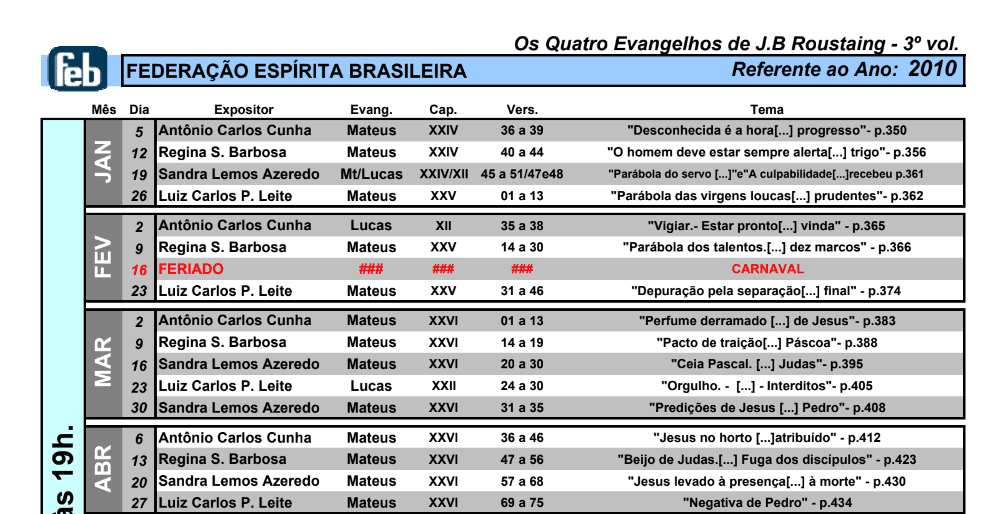
We could extend this article at length, demonstrating that the presidents of this institution have always been Roustainuists; that the FEB, as read in O Reformador, placed Roustaing above Kardec several times; that FEB, at the beginning of the 20th century, published the work The Gospels, by Roustaing, bringing, in the preface, a true affront to Kardec, Spiritism and confessed Spiritists. We will leave this observation to the dear reader, who will find material available here, largely obtained from the FEB website itself (on Google, search like this: “site:febnet.org.br Roustaing”), proof of what we now say. We limit ourselves to highlighting the following image, obtained from a document from the FEB website:
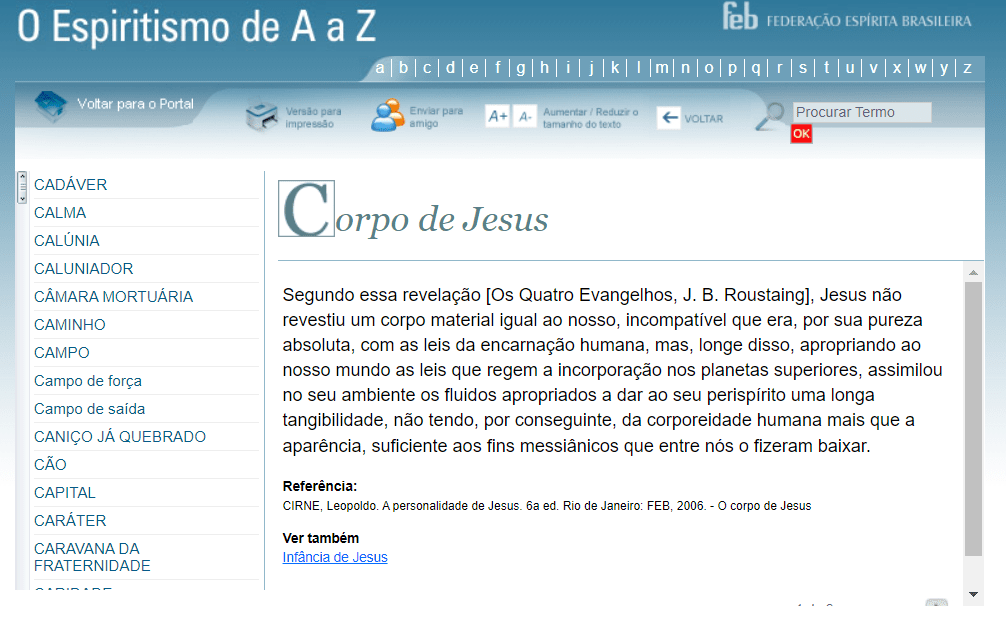
It is also important to highlight that, in the FEB domain, there is a glossary, “Spiritism from A to Z”, containing an explanation of terms and words — in the light of Spiritism, obviously? No. In the shadow of Roustaining:
No, the FEB (Brazilian Spiritist Federation) hasn't abandoned Roustainguism. As you can see in the image below, obtained from the official FEB Instagram account, on May 19th, two lectures (not yet published) based on QE (Questionnaire Experimental), which is nothing more than... Roustaing's Four Gospels!
Spiritist Movement away from Spiritism
We will, however, focus on evaluating the effects of a Spiritist Movement formed by the FEB:
Spiritists who are unaware of Spiritism; spiritists who are afraid of Spirits; spiritists who do not evoke the Spirits, questioning the obviously misleading communications; spiritists who blindly believe in the communications of Spirits, accepting everything as a “doctrinal complement”; spiritists who do not practice mediumship at home, believing that this would attract obsessors and that – an absurdity – only in the spiritist center would they have protection from good Spirits, if they did not go to the homes of well-intentioned people; spiritists, in short, who reproduce various false ideas, gleaned from blindly accepted communications and the opinions of idolized mediums, causing real embarrassment to Spiritism and giving ammunition to its critics.
We should mention that, among these idolized mediums, is Divaldo Franco, who, in the words of Augusto dos Anjos:
Divaldo Pereira Franco, the first centenarian, made the statement to me personally more than once that there is no way to explain the Gospels except in the light of the “Revelation of Revelation”. Would it be a reserved position, just for my private knowledge? Of course. First of all because good men do not have to, under any pretext, form dubious positions, one public and the other for private friends. This aphibological behavior does not belong to spirits of good morals. Afterwards, because the esteemed Bahian medium has already made the same statement from the platform, at the top of his lungs, from the height of authority and resounding that we recognize in him and that have served so much to the spiritual enlightenment of all of us, spiritists from Brazil and outside Brazil . To prove this, I transcribe below, «verb ad verbum», the most recent words of Divaldo Pereira Franco spoken from the top of the rostrum of the Grupo Espírita Fabiano (one of the most serious and well-oriented groups that exist in Guanabara), in night of October 6, 1969, with the auditorium being overcrowded as usual. Here is an excerpt from the memorable speech, recorded on magnetic tape, with the speaker's knowledge:
“For many years I didn’t understand. I went to Roustaing, which is my inexhaustible source of evangelical study! For almost twenty years I have been reading the benefactor João Batista Roustaing, meditating on his little words, on Mrs. Collignon's beautiful information, coming from Spirituality. But it’s a wonderful interpretation!”
ANJOS, Luciano dos. One taste and 4 cents. Reformer, Rio de Janeiro, p. 9-11, Jan. 1970. Extracted from the book The Zero Position.
Unfortunately, this was not the only case of an idolized medium or his psychographics defending the figure of Roustaing and his ideas, as you will see in this article. We remember that, here, we are discussing ideas, and not judging people.
It is evident that, although not all of the Spiritist Movement is affiliated with the FEB, the tentacles of Roustainuism and mysticism have enveloped the entire Brazilian Spiritist Movement. Unfortunately, these tentacles also crossed the oceans…
Campaign Plan
We see, finally, the “prophecy” made in 1867 and presented in the Revista Espírita of August of the same year, article “Campaign Plan” fulfilled:
Annihilating it is, therefore, an impossible thing, because it would be necessary to annihilate it not in one point, but in the entire world; and then, aren't ideas carried on the wings of the wind? And how to achieve them? You can pick up packages of goods at customs, but ideas are intangible.
What to do, then? Trying to take control of them, to accommodate them to your will… Well then! It is the party for which they decided. They said to themselves: Spiritism is the precursor of an inevitable moral revolution; before it is completely realized, let us try to divert it to our advantage; let us do it in a way that happens with it as with certain political revolutions; By denaturing its spirit, another course could be given to it.
So, the campaign plan has changed… You will see spiritist meetings being formed whose confessed objective will be the defense of the Doctrine, and whose secret objective will be its destruction; supposed mediums who will have communications ordered, suitable for the purpose they propose; publications that, under the cloak of Spiritism, will strive to demolish it; doctrines that will take some ideas from him, but with the thought of supplanting him. This is the fight, the real fight that he will have to sustain, and that will be fiercely pursued, but from which he will emerge victorious and stronger.
The much-desired unity of the Spiritist Movement will not occur through affiliation with an institution that is more similar to the Catholic clergy. No. This, in fact, goes against the plans for Spiritism, idealized by Kardec in the Spiritist Magazine of December 1868 — Transitional Constitution of Spiritism. This unity will only occur among those who, willingly, delve into the study of spiritist science, returning to, after that, practice mediumship at home, in small, harmonious, cohesive groups, carrying out the analysis of communications and evocations. These groups, spread far and wide, collaborating with each other, without any submission to the control of an institution, but rather to the control of the generality of the teachings of the Spirits, subjected to the sieve of reason, they will then be able to return to work on doctrinal development. Not before, not without it.
Therefore, we highlight the need the formation of study groups – at home, over the internet, at the spiritist center – for the dedicated study of Kardec’s works unadulterated and contextualization works. We leave here our modest collaboration in this regard: Semear Project — Formation of Study Groups.
On the day that the Brazilian Spiritist Federation accepts its deviation, committing itself to reparation and withdrawing from the purpose of determining the direction of Spiritism in Brazil, we will once again value it. Not before, not without this.