Recently, Friar Gilson declared that if someone finds healing through Spiritism, it is because "the devil can also heal." This statement is not new. It echoes the same accusation the Pharisees made against Jesus, saying that He cast out demons by the power of Beelzebub.
Jesus, however, rejected this absurd logic with an irrefutable argument:
“Every kingdom divided against itself will be destroyed, and every city or house divided against itself will not stand. And if Satan casts out Satan, he is divided against himself. How then will his kingdom stand?” (Matthew 12:25-26)
Furthermore, He taught that A bad tree cannot bear good fruit.:
“By their fruits you will know them. Do people pick grapes from thornbushes, or figs from thistles? Likewise, every good tree bears good fruit, but a bad tree bears bad fruit. A good tree cannot bear bad fruit, nor can a bad tree bear good fruit.” (Matthew 7:16-18)
If there is healing in Spiritism, if there is comfort, if there is spiritual enlightenment, how can Frei Gilson claim that it comes from evil? Would Jesus himself have been wrong to say that a bad tree cannot produce good fruit?
The frivolousness of the attacks on Spiritism
Attacks on Spiritism follow a pattern: they are based on the most false ideas, the grossest distortions, and the repetition of unfounded accusations. Without understanding the Spiritist Doctrine, its critics condemn it. without study, without analysis, and often without any intellectual honesty..
The accusation that "the devil heals" is a classic example of a fallacy constructed to confuse people. If the devil had the power to heal, he wouldn't be an enemy of humanity, but a benefactor! Would Frei Gilson be willing to defend the idea that evil is dedicated to alleviating suffering? This logic, besides contradicting Catholic theology itself, is an outrage to common sense.
Accusing Spiritism of operating through the devil is a serious mistake. Spiritism is not based on occult rituals, magical practices, or the worship of entities. On the contrary, It is a doctrine that preaches reasoned faith, selfless charity, and the pursuit of truth above human conventions..
The commitment to Truth
Jesus clearly stated that he came. to bear witness to the truth (John 18:37) and that only the truth sets you free (John 8:32). But when Frei Gilson attributes something that produces good to the devil, he not only ignores the teachings of Jesus but also becomes a witness to the lie.
By spreading this falsehood about Spiritism, Who is Frei Gilson really with? If he is not telling the truth, he is not with Jesus. If he is spreading the same accusation as the Pharisees, wouldn't he be repeating their mistake?
Let each one reflect: Who benefits from distorting the teachings of Jesus to lead people away from the truth?
Friar Gilson's ...
It is regrettable that, almost 160 years after Allan Kardec organized the principles of Spiritism with method and rigor, we still have to deny absurdities that could be avoided with a simple reading of What is Spiritism.
Frei Gilson, like so many other critics who speak without knowledge, insists on distorting the Spiritist Doctrine, mixing it with practices of divination, magic, and esotericism. His approach is not based on study, but on the repetition of old misconceptions that have long since been clarified. The effect of such irresponsible statements is always the same: to misinform and fuel prejudice against knowledge he has not even bothered to understand.
Friar Gilson's Frivolous Opinion on Spiritism It is regrettable that, almost 160 years after Allan Kardec organized the principles of Spiritism with method and rigor, we still have to deny absurdities that could be avoided with a simple reading of What is Spiritism? Friar Gilson, like many other unprepared critics, offers opinions on the Spiritist Doctrine without demonstrating the slightest understanding of its foundations. His statements confuse Spiritism with divination, magic, and esoteric practices that have nothing to do with Kardec's proposals. This type of irresponsible statement only perpetuates ignorance and misinforms those seeking to understand the Spiritist Doctrine. Spiritism: Science, Philosophy, and Moral Consequences Contrary to what misinformation preaches, Spiritism is not a set of rituals, does not involve mystical practices, and has no connection with divination. Kardec defines it clearly in What is Spiritism: "Spiritism is at the same time a science of observation and a philosophical doctrine." In other words, it is based on the rational analysis of spiritual phenomena and the search for understanding the nature of spirits and their relationship with the material world. Why doesn't Spiritism involve divination? Divination is based on the idea of predicting the future, usually through oracles or omens. However, Spiritism teaches that the future is not absolutely fixed, as free will is a fundamental principle of spiritual life. In The Spirits' Book, Kardec questions the spirits about this issue and receives the following answer in question 868: "If man knew the future, he would neglect the present and would not act with the same freedom." This demonstrates that any attempt to predict the future with absolute certainty goes against Spiritist principles. And what about magic? Magic, as popularly understood, involves the manipulation of occult forces and rituals to gain advantages. Spiritism opposes any superstitious practice. Kardec warns, in The Mediums' Book, that many deceptive Spirits exploit human credulity, encouraging deceptive practices. In Genesis, chapter II, Kardec reinforces: "Spiritism does not perform miracles or prodigies; it does not derogate the laws of Nature." Therefore, there is no room for mysticism or supernatural manipulation in the Spiritist Doctrine. Ignorance or bad faith? The question that arises is: are those who propagate such falsehoods truly unaware of Spiritism or are they deliberately distorting its teachings? The answer may vary, but the effect is the same: the perpetuation of lies that distance people from true knowledge. Spiritism has always been open to rational debate, unlike many dogmatic beliefs that condemn without study. Friar Gilson could at least have the intellectual humility to read What is Spiritism before passing judgment. But, like so many others, he prefers to offer opinions without proper knowledge. Do you want to know true Spiritism? In addition to the works of Allan Kardec, a fundamental read to understand how Spiritism deviated from its original principles in Brazil is *Autonomia – A História Jamais Contada do Espiritismo*, by Paulo Henrique de Figueiredo. This book clarifies how religious and ideological interests distorted the Spiritist Doctrine over time, distancing it from its original proposal of freedom of thought and scientific method. Let us be responsible when speaking about what we do not know. And, for those who wish to understand true Spiritism, the path lies in Kardec's works and serious studies, not in frivolous discourse. #hespiritism#spiritual doctrine#allankardec#freigilson#hespiritismoftruth
Spiritism: Science, Philosophy and Moral Consequences
Contrary to what its detractors preach, Spiritism is not based on rituals or mysticism. It relies on the rational investigation of spiritual phenomena and the search for understanding the nature of spirits and their relationship with the material world.
Kardec clearly defines this proposal in What is Spiritism (which you can download for free, clicking here):
“Spiritism is at the same time a science of observation and a philosophical doctrine.”
In other words, far from any superstitious practice, he proposes a serious study of spiritual reality, guided by logical reasoning and the experimental method.
Why doesn't Spiritism get involved with divination?
Divination is based on the belief that the future can be absolutely predicted. However, Spiritism teaches that the future depends on individual choices and circumstances that unfold over time.
Kardec addresses this issue in The Book of Spirits, question 868:
“If man knew the future, he would neglect the present and would not act with the same freedom.”
Therefore, Spiritism does not make deterministic predictions, as this would contradict the principle of free will and the very logic of spiritual evolution.
What about magic?
Magic, in the popular imagination, involves the manipulation of occult forces to obtain advantage. Spiritism opposes any such practice, as everything in it must be analyzed through the lens of reason and morality.
Kardec warns, in The Mediums' Book, about the existence of deceiving spirits who exploit human credulity. And in The Genesis, chapter II, he reinforces:
“Spiritism does not perform miracles or prodigies; it does not derogate the laws of Nature.”
In other words, it does not rely on rituals or magic formulas, but on the rational understanding of spiritual phenomena.
Ignorance or bad faith?
Those who insist on spreading misinformation about Spiritism do so either out of ignorance or deliberately. In both cases, the result is the same: perpetuation of prejudice and distancing from the truth.
Spiritism has always been open to rational debate, unlike dogmatic doctrines that condemn what they do not understand. Friar Gilson could at least have the intellectual honesty to read What is Spiritism before expressing his opinions. But, like so many others, he prefers to criticize without knowing.
The real reason for the attack on Spiritism
Frei Gilson's repeated statements about Spiritism, repeating the most absurd—and frivolous—ignorance, make clear the true motive behind these attacks. The Catholic Church, sustained by dogma and the subjugation of its faithful, has for centuries viewed with fear any idea capable of liberating consciences.
In the past, he burned at the stake those who dared to say they heard spirits, as this undermined the priestly monopoly on communication with the divine. Later, he persecuted heliocentrism and nearly condemned Galileo to the stake for stating the obvious. Later, he rejected fossil evidence, as evolution contradicted his dogmatic narrative. Now, his fight is against Spiritism, as it offers a rational Christianity, free from arbitrary impositions and based on freedom of conscience.
History repeats itself. And those who refuse to learn from it continue to spread the same old fallacies.
Do you want to know true Spiritism?
In addition to the works of Allan Kardec, an essential reading to understand how Spiritism was diverted from its original principles in Brazil is Autonomy – The Untold Story of Spiritism, by Paulo Henrique de Figueiredo. This work reveals how religious and ideological interests have distorted the Spiritist Doctrine over time, distancing it from its proposal for freedom of thought and rational inquiry.
Talking without knowledge is easy. But for those who truly wish to understand Spiritism, the path lies through serious study, not empty talk.
Obstacles of Mediums
Mediumship is a faculty that allows interaction between the material world and the spiritual world. Allan Kardec, throughout his studies, observed that mediumship expresses itself in diverse ways and with distinct effects, which leads us to understand that there is no single way to establish communication with spirits. As he himself states, “mediumship is a multifaceted faculty”, which implies the variety of manifestations and experiences that it can generate.
Collaboration by Ceres Marcon
"Mediumship is a multifaceted faculty; it presents an infinity of nuances in its means and effects. Whoever is able to receive or transmit communications from Spirits is, for this very reason, a medium, regardless of the means employed or the degree of development of the faculty—from simple occult influence to the production of the most unusual phenomena."
Allan Kardec, Spiritist Review, February 1859
Among the countless mediumistic manifestations, one of the best known and most used is psychographyIn this type of mediumship, the medium acts as a channel for written communication with the spiritual plane, being one of the most common forms of manifestation in the field of Spiritism. When we address psychography, we can observe that mediums can be classified according to their degree of control over the process, and these classifications directly influence the obstacles they face throughout the development of this faculty.
There are three main types of psychographic mediums:
Intuitive mediums: These are those who receive inspiration from spirits but write consciously, with some control over what is being said. The communication is more indirect, with the medium receiving intuitions or guidance, but still maintaining control over the writing.
Mechanical mediums: These mediums become automatic channels for spirit communication. During the process of psychography, they have no conscious control over what is being written, which characterizes a more spontaneous and intense manifestation.
Semi-mechanical mediums: They represent a middle ground between the previous types. Although there is some influence of the spirit on the writing, the medium still maintains some degree of control and awareness over the process.
However, as Kardec warns us, even though it is a natural faculty, mediumship is not without its difficulties. He tells us:
"Although the faculty is not an exclusive privilege, it certainly encounters opponents, at least in the sense that it is understood. It is also true that it does not fail to present obstacles to those who possess it; it can be altered and even lost, and it can often be a source of serious disappointment."
Allan Kardec, Spiritist Review, February 1859
These words from Kardec remind us that mediumship, despite its accessibility to many people, is not simple. It can encounter resistance, both internal and external, and the medium may face obstacles of various kinds—from difficulty maintaining control over communications to the risk of being influenced by deceptive or malicious entities.
In his analysis, Kardec alerts us to the complexity of the causes of mediumship and how it can often manifest in individuals whose moral characteristics are not necessarily exemplary. He states:
"The gift of mediumship depends on causes still imperfectly understood, in which physical factors appear to play a large role. At first glance, it would seem that such a precious gift should only be shared by select souls. However, experience proves otherwise, for we find powerful mediumship in people whose morals leave much to be desired, while others, esteemed in every respect, lack it."
Allan Kardec, Spiritist Review, February 1859
From the above excerpt, we can see that, contrary to what one might assume, this mediumistic faculty is not an exclusive privilege of people of great moral virtue. Mediumship does not depend solely on the individual's purity or moral character, but involves a combination of factors, including physical and spiritual aspects that are not yet fully understood. This complexity can even result in powerful manifestations in individuals whose moral conditions are not ideal, while others, who could be considered more balanced, lack it.
Therefore, mediumship, by its very multifaceted and unpredictable nature, presents a series of challenges that go beyond spiritual matters, also involving physical, psychological, and moral issues. It is precisely for this reason that mediums, when seeking to develop and control their faculties, must be aware of the internal and external obstacles that may arise along the way.
Furthermore, Kardec also warns us:
“(…) the good quality of the medium is not only in the ease of communication, but solely in his ability to receive only good ones. Now, it is in this that his moral conditions are omnipotent; and it is also in this that he encounters the greatest obstacles.”
Allan Kardec, Spiritist Review, February 1859
This statement is crucial to understanding that, for a medium, the quality of spiritual communications is related to the quantity or ease with which they receive messages, as well as their ability to discern and filter spiritual influences. The medium must be prepared to reject the influences of imperfect spirits and accept only messages from elevated and trustworthy spirits.
However, Kardec emphasizes that the medium's moral condition is of paramount importance. The medium's morality not only influences the type of communication they are able to receive, but also acts as a true "filter" to prevent them from being deceived or influenced by inferior or deceptive spirits. Therefore, the greatest obstacles for the medium are not only technical or physical difficulties, but also moral issues, which require constant vigilance and improvement.
In this sense, mediums must be in a constant process of self-knowledge and inner transformation. Mediumship is, by its very nature, an opportunity for growth, but it also demands great responsibility. The medium cannot be a mere passive channel, but must constantly seek moral elevation, ethics, and spirituality, so that their mediumistic faculties will be well-directed and bring benefits to themselves and others.
Therefore, the moral obstacles mediums face are often linked to a tendency to be carried away by ego, vanity, or the anxiety of "showing" their abilities. Humility, discipline, and detachment are essential qualities to ensure that the medium does not stray from the path of goodness and truth, thus minimizing the risk of disappointment or harmful communications.
Homosexuality and Spiritism
This is a rather complex subject, whose approach varies depending on the perspective used. Some attempt to address it through ideologies; others, through interpretations that disregard the very essence of human nature. There are even those who seek to justify human homosexual behavior by using the example of animals, as if it were merely an expression of instinctive and materialistic impulses. However, animals, lacking moral consciousness, can act in ways that, to human eyes, seem contradictory—as in cases of incest or infanticide. The issue of human behavior, however, cannot be resolved this way, as it involves the moral consciousness of the Spirit. Focusing on these points results in misunderstandings and discussions that lead nowhere. Discussing homosexuality in the context of Spiritism, from a doctrinal perspective, is therefore fundamental.
We must emphasize that Spiritism goes further and, because it is entirely moral, provides a simple and clear answer to the question: in everything, what matters is the Spirit, which has no gender, and its actions. Since the Spirit has free will, and as long as this free will does not result in harm to others, as in this case, it must be left free to act and its decisions must be respected.
The explanation that Kardec gives for what was known as an "anomaly" in his time, and which he demonstrates to be only "apparent," is as follows:
“If this influence of the corporeal life has repercussions on the spiritual life, the same happens when the Spirit passes from the spiritual to the corporeal life. In a new incarnation he will bring the character and inclinations he had as a Spirit; if he is advanced, he will be an advanced man; if he is late, he will be a late man.
By changing his sex, he will therefore be able, under this impression and in his new incarnation, to retain the tastes, tendencies and character inherent in the sex he has just left. This explains certain apparent anomalies in the character of certain men and women.”.
Therefore, there is only difference between man and woman in relation to the material organism, which is annihilated with the death of the body. But as for the Spirit, the soul, the essential, imperishable being, it does not exist, because there are not two kinds of souls.
Allan Kardec, RE, Jan/1866
It's worth repeating that science, in Kardec's time, defined such behaviors as anomalous. Kardec, using Spiritist theory, emphasizes that it is only an apparent anomaly, that is, it is not, in fact, an anomaly.
I dare go a little further than this explanation: what if the Spirit, having been female in several lives, deliberately chooses to incarnate as a man, maintaining her tendencies, in order to learn from them? What if she chooses this kind of test to help, setting an example? Furthermore, homosexuality can simply be an expression of the Spirit's nature, without necessarily requiring the "overcoming" of moral issues. Thus, orientation is not a test in itself, but a legitimate expression of the plurality of Spirits in their evolutionary journey.
The point is that we cannot judge an individual's past, much less see them as someone serving a punishment. Each Spirit is unique and expresses a plurality of equally valuable characteristics throughout their journey. Therefore, we must respect the choices of others, within the limits of ethics and charity, and always be ready to help and be helped, to teach and learn, to share and collaborate, without judging appearances.
The Deviation of the Brazilian Spiritist Movement: The Influence of Roustainguism and Its Consequences
The Brazilian Spiritist Movement has a unique characteristic: it was profoundly influenced by the work of Jean-Baptiste Roustaing, especially after Bezerra de Menezes assumed the presidency of the Brazilian Spiritist Federation (FEB) in 1895. This influence brought to Brazilian Spiritism an interpretation that diverges from the teachings organized by Allan Kardec, imprinting a mystical and traditional Christian vision that contrasts with the original proposal of a scientific and philosophical doctrine.
The Spiritist Doctrine and Its Method of Control
Allan Kardec, in his mission to organize the teachings of spirits, developed a rigorous method of analysis and control, known as "universal spirit control." This method aimed to guarantee the coherence and authenticity of spiritual messages: only teachings validated by multiple communications, in different locations, and with consistent logic and morality were accepted. The goal was to protect Spiritism against illusions, falsehoods, and incoherent interpretations, ensuring that the doctrine remained grounded in rational and universal principles.
In the Spiritist Doctrine organized by Kardec, spirits evolve continuously and naturally, without the idea of an "initial fall" or atonement for "original sin." Incarnation is seen as a process of learning and progress, without the need for traditional religious justifications.
Roustaing and the Introduction of a Mystical Vision
Jean-Baptiste Roustaing, on the other hand, introduced a divergent interpretation of Spiritism. In his work The Four Gospels, he proposes concepts that include the theory of a "fluidic body" of Jesus and the idea of an "original fall of the spirits," approaching a spiritualized view of the Gospels that resembles traditional mystical and Christian doctrines. Unlike Kardec, Roustaing did not apply the method of universal control, accepting mediumistic communications he received through a single medium, Émilie Collignon, which brought a set of ideas that contrast with the doctrinal principles of Spiritism.
When Bezerra de Menezes took over the FEB, he introduced Roustaing's work into the movement, promoting The Four Gospels as a sort of official interpretation of the Spiritist Doctrine in Brazil. With this, the FEB began to emphasize a religious and Christian vision, introducing the idea of a "messianic role" for Brazil as the "Heart of the World, Homeland of the Gospel." This interpretation is evident in the eponymous work, attributed to the spirit Humberto de Campos and psychographed by Chico Xavier, which describes Brazil as the country chosen to lead the spiritual regeneration of humanity.
The Deviation of Spiritism in Brazil
The promotion of Roustainguism within the FEB had lasting consequences for the Brazilian Spiritist Movement. Over time, the emphasis on mysticism and messianic interpretations led to a less critical acceptance of spirit communications, lacking the analytical rigor advocated by Kardec. Works with mystical and nationalist interpretations, such as Brazil, Heart of the World, Homeland of the Gospel, were widely accepted, despite contradicting the impartial universalism and objectivity of the original Spiritist Doctrine.
This influence gave Brazilian Spiritism a religious and mystical character, distancing itself from the principles of scientific investigation and analysis. Instead of a rational doctrine centered on the progress and continuous learning of spirits, the Brazilian Spiritist Movement adopted elements that conveyed a spiritualized vision of the Gospel, transforming the doctrine into something hybrid, blending Spiritist concepts and religious dogma.
Conclusion
The impact of Roustainguism on the Brazilian Spiritist Movement resulted in a deviation that brought mystical and religious ideas into the doctrine, distancing it from Allan Kardec's original proposal. The FEB, under the influence of Bezerra de Menezes and Roustaing's followers, adopted practices that contradict the scientific and philosophical method of the Spiritist Doctrine, leading the movement to accept communications without the necessary analytical rigor and to promote interpretations that distort the rational essence of Spiritism.
This deviation continues to be a topic of debate and reflection among scholars and practitioners of Spiritism in Brazil, as it raises questions about the fidelity and preservation of the principles that Kardec established as the foundations of the doctrine.
Punishment through remorse and return to good through repentance
The concept of punishment, little understood in the Spiritist context today, was widely understood and disseminated among Rational Spiritualists and Spiritists in Allan Kardec's time, representing nothing more than the consequence of our actions. We discuss this in the article "Punishment and reward: you need to study Paul Janet to understand Allan Kardec“Until recently, however, the understanding of the topic was not perfectly clear to me — not until we approached the study of the article Remorse and regret, in the Spiritist Magazine of May 1860:
“[…] Remember that sincere repentance obtains forgiveness for all sins, so great is God's goodness. Remorse has nothing in common with repentance. Remorse, my brothers, is already the prelude to punishment. Repentance, charity, and faith will lead you to the happiness reserved for good spirits.“
This small, profound passage sparked in us the idea of researching the term “remorse” throughout Kardec’s work, and oh, how much we learned from it.
Remorse, dear reader, is the divine tool that leads the Spirit back to goodness. It is the result of consciousness of having disrespected divine law, and the worse it will be the more this disrespect is conscious. That is why remorse depends on the development of moral sense:
Remorse is a consequence of the development of the moral sense; it does not exist where the moral sense is still latent. This is why savage and barbaric peoples commit the worst actions without remorse. Anyone who claims to be inaccessible to remorse would be like a brute. As man progresses, the moral sense becomes more refined; it becomes clouded at the slightest deviation from the straight path. Hence remorse, which is the first step toward returning to goodness.
Spiritist Magazine, August 1867
That is why, revisiting the evocation of the Assassin Lemaire, in the Spiritist Magazine of March 1858, we will find the following:
6. Immediately after your execution, were you aware of your new existence?
—I was plunged into an immense disturbance, from which I have not yet emerged. I felt great pain; it seems like my heart felt itfelt it. I saw something roll at the foot of the scaffold. I saw the blood flow and my pain became more acute.
7. Was it a purely physical pain, similar to that caused by a serious injury, such as the amputation of a limb?
- No. Imagine remorse, great moral pain.
8. When did you start feeling this pain?
— Since I got free.
9. Was the physical pain caused by the torture felt by the body or by the Spirit?
—The moral pain was in my Spirit. The body felt the physical pain, but, separated, the Spirit still felt it.
[…]
41. Could we give some relief to your sufferings?
— Make wishes that it may come to atonement.
Since atonement is the result of the sincere repentance of the Spirit, which then choose new tests, and a new life, aiming to overcome the imperfection acquired by his departure conscious of good. It has nothing to do with the false idea of “law of return” or punishment, although the Spirit, when evoked, may refer to his atonement as a punishment, imposed, however, by himself:
[…]; if I returned to endure this trial of poverty, it was to punish me of a vain pride that had made me reject what was poor and miserable. Then I suffered this just law of retaliation, which made me the most horrible poor person in this region; and, as if to prove to me the goodness of God, I was not rejected by everyone: this was all my fear; thus I endured my trial without murmuring, foreseeing a better life from which I would never again return to this land of exile and calamity.
Thus, through prayer or evocation, help a guilty Spirit to awaken remorse, without judging him, it is a great charity that we can do and that the Spiritist Movement practically no longer does:
And if, on the one hand, I suffer less, on the other, the tortures increase due to remorse. But, at least, I have hope.
The Story of a Damned Man — Spiritist Magazine, February 1860
For our part, this entire study brings enormous learning about our attitude toward suffering Spirits, toward hardened Spirits, but also, and most importantly, toward ourselves. When our conscience shout While we choose to do wrong, we must not stifle these cries. On the contrary, we must listen to them and heed them, taking care to correct our attitudes and make better choices. Otherwise, we will be consciously cultivating imperfections, and the day will come when the conscience, once stifled, will throw us into a true personal hell, that will seem to have no end — until we surrender to ourselves and repentance.
It remains to be remembered that sincere repentance leads the Spirit back to goodness and happiness, as we find in the original, unadulterated edition of Heaven and Hell, by Allan Kardec (which you can download by clicking on here):
“8º) The duration of the punishment is subordinated to the improvement of the guilty spirit. No condemnation for a fixed time is pronounced against him. What God requires to put an end to suffering is repentance, atonement, and reparation—in short: a serious, effective improvement, as well as a sincere return to the good.”
The spirit is thus always the arbiter of its own destiny; he can prolong his sufferings by his hardening in evil, alleviate them or abbreviate them by his efforts to do good.
Kardec criticizing the ideas of a Spirit: what we are not doing.
Brief article: In the July 1860 issue of the Spiritist Review, Kardec presents the article "Of Animals," in which a spirit, presenting himself as the spirit of Charlet, the painter, begins to discuss the subject at hand. Up to a point, everything seems to make sense; however, near the end, and especially in the ninth paragraph, the spirit apparently "loses a screw" and begins to spout nonsense. Charlet claims that the development of ferocity in animals is the fault of humans, when they fall into sin, at the moment Cain kills Abel (sic!), which would have set a bad example that, through human magnetism, which dominates the animal, causes ferocity to emerge within it (sic!).
It seemed absurd for Kardec to publish this article… But then the impatient reader is surprised by the subsequent article, “Critical Examination (of Charlet’s Dissertations on Animals)”, where, paragraph by paragraph, Kardec goes on to question the Spirit about his understanding of certain points. After all, Kardec addresses the infamous ninth paragraph, saying:
In this passage Charlet seems to have been carried away by his imagination, for the picture he paints of the animal's moral degradation is more fantastic than scientific.
[…]
What does Charlet think of these reflections?
─ I can only approve them. I was a painter, not a man of letters or a scientist.. So, from time to time I let myself be carried away by the pleasure, new to me, of writing beautiful sentences, even to the detriment of the truth. But what you say is very fair and inspired […]. However, I agree that I was wrong. I acted recklessly, and This proves to you the extent to which you must control the communications you receive.
The depth of this lesson is easily understood on its own. However, it can be supplemented by item 247 of The Mediums' Book:
247. Spirits given to systems are generally scribblers, so they seek out mediums who write easily and whom they try to make docile and, above all, enthusiastic instruments, fascinating them. They are almost always verbose, very wordy, seeking to compensate for quality with quantity. They delight in dictating to their interpreters voluminous, indigestible writings [...]. Truly superior spirits are sparing with words; they say a lot in a few sentences. It follows that such prodigious fecundity should always be suspect.
One can never be too circumspect when publishing such writings. The utopias and eccentricities that sometimes abound in them and shock common sense produce a regrettable impression on people still new to the doctrine, giving them a false idea of Spiritism, without even considering that they are weapons used by its enemies to ridicule it. Among such publications, there are some that, without being bad or stemming from an obsession, can be considered imprudent. untimely, or unlucky.
Therefore, we highlight the importance of passing on ALL spiritual communications, no matter why mediums came, through the sieve of reason, never failing to question points that seem to contradict reason or common sense. The superior Spirits don't mind it. On the contrary: they recommend that this be done, because, having nothing to fear, they know that those who fear such control are systematic and, above all, mystifying Spirits, who will end up moving away from the group where their mystifications fool no one. This is an excellent way to keep the group, including the mediums, free from fascinating and deceiving Spirits.
By not having accomplished this task, the Spiritist Movement blindly accepted serious mystifications, such as those in Brazil, Heart of the World, Homeland of the Gospel, or the imaginations of André Luiz, in Nosso Lar — a case that would most likely be similar to the one presented above.
False comforting letters and incorrect mediumistic work
The search for communication with the Spirits of loved ones and acquaintances, by all who are aware of this possibility, has always occurred. This search is neither wrong nor improper, as long as it is done with utility and seriousness, as Allan Kardec always demonstrated to us. The way she is being “attended to”, however, through the famous “consoling letters” is incorrect and, sometimes, misleading, as we will demonstrate below.
We begin by saying that correct mediumistic work must adhere to some essential rules, as we have learned from studying Spiritist science:
Mediumistic work must be carried out anonymously, so that the shadow of vanity does not obscure the medium's work.
Mediumistic work must be carried out in private, that is, it must not be exposed to the public, since open access to anyone can expose the group and the medium to malevolent or frivolous Spirits, attracted by individuals with less or no constructive purposes, who find free access to the mediumistic group.
Any supposed medium who claims to have the Spirits at his disposal is already betraying his charlatanism.
The mediumistic faculty, even when restricted to the limits of physical manifestations, was not granted for fairground displays. Anyone who seeks to have Spirits at their command for public display may be rightly suspected of charlatanism or the practice of more or less skillful sleight of hand. Let this be remembered every time advertisements for supposed Spiritism or Spiritualism sessions with paid admission appear, and remember the right one acquires upon entry. From all that has been said, we conclude that absolute disinterest is the best guarantee against charlatanism. While it does not always ensure the veracity of intelligent communications, it deprives bad Spirits of a powerful means of action and shuts the mouths of certain detractors.
Allan Kardec – The Mediums’ Book
One should not wait for "consoling letters." The work is one of dialogue, through evocations, which, first and foremost, must be directed to the group's guiding Spirit, who can determine whether or not the Spirit to be evoked is ready for dialogue.
When one wishes to communicate with a particular Spirit, it is absolutely necessary to evoke him (see no. 203). If he is able to respond, one generally receives the response: "yes" or "here I am," or even "what do you want from me?" Sometimes he enters directly into the matter, answering in advance the questions one intends to ask.
Allan Kardec – The Mediums’ Book
The medium should not place himself in the role of a “fax machine of the spiritual world,” being available to whoever arrives, without any control.
“[…] not calling anyone in particular is opening the door to everyone who wants to come in.”
“Spontaneous communications have no drawbacks when we control the Spirits and are sure not to let the bad ones dominate”
Allan Kardec — The Mediums' Book
The person interested in the evocation, that is, the person who knew the individual he seeks to evoke, must be present, participating in the dialogue. It is she who will be able to attest to the identity of the Spirit, who will provide evidence of her own free will (see Spiritist Magazine — Journal of Psychological Studies — 1858 > January > Private Evocations. > Mom, here I am).
It is also advisable to only make evocations with great prudence in the absence of the people who request them, and most of the time it is preferable not to do them. Because only these people are able to control the responses, to judge the spirit's identity, to elicit the clarifications that the answers may elicit, and to ask the occasional questions that circumstances may lead to. Furthermore, their presence is a source of attraction for the spirit, who is generally unwilling to communicate with strangers for whom they have no sympathy. In short, the medium must avoid anything that could transform them into a tool for consultation, which, for many people, is equivalent to fortune-telling.
Allan Kardec — The Mediums' Book.
To carry out the formal evocation, no more than the individual's name and date of death are required. One should be suspicious from the excess of questions asked in advance, especially well in advance, which can give rise to charlatans looking for information exposed on the Internet.
Excessive evidence and the lack of usefulness of alleged communications should be taken into account.: Any Spirit, other than a frivolous or malicious Spirit, will not waste time talking about pleasantries and gossip from the Spiritual world. The interest will be to help or seek help, depending on the Spirit's elevation. Alleged "letters" that never go beyond "Mommy, I'm fine, I was in the Umbral, but I was rescued, taken to a hospital, and now I'm working at Nosso Lar" are mystifications by frivolous Spirits or charlatans and would-be mediums, trying to gain a foothold in the minds of religious fanatics. Furthermore, one can perceive in many "letters" a excessive desire to prove, in each sentence, that the Spirit is himself, without going further into the deeper questions, something that Spirits do not do.
All communications must be judged, whether spontaneous or the result of evocations. This avoids the completely absurd habit of blindly believing what the Spirits say.
[…] Mr. Allan Kardec proposes a thorough and detailed examination of certain spontaneous messages and others, which could be analyzed and commented on, as is done with literary criticism. This kind of study would have the dual advantage of exercising appreciation for the value of spiritist communications and, secondly, and as a consequence of this same appreciation, of discouraging deceptive spirits who, seeing their words summarized, controlled by reason, and ultimately rejected, as long as they have a suspicious tone, would eventually realize they are wasting their time. As for serious spirits, could be called upon to give explanations and developments on the points of their communications that required clarification”
Allan Kardec – RE60/May
It is worth remembering that the question of the identity of spirits, especially in private communications, is of paramount importance. The fruits of charlatanism, or even mystification, can undermine the faith of certain people, especially on occasions when, seeking such consolation, they are often desolate.
It is important to highlight that the abolition of evocations, by the Spiritist Movement, diverted from its essence by strong Roustainguist influence of the Brazilian Spiritist Federation throughout the 20th century, was the greatest mistake facing Spiritism. Without evocations, we cease to dialogue with the Spirits, to question, to investigate, which is precisely the necessary tool for the development of Spiritist science, now replaced by individual opinions of Spirits, blindly accepted.
Finally, we remind you that the medium's job should not be to centralize attention. They are tools of the Spirits (when they are true mediums) and should use the communications they receive, first and foremost, for their own moral development. It is not up to them, nor anyone else, to place themselves at the center of attention. The mediumistic group—again: private, small, harmonious—should be an organism in which each cell does its part, in harmony and with trust in the others.
The deviation of the Brazilian Spiritist Federation: how Roustainguism distanced the Spiritist Movement from Spiritism
What is known about Spiritism in Brazil necessarily involves the image of a Spiritist Movement formed mainly by the influence of the Brazilian Spiritist Federation. However, the more we study, the more strange we find the unquestionable distance between this Movement and original Spiritism. We then began to ask ourselves: “what happened?” Recently discovered information has made us aware of what, for some, has been very clear for a long time.
It all started with reading Ponto Final: the reunion of Spiritism with Allan Kardec, by Wilson Garcia. The undisputed fact finally comes to light our doubts: The Brazilian Spiritist Federation is an institution with tradition and Roustainuist roots, since its first steps!
Roustaing
Roustaing — Jean-Baptiste Roustaing — for those who don't know, he was a powerful lawyer at the time of Kardec. In short, he began to receive spiritual communications through a medium — yes, just a medium. In these communications, “the Spirits” (probably there was just one) presented themselves as the four evangelists and said that he, Roustaing, was the Revealer of Revelations. Needless to say, this was a blatant mystification, is it? We will say: this was a blatant mystification, easily recognized by someone who deeply knew spiritist science. This someone, Kardec, criticizes the work transmitted by these Spirits, “The Gospels”, and, thus, touching on that gentleman's blatant pride and vanity, creates a new enemy.
Among the dogmas admitted by this gentleman was the idea that a Spirit who makes a lot of mistakes is sent to an inferior planet, where he would incarnate as a slug (“fleshy cryptogams”). There was also the dogma of the fall through sin, where the human being would only have to incarnate after making a mistake and, thus, acquiring a guilt that would project him to a punishment, through incarnation — the same idea inserted in adulteration of Heaven and Hell — as well as the dogma that Jesus was just an agender, that is, he never incarnated among us.
Mystical ideas, for some reason that we do not understand, appeal to many, no matter how complicated and meaningless they may seem to us, given the unbreakable crystallinity of Spiritism. Thus, these ideas found support even in French territory, including by Leymarrie, most responsible for the adulteration of the purposes of the Sociedade Anônima and the Revista Espírita, after Kardec's death. Soon, these ideas were imported to Brazilian soil, where the Sayão Group was founded. worshiped by FEB)), or the Humble Group, or the Ismael Group. In this group, in fact, the Spirit of the “Angel” Ismael communicated, reproducing various mysticist absurdities, the same “Angel” Ismael who appears in “Brazil, Heart of the World, Homeland of the Gospel”, a work produced by a mystifying Spirit, and full of mysticistic absurdities and even lies. The well-known Dr. Bezerra de Menezes was also part of this group. AND.
FEB, roustainuist
Before the Sayão Group, the Confúcio Group was founded. This Group included, among others, Dr. Siqueira Dias, Dr. Francisco Leite de Bittencourt Sampaio, Dr. Antonio da Silva Neto, Dr. Joaquim Carlos Travassos, Prof. Casimir Lieutaud. Many of these you will see in the material available, declaring their “faith” in Roustaing and his four Gospels. This group was followed by the Society for Spiritist Studies “God, Christ and Charity”, founded in March 1876. “God, Christ and Charity” is, to this day, the motto of the FEB.
“Accepting Bezerra de Menezes to accept the Presidency of the Federation, in 1895, the 'Ismael Group' accompanied the apostle, supported him in the direction of the House and joined it”, as read on the FEB portal itself (A FEB – Origens), accessed on 06/23/2024. Thus, a Roustainuist group came to dominate the FEB, which established itself and created roots that would cross the 20th century, enter the 21st century and, in the first years of that, in 2018, although they left the Febian status, which previously required study and dissemination of these works, continued in its bowels, even though to this day this institution has not publicly acknowledged its deviations and committed itself to reparation.
The coordinator of the CFN's legal consultancy, Francisco Ferraz Batista, presented the results of the proceedings in the 29th Civil Court of the District of Rio de Janeiro, regarding the withdrawal, from the FEB Statute, of the part of the item referring to the disclosure and study of works of JB Roustaing. The results were favorable to FEB, for the removal of the aforementioned section of the item from its Statute, which should formally occur at a General Assembly meeting.
The removal of this section from the FEB statute obviously did not remove Roustaing from its depths, since it still requires the study of “Brazil, Heart of the World,” a work that continues to support the lie about Roustaing, highlighted by us in bold:
“According to the work plans of the invisible world, the great missionary, in his wonderful effort of synthesis, would count on the cooperation of a multitude of assistants to his work, particularly designated to assist him, in the individualities of João-Batista Roustaing, who would organize the work of faith; by Léon Denis, who would effect the philosophical unfolding”.
This is how, “to be a spiritist”, most of the spiritist centers you step into will direct you to the Febian catechization, studying “Spiritism” not in the works of Kardec, but in the booklets of the Brazilian Spiritist Federation, where, bringing as a work basic to the probably adulterated “Brazil, Heart of the World”, the lie about the figure of Roustaing and the mysticism of the “angel” Ismael are validated at the same time. Therefore, the entire Febian tradition is validated and the entire methodology and organization necessary for the continued development of Spiritism are discarded, replacing all spiritist science with blind belief in the Spirits and in the personalities endorsed by the FEB...
Sérgio Aleixo quotes:
As predicted by the so-called “Golden Pact” (05/10/1949), “it is up to the spiritists of Brazil to put into practice the exposition contained in the book Brazil, Heart of the World, Homeland of the Gospel, in order to accelerate the evolutionary march of Spiritism”. Well done! This passed into art. 63 of the statute of the Mother House of Rustenism in the world, which records:
The Council [National Federation of FEB] will make it clear to all spiritist societies in Brazil that it is up to them to put into practice the exposition contained in the book Brazil, Heart of the World, Homeland of the Gospel, by Francisco Cândido Xavier.
Among other jokes from beyond the grave, in chapter I of this work, “the divine bitterness” of Jesus “excites” a whole “beautiful assembly of cherubim and archangels” and he, “who directs this globe”,[1] does not even know where is Brazil.
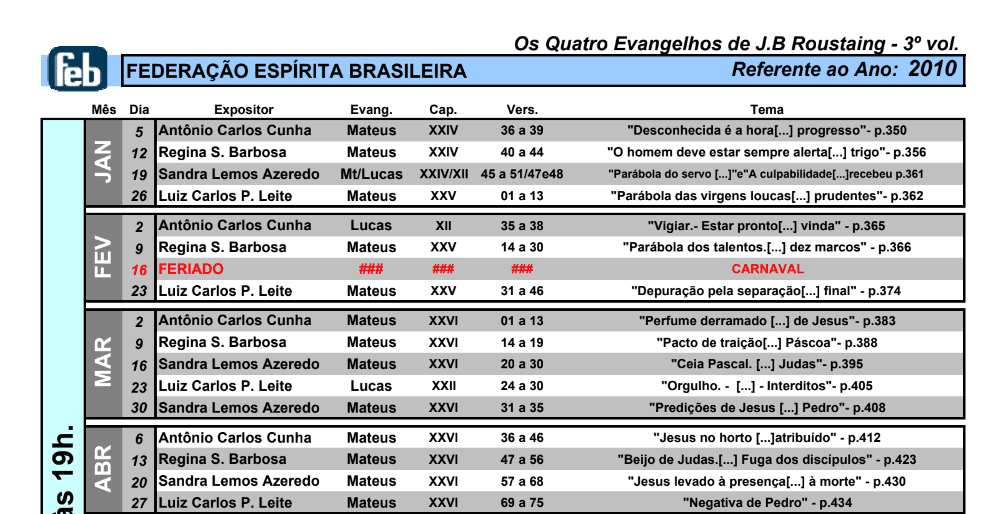
We could extend this article at length, demonstrating that the presidents of this institution have always been Roustainuists; that the FEB, as read in O Reformador, placed Roustaing above Kardec several times; that FEB, at the beginning of the 20th century, published the work The Gospels, by Roustaing, bringing, in the preface, a true affront to Kardec, Spiritism and confessed Spiritists. We will leave this observation to the dear reader, who will find material available here, largely obtained from the FEB website itself (on Google, search like this: “site:febnet.org.br Roustaing”), proof of what we now say. We limit ourselves to highlighting the following image, obtained from a document from the FEB website:
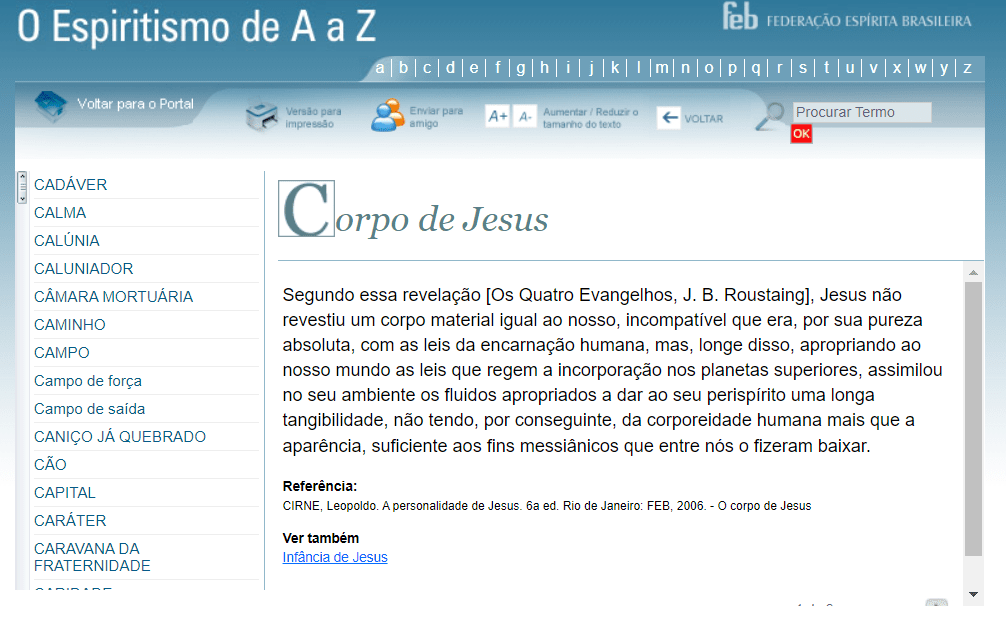
It is also important to highlight that, in the FEB domain, there is a glossary, “Spiritism from A to Z”, containing an explanation of terms and words — in the light of Spiritism, obviously? No. In the shadow of Roustaining:
We will, however, focus on evaluating the effects of a Spiritist Movement formed by the FEB:
Spiritists who are unaware of Spiritism; spiritists who are afraid of Spirits; spiritists who do not evoke the Spirits, questioning the obviously misleading communications; spiritists who blindly believe in the communications of Spirits, accepting everything as a “doctrinal complement”; spiritists who do not practice mediumship at home, believing that this would attract obsessors and that – an absurdity – only in the spiritist center would they have protection from good Spirits, if they did not go to the homes of well-intentioned people; spiritists, in short, who reproduce various false ideas, gleaned from blindly accepted communications and the opinions of idolized mediums, causing real embarrassment to Spiritism and giving ammunition to its critics.
We should mention that, among these idolized mediums, is Divaldo Franco, who, in the words of Augusto dos Anjos:
Divaldo Pereira Franco, the first centenarian, made the statement to me personally more than once that there is no way to explain the Gospels except in the light of the “Revelation of Revelation”. Would it be a reserved position, just for my private knowledge? Of course. First of all because good men do not have to, under any pretext, form dubious positions, one public and the other for private friends. This aphibological behavior does not belong to spirits of good morals. Afterwards, because the esteemed Bahian medium has already made the same statement from the platform, at the top of his lungs, from the height of authority and resounding that we recognize in him and that have served so much to the spiritual enlightenment of all of us, spiritists from Brazil and outside Brazil . To prove this, I transcribe below, «verb ad verbum», the most recent words of Divaldo Pereira Franco spoken from the top of the rostrum of the Grupo Espírita Fabiano (one of the most serious and well-oriented groups that exist in Guanabara), in night of October 6, 1969, with the auditorium being overcrowded as usual. Here is an excerpt from the memorable speech, recorded on magnetic tape, with the speaker's knowledge:
“For many years I didn’t understand. I went to Roustaing, which is my inexhaustible source of evangelical study! For almost twenty years I have been reading the benefactor João Batista Roustaing, meditating on his little words, on Mrs. Collignon's beautiful information, coming from Spirituality. But it’s a wonderful interpretation!”
ANJOS, Luciano dos. One taste and 4 cents. Reformer, Rio de Janeiro, p. 9-11, Jan. 1970. Extracted from the book The Zero Position.
Unfortunately, this was not the only case of an idolized medium or his psychographics defending the figure of Roustaing and his ideas, as you will see in this article. We remember that, here, we are discussing ideas, and not judging people.
It is evident that, although not all of the Spiritist Movement is affiliated with the FEB, the tentacles of Roustainuism and mysticism have enveloped the entire Brazilian Spiritist Movement. Unfortunately, these tentacles also crossed the oceans…
Campaign Plan
We see, finally, the “prophecy” made in 1867 and presented in the Revista Espírita of August of the same year, article “Campaign Plan” fulfilled:
Annihilating it is, therefore, an impossible thing, because it would be necessary to annihilate it not in one point, but in the entire world; and then, aren't ideas carried on the wings of the wind? And how to achieve them? You can pick up packages of goods at customs, but ideas are intangible.
What to do, then? Trying to take control of them, to accommodate them to your will… Well then! It is the party for which they decided. They said to themselves: Spiritism is the precursor of an inevitable moral revolution; before it is completely realized, let us try to divert it to our advantage; let us do it in a way that happens with it as with certain political revolutions; By denaturing its spirit, another course could be given to it.
So, the campaign plan has changed… You will see spiritist meetings being formed whose confessed objective will be the defense of the Doctrine, and whose secret objective will be its destruction; supposed mediums who will have communications ordered, suitable for the purpose they propose; publications that, under the cloak of Spiritism, will strive to demolish it; doctrines that will take some ideas from him, but with the thought of supplanting him. This is the fight, the real fight that he will have to sustain, and that will be fiercely pursued, but from which he will emerge victorious and stronger.
The much-desired unity of the Spiritist Movement will not occur through affiliation with an institution that is more similar to the Catholic clergy. No. This, in fact, goes against the plans for Spiritism, idealized by Kardec in the Spiritist Magazine of December 1868 — Transitional Constitution of Spiritism. This unity will only occur among those who, willingly, delve into the study of spiritist science, returning to, after that, practice mediumship at home, in small, harmonious, cohesive groups, carrying out the analysis of communications and evocations. These groups, spread far and wide, collaborating with each other, without any submission to the control of an institution, but rather to the control of the generality of the teachings of the Spirits, subjected to the sieve of reason, they will then be able to return to work on doctrinal development. Not before, not without it.
Therefore, we highlight the need the formation of study groups – at home, over the internet, at the spiritist center – for the dedicated study of Kardec’s works unadulterated and contextualization works. We leave here our modest collaboration in this regard: Semear Project — Formation of Study Groups.
On the day that the Brazilian Spiritist Federation accepts its deviation, committing itself to reparation and withdrawing from the purpose of determining the direction of Spiritism in Brazil, we will once again value it. Not before, not without this.
Karma does not exist: the laws of the soul according to Spiritism
According to the original work by Allan Kardec, Heaven and Hell, before adulteration ((The original work, from Editora FEAL, can be downloaded by clicking on here )), the laws of the soul are simple, logical and completely consistent with divine goodness. There is no karma, law of return, etc.
Briefly:
Happiness and Unhappiness
Joy, pain, pleasure, fear, sadness are emotions generated by physiological reactions. Good and bad Spirits pass through all of them, so that one can be good and be sad or bad and be happy.
Happiness and unhappiness are conditions of the Spirit. Happiness is being in good — the only thing that exists in Divine Creation — corresponding to being in a state of collaboration: learning, assisting, helping, teaching.
True charity, therefore, is doing good out of moral duty, without expecting a return or trying to control the result. That is why Kardec says that the motto of Spiritism would be “outside of charity there is no salvation”.
The problem is that the error persists
In the development process, making mistakes is part of it, coming from choice, from trying. The problem is persisting in the error, willingly.
When the individual persists in error, because he enjoys his false ideas, he moves away from good. Pride, selfishness and all other imperfections arising from them arise. Not everyone does this.
By repeating the error, the individual acquires an imperfection that settles in them. Far from the good, where happiness exists, he becomes unhappy, as he cannot find satisfaction. He may be happy, distracted by material things, but he is not happy. Not infrequently, he even commits suicide…
It is in this state that evil exists, and only in it: for the individual far from good, WHILE he is far from good.
Conscience: our only judge and executioner
The divine law is engraved in our consciousness (The Spirits' Book, q. 621). The individual remains in this state, knowing that they are making a mistake, but ignoring their conscience, for more or less time, until it awakens for some reason.
When conscience awakens, remorse comes, the awareness of having made the mistake. This causes great moral suffering and, even worse, when people make mistakes voluntarily.
The moral suffering caused by remorse lasts as long as the Spirit refuses to sincere repentance. It can last centuries.
Repentance leads the Spirit back to happiness
When the Spirit sincerely repents, moral suffering ends and happiness resurfaces with the will to return to good, with decision. The need for repair arrives.
Repair consists of CHOOSING a new incarnation, with certain tests and opportunities, aiming to overcome the imperfection created by one's own will. This is atonement, and is therefore not a divine punishment.
Repairing does not NECESSARILY mean being reborn with your victims, as they may already be long gone, while you were left behind, attached to the error. To repair is to correct the deviation taken, in the effort of detachment.
In this way, we see that autonomy and free will are the only rule of divine law. Everything according to our choices and our time, within divine law. But the Law determines that we will all achieve happiness, without exception.
Teachings of Jesus
We see, then, the figure of the parable of the prodigal son: despite the father's warnings, the son goes to the world of pleasures. He loses everything, becomes remorseful, suffers, regrets and then returns home, humiliated...
His father welcomes him not with a punishment, but with open arms, AND STILL HAS A PARTY, and then RESUMES WORK. Your son has already had the punishment, caused by his own conscience, true judge and executioner of ourselves.
Jesus always demonstrated a God of full love, not a God of revenge. It was like that with the thief nailed to the cross next door, it was like that with the adulterous woman and with so many others...
Spiritism, as a result of spiritist science, only reinforces what Jesus already demonstrated: there is no karma, there is no punitive God. The punishment is carried out by the individual himself, for deciding to move away from good.
True Spiritism does not teach karma, it does not judge the individual's past based on their present physical suffering, it does not affirm that physical suffering is deserving or repaying debts.
Recommended Books
– Heaven and Hell, from FEAL (unadulterated edition – link in bio)
– Autonomy: the untold story of Spiritism, by Paulo Herinque de Figueiredo
– Neither Heaven nor Hell: the laws of the soul according to Spiritism, by Paulo Herinque de Figueiredo and Lucas Sampaio
Photo by Olga: https://www.pexels.com/pt-br/foto/mulher-de-vestido-amarelo-em-pe-no-campo-de-flores-de-petalas-rosa-1146242/