I have just responded to an objection related to the topic of Science versus Spiritism (the subject wanted to impute Spiritism to the imagination). I found it interesting to reproduce it here:
“"X, it's clear you're talking about what you think is true, that is, you're speaking from your own opinion. That's not science. You probably don't know that Science (with a capital "S") was formed alongside metaphysics, and that the great geniuses of the past were also great philosophers, addressing the question of God and Creation, but distanced from dogmatic and retrograde theology. Naturally, Science, becoming as dogmatic as the Church, turned its back on metaphysics, labeling as superstitious, mystical, or crazy anyone who dares to touch on the subject of God or spirituality, even rationally. Well, my friend. That's precisely what those who started the [scientific field] did." Rational Spiritualism, in the 19th century, and that was precisely what Kardec did in the study of certain phenomena that, despite crossing humanity, were treated in a dogmatic way, both by the Church and by Science.
What modern Science does not realize, because it has forgotten this knowledge, is that, by acting as it does, it acts like the Church. While the latter led man by the dogma of the fall through sin and punishment, the former leads man by the dogma of materialism. Both one and the other make him absent from his responsibilities: the latter, because it subjects man to the will of third parties — he acts bad through the influence of the devil and he acts well through the influence of Christ — and the first because he becomes man is this machine that acts in this or that way simply by force of sensations, acting chemically on his brain ((not excluding from here, of course, the influence that “body chemistry” and even genetics have on the individual. Just highlighting- If they are not the only factors, why, when faced with a great temptation, the individual can choose, by his will, not to give in to it.)). They fall into the same error as certain ancient scientists, who attributed good and bad behavior to white bile and black bile. The only difference is that modern science does not treat the psychological with leeches, but with pills.
I said that Science, in the past, dealt with metaphysics, in a rational way (and, of course, not at all mysticistic). It turns out that, for her, a key was missing, just as psychology of the time was missing, which investigated man as an incarnated soul only through the processes of logical induction and extrapolation. This key, which came to give, was Spiritism, not this false “spiritism”, gathered between the lines of false ideas, arising from errors and opinions of supposed mediumistic works, but the spiritism studied by Kardec, with methodology, that Spiritism that, more than 150 years ago, advanced knowledge, or paths to it, that modern Science is only now beginning to verify. It is important, of course, to separate the errors, natural to the human side, found in the science of the time (such as the theory of fluids), from the successes of the part that concerns natural law. What Kardec did was investigate the causes of certain effects, from which he deduced a Doctrine, which touches not only on the issue of certain material phenomena, but which is entirely moral in aspect.
The researcher and scientist who had the good faith to investigate the works “O Céu e o Inferno” and “A Gênese” (taking care to refer to the recent editions of FEAL, where we are sure that they are the original works of Kardec, untouched) would find, with great surprise, something very different from what they thought Spiritism was, and, however much they might end up disagreeing, by imputing whatever it was to Kardec, they could not conclude this study without realizing that he launched very seriously into this research, which constituted something that, contrary to what you think, was not a religion.”
New Horizons
In the first half of 2021, I had — and I don't even remember how — contact with the work of Simoni Privato — The Legacy of Allan Kardec — a work that shook me a lot, given the understanding of everything that happened with the French Spiritist Movement, after Kardec's death, and how much this defined the direction of this movement in the following century, especially in Brazil. Then, “by chance”, someone posted, in a group, a question about a recently released work at the time: “Neither heaven nor hell”, by Lucas Sampaio and Paulo Henrique de Figueiredo (PHF). The first thought was: it must be absurd. But the title was too challenging to pass up. I decided to research and found an article, on a spiritist blog, talking about the work... And, to understand what the bases of what the authors were saying were, I acquired and read the work, with great avidity, I must confess.
. Demerit? None. I studied what was within my reach. Humiliation? Only if I thought that the truth was just what I knew and that, outside of that, nothing would exist. But if there's one thing I knew about Kardec, by tradition of studying The Spirits' Book with my father, it was his great commitment to the scientific search for the truth, which was the reason that instigated me to study, without attachments. But… Study what? I already knew most of the Spirits' Book. The essence of The Mediums' Book, too. I mean: in the face of what was within my reach, the moral and scientific essence seemed to me to be well understood.
A fact that caught my attention and that perhaps intuition reinforced is that there must be something important in this “Spiritist Magazine”, since these authors often resorted to very pertinent and insightful quotes from Kardec or Spirits, contained in these volumes. Thus, this initiative and our study group were born… But you probably already know all of this. That's not the point, I just thought it would be interesting to demonstrate, once again, the path I've taken so far, as this path is taking me to places I've never visited before.
A very important fact that happened in this trajectory was the approximation with the Grupo de Estudos Espiritismo para Todos, which happened because, in contact with Paulo Henrique, he himself referred me to someone from that group, who studied with him the works of Kardec and its scientific context. Then came the knowledge of Rational Spiritualism, which we have discussed here several timesand, more recently, a massive in-depth study of Kardec's entire context, which is unknown today. Metaphysics, something unknown or disconnected from current science, was an elementary part of any scientist's studies at the time, and it was this, along with everything that science provided at the time, that made the formation of the Spiritist Doctrine possible.
In the same way that Science itself has as its object the study of the laws of the material principle, the special object of Spiritism is the knowledge of the laws of the spiritual principle. Now, as this last principle is one of the forces of nature which incessantly reacts on the material principle and reciprocally, it follows that the knowledge of the one cannot be complete without the knowledge of the other; that Spiritism and Science complement each other; that Science without Spiritism is unable to explain certain phenomena resorting only to the laws of matter, and for having dispensed with the spiritual principle, it finds itself in the midst of so many difficulties; that Spiritism without Science would lack support and control and could make mistakes. If Spiritism had arrived before scientific discoveries, it would have failed, like everything that happens before its time.
KARDEC, Allan. The Genesis, 1868
It's impossible to describe everything we've studied so far in this article alone. The reader who follows us will be able to identify when reading the texts on this site, various suggestions and clues that we often give and that it is up to each person whether or not they want to investigate. The fact is that we are reaching a point, following the studies of our friend Paulo Henrique, where my first questions are beginning to be answered: is it possible to return to Spiritism, studied scientifically, as Kardec did? Is it possible to resume contact with the Spirits, continuing the formation, or even the doctrinal recovery? Indeed, it is possible (and I write this with a smile on my face).
Have a look: Kardec had understood and advanced on scientific points that we had never suspected, and this could be verified through a method that will soon be made known to us and to the dear reader, because the interest is to present it to humanity. Not just the method, in fact, but the knowledge found through it. In my study with PHF, where this knowledge is being developed, I could feel nothing but very diminished compared to Kardec. I felt ignorant of my previous understanding of Spiritism. With each new realization, I laughed, but it wasn't a laugh of disdain or sarcasm: it was a laugh that was impossible to contain, expressing my level of ignorance in the face of the size of Spiritist science, formed by Kardec's studies through years of learning from the Spirits.
We already know (and if you don't, hurry up and read the Spiritist Review) that when we learn from the spirits, we can't treat them as revelators to whom all we have to do is ask and they'll answer with the theory ready. No.
“… in the world of spirits a very singular fact occurs, which surely no one had suspected – that there are spirits that do not consider themselves dead. Well then: the superior Spirits, who know this fact perfectly, never came to say in advance: “There are Spirits who suppose they still live in terrestrial life; preserving their tastes, habits and instincts”. Instead, they caused the manifestation of Spirits of this category so that we could observe them. Thus, after seeing Spirits who are insecure about their state, or claiming to belong to this world and carrying out their usual occupations, the rule can be deduced from the example. The multiplicity of similar facts proved that this is not an exception, but one of the phases of spiritual life, allowing us to study all the varieties and causes of this singular illusion, in addition to recognizing, above all, that this situation is typical of Spirits who are not yet morally advanced, and characteristic of certain types of death; which is only temporary, but can last days, months and years. Thus, the theory was born from observation. The same happened with all the other principles of the doctrine.”
KARDEC, Allan. Ibid.
It's easy to see, therefore, how much knowledge these studies require and, in a century where each area is niche, that is, where the physicist doesn't study philosophy; where the mathematician doesn't know botany; where the chemist doesn't know astronomy, and where none of them know metaphysics, it's even easier to understand the difficulty we face. I recognize that adventuring in these studies is not for everyone, and I can only behave like a goose (because I don't want to compare myself to a hen, that would be too humiliating), chasing the crumbs that fall from the hands of the one who planted and who now reaps the grains of the plantation.
Well, as I was saying, new horizons are opening up and everyone who is interested in learning and spreading knowledge can and should throw themselves into their studies in whatever way they can. It's difficult to gather all the lessons learned in order to take up the scientific study of Spiritism in our own hands, but who says we need to be as brilliant as Einstein to understand the essence of the laws of our universe, as demonstrated by this great genius? We can behave in the same way with Spiritism: all it takes is dedication, putting our minds to work and, on our part, researching, questioning and delving into everything that seems nebulous to us. The most important thing of all is that we are not alone: in a group, construction becomes much more fruitful, as each person, being in a position to help and be helped, assists and participates in the construction of knowledge. All that we need to do is get out of the position of being teachers of Spiritism.
We ended our last study with Paulo saying something more or less like this: “if this knowledge is so interesting and transformative for us, who are ignorant, imagine for those who are intelligent!”. Yes. Imagine what it would be like for a mathematician to discover that Spiritism talks about mathematics. Imagine what it will be like for the physicist, the chemist, the doctor, the philosopher, to realize that, in Spiritism, it is all about this, with moral aspect and without mysticism? From what can everything be deduced from Natural Law, and what is Spiritism about?
But, to achieve this, it is necessary to overcome some barriers created by materialism, not only in science, but also within the spiritist movement. Firstly, it will be necessary to demonstrate that modern science, by turning its back on metaphysics, has become as dogmatic as the Church which, in the past, treated as a heretic anyone who stated that the Earth revolved around the sun, or that it burned. witches” for claiming to be hearing or seeing Spirits. Then, it will be necessary to demonstrate that what they think is Spiritism — often based on absurd things they read out there, other times based on what acquaintances present to them, so-called spiritists, but dogmatic and walking on false ideas, or even false confusion between Spiritism and modern, mystical, superstitious and also dogmatic spiritualism — it will be necessary to demonstrate, I said, that this is not Spiritism. It will be necessary to demonstrate that Spiritism was (is) something so rational and serious, an undeniable fact, that, more than 150 years ago, it advanced truths that Science is only now confirming. Finally, for those who reach this point, through the use of common sense, it will be necessary to demonstrate that Spiritism, as a science very well established in its time, was formed in the same way as all other sciences of observation, being, therefore, rational — as rational as the search, in current physics, for the existence of dark matter or the existence of other universes, guided by effects whose causes are not, and may never be, directly observable. Here's the challenge.
I needed help, and, despite the predominance of Catholic religious culture, I found some volumes of the Spiritist Magazine on the shelf! No. I opened it and leafed through it, but at that moment I didn't go any further. It was necessary to pass the trouble, to, only later, give attention to such work, through the process explained above. It is natural for everyone to follow their path, and we must respect each other's choices. Perhaps those who cling to and close themselves off from knowledge believe that they are doing good, just as many of those who burned scientific works believed that they were doing what was right (which does not exempt them from their responsibility, but which mitigates their faults, before their consciences). Let us present the knowledge if we wish, but if they wish to burn it let them be while we do our part. Time takes care of everything.
Well, I've written a lot. I stop here for this moment. I need to harvest some grains that were left along the way.
Spiritism without Kardec?
At the doors of the 21st century, it is difficult to see how the spiritist movement intends to do Spiritism, after having forgotten, modified and misrepresented the work of Allan Kardec. After 154 years of Professor Rivail's disincarnation, it is very common to find so-called spiritist literature in which, in very few cases, only images of Kardec remain on sensationalist and advertising covers.
Spiritist philosophy has a method, for study purposes, it has principles or fundamentals that are impossible to separate if we try to practice it; here is the cause of such frequent errors. Faced with such a scenario, we ask ourselves:
Would it be possible today to practice, disseminate, study Spiritism, leaving aside the concepts systematized by Denizard Rivail? Is there spiritism without Kardec?
We believe that returning to Kardec, studying Kardec through Kardec, educating the mass of Spiritism followers on the need to practice this philosophy from its bases are urgent issues and necessary development, because in this and many other ways we would adopt measures against a movement that it has lost the identity of the Doctrine it supposedly practices, which it supposedly disseminates. It is an indispensable measure in the face of a movement that has been confused by a sea of opinions, distorted by waves of figures in sales of books and magazines, mistaken in the exaltation of men and women who were nothing more than imperfect mediumistic instruments like all the others. others. Dear brothers, there is the work of that man firm in his determinations, there is the logical and reasoned guide, the bases that we need to develop. The starting point of a destination full of freedom. Let's use it!
Let's walk together, and finally rescue, once and for all, Kardec's legacy without which there is no possible Spiritism.
Is there any other way to verify the existence of the soul without experiments?
The question was proposed in a discussion, on Facebook, regarding science's resistance to investigating the soul, attributing the matter to mysticism and the supernatural. I highlight below my considerations on the possibility of verifying the existence of the soul:
Tell me: is the atom observable? He will say yes, that's it and a fact: by means of an instrument, it is possible to observe the atom, whose behavior investigation leads scientists to theorize in several hypotheses.
Without the microscope, in the past, man, certainly, I would say that this is madness or supernatural. The point is always to attribute to the supernatural what we do not understand: that is the point.
Are we like that, so knowledgeable about everything, to the point that we can discard the body as an instrument of the soul?
Unfortunately, due to a materialist turn in philosophical paradigms, after the end of the 19th century, many truths were forgotten. Today, when we talk about Psychology, we don't quote Victor Cousin or Paul Janet; when the subject is quantum physics, nobody talks about Mesmer, who, labeled crazy in the past, envisioned theories in agreement with modern physics.
The mistake, always, is to associate Science only with what is observable, forgetting that scientific investigation also advances through the elaboration of theories based on hypotheses based on rational observations. Want to see?
“Dark matter is a hypothetical form of matter that scientists believe exists in the universe due to astronomical observations. It is called “black” because it does not emit, absorb or reflect light or other forms of electromagnetic radiation, making it invisible to our telescopes.
Dark matter is believed to make up about 85% of matter in the universe, but has yet to be directly detected. Scientists infer its existence from the gravitational effects it causes on observed objects, such as galaxies and galaxy clusters.
Although many studies and experiments have been carried out to try to identify dark matter, its nature is still unknown. Several hypotheses have been proposed, including as yet undetected exotic particles, primordial black holes, and alternative theories of gravitation. Dark matter research remains one of the most important and intriguing areas of modern physics and astronomy.”
Would we say that scientists are crazy, chasing something that cannot be observable by our instruments (and may never be) simply because they observed certain effects? Starting from the common census, could we say that dark matter would be something supernatural?
And this is not to enter the scope of theories of parallel universes, which are a logical consequence of some theories of quantum mechanics.
You see: science seeks answers in something unobservable, based merely on effects. Seeks the cause of an effect. And is it really that the effects, in the human scope, are unobservable - or is the tendency to treat any form of spiritualism as mysticism or the supernatural just a prejudice in a field where prejudice should not enter?
Paulo Henrique de Figueiredo says, in “Mesmer: the denied science of animal magnetism”:
The magnetizers very soon proved the relationships of somnambulists with invisible beings. Deleuze, a disciple of Mesmer, in his correspondence maintained with doctor GP Billot for more than four years, from March 1829 to August 1833, was initially reluctant, but finally affirmed: “Magnetism demonstrates the spirituality of the soul and its immortality; it proves the possibility of communication between intelligences separated from matter and those still connected to them.” (BILLOT, 1839)”
[…]
In turn, Deleuze stated: “I see no reason to deny the possibility of the appearance of people who, having left this life, take care of those they loved here and come to manifest themselves to them, to give them healthy advice. I just had an example of this.” (Ibid.)
[…]
“Years later, the magnetizer Louis Alphonse Cahagnet (1809-1885), with courage and determination, spoke to the spirits through his somnambulists in ecstasy, mainly Adèle Maginot, recording in his work more than one hundred and fifty letters signed by witnesses who recognized the identity of the communicating spirits. Cahagnet anticipated this spiritist science research instrument by more than ten years.
We see, therefore, that the soul is as observable as dark matter: through its intelligent effects. The difference is that the Spirit (synonymous with soul) acts of its own will.
Rational Spiritualism and Spiritism – a new division in the Spiritist milieu?
It seems that some Spiritists – those who did not understand the proposal of Spiritism – work by division, and not through collaborative construction. They find in every place and in every person an object of their criticisms which, although they may have some basis, are almost always lost due to the notorious lack of depth and of a real and solid argumentation, which presents point and counterpoint, not giving final judgment on nothing that cannot be proven or sufficiently elaborated by reason. Interesting, because, precisely, they are (we are) supporters of a Doctrine entirely based on logic and reason, where evidence and hypotheses corroborate theories, without giving ownership over the truth. Not acting like this, Carlos Seth Bastos, from the “CSI of Spiritism”, comes to say that the theme of Rational Spiritualism and Spiritism would be a new division in the spiritist movement, without having the courage (or the will) to mention the name of the author to whom it refers. refers.
History repeated itself between 2016 and 2020 now in the field of morality, with the release of books that sought to bring the thoughts of Kant, Maine de Biran and Victor Cousin into Spiritism, even if that meant distorting the ideas of Allan Kardec.
Its propagation, under the pretext of convincing people averse to religion, seems to us the same speech as Marius George (Surprised that the spiritist idea had recruited so few adherents from the army of republicans, he was finally led to see that the obstacle was entirely due to the disguise under which Allan Kardec had introduced him) and Émile Blin (Until we have brought to the Parisian Society a sufficient number of members to enter this path of research, we must, in order to see our ranks increase, invite to come to us the unbelievers and the unbelievers to, by word, let them know our intentions, prove to them our disinterest, and persuade them of our good faith and honesty; then, by experiments as simple as possible, to place in their hands the means of acquiring for themselves the certainty that everything we propose is real and, in fact, the immortalist doctrine is the only one that, without mysticism and without prayers, gives man consolation and courage in the present, and hope and faith in the future).
At least these speeches were not based on the fallacy of an improbable adulteration of Allan Kardec's works.
In the first place, it is important to point out that Spiritism is not divided. Being a natural truth, it is one. Putting aside the difficulties encountered in communications made without control, Spiritism is one, at all times. What, yes, can be divided, is the Spiritist Movement – and this division is countless. Over time, after Kardec, it split with “roustainguization” and then with countless others, for various reasons that cannot be mentioned here, but which Simoni Privato, Paulo Henrique de Figueiredo and Wilson Garcia, among others, recount well in their works (see Recommended Works).
According to Carlos Seth, “head” of the CSI of Spiritism, the division now occurs in the moral field, because Paulo Henrique de Figueiredo – the author of the aforementioned works, from 2018 and 2020, to whom Seth does not even deign to make reference – would be distorting Kardec’s words to implant, in the Doctrine, something that has nothing to do with it. We'll see.
Secondly, it is important to address the sentence “on the pretext of convincing people averse to religion”. As if making legitimate and well-founded efforts to attract the interest of “people averse to religion” were a demerit, since (1) Spiritism is not a religion, (2) it developed from a science, as a science and (3) it was precisely in the non-religious milieu that it found, at its origin, the greatest adherence – precisely because a large part of the scientists who became followers of Spiritism were well penetrated by the development of Rational Spiritualism and its scientific findings.
The author ends by again attacking those who, based on other evidence and logical and rational arguments, conclude that adulteration is likely ((The theory of non-adulteration (from Heaven and Hell and Genesis) also has evidence and arguments, but does not present conclusive proof. It takes on one fallacy to attack another (as it defends), forgetting Kardec's valuable suggestions: never take as final anything other than what can be proven.))
Kardec defended Rational Spiritualism, but Seth doesn't seem to know that
First of all, however, we need to evoke Kardec and question why he defended Rational Spiritualism – a philosophical-scientific movement led by people like Maine de Biran and Victor Cousin ((By A + B, if Rational Spiritualism was officially established in French teaching and if it was a solid movement, founded mainly by the authors cited, it is easy to conclude, with certainty, that Kardec refers to the same movement, and not to any other)). Now, we see, in the Spiritist Review of 1868, that:
The work of Mr. Chassang is the application of these ideas to art in general, and to Greek art in particular. We are happy to reproduce what the author of the Patrie review says about it, because it is further proof of the energetic reaction that takes place in favor of spiritualist ideas and which, as we said, every defense of rational spiritualism opens the way to Spiritism, which is its development, fighting its most tenacious adversaries: materialism and fanaticism.
“This book, of a very special character, was not made during the recent debates on materialism and, without the slightest doubt, it is regardless of the author's will that circumstances have given it a kind of topicality. Writing it, Mr. Chassang did not intend to do work of metaphysician, but simply literate. However, as the great questions of metaphysics are currently, as always, on the agenda, and every literary work truly worthy of the name always presupposes some philosophical principle, this book, of a very decided spiritualist inspiration, is found in correlation with the concerns of the moment.
KARDEC, Allan. Spiritist Magazine, November 1868
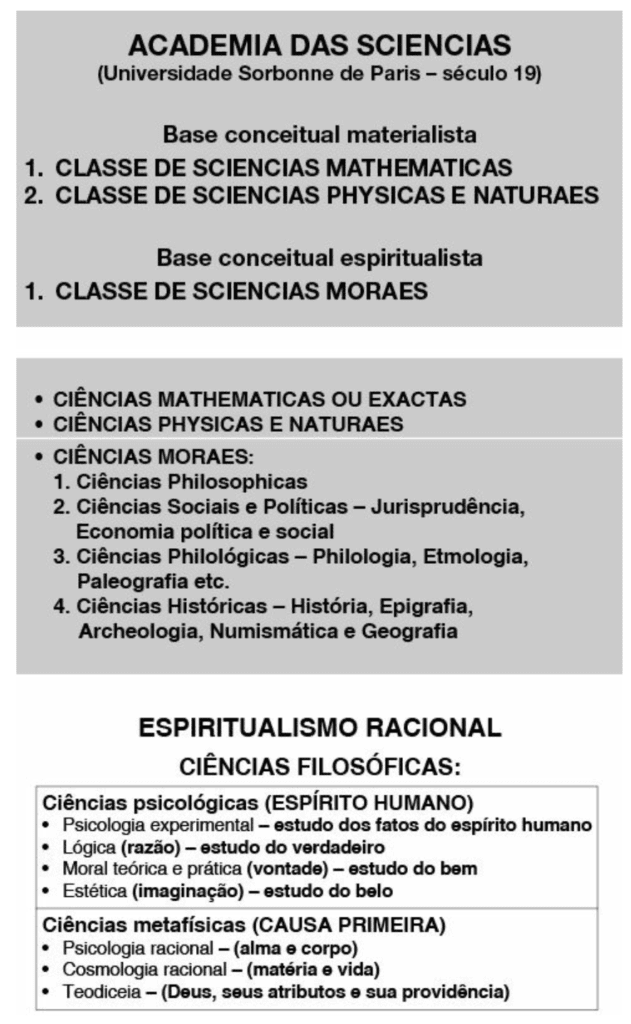
Since metaphysics was one of the fields of study of the philosophical sciences, officially Instituted at the University of the Sorbonne:
Image extracted from the Elementary Treatise of Philosophia, by Paul Janet
And that's not all. Before that, in 1863, Kardec says, in the article entitled “Bibliographical News – The rational spiritualism by Mr. G.H. Love, engineer”:
This remarkable and conscientious book is the work of a distinguished scientist, who proposed to draw from Science itself and from the observation of facts the demonstration of the reality ofspiritualist ideas. It is one more piece in support of the thesis that we support above. It is even more, because it is a first step, almost official, of Science, in the spiritist way; in fact, it will soon be followed - and of this we are sure - by other, even more resonant adhesions, which will lead deniers and opponents of all schools to seriously reflect
KARDEC, Allan. Spiritist Magazine, October 1863
What nonsense, Mr. Kardec! Defending ideas that, according to some, have nothing to do with Spiritism! Claiming that Rational Spiritualism, which he refers to in the text merely as "spiritualist ideas" (which leads us to believe that in other similar references—"spiritualism," "spiritualists," etc.—he was referring to the same Rational Spiritualism) is something obtained through scientific observation of facts! Now, where have you ever seen science and spiritualism go hand in hand? Only in the past, during the time of the "crazy" Kardec.
The biggest nonsense, in fact, is that of Paulo Henrique de Figueiredo, who decided to investigate in depth and discovered that metaphysics, at the time of Kardec, was one of the areas of study of the Moral Sciences officially taught at the University of Paris and also at the Normal School (refer to “Autonomy: the never told story of Spiritism”, by this author). All this contained in works that, until then, were unknown or forgotten by the modern world.
The great difficulty, however, will be that all of us, who follow the work of Paulo Henrique and himself, will have to deny reality, deny historical documents and existing works, censor the works of Paul Janet, deny Kardec, deny his conclusions and his statements, all so as not to cause a new split, “now in the moral field”. In other words: let us erase and adulterate the truth, so that morality, as they understand it, remains untouched. Well, this desire to take the truth for oneself, ignoring facts, seems like a habit of the WArlos seth Iinvestigates Spiritism, as we demonstrated in the article “CSI of Spiritism: the official organ of Truth“".
We also need to evoke the Spirit of Mr. Love and have a serious conversation with him, in order to clarify his audacity in, being a rational spiritualist, affirming that he found the same moral obtained in his observations, precisely in “Kardec’s” Spiritism:
Morality, as I understand it and deduce it from scientific notions - I am not afraid to admit it - has numerous points of contact with that transmitted by the mediums of Mr. Allan Kardec. I am also not far from admitting that if there are many pages written by them that do not go beyond the ordinary reach of the human spirit, including theirs, there must be, and there are, of such a scope that it would be impossible for them to write identical ones in the books. your ordinary moments.
LOVE, GH apud KARDEC, Allan. Spiritist Magazine, October, 1863.
I don't think it's necessary to go any further. I leave the reader the freedom and the task, if he so wishes, of seeking to obtain information that will allow him to arrive, through his own reasoning, at his answers. I would just like to quote Carlos Seth once again:
The spiritist doctrine is progressive, but your study is the key. Let us know how to wait for new data instead of rejecting some of its aspects, such as the action of Spirits in natural phenomena. If, even so, a certain characteristic, such as the religious one, bothers us to the point that we are unable to put it aside, let us stop being Kardecist Spiritists and then follow any other sects originating from the original Spiritism. Despite recurring in history, This is what we are witnessing once again today with secular, eclectic and syncretic people.
BASTOS, Carlos Seth. Ibid. My emphasis.
Oh, if Mr. Carlos had followed his own teaching and studied. If I had known how to wait, before jumping hastily to foolish hasty conclusions... I would have seen Paulo Henrique affirm, in Spiritist Revolution, how evident it is that Spiritism complements and develops what Rational Spiritualism was unable to study, in fact resolving many of its errors , contradictions and uncertainties. Ah, this rush from certain “renowned researchers”…
Why didn't Kardec give more details about Rational Spiritualism?
It should be noted that, to the objection of why Kardec did not give more information about something so important to him, we must answer the following: the same happened with Magnetism, a science that he claims to have studied for more than 35 years. He simply did not delve into something that was so deeply established in its context, in the same way that, today, to talk about astronomy, we do not dedicate time to narrate the entire current scientific context, limiting ourselves to talking, for example, of the theory of Big Bang. If, by chance, this theory were put into oblivion, because it was outdated or because of the adoption of another theory, not necessarily correct, any reader, in the future, would need to seek to recover this knowledge in order to better understand our theories, assumptions and doctrines.
I should just mention that, when pronouncing on the case, I am asked for evidence that Kardec would have, as I said, widely defended Rational Spiritualism. Here's my answer:
X, if the authors of the article (PDF), willingly, had dedicated themselves to studying the work of this author, before criticizing, they would have understood this whole context very easily, so that I would not have to repeat all the information here that already exists.
I've already mentioned one of the times Kardec emphatically cited "Rational Spiritualism," stating that any defense of it would be favorable to Spiritism. In October 1863 (RE), you'll find two very interesting articles on the subject. I quote the beginning of the second, at the end of the issue ("Rational Spiritualism by Mr. G.H. Love, Engineer"):
“This remarkable and conscientious book is the work of a distinguished scientist, who set out to extract from Science itself and from the observation of facts the demonstration of the reality of spiritualist ideas. It is one more piece in support of the thesis that we support above. It is even more, because it is a first step, almost official, of Science, in the spiritist way”.
Go to Google and type in: “site:kardecpedia.com spiritualism”, and you will find a lot.
Well, if Kardec was talking about fluids (vital, electric, magnetic, etc.) isn't it up to us to investigate what that is, instead of blindly adopting wrong theories? Let's then verify that it was a concept of the science of the time, surpassed by current science and, by all indications, abandoned by Kardec, after becoming convinced of the veracity of Mesmer's theory. Without doing this, I fall into the error of saying that Mesmer and Spiritism have nothing to do, not knowing that Kardec ALSO defended Mesmer's Magnetism.
After all, what line of research is this, to which they want to give so many airs of seriousness and confidence, but which makes such a serious and absurd error as such, with the aggravating factor of giving final sentences on this or that subject, influencing the spiritist environment? towards a new split that only exists in their minds, attached to an initial disagreement ((I'm referring to the disagreement between whether or not there were adulterations in the works Heaven and Hell and Genesis))?
Those who act in this way end up being ridiculed and discredited. Not that we are not free, on our part, from making similar or worse mistakes, but the study of Spiritism and Kardec's scientific approach has helped us a lot in this sense.
The monopoly of common sense
I will end with an observation by Kardec, made about the article “The Librarian of New York”, in the Spiritist Magazine of May 1860. It is not related to the main theme, but, who knows, it will serve as a reflection. The italics are mine, as always:
About the article, we will make a first observation: it is the indifference with which the deniers of the Spirits attribute to themselves the monopoly of common sense. “The spiritualists, says the author, see in this one more example of the manifestations of the other world. sensible people will not seek the explanation so far and recognize clearly the symptoms of a hallucination”. Thus, according to this author, only people who think like him are sensible; the rest have no common sense, even if they were doctors, and Spiritism counts them by the thousands. A strange modesty, indeed, which has as its maxim: no one is right but us and our friends!
KARDEC, Allan. Spiritist Magazine, May 1860
The documents they found, corroborating a hypothesis of non-adulteration, they are, according to them, probative, they give final sentences – even though they are nothing more than evidence that does not explain many things. Beyond that, according to them, everything is disposable, fallacy or invention.
Questioning is natural, healthy and necessary. He encourages us to research, to reread, to study. But it would be even more productive if the dissenting opinion were always born from a deep bibliographic and scientific basis, so as not to end up like Messrs. Schiff and Jobert (Revista Espírita, June, 1859) who, having discovered in the snapping of a muscle confirmation of one hypothesis, ended up stating categorically, with the final word, against all spiritist phenomena. Well, just read the article to see how ridiculous they were when faced with the facts presented by Kardec.
This is science. This is detachment. This is commitment to the truth. For all this commitment, far from configuring it as an attack, but as a defense, I do what they did not do, and I give name and surname to those who frivolously attack the work of others.
Strangely, Seth sees a division when dealing with the movement that gave basis to the emergence of Spiritism, but he sees no problem in poking around and bringing up gossip of the time, launched by mediums who did not want to adapt to what the Spiritist Doctrine demanded. Go figure…
The attack on schools and the “vision according to Spiritism”
I'm going to give myself the luxury of “getting wet”, just because the subject is important and requires, I think, reflection and rationality. The attacks carried out in schools were regrettable, but even more regrettable is hearing the absurdities that speak in the name of Spiritism.
In the face of the events in question, we see again the search for “spiritualist” answers to the reasons why those children went through such tragedies, and it is not uncommon to come across speakers who, in the name of Spiritism, will say that “they are indebted spirits who came together to redeem past faults”. Having overcome the initial moment of true disgust due to the lack of empathy of someone who puts himself in the position of judge of the path of others, without putting himself in the position of a father or mother listening to such words – a real disservice to Spiritism – I feel it necessary to reiterate: no it is possible, much less reasonable, to point to anyone to say whether the situation that the person is going through is the result of their choices – I repeat: choices – or whether it is a simple result of natural law, that is, the result of being alive.
We've covered this a few times already (see Can a person die before his time or is it always fate or fate?, The Petrópolis disaster from the point of view of Spiritism: collective rescue? and Karma and Spiritualism. There is no karma, everything is the effect of the Spirit's choices, which, only in exceptional cases, due to lack of reasoning capacity, is subjected tocompulsorily incarnate (ref. OLE, p. 262). God does not punish his children for making bad choices, because he knows that everything is the result of ignorance, and when that ignorance is so great as to obliterate his ability to judge, his laws make up for this momentary incapacity.
Let's say that participating in certain disasters, private or collective, could even be the effect of a lucid choice of the Spirit who believes that that will teach him something or who believes in the law of talion or karma, judging it necessary to go through the same kind of suffering to in order to "debug". This has its basis in logic and truth, and we will see some cases like this permeating Allan Kardec's studies.
Could all these children have chosen to be there voluntarily, as a result of a choice made in Spirit? Let's assume so, and analyze the logic of the assumption. For that, one of two things: either these Spirits would have to know, in advance, that that individual, practically of the crime, would choose that school where they would have have to study, to commit their crime, premeditated for years, or these Spirits would have to, through themselves or others, instigate this individual to commit a crime (taking on, in turn, a “debt”) just so that they could carry out your “rescue” – a true never-ending cycle.
Yes, a particular Spirit could have premeditatedly foreseeing the crime and managed to be there, to suffer its consequences, who knows why, just as another could have chosen to leave that place, that day, due to the same premonition. We see this all the time. It becomes inconceivable, however, to imagine that all those who are killed in any disaster chose to be there, often months or years before, just waiting for all the aligned circumstances to provoke the situation that would offer the opportunity of “rescue”. Furthermore, when Kardec or other Spirits speak of “rescue”, it is the rescue of oneself, through the process “repentance, expiation and reparation – in short: a serious, effective improvement, as well as a sincere return to the good“((KARDEC, Allan. O Céu e o Inferno. Translation by Emanuel G. Dutra, Paulo Henrique de Figueiredo and Lucas Sampaio. 2021.)), and not a redemption of reciprocal debts or with divine law – because God does not charge debts that, in truth, do not even exist.
Children who died in such tragic cases are not paying for anything. They died as a result of being incarnated and as a result of a bad choice by another individual. This individual, who already suffers as a result of his choices, even if he does not realize it, will suffer when his conscience awakens, either because of a feeling of guilt in the face of the crime committed, or because of the realization of his own condition of attachment, because of the effect of his actions, even who doesn't even remember the specific case in question. Children's Spirits may have already moved on, evolved a lot, by the time the criminal's Spirit becomes aware. There is no need to consider, therefore, a joint incarnation with the aim of any reciprocal rescue, but we can imagine the spirit of one of these children, touched with compassion for the other, choosing be born with him to help him on his way back to goodness. Or not. The spirit of the criminal can choose, if he is aware of it, to be born in the midst of a very good family, with great spiritual values, which can help him to learn... Or he can choose to be born in the midst of criminality, to put himself to the test of resistance. What is better? How to know who and for what reason made this or that choice? I don't know. Neither do you. The point is: any of the choices, for that Spirit, will be an atonement, and “atonement” does not mean punishment, but condition in which he has his “unceasingly concentrated attention on the consequences of this evil, understands its inconveniences better and is motivated to correct itself“((Ibidem)).
If you have already gone through something similar or if you have someone close to you who has gone through it, my message is this: the Spirit survives and will continue its journey. Those who go and those who stay need to make an effort not to get attached to what happened, understanding that whoever commits the crime will suffer alone, and that getting attached to him or the situation will lead you to suffer too. Sadness is part of it. Miss you, hurt. But attachment is unhappiness. Pray that you and the Spirit who passed away will not become attached to all of this, nor the personality that died with the body. Spirits that love each other communicate instantly, without intermediaries, and it is enough for one to think of the other for them to be together, without any need for this to be perceived as a sensation of presence. Thought reaches everything, anywhere in the Universe.
Finally: be careful when accepting “spiritist visions” without studying the foundations of Spiritism. Spirits, incarnated or disembodied, say what they want and, due to carelessness, often serve as a tool for the enemies of the Doctrine.
An invitation to self-criticism of the Spiritist Movement
Our last virtual study meeting, on 04/06/23, was based on the article “Refutation of an article from L'Univers”, from the Spiritist Magazine of May 1859.
Kardec's article begins with a full citation of a publication by Abbot Chesnel in the aforementioned newspaper, a publication that is, by the way, somewhat complex to understand and, in fact, quite confused in its ideas. Despite citing several current ideas at that time, such as Spiritualism, Magnetism and Spiritism (although he confuses Spiritism with Rational Spiritualism), it is very easy to notice the confusion of concepts made by the Abbot, who, as a central point, defends the idea that Spiritism (Spiritualism) would be a new religion, presenting dangers and a threat to the Catholic religion.
The text, although written with some depth, is notably frivolous, in the sense of making several statements about Spiritism (which, I reiterate, he calls Spiritualism), without having read even The Spirits’ Book – which is certain, because, right at the beginning of the work, Kardec makes a clear distinction between Spiritism and [Rational] Spiritualism. But that is not the main point of this discussion.
What we noticed in our study, and about what we had already talked about other times, is the distance between the modern Spiritist Movement and Spiritism "of Kardec" - with great care when using this term, because Spiritism was never of Kardec, neither created nor imagined by him. Now, it is not possible to deny that the Spiritist Movement made Spiritism a religion, a definition that many defend fiercely, while Kardec makes, with all letters, an arduous rational defense to the contrary, demonstrating that Spiritism had no aspect of a religion, but that of a science. We already talked about this in the article “Spiritism is religion?", ”Science and Spiritism: matters in opposite dimensions?“, “The distance between Spiritism and the Spiritist Movement” and on other occasions, but we decided to return to the subject due to the new opportunity provided and the emphatic persistence of Kardec – which continues in the RE of July, with a reply to the Abbot’s response.
The more we study the Spiritist Magazine, the more we notice this enormous distance mentioned. We invite the reader to ask: why? Is "our" Spiritism, based on information from Spirits not verified in a scientific and controlled manner, "more correct" than the Spiritism studied so seriously, in a methodical and controlled manner, by Kardec and other members of the Parisian Society of Studies Spiritualists? Note the following:
Its true character is, therefore, that of a science and not of a religion, and the proof is that it counts as adherents men of all beliefs, who have not, for that reason, renounced their convictions: fervent Catholics, who practice all the duties of his cult; Protestants of all sects; Israelites, Muslims and even Buddhists and Brahmanists.
Kardec, Spiritist Magazine, May 1859
Let's look coldly at the Spiritist Movement and try to find people from other religions inserted in it: they practically don't exist. They are very rare and, almost always, they are people who say they have “no defined religion”. Is this normal, compared to what Kardec demonstrated? Another question: if a Census agent asks you what your religion is and you are a follower of Spiritism, what will you answer?
All these questions are not intended to attack the personal belief of each one (because, in fact, Spiritism is not made of beliefs, but of scientific investigation), but to raise a serious aspect that, perhaps, many do not notice : defining Spiritism as a religion has become the reason for the downfall of the Spiritist Movement, which is increasingly emptied. Read the article quoted right at the beginning – you can find it on here – at least from Kardec’s answer and try to analyze, for yourself, how much the definition of “religion” makes Spiritism lose in reach and help in the development of terrestrial humanity. See the Abbot's position, compatible with the modern position of most of his opponents: instead of understanding in this science support for your beliefs; instead of having it as an aid to their uncertainties, they have an enemy in it, as if the fact of filling the pews of a spiritist center means emptying the pews of a church. Sadly, very unfortunately, this has come to be true.
We are extremely happy to have, among our most active students, at least one person who identifies himself as a practicing Catholic, who goes to Mass, who takes Communion, who practices, in short, his religion, but who studies deeply and who, many times, understands better than us the moral, philosophical and scientific precepts of Spiritism, understanding its scientific character with clear distinction. Spiritism is the science of what we are and what creation is; religion is the choice of human, material practices, with a spiritualist meaning.
Finally, think about the following: while Kardec recommended the practice of spiritist studies at home, which was really common at that time, ask yourself: is there, today, Spiritism outside the centers? What is said about mediumistic practice outside the spiritist center?
Finally, the invitation is reiterated: study the Spiritist Magazine. Many well-known mediums did not have access to it. Today, we have it, and in a very, very easy and practical way. Leaving it aside to study mediumistic novels, without contestation or investigation, is attachment, and brings demerit, difficulties and errors to Spiritism, which, today, in the Spiritist Movement, has nothing.
Join the Study Group of the Spiritist Magazine
Once again, and always with joy, we invite you, dear friend, to participate with us in our Spiritist Magazine study group, live, online. In this group, we are not teaching, but learning. If you are interested in the Spiritist Doctrine, come and study with us!
we gathered every thursday, at 7:30 pm (entering at 19:20), and the study lasts about 1:15h to 1:30h.
You will need:
– Camera and microphone, and a quieter corner to study
– Around 01:15h free
– detachment own opinion and interest in to help, cooperate and learn.
“God will be ahead”; “God will not allow this or that fact to happen”. But then the fact, seen as negative, is consummated. And at that moment, the faith of many falters. “How could God allow such a thing?”, many will ask. We will approach and face this problem in the following lines.
Many, in moments of suffering, injustice, barbarism, fall into this questioning and, without having a concrete answer, see their faith almost crumbling, to the point where they often turn away from religion and spirituality, falling into the grip of materialism. This movement occurs only for one reason: because we are almost entirely based on false ideas. Now the false idea, being false, does not stand against the natural law. It is denied and collapses, before the course of the divine law, no matter our protests. Was this divine impiety? Or, worse, would all this demonstrate that God does not exist?
We talk about false ideas. Well, one of them is that God interferes with our choices. Another is that God would have an opposite, the Devil. Both are linked to the same problem: the false assumption that we are guided, either by God, or by the Devil, or by the “forces”, or by the stars or by the “universe”. It is the false idea of heteronomy, which, created on a philosophical doctrine that dominates society, makes us fall into these moral and intellectual traps.
Therefore, the question arises: is it wrong to reason if this reasoning leads us away from God? Would human science be reprehensible in this sense? I say: the problem is not in reasoning, but in reasoning on false principles. Since man is God's creation, his intellect is also. To deny the intellect, reasoning, would be to deny God. Reasoning is necessary – it is an imposition of the law – and when reasoning leads us to a denial of the law (here, referring to the natural, divine law) and of reason itself, it means that we are basing ourselves on a false idea, which leads to false results.
I will not spend time stressing the impossibility of the existence of a force contrary to God, or even the non-existence of evil. Allan Kardec has already done an excellent and unassailable job in the works Heaven and hell and The Genesis. We recommend the study to the reader, preferably based on FEAL editions. We also recommend that readers who have never studied Spiritism, and who only have inaccurate ideas about this doctrine, read the booklet “Spiritism in its simplest expression”, available for download using the button below.
Let's talk about the impossibility of the interference of God, Jesus or any superior being in our choices, asking: how is any learning really established in ourselves? By imposition, or by the exercise of reason? Of course, the answer can only be the latter, otherwise life itself would be meaningless, and all materialistic logic would be right.
Imagine the situation of a father and his son. The first is the best father we can imagine: centered, affable, sensible, fraternal, but energetic, as well as intelligent and very wise. The second is a rebellious son, with a “strong temper”, as some would say. Despite all his father's efforts, this son insists on making decisions contrary to his recommendations, always ignoring his thoughtful warnings. Once, the son says to his father: “I'm going to a party with Dona Maria's children”, to which the father replies: “Son, be careful. They, unfortunately, do not listen to reason. They are always involved with bad people, with drugs and I heard that, recently, they even got involved in some robberies”. The son responds, “Bullshit, dad. I'm going!".
This father would have two choices: the first would be to use his physical and moral strength to physically prevent his son from leaving home in such bad company; the other would be to always warn him, but leave it to his free and autonomous choice of what to do. It was always this second choice that she decided to make, since her son's childhood. He believes that it is only through his own choices and their results, and not through imposition, that the child will really learn what he is still unable to learn through reason and intuition.
The son leaves and, hours later, the father receives a call: it's from the police. They are saying that the son was involved in a case of armed robbery and, although he was not the one who drew the weapon, he was arrested for collaborating with the group, taking a woman's purse and necklace, a fact pointed out by the two sons. from Dona Maria, who wanted to see their feathers reduced. Sadness overwhelms this father, who, however, does not become unhappy: “I did everything I could do”, he has it on his conscience. Convicted after trial, his son spends the next eight years of his life behind bars, while he visits him weekly, advising and morally stimulating him. The other two are in the same prison and, formerly companions of vagrancy, now subject him to vexatious acts. The son says he regrets it, but if it's just remorse, for the punishment received, or if it's moral regret for the acts performed, only time will tell.
This small allegory demonstrates that God, incomparable to this father, whose morals and way of acting cannot be criticized on a single point, could not act differently, always leaving us free will and choice as fundamental tools of our evolution . And that, transposed to the social level, explains everything that affects us through these means. God gives us matter as a tool of the Spirit, but guarantees us free will, always. Of course, he does not abandon us – on the contrary: through his own creation, which is solidary, we are constantly influenced by spirits more advanced than ourselves, who, however, do not interpose obstacles in our choices:
“To rise, man must be tried. To impede their action and put an obstacle to their free will would be to go against God and in this case the tests would become useless, because the spirits would not commit faults. The Spirit was created simple and ignorant. To reach the happy spheres, it is necessary for him to progress and to rise in knowledge and wisdom, and it is only in adversity that he acquires an elevated heart and better understands the greatness of God.”
Quote from São Luis in the Spiritist Magazine of November 1858
Let's see: it was the people themselves – which is a mass of individuals, each with their choices – who elected and glorified Hitler, who, inflaming a materialistic pride, led the nation to that state of barbarism. It was, in fact, the people who, inflamed against the truths that hurt their pride or seduced by gold, chose to release Barabbas, condemning Jesus to martyrdom. And what followed from that, if not a lot of learning, in the midst of absolutely adverse conditions?
But how to explain, within this dynamic, the suffering of those who no fall into the bad choices? We speak of those who, by their own will and for a different state of spiritual progress, make better choices, more connected to the morality of the divine law.
Now, in the same way that that father suffered, limiting his life in many aspects, to be with his son, doing him the good of seeking to help him exercise his reason; in the same way that the apostles of Jesus suffered, who, far from throwing themselves at arms, threw themselves at good, through the propagation of the ideas of Christ. They are proofs, derived from natural law. They are not arbitrary impositions of a wrathful God, with the purpose of collecting debts, but only consequences of divine law, which imposes effects that, in one way or another, bring learning to the Spirit. the natural law imposes that a layer of the Earth's crust, under pressure from the mantle, may crack, causing earthquakes or the explosion of volcanoes, whose effects will inevitably bring difficulties. This same law imposes that our choices will produce effects, which, of course, are not the result of a system of sin and punishment, “an eye for an eye, a tooth for a tooth” or “karma”.
Look: the father did not choose that the son make those decisions, any more than the Jews chose that Hitler was elected. A person, murdered by a criminal, did not choose to be murdered: it was the criminal who chose to commit the crime, without reflection. Because we are incarnated, we are subject to the choices of others, and that is not a penance imposed by God: on the contrary, it is a reflection of the natural law, which brings us, I repeat once more, learning, useful for our progress. Now, how many Jews, imprisoned and treated like animals, have not seen their souls lifted by the exercise of fraternity and faith, while they dealt with so many and suffered adversities? An example: Anne Frank, who lived for two years locked in an attic, with her family, without being able to make a sound, went from the state of hatred of her mother to the state of brotherly pity, and probably learned a lot from it. The Spirit of the person murdered by a criminal may learn a lot from this, or may become attached to the fact, which may cause him suffering. One way or another, you will learn, after all, as we know, the end of a life in matter does not represent the end of the Spirit's progress.
For the liberated Spirit, the suffering of the flesh is nothing more than a passing detail, which it gets rid of with happiness, when fulfilled in God's time, and with commitment to learning, or which it narrows even more, when fulfilled with rebelliousness. or terminated ahead of time, by the regrettable act of ending one's own life - and that, once again, not by an act of divine punishment, but by the very condition of connection to the matter in which that Spirit places itself.
God, after all, has not abandoned us, and he has no material suffering or a single injustice that demonstrates that he is not, in fact, “in charge”. It is enough for us to detach ourselves from the false idea that it interferes with our choices, individual and collective, as well as the idea that the individual who acts in evil would be guided by a power contrary to God. No: everything stems from choices, relative to the moral and intellectual state of each one. The evil that arises from these choices does not exist by itself, as the individual is only choosing with a view to satisfying his own desires and inclinations, which, at the root of the problem, is linked to selfishness and pride. Kardec would say, in the August 1863 Spiritist Magazine:
So why evil and how to explain it? Evil does not come from a primitive fall that would have changed all conditions of human life. He has because of the non-fulfillment of God's law and the disobedience of man, misuse of free will.
These very deep roots are not destroyed with an axe: they need to be slowly unearthed by a continuous effort, in which education and fraternity play a fundamental role.
God, far from seeing himself diminished by this, exalts himself in all his attributes, as he gives us autonomy, progress through his own effort and the opportunity for learning and teaching: those who are a little above, teach those who are a little below. , in all the infinite levels of evolution.
Thus, everything is connected, everything is linked in the Universe. Everything is subject to the great and harmonious law of unity, from the most compact materiality to the purest spirituality. The Earth is like a vessel from which a thick smoke escapes, which is rarefied as it rises, and whose rarefied parts are lost in infinite space.
The divine power shines in all parts of this grandiose ensemble, and yet they wanted, to better prove the power if God, that he, not content with this, come to disturb this harmony! Let him lower himself to the role of a magician with puerile effects, worthy of a conjuror! And they dare, in addition, to rival him in skill with Satan himself! Never has the divine majesty been lowered so low, and they are astonished at the progress of unbelief!
There is reason to say, "Faith is gone!" But it is faith in everything that shocks common sense and reason; faith similar to that which, in times past, caused them to say: “The gods are gone!” But faith in serious things, faith in God and immortality is always alive in the heart of man and has been smothered by the silly stories with which they oppressed. It rises stronger, as soon as it is released, as a plant in a dark place recovers when it receives the rays of the Sun again!
KARDEC, Allan. The Genesis, 1868. FEAL Publisher.
As for the question “Does God exist?”, we will answer that it is enough to look at everything we have said, with a look elevated above matter, and the finding cannot be otherwise. However, if your reason still struggles with the things you've learned, give the aforementioned works a chance, and study them. Most likely you will find there such a clear, brilliant rationality that you will find the answers you are looking for so much.
One last observation: we said at the beginning that, in the face of the fact, seen as negative, many faint. From our narrow earthly view, everything is negative, everything is bad, everything is retrogression. Let us look, however, to the past: how many advances, in all fields of humanity, were harvested from adversities? How much learning? This means that, although God does not interfere arbitrarily, his Law is perfect, and everything converges to a single point: progress, which is irresistible.
Optimism, therefore. Let's keep studying and doing our part. No individual, much less the world, will be changed by imposition or violence - and here is the collapse of many materialist systems and ideologies, which continue to seduce many unwary people - but only by autonomous will and conscious of each individual. Forward: the work is great, it begins with ourselves and spreads in fraternity to the next. I leave, on here, a suggestion of excellent studies.
The power of the will over the passions (emotions)
Text fully reproduced from the Spiritist Magazine of July 1863, where Kardec graces us with a wonderful reflection on the power of the will and the responsibility of the Spirit.Emphasis and notes ours.
(Extract from the works of the Spiritist Society of Paris)
A young man of twenty-three years old, Mr. A…, from Paris, initiated into Spiritism just two months ago, so quickly assimilated its scope that, without having seen anything, he accepted it in all its moral consequences. They will say that this is not surprising on the part of a young man, and only one thing proves it: levity and unreflective enthusiasm. It is. But let's continue. This thoughtless young man had, as he himself recognizes, a large number of defects, the most prominent of which was an irresistible disposition to anger, from his childhood. For the slightest annoyance, for the most futile causes, when I entered the house and didn't immediately find what I wanted; if a thing was not in its usual place; If what he had ordered wasn't ready within a minute, he would go into a rage, to the point of everything breaking down. It got to the point that one day, in a paroxysm of anger, throwing himself at his mother, he said to her: “Go away, or I’ll kill you!” Then, exhausted by overexcitation, he would fall unconscious. It should be added that neither the advice of his parents nor the exhortations of religion had been able to overcome this indomitable character, which was compensated by vast intelligence, careful instruction and the noblest feelings.
They will say that it is the effect of a bilious-sanguine-nervous temperament, a result of the organism and, consequently, irresistible entrainment. It follows from such a system that if, in his folly, he had committed a murder, it would have been perfectly excusable, because it would have been due to an excess of bile ((Paulo Henrique de Figueiredo, in “Mesmer: the negated science of Animal Magnetism”, says that "Galen was wrong to rigidly defend the theory of humours as an authentic doctrine of Hippocrates. He disseminated and developed this theory widely by commenting, exhaustively, on Polybius' treatise On the Nature of Men. According to Galen's interpretation, life was maintained by the balance between the four humors — blood, phlegm, yellow bile and black bile, which came, respectively, from the heart, brain, liver and spleen. The imbalance would be the disease. According to the natural predominance of one of these humors In the constitution of individuals, we would have different physiological types: sanguine, phlegmatic, bilious or choleric and melancholic. “ To this day, when someone is happy and in a good mood, we say that he is in a good mood, and someone who is angry , we say he is in a bad mood.”)). It also follows that, unless he changed his temperament, changed the normal state of his liver and nerves, this young man would be predestined to all the disastrous consequences of cholera.
─ Do you know a remedy for such a pathological state?
─ None, unless, with time, age can attenuate the abundance of morbid secretions.
─ Now, what Science cannot, Spiritism does, not slowly and by force of a continuous effort, but instantly. A few days were enough to make this young man a gentle and patient being. The acquired certainty of the future life; knowledge of the purpose of earthly life; the feeling of man's dignity, revealed by free will, which places him above the animal; the liability arising therefrom; the thought that most earthly evils are the consequence of our actions; all these ideas, taken up in a serious study of Spiritism, produced a sudden revolution in his brain. It seemed to him that a veil had been lifted over his eyes and life had presented itself to him under another face. Certain that he had in himself an intelligent being, independent of matter, he said: “This being must have a will, whereas matter does not. So he can master matter.” Hence this other reasoning: “The result of my anger was to make me sick and unhappy, and it doesn't give me what I lack, so it's useless, because that's how I didn't progress. She produces evil for me and gives me no good in return. Furthermore, it can drive me to reprehensible and even criminal acts.”
He wanted to win, and he won. Since then, a thousand occasions have arisen that would have infuriated him before, but before them he was impassive and indifferent, much to his mother's astonishment. He felt the blood boil and rise to his head, but, of his own accord, it repressed it and forced it to descend..
A miracle could not have done better, but Spiritism has done many others, which our Magazine would not suffice to record them if we wanted to report all those that are of our personal knowledge, relating to moral reforms of the most inveterate habits. We cite this as a remarkable example of the power of the will and, moreover, because it raises an important problem that only Spiritism can solve.
By the way, Mr. A… asked us if his Spirit was responsible for his movements, or if he was simply influenced by matter. Here is our answer:
Your Spirit is so responsible that, when you seriously wanted it, you stopped the blood movement. Thus, if you had wished to do so before, the attacks would have stopped sooner and you would not have threatened your mother. Besides, who is angry? Is it the body or the Spirit? If the attacks came for no reason, they could be attributed to the blood flow, but, futile or not, they were caused by an annoyance. Now, it is evident that the body was not upset, but the Spirit, which was very susceptible. Annoyed, the Spirit reacted on an irritable organic system, which would have remained at rest, had it not been provoked.
Let's make a comparison. You have a fiery horse. If you know how to direct him, he submits. If you mistreat him, he shoots and knocks you down. Who is missing? Yours or the horse's?
It is evident to me that your spirit is naturally irascible, but as each one carries with him his original sin, that is, a remnant of his former inclinations, it is no less evident that, in your previous existence, you must have been a man of extreme violence that you probably had to pay dearly, perhaps with your life. In erraticity, your good qualities helped you to understand errors. You took the resolution to overcome yourselves, and for this to fight in a new existence. But if you had chosen a soft and lymphatic body, not encountering any difficulties, your Spirit would have gained nothing, which would result in the need to start over. It was for this purpose that you chose a bilious body, in order to have the merit of the fight. Now the victory is won. You have conquered the enemy of your rest and nothing can hinder the free exercise of your good qualities.
As for the ease with which you accepted and understood Spiritism, it can be explained by the same reason. You were a spiritist a long time ago. This belief was innate in you, and materialism was only the result of the false direction given to your ideas. At first muffled, the spiritist idea remained in a latent state and a spark was enough to awaken it. Bless Providence that allowed this spark to arrive at a good time to stop an inclination that perhaps would have caused you bitter grief, while you still have a long career to travel in the path of good.
All philosophies clashed with these mysteries of human life, which seemed unfathomable until Spiritism brought them its torch.
In the presence of such facts, one can still ask what it is for? Are we not in a position to send good omens about the moral future of Humanity when it is understood and practiced by everyone?