Rational Spiritualism and Spiritism – a new division in the Spiritist milieu?
It seems that some Spiritists – those who did not understand the proposal of Spiritism – work by division, and not through collaborative construction. They find in every place and in every person an object of their criticisms which, although they may have some basis, are almost always lost due to the notorious lack of depth and of a real and solid argumentation, which presents point and counterpoint, not giving final judgment on nothing that cannot be proven or sufficiently elaborated by reason. Interesting, because, precisely, they are (we are) supporters of a Doctrine entirely based on logic and reason, where evidence and hypotheses corroborate theories, without giving ownership over the truth. Not acting like this, Carlos Seth Bastos, from the “CSI of Spiritism”, comes to say that the theme of Rational Spiritualism and Spiritism would be a new division in the spiritist movement, without having the courage (or the will) to mention the name of the author to whom it refers. refers.
History repeated itself between 2016 and 2020 now in the field of morality, with the release of books that sought to bring the thoughts of Kant, Maine de Biran and Victor Cousin into Spiritism, even if that meant distorting the ideas of Allan Kardec.
Its propagation, under the pretext of convincing people averse to religion, seems to us the same speech as Marius George (Surprised that the spiritist idea had recruited so few adherents from the army of republicans, he was finally led to see that the obstacle was entirely due to the disguise under which Allan Kardec had introduced him) and Émile Blin (Until we have brought to the Parisian Society a sufficient number of members to enter this path of research, we must, in order to see our ranks increase, invite to come to us the unbelievers and the unbelievers to, by word, let them know our intentions, prove to them our disinterest, and persuade them of our good faith and honesty; then, by experiments as simple as possible, to place in their hands the means of acquiring for themselves the certainty that everything we propose is real and, in fact, the immortalist doctrine is the only one that, without mysticism and without prayers, gives man consolation and courage in the present, and hope and faith in the future).
At least these speeches were not based on the fallacy of an improbable adulteration of Allan Kardec's works.
BASTOS, Carlos Seth. Added bonus – The ending. Spirits under investigation. Available at: <https://www.luzespirita.org.br/leitura/pdf/L193.pdf>. Accessed on: 04/15/2023.
Division in Spiritism?
In the first place, it is important to point out that Spiritism is not divided. Being a natural truth, it is one. Putting aside the difficulties encountered in communications made without control, Spiritism is one, at all times. What, yes, can be divided, is the Spiritist Movement – and this division is countless. Over time, after Kardec, it split with “roustainguization” and then with countless others, for various reasons that cannot be mentioned here, but which Simoni Privato, Paulo Henrique de Figueiredo and Wilson Garcia, among others, recount well in their works (see Recommended Works).
According to Carlos Seth, “head” of the CSI of Spiritism, the division now occurs in the moral field, because Paulo Henrique de Figueiredo – the author of the aforementioned works, from 2018 and 2020, to whom Seth does not even deign to make reference – would be distorting Kardec’s words to implant, in the Doctrine, something that has nothing to do with it. We'll see.
Secondly, it is important to address the sentence “on the pretext of convincing people averse to religion”. As if making legitimate and well-founded efforts to attract the interest of “people averse to religion” were a demerit, since (1) Spiritism is not a religion, (2) it developed from a science, as a science and (3) it was precisely in the non-religious milieu that it found, at its origin, the greatest adherence – precisely because a large part of the scientists who became followers of Spiritism were well penetrated by the development of Rational Spiritualism and its scientific findings.
The author ends by again attacking those who, based on other evidence and logical and rational arguments, conclude that adulteration is likely ((The theory of non-adulteration (from Heaven and Hell and Genesis) also has evidence and arguments, but does not present conclusive proof. It takes on one fallacy to attack another (as it defends), forgetting Kardec's valuable suggestions: never take as final anything other than what can be proven.))
Kardec defended Rational Spiritualism, but Seth doesn't seem to know that
First of all, however, we need to evoke Kardec and question why he defended Rational Spiritualism – a philosophical-scientific movement led by people like Maine de Biran and Victor Cousin ((By A + B, if Rational Spiritualism was officially established in French teaching and if it was a solid movement, founded mainly by the authors cited, it is easy to conclude, with certainty, that Kardec refers to the same movement, and not to any other)). Now, we see, in the Spiritist Review of 1868, that:
The work of Mr. Chassang is the application of these ideas to art in general, and to Greek art in particular. We are happy to reproduce what the author of the Patrie review says about it, because it is further proof of the energetic reaction that takes place in favor of spiritualist ideas and which, as we said, every defense of rational spiritualism opens the way to Spiritism, which is its development, fighting its most tenacious adversaries: materialism and fanaticism.
Mr. Chassang is the author of the story of Apollonius of Tiana, The which we refer to Magazine of October 1862.
“This book, of a very special character, was not made during the recent debates on materialism and, without the slightest doubt, it is regardless of the author's will that circumstances have given it a kind of topicality. Writing it, Mr. Chassang did not intend to do work of metaphysician, but simply literate. However, as the great questions of metaphysics are currently, as always, on the agenda, and every literary work truly worthy of the name always presupposes some philosophical principle, this book, of a very decided spiritualist inspiration, is found in correlation with the concerns of the moment.
KARDEC, Allan. Spiritist Magazine, November 1868
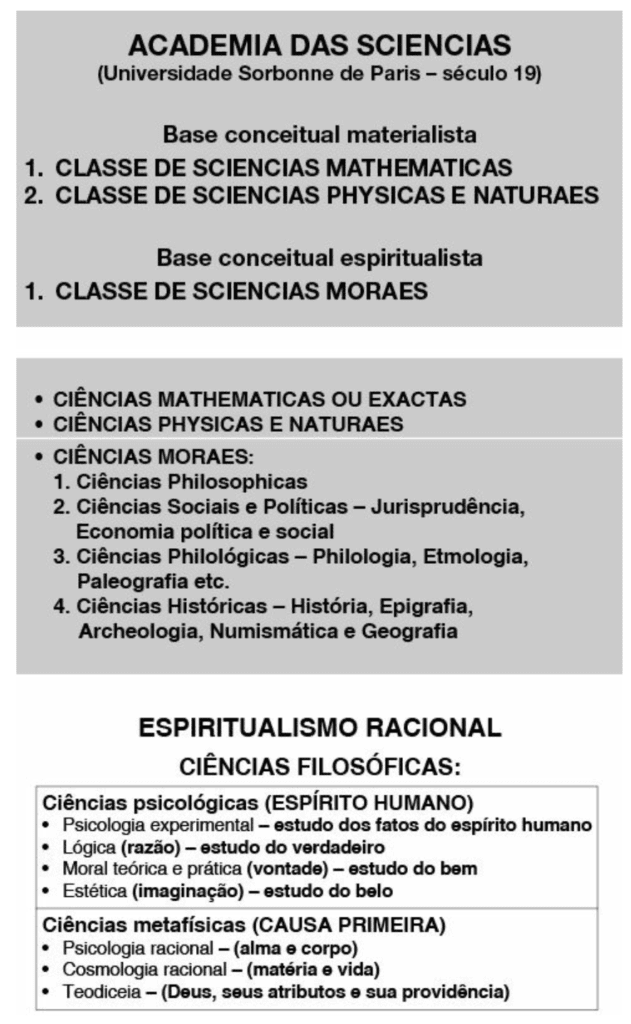
Since metaphysics was one of the fields of study of the philosophical sciences, officially Instituted at the University of the Sorbonne:
And that's not all. Before that, in 1863, Kardec says, in the article entitled “Bibliographical News – The rational spiritualism by Mr. G.H. Love, engineer”:
This remarkable and conscientious book is the work of a distinguished scientist, who proposed to draw from Science itself and from the observation of facts the demonstration of the reality of spiritualist ideas. It is one more piece in support of the thesis that we support above. It is even more, because it is a first step, almost official, of Science, in the spiritist way; in fact, it will soon be followed - and of this we are sure - by other, even more resonant adhesions, which will lead deniers and opponents of all schools to seriously reflect
KARDEC, Allan. Spiritist Magazine, October 1863
What nonsense, Mr. Kardec! Defending ideas that, according to some, have nothing to do with Spiritism! Claiming that Rational Spiritualism, which he refers to in the text merely as "spiritualist ideas" (which leads us to believe that in other similar references—"spiritualism," "spiritualists," etc.—he was referring to the same Rational Spiritualism) is something obtained through scientific observation of facts! Now, where have you ever seen science and spiritualism go hand in hand? Only in the past, during the time of the "crazy" Kardec.
The biggest nonsense, in fact, is that of Paulo Henrique de Figueiredo, who decided to investigate in depth and discovered that metaphysics, at the time of Kardec, was one of the areas of study of the Moral Sciences officially taught at the University of Paris and also at the Normal School (refer to “Autonomy: the never told story of Spiritism”, by this author). All this contained in works that, until then, were unknown or forgotten by the modern world.
The great difficulty, however, will be that all of us, who follow the work of Paulo Henrique and himself, will have to deny reality, deny historical documents and existing works, censor the works of Paul Janet, deny Kardec, deny his conclusions and his statements, all so as not to cause a new split, “now in the moral field”. In other words: let us erase and adulterate the truth, so that morality, as they understand it, remains untouched. Well, this desire to take the truth for oneself, ignoring facts, seems like a habit of the WArlos seth Iinvestigates Spiritism, as we demonstrated in the article “CSI of Spiritism: the official organ of Truth“".
We also need to evoke the Spirit of Mr. Love and have a serious conversation with him, in order to clarify his audacity in, being a rational spiritualist, affirming that he found the same moral obtained in his observations, precisely in “Kardec’s” Spiritism:
Morality, as I understand it and deduce it from scientific notions - I am not afraid to admit it - has numerous points of contact with that transmitted by the mediums of Mr. Allan Kardec. I am also not far from admitting that if there are many pages written by them that do not go beyond the ordinary reach of the human spirit, including theirs, there must be, and there are, of such a scope that it would be impossible for them to write identical ones in the books. your ordinary moments.
LOVE, GH apud KARDEC, Allan. Spiritist Magazine, October, 1863.
I don't think it's necessary to go any further. I leave the reader the freedom and the task, if he so wishes, of seeking to obtain information that will allow him to arrive, through his own reasoning, at his answers. I would just like to quote Carlos Seth once again:
The spiritist doctrine is progressive, but your study is the key. Let us know how to wait for new data instead of rejecting some of its aspects, such as the action of Spirits in natural phenomena. If, even so, a certain characteristic, such as the religious one, bothers us to the point that we are unable to put it aside, let us stop being Kardecist Spiritists and then follow any other sects originating from the original Spiritism. Despite recurring in history,
This is what we are witnessing once again today with secular, eclectic and syncretic people.BASTOS, Carlos Seth. Ibid. My emphasis.
Oh, if Mr. Carlos had followed his own teaching and studied. If I had known how to wait, before jumping hastily to foolish hasty conclusions... I would have seen Paulo Henrique affirm, in Spiritist Revolution, how evident it is that Spiritism complements and develops what Rational Spiritualism was unable to study, in fact resolving many of its errors , contradictions and uncertainties. Ah, this rush from certain “renowned researchers”…
Why didn't Kardec give more details about Rational Spiritualism?
It should be noted that, to the objection of why Kardec did not give more information about something so important to him, we must answer the following: the same happened with Magnetism, a science that he claims to have studied for more than 35 years. He simply did not delve into something that was so deeply established in its context, in the same way that, today, to talk about astronomy, we do not dedicate time to narrate the entire current scientific context, limiting ourselves to talking, for example, of the theory of Big Bang. If, by chance, this theory were put into oblivion, because it was outdated or because of the adoption of another theory, not necessarily correct, any reader, in the future, would need to seek to recover this knowledge in order to better understand our theories, assumptions and doctrines.
I should just mention that, when pronouncing on the case, I am asked for evidence that Kardec would have, as I said, widely defended Rational Spiritualism. Here's my answer:
X, if the authors of the article (PDF), willingly, had dedicated themselves to studying the work of this author, before criticizing, they would have understood this whole context very easily, so that I would not have to repeat all the information here that already exists.
I've already mentioned one of the times Kardec emphatically cited "Rational Spiritualism," stating that any defense of it would be favorable to Spiritism. In October 1863 (RE), you'll find two very interesting articles on the subject. I quote the beginning of the second, at the end of the issue ("Rational Spiritualism by Mr. G.H. Love, Engineer"):
“This remarkable and conscientious book is the work of a distinguished scientist, who set out to extract from Science itself and from the observation of facts the demonstration of the reality of spiritualist ideas. It is one more piece in support of the thesis that we support above. It is even more, because it is a first step, almost official, of Science, in the spiritist way”.
Go to Google and type in: “site:kardecpedia.com spiritualism”, and you will find a lot.
Well, if Kardec was talking about fluids (vital, electric, magnetic, etc.) isn't it up to us to investigate what that is, instead of blindly adopting wrong theories? Let's then verify that it was a concept of the science of the time, surpassed by current science and, by all indications, abandoned by Kardec, after becoming convinced of the veracity of Mesmer's theory. Without doing this, I fall into the error of saying that Mesmer and Spiritism have nothing to do, not knowing that Kardec ALSO defended Mesmer's Magnetism.
After all, what line of research is this, to which they want to give so many airs of seriousness and confidence, but which makes such a serious and absurd error as such, with the aggravating factor of giving final sentences on this or that subject, influencing the spiritist environment? towards a new split that only exists in their minds, attached to an initial disagreement ((I'm referring to the disagreement between whether or not there were adulterations in the works Heaven and Hell and Genesis))?
Those who act in this way end up being ridiculed and discredited. Not that we are not free, on our part, from making similar or worse mistakes, but the study of Spiritism and Kardec's scientific approach has helped us a lot in this sense.
The monopoly of common sense
I will end with an observation by Kardec, made about the article “The Librarian of New York”, in the Spiritist Magazine of May 1860. It is not related to the main theme, but, who knows, it will serve as a reflection. The italics are mine, as always:
About the article, we will make a first observation: it is the indifference with which the deniers of the Spirits attribute to themselves the monopoly of common sense. “The spiritualists, says the author, see in this one more example of the manifestations of the other world. sensible people will not seek the explanation so far and recognize clearly the symptoms of a hallucination”. Thus, according to this author, only people who think like him are sensible; the rest have no common sense, even if they were doctors, and Spiritism counts them by the thousands. A strange modesty, indeed, which has as its maxim: no one is right but us and our friends!
KARDEC, Allan. Spiritist Magazine, May 1860
The documents they found, corroborating a hypothesis of non-adulteration, they are, according to them, probative, they give final sentences – even though they are nothing more than evidence that does not explain many things. Beyond that, according to them, everything is disposable, fallacy or invention.
Questioning is natural, healthy and necessary. He encourages us to research, to reread, to study. But it would be even more productive if the dissenting opinion were always born from a deep bibliographic and scientific basis, so as not to end up like Messrs. Schiff and Jobert (Revista Espírita, June, 1859) who, having discovered in the snapping of a muscle confirmation of one hypothesis, ended up stating categorically, with the final word, against all spiritist phenomena. Well, just read the article to see how ridiculous they were when faced with the facts presented by Kardec.
This is science. This is detachment. This is commitment to the truth. For all this commitment, far from configuring it as an attack, but as a defense, I do what they did not do, and I give name and surname to those who frivolously attack the work of others.
Strangely, Seth sees a division when dealing with the movement that gave basis to the emergence of Spiritism, but he sees no problem in poking around and bringing up gossip of the time, launched by mediums who did not want to adapt to what the Spiritist Doctrine demanded. Go figure…